A saw tooth appearance in an abdominal barium enema X-ray is indicative of which of the following conditions?
What condition is characterized by an "upside down" stomach appearance on a Barium meal study?
Elevation of which of the following metabolites in Magnetic Resonance Spectroscopy suggests a possibility of carcinoma of the prostate?
A 28-year-old male presents with sudden onset of severe, colicky right lower abdominal pain. Ultrasound KUB showed mild hydronephrosis of the right kidney but no evidence of stones. Renal function tests and creatinine levels were normal. Urine culture was negative. What is the most appropriate next step?
Which of the following is NOT a radiological sign of acute pancreatitis?
The double bubble sign in an X-ray abdomen is indicative of which condition?
The 'drooping water lily' sign is seen in which of the following conditions?
The "mushroom cap sign" in MRI is most commonly seen in which of the following conditions?
Gas shadow in the heart and vessels is seen in which condition?
Which radionuclide scan is used for parathyroid adenoma?
Explanation: **Explanation:** The **"Saw-tooth appearance"** on a barium enema is the classic radiological hallmark of **Diverticulosis**, specifically when associated with muscular hypertrophy of the colonic wall (often seen in the sigmoid colon). This appearance is caused by two factors: the protrusion of mucosa through the muscular layers (forming diverticula) and the thickening of the circular muscle fibers (myochosis), which creates serrated, pointed indentations along the bowel wall. **Analysis of Options:** * **Diverticulosis (Correct):** The combination of thickened muscular folds and multiple small outpouchings creates the characteristic jagged, saw-tooth contour. * **Multiple Polyposis:** Typically presents as multiple rounded, smooth **intraluminal filling defects**. It does not cause a serrated wall pattern. * **Ischemic Colitis:** Characterized by **"Thumbprinting"** on X-ray, which represents focal submucosal edema and hemorrhage. * **Ulcerative Colitis:** In the acute phase, it may show fine mucosal ulcerations (granular appearance). In chronic stages, it leads to a **"Lead pipe appearance"** due to the loss of haustrations and shortening of the colon. **NEET-PG High-Yield Pearls:** * **Lead pipe colon:** Chronic Ulcerative Colitis. * **Thumbprinting:** Ischemic Colitis or severe IBD. * **Apple core lesion:** Colorectal Carcinoma (Annular type). * **Cobblestone appearance:** Crohn’s Disease (due to deep transverse and longitudinal ulcers). * **Bird’s beak appearance:** Sigmoid Volvulus (on barium enema).
Explanation: **Explanation:** **Mesenteroaxial gastric volvulus** is the correct answer because it involves rotation of the stomach around its short axis (a line connecting the mid-lesser curvature to the mid-greater curvature). In this condition, the antrum and pylorus rotate superiorly, while the fundus moves inferiorly. On a Barium meal, this results in the **"upside down" stomach** appearance, where the antrum lies above the fundus. This type is less common than organoaxial but is more frequently associated with acute presentation and ischemia. **Analysis of Incorrect Options:** * **Organoaxial gastric volvulus:** This is the most common type (60%). Rotation occurs around the long axis (connecting the cardia to the pylorus). It typically presents with the greater curvature lying superior to the lesser curvature, but not the classic "upside down" antrum-above-fundus configuration. * **Large gastric adenocarcinoma:** While it can cause gastric outlet obstruction and significant distension, it does not cause the anatomical rotation required to produce an "upside down" appearance. * **Rolling (Paraesophageal) hiatus hernia:** In this condition, the fundus herniates alongside the esophagus into the chest. While the stomach is displaced, it does not necessarily undergo the specific mesenteroaxial rotation that characterizes the "upside down" stomach. **Clinical Pearls for NEET-PG:** * **Borchardt’s Triad (Acute Volvulus):** 1. Sudden epigastric pain, 2. Violent unproductive retching, 3. Inability to pass a nasogastric tube. * **Organoaxial Volvulus:** Often associated with diaphragmatic defects (e.g., Bochdalek hernia). * **Mesenteroaxial Volvulus:** Often associated with laxity of gastric ligaments; less common but carries a higher risk of strangulation.
Explanation: **Explanation:** Magnetic Resonance Spectroscopy (MRS) is a functional imaging technique that measures the concentration of specific metabolites in tissues. In the context of prostate cancer, the diagnosis relies on the ratio of **Choline** and **Citrate**. * **Why Choline is Correct:** Choline is a marker of cell membrane turnover (phospholipid metabolism). In malignant tissues like prostate carcinoma, there is rapid cell proliferation and increased membrane synthesis, leading to a significant **elevation of Choline**. Conversely, healthy prostate tissue is rich in **Citrate** (produced by the glandular epithelium). Therefore, a high **(Choline + Creatine) / Citrate ratio** is highly suggestive of malignancy. * **Why other options are incorrect:** * **Citrate:** In prostate cancer, the normal glandular architecture is destroyed, leading to a **decrease** in Citrate levels. An increase in Citrate would suggest healthy or hyperplastic tissue. * **Acetate:** While Acetate can be used in PET imaging for prostate cancer, it is not a primary metabolite measured in standard clinical MRS for prostate evaluation. * **NAA (N-acetylaspartate):** This is a marker of neuronal integrity. It is the hallmark metabolite for **Brain MRS** (decreased in tumors/strokes) and has no relevance in prostate imaging. **High-Yield Clinical Pearls for NEET-PG:** * **Prostate MRS Signature:** ↑ Choline, ↓ Citrate. * **Brain MRS Signature (Glioma):** ↑ Choline, ↓ NAA, ↑ Lactate (if anaerobic metabolism/necrosis). * **Multiparametric MRI (mpMRI):** This is the current gold standard, combining T2-weighted imaging, Diffusion-Weighted Imaging (DWI), and Dynamic Contrast Enhancement (DCE). MRS is often used as an adjunct. * **PI-RADS:** The scoring system used to communicate the probability of clinically significant prostate cancer on MRI.
Explanation: ### Explanation **1. Why Option A is Correct:** The clinical presentation of sudden onset, severe, colicky abdominal pain is classic for **ureteric colic**. While Ultrasound (USG) is often the initial screening tool, it has limited sensitivity (approx. 70%) for detecting small ureteric stones, especially those in the mid-ureter or those not causing significant obstruction. **Non-Contrast Computed Tomography (NCCT) KUB** is the **gold standard** and the most appropriate next step because it has a sensitivity and specificity of >95% for detecting urolithiasis. In this case, the presence of hydronephrosis on USG is a secondary sign of obstruction, necessitating a CT scan to locate the stone and plan management. **2. Why Other Options are Incorrect:** * **Option B (Pyelonephritis):** Pyelonephritis typically presents with fever, chills, and flank pain rather than "colicky" pain. Furthermore, the negative urine culture and normal renal function make an infectious etiology less likely. * **Option C (Ample Hydration):** While hydration is part of supportive management, it is not a diagnostic "next step." One must first confirm the diagnosis and assess the size/location of the stone, as forced diuresis in the presence of a complete obstruction can worsen the pain and hydronephrosis. **3. Clinical Pearls for NEET-PG:** * **Gold Standard Investigation:** NCCT KUB is the investigation of choice for acute flank pain/ureteric colic. * **Radiolucent Stones:** All stones (including Uric acid and Xanthine stones) are **radio-opaque on CT**, except for Indinavir stones (seen in HIV patients). * **Secondary Signs on CT:** Look for the "Rim sign" (edema around the stone) and "Stranding" of perinephric fat. * **USG Limitation:** USG is excellent for identifying hydronephrosis and renal stones but poor at visualizing the mid-ureter.
Explanation: The correct answer is **B. Cullen's sign**. ### **Explanation** The distinction here lies between **radiological signs** (seen on imaging like X-ray or CT) and **clinical signs** (observed during physical examination). 1. **Why Cullen's sign is the correct answer:** Cullen’s sign is a **clinical sign** characterized by periumbilical ecchymosis (bruising) due to the tracking of hemoperitoneum into the falciform ligament. While it indicates severe necrotizing pancreatitis, it is a physical exam finding, not a radiological sign. 2. **Analysis of Radiological Signs (Incorrect Options):** * **Colon cut-off sign (Option A):** An abdominal X-ray finding where there is abrupt termination of gas in the splenic flexure. This occurs because inflammatory exudate from the pancreas spreads to the phrenicocolic ligament, causing functional spasm of the colon. * **Renal halo sign (Option C):** Seen on CT or X-ray, this represents edema or fluid collection in the pararenal space, which outlines the kidney, making it appear as if it has a "halo." * **Sentinel loop sign (Option D):** A localized paralytic ileus of a loop of small bowel (usually the jejunum) located near the inflamed pancreas. It appears as a single, dilated air-filled bowel loop in the left upper quadrant on X-ray. ### **NEET-PG High-Yield Pearls** * **Grey Turner’s sign:** Ecchymosis of the flanks (also a clinical sign of hemorrhagic pancreatitis). * **Gold Standard Imaging:** Contrast-Enhanced CT (CECT) is the investigation of choice for staging and detecting complications (best done 48–72 hours after symptom onset). * **Pancreatic Calcification:** The most specific radiological sign for **Chronic** Pancreatitis. * **Ground glass appearance:** May be seen on X-ray due to ascites or massive peripancreatic fluid collection.
Explanation: The **Double Bubble Sign** is a classic radiological finding seen on a plain abdominal X-ray (erect or supine). It represents a dilated stomach and a dilated proximal duodenum, with a constriction in between (the pylorus). ### Why Annular Pancreas is Correct The double bubble sign indicates **proximal intestinal obstruction**, specifically at the level of the duodenum. In **Annular Pancreas**, a ring of pancreatic tissue encircles the second part of the duodenum, causing extrinsic compression and high-grade obstruction. This leads to gas distending the stomach (first bubble) and the first part of the duodenum (second bubble), with no gas distal to the obstruction. ### Why Other Options are Incorrect * **Ileal Atresia:** This is a distal small bowel obstruction. It typically presents with **multiple dilated loops** of bowel and multiple air-fluid levels, rather than just two bubbles. * **Anorectal Malformation:** This is a low intestinal obstruction. It presents with generalized bowel dilatation and a lack of gas in the rectum. ### High-Yield Clinical Pearls for NEET-PG * **Differential Diagnosis for Double Bubble Sign:** 1. Duodenal Atresia (Most common cause) 2. Annular Pancreas 3. Malrotation with Midgut Volvulus (Ladd’s bands) 4. Duodenal Web * **Association:** Duodenal atresia/annular pancreas is strongly associated with **Down Syndrome (Trisomy 21)** in approximately 30% of cases. * **Antenatal Finding:** On prenatal ultrasound, this presents as **polyhydramnios** due to the fetus's inability to swallow and absorb amniotic fluid. * **Management:** The definitive treatment for annular pancreas is a bypass procedure, typically a **duodenoduodenostomy**.
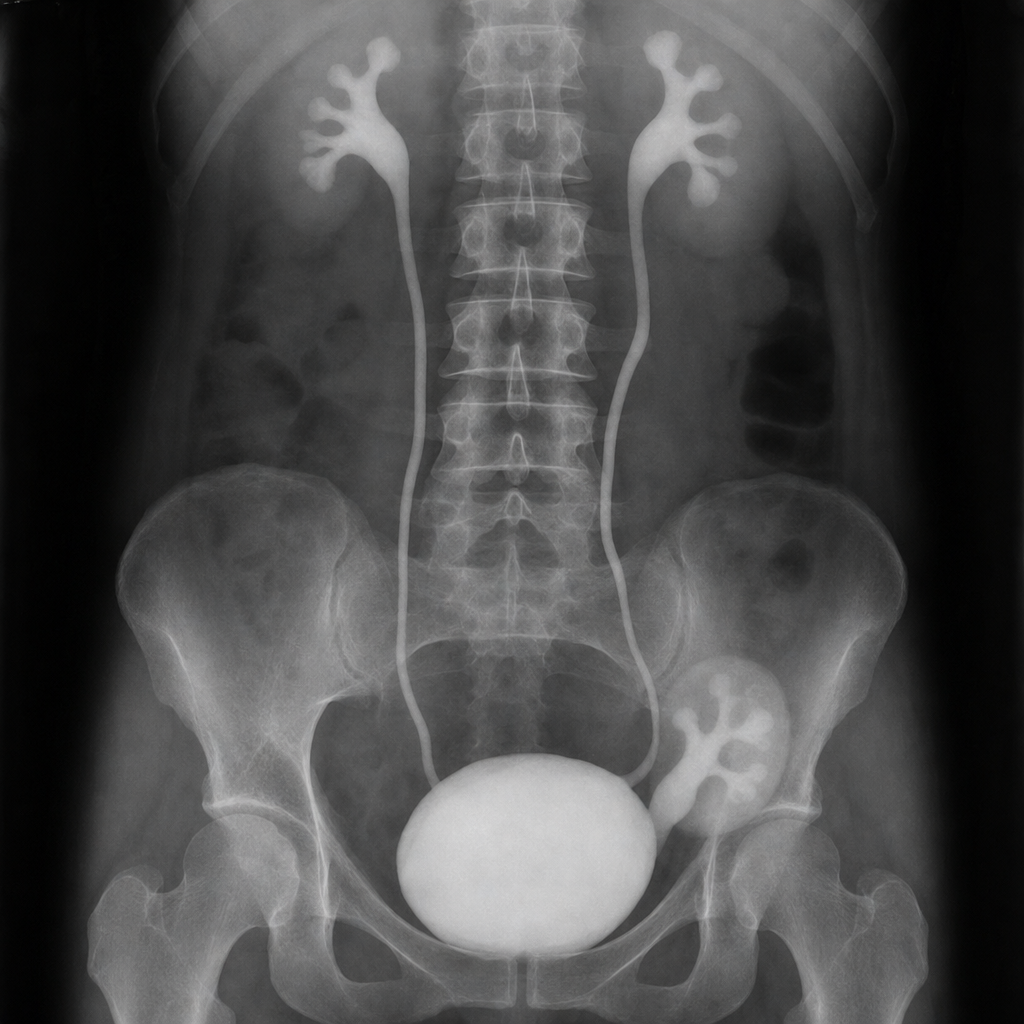
Explanation: **Explanation:** The **'Drooping Water Lily' sign** is a classic radiological finding seen on an Intravenous Urogram (IVU). It occurs in the presence of a **duplex collecting system** or a large **upper pole renal mass** (such as a Wilms' tumor or a large cyst). **Why Option D is correct:** In a duplex kidney (specifically the Weigert-Meyer law), the upper pole moiety often becomes obstructed (due to an ectopic ureterocele), leading to hydronephrosis. This dilated upper pole system acts as a mass that displaces the functioning lower pole collecting system **downward and laterally**. On an IVU, the opacified lower pole calyces appear tilted and pushed away from the spine, resembling a wilted or "drooping water lily." **Why other options are incorrect:** * **A & B (Splenic/Liver tumors):** While these are upper abdominal masses, they are extrinsic to the renal fascia. They may displace the entire kidney inferiorly but do not typically cause the specific architectural distortion of the calyces required to produce this sign. * **C (Suprarenal mass):** An adrenal mass (like Neuroblastoma) typically displaces the entire kidney downward (caudad) without distorting the internal relationship between the upper and lower calyces in the same characteristic "drooping" fashion. **High-Yield Clinical Pearls for NEET-PG:** * **Weigert-Meyer Law:** In a duplex system, the ureter from the **upper** pole inserts **ectopically** (inferomedial to the normal orifice) and is prone to **obstruction/ureterocele**. The **lower** pole ureter inserts normally but is prone to **reflux**. * **Differential:** While classically associated with a duplex system, any large non-functioning upper pole mass (like a tumor) can produce this appearance. * **Maiden Hair Ureter:** Another high-yield sign seen in ureteric tuberculosis (long, thin, thread-like ureter).
Explanation: **Explanation:** The **"Mushroom Cap Sign"** is a classic MRI finding highly specific for **deep infiltrating endometriosis (DIE)** involving the rectum or rectosigmoid colon. **1. Why Rectal Endometriosis is Correct:** The sign occurs when an endometriotic plaque implants on the serosal surface of the bowel and infiltrates the muscularis propria. On T2-weighted MRI sequences, the hypertrophied, dark (hypointense) muscularis propria represents the "cap" of the mushroom. This contrasts with the displaced, hyperintense (bright) mucosa and submucosa, which represent the "stem" of the mushroom protruding into the bowel lumen. **2. Why Other Options are Incorrect:** * **Ileocecal Tuberculosis:** Typically presents with the "Stierlin sign" or "Fleischner sign" (inverted umbrella sign) on barium studies, characterized by a narrowed terminal ileum and a gaping ileocecal valve. * **Pulmonary Endometriosis:** Usually presents with catamenial pneumothorax or hemoptysis; imaging shows nonspecific nodules or ground-glass opacities, not the mushroom cap sign. * **Ovarian Endometriosis:** Characteristically presents as an **"Endometrioma"** (Chocolate cyst). On MRI, it shows the **"Shading Sign"** (T2-weighting shows loss of signal/darkening compared to T1 due to high iron/protein content). **3. High-Yield Clinical Pearls for NEET-PG:** * **Gold Standard for Endometriosis:** Laparoscopy with biopsy. * **MRI Sequence of Choice:** T2-weighted imaging (without fat suppression) is best for identifying the mushroom cap sign. * **Kissing Ovaries Sign:** Seen in severe pelvic endometriosis where ovaries are adhered to each other in the Pouch of Douglas. * **Powder-burn lesions:** The classic laparoscopic appearance of peritoneal endometriosis.
Explanation: **Explanation:** The presence of gas shadows within the fetal heart and great vessels on an abdominal X-ray of a pregnant woman is known as **Robert’s Sign**. This is a classic radiological indicator of **Intrauterine Fetal Death (IUFD)**. The underlying mechanism involves the decomposition of fetal blood, which releases gases (primarily nitrogen) into the circulatory system. This sign can appear as early as 12 hours after fetal demise and is considered one of the earliest radiological signs of IUFD. **Analysis of Options:** * **Intrauterine Death (IUD):** This is the correct answer. Robert’s Sign (intravascular gas) is a specific sign of fetal death. Note: In the context of this question, "IUD" refers to Intrauterine Death, not an Intrauterine Device. * **Stillbirth:** While a stillbirth involves fetal death, the term refers to the delivery of a dead fetus. Robert's Sign is a diagnostic sign used *in utero* to confirm death before delivery. * **Abortion:** This refers to the termination of pregnancy before viability. While gas can theoretically form in a dead embryo, Robert’s Sign is specifically described in later stages of pregnancy where the heart and vessels are well-developed. * **IUGR:** This refers to a living fetus that is small for gestational age. The presence of intravascular gas is incompatible with life. **High-Yield Clinical Pearls for NEET-PG:** * **Robert’s Sign:** Gas in fetal heart/vessels (Earliest sign, ~12 hours). * **Spalding’s Sign:** Overlapping of fetal skull bones due to loss of liquor and brain liquefaction (Appears after 24–48 hours). * **Deuel’s Halo Sign:** Edema of the fetal scalp causing elevation of the subcutaneous fat layer (indicates fetal distress/death). * **Curvature of Spine:** Extreme angulation or collapse of the fetal spine due to loss of muscle tone. * **Gold Standard:** Today, **Ultrasonography** (demonstrating absence of cardiac activity) has replaced X-ray as the definitive investigation for IUFD.
Explanation: **Explanation:** **1. Why Sesta MIBI is correct:** Technetium-99m Sestamibi (99mTc-MIBI) is the gold standard radionuclide for localizing parathyroid adenomas. The physiological basis relies on the fact that parathyroid adenomas contain **mitochondria-rich oxyphil cells**. 99mTc-MIBI is a lipophilic cation that accumulates in mitochondria. While both the thyroid and parathyroid glands initially take up the tracer, it **washes out rapidly from normal thyroid tissue** but remains "sequestered" within the hyperfunctioning parathyroid adenoma. Delayed imaging (usually at 2 hours) typically shows a persistent "hot spot" representing the adenoma. **2. Why the other options are incorrect:** * **Iodine-123 scan:** This is used primarily for thyroid imaging (evaluating nodules or hyperthyroidism) as iodine is trapped and organified by thyroid follicular cells, not parathyroid tissue. * **99mTc-sulphur colloid:** This tracer is taken up by the reticuloendothelial system (RES). It is used for liver-spleen imaging, detecting gastrointestinal bleeds, or bone marrow scanning. * **Gallium-67 scan:** This is used to detect areas of chronic inflammation, infections (like sarcoidosis), or certain malignancies (like lymphoma), but it has no role in parathyroid localization. **Clinical Pearls for NEET-PG:** * **Dual-phase technique:** This is the most common method using MIBI alone (comparing early vs. delayed images). * **Subtraction technique:** MIBI (parathyroid + thyroid) minus Pertechnetate or I-123 (thyroid only) can also be used to isolate the parathyroid signal. * **Ectopic Parathyroid:** MIBI is particularly useful for identifying ectopic adenomas (e.g., in the mediastinum). * **SPECT/CT:** Combining MIBI with CT provides superior anatomical localization for the surgeon.
Imaging of Liver
Practice Questions
Biliary Tract Imaging
Practice Questions
Pancreatic Imaging
Practice Questions
Spleen and Lymphatic System
Practice Questions
Gastrointestinal Tract Imaging
Practice Questions
Renal and Urinary Tract Imaging
Practice Questions
Adrenal Imaging
Practice Questions
Female Pelvic Imaging
Practice Questions
Male Pelvic Imaging
Practice Questions
Abdominal Trauma Imaging
Practice Questions
Acute Abdomen Imaging
Practice Questions
Imaging of Peritoneal Cavity and Retroperitoneum
Practice Questions
Get full access to all questions, explanations, and performance tracking.
Start For Free