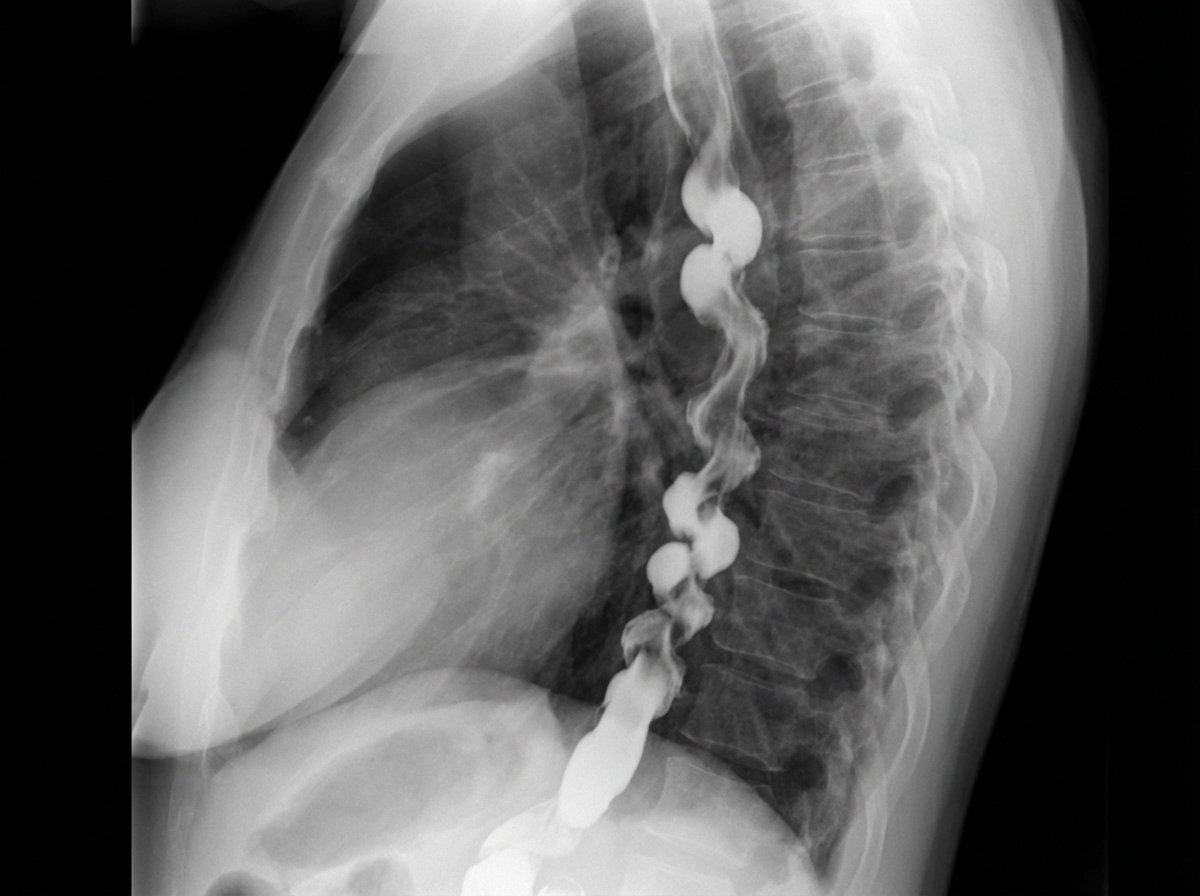
A large volume of gas is seen at the subdiaphragmatic level on an X-ray. What is the most likely diagnosis?
Which of the following is the best radiological investigation in a case of suspected splenic rupture?
What condition is characterized by the presence of a central dot sign?
What is the characteristic finding of a "saw tooth appearance" in an abdominal barium enema X-ray?
CT findings in gastric volvulus typically include which of the following?
What is the most reliable investigation in bladder rupture?
What percentage of gallstones are radio-opaque?
Snow storm ascites is seen in which of the following conditions?
What is the investigation of choice to visualize the gallbladder?
What is a typical ultrasound finding in chronic renal disease?
Explanation: **Explanation:** The presence of free gas under the diaphragm on an erect chest or abdominal X-ray is the hallmark sign of **Pneumoperitoneum**, most commonly caused by a **peritoneal (hollow viscus) perforation**. **1. Why the correct answer is right:** When a hollow organ (like the stomach or duodenum) perforates, air escapes into the peritoneal cavity. Because air is lighter than solid organs and fluid, it rises to the highest point of the abdominal cavity. In an erect position, this air collects between the liver/spleen and the diaphragm, appearing as a thin, radiolucent (black) crescent-shaped shadow known as the **"Crescent Sign."** **2. Why the incorrect options are wrong:** * **Intestinal obstruction:** Typically presents with dilated bowel loops and multiple air-fluid levels on an erect film, but the gas remains *intraluminal* (inside the bowel). * **Paralytic ileus:** Characterized by generalized gaseous distension of both the small and large intestines. Air is contained within the bowel, not free in the peritoneum. * **Intussusception:** Radiological features include a "Target sign" or "Meniscus sign" on X-ray/USG. It does not cause subdiaphragmatic gas unless it leads to secondary gangrene and perforation. **3. High-Yield Clinical Pearls for NEET-PG:** * **Most sensitive view:** An **Erect Chest X-ray** is more sensitive than an abdominal X-ray for detecting small amounts of free air (as little as 1-2 ml). * **Alternative view:** If the patient cannot stand, a **Left Lateral Decubitus** view is preferred (look for air between the liver and the right abdominal wall). * **Rigler’s Sign:** Seeing both the inner and outer walls of the bowel due to free intraperitoneal gas. * **Football Sign:** A large oval radiolucency seen in massive pneumoperitoneum (common in neonatal necrotizing enterocolitis). * **Chilaiditi Syndrome:** A common mimic where the colon is transposed between the liver and diaphragm; look for haustral markings to differentiate it from true perforation.
Explanation: **Explanation:** **1. Why CT Scan is the Correct Answer:** Contrast-Enhanced Computed Tomography (CECT) is the **gold standard** and investigation of choice for hemodynamically stable patients with suspected splenic trauma. It is highly sensitive and specific for detecting parenchymal lacerations, subcapsular hematomas, and active extravasation of contrast ("blush"). Crucially, CT allows for the **grading of splenic injury** (AAST Grading), which dictates whether the patient can be managed conservatively or requires surgical intervention. **2. Why Other Options are Incorrect:** * **Ultrasound (USG/FAST):** While FAST (Focused Assessment with Sonography for Trauma) is the initial screening tool to detect free intraperitoneal fluid (hemoperitoneum), it is **insensitive to organ-specific injuries** and cannot accurately grade the severity of a splenic tear. * **MRI Scan:** Although highly accurate, MRI is impractical in acute trauma settings due to long acquisition times, difficulty in monitoring unstable patients, and incompatibility with metallic resuscitation equipment. * **Peritoneal Lavage (DPL):** This is an invasive procedure used to detect blood in the peritoneum. It has largely been replaced by FAST and CT as it cannot identify the specific organ injured or the grade of injury. **3. Clinical Pearls for NEET-PG:** * **Kehr’s Sign:** Referred pain to the left shoulder due to diaphragmatic irritation from a ruptured spleen. * **Ballance’s Sign:** Fixed dullness to percussion in the left flank and shifting dullness in the right flank. * **Management Rule:** If the patient is **hemodynamically unstable**, the next step is **Emergency Laparotomy**, not a CT scan. * **Most Common Organ Injured:** The spleen is the most frequently injured organ in blunt abdominal trauma.
Explanation: **Explanation:** The **central dot sign** is a pathognomonic radiological finding for **Caroli’s disease**. Caroli’s disease is a rare congenital disorder characterized by multifocal, segmental saccular dilatation of the large intrahepatic bile ducts. On contrast-enhanced CT or MRI, the "central dot" represents a small **portal venous branch** (the dot) surrounded by the dilated, fluid-filled bile ducts. This occurs because the dilated ducts wrap around the fibrovascular bundles containing the portal vein and hepatic artery. **Analysis of Options:** * **Primary Sclerosing Cholangitis (PSC):** Characterized by a "beaded appearance" or "string of pearls" sign due to alternating segments of strictures and focal dilatations of the bile ducts. It does not involve the invagination of portal vessels. * **Polycystic Liver Disease:** Presents as multiple simple cysts throughout the liver parenchyma. Unlike Caroli’s, these cysts do **not** communicate with the biliary tree and do not show the central dot sign. * **Liver Hamartoma (Mesenchymal Hamartoma):** Typically presents as a large, multiloculated cystic mass in pediatric patients. It lacks the specific ductal-vascular relationship seen in Caroli’s. **High-Yield Clinical Pearls for NEET-PG:** * **Caroli’s Syndrome:** When Caroli’s disease is associated with **Congenital Hepatic Fibrosis** (leading to portal hypertension). * **Genetics:** Often associated with Autosomal Recessive Polycystic Kidney Disease (ARPKD) and mutations in the *PKHD1* gene. * **Complications:** Recurrent pyogenic cholangitis, cholelithiasis (intrahepatic stones), and a significantly increased risk of **Cholangiocarcinoma** (approx. 7%). * **Imaging Choice:** MRCP is the non-invasive gold standard to demonstrate communication between the cysts and the biliary tree.
Explanation: ### Explanation **Correct Option: B. Prediverticulosis** The "saw tooth appearance" is a classic radiological sign of **prediverticulosis** (the early stage of diverticular disease). This appearance is caused by **circular muscle hypertrophy** and thickening of the *taeniae coli* in the sigmoid colon. This muscular thickening results in a narrowed lumen and a series of sharp, serrated indentations along the bowel wall on a barium enema, resembling the teeth of a saw. It represents the spastic phase before the actual herniation of mucosa (diverticula) occurs. **Analysis of Incorrect Options:** * **A. Multiple polyposis:** Characterized by multiple small, rounded **filling defects** within the barium column, often described as a "carpet of polyps." * **C. Ischemic colitis:** Typically presents with **"thumbprinting"** (indentations caused by submucosal edema/hemorrhage), usually at the splenic flexure or Griffith’s point. * **D. Ulcerative colitis:** Early stages show fine mucosal granularity; chronic stages show loss of haustrations, leading to a smooth, rigid **"lead pipe"** appearance. **High-Yield Clinical Pearls for NEET-PG:** * **Diverticulosis:** The most common site is the **sigmoid colon**. The gold standard for diagnosing *acute diverticulitis* is a **Contrast-Enhanced CT (CECT)**, not a barium enema (due to perforation risk). * **Lead Pipe Appearance:** Chronic Ulcerative Colitis. * **Cobblestone Appearance/String Sign of Kantor:** Crohn’s Disease. * **Apple Core Appearance:** Colorectal Carcinoma (specifically annular lesions). * **Bird’s Beak Appearance:** Achalasia Cardia (on barium swallow) or Sigmoid Volvulus (on barium enema).
Explanation: **Explanation:** **Gastric volvulus** is a surgical emergency characterized by the rotation of the stomach (more than 180°) around its longitudinal or transverse axis, leading to obstruction and potential ischemia. 1. **Why Option B is correct:** In gastric volvulus, the stomach becomes **enlarged** because the rotation creates a closed-loop or high-grade obstruction. This prevents the passage of gastric contents and swallowed air into the duodenum, while the proximal esophagus may also be obstructed. Consequently, the stomach becomes massively distended with fluid and gas. CT imaging typically reveals a dilated stomach in an abnormal position, often with two separate air-fluid levels and a "whirl sign" representing the twisted mesentery. 2. **Why other options are incorrect:** * **Option A & C:** A small or normally sized stomach is inconsistent with a volvulus. The hallmark of the condition is the mechanical obstruction; without distension (enlargement), the diagnosis of a clinically significant volvulus is unlikely. **High-Yield Clinical Pearls for NEET-PG:** * **Borchardt’s Triad:** The classic clinical presentation includes: 1. Sudden epigastric pain/distension, 2. Violent unproductive retching (inability to vomit), and 3. Inability to pass a nasogastric tube. * **Types:** * **Organo-axial (Most common):** Rotation around the long axis (connecting cardia and pylorus). Often associated with paraesophageal hernias. * **Mesentero-axial:** Rotation around the short axis (connecting lesser and greater curvatures). More common in children and associated with wandering spleen. * **Imaging Gold Standard:** While CT is excellent for complications, a **Barium Swallow** is often used to confirm the anatomy of the twist. * **Complication:** Ischemia can lead to gastric necrosis and perforation (high mortality).
Explanation: **Explanation:** The gold standard and most reliable investigation for diagnosing bladder rupture is a **Retrograde Cystogram**. **Why Retrograde Cystogram is the Correct Choice:** In cases of suspected bladder trauma (often associated with pelvic fractures), the goal is to visualize the integrity of the bladder wall. A retrograde cystogram involves instilling water-soluble contrast directly into the bladder via a catheter under gravity (usually 300-400 mL). This provides adequate distention, allowing for the detection of contrast extravasation. It can differentiate between **extraperitoneal rupture** (molar tooth sign/sunburst pattern) and **intraperitoneal rupture** (contrast outlining bowel loops). **Analysis of Incorrect Options:** * **Intravenous Pyelogram (IVP):** While IVP visualizes the upper urinary tract (kidneys and ureters), the concentration of contrast reaching the bladder is often insufficient to detect small leaks or provide the distention necessary to diagnose a rupture. * **Cystoscopy:** This is an invasive endoscopic procedure. It is technically difficult in an acute trauma setting due to poor visibility (hematuria) and the risk of converting a partial tear into a complete one. * **Catheterisation:** While the presence of gross hematuria upon catheterization is a strong clinical indicator of bladder injury, it is a diagnostic sign, not a definitive radiological investigation to confirm the site or type of rupture. **High-Yield Clinical Pearls for NEET-PG:** 1. **CT Cystography** is now often preferred in multi-trauma patients as it can be performed alongside a trauma CT, but "Retrograde Cystogram" remains the classic textbook answer for the "most reliable" test. 2. **Management Rule:** Extraperitoneal ruptures are usually managed **conservatively** (catheter drainage), whereas intraperitoneal ruptures require **emergency surgical repair** due to the risk of chemical peritonitis. 3. **Triad of Bladder Rupture:** Pelvic fracture, gross hematuria, and inability to void.
Explanation: **Explanation:** In radiology, the visibility of gallstones on a plain X-ray (KUB) depends entirely on their calcium content. Approximately **10% of gallstones** contain enough calcium salts (calcium carbonate or bilirubinate) to be visualized as **radio-opaque** structures. The remaining 90% are primarily composed of cholesterol, which is radiolucent and therefore invisible on conventional radiography. * **Option A (10%) is Correct:** This is the classic teaching in surgical radiology. While some modern studies suggest a range of 10-15%, "10%" remains the standard high-yield fact for competitive exams like NEET-PG. * **Options B, C, and D (20%, 30%, 40%) are Incorrect:** These percentages overestimate the prevalence of calcified gallstones. It is important to contrast this with **renal stones (urolithiasis)**, where approximately **80-90% are radio-opaque**, making X-ray a much more useful screening tool for kidney stones than for gallstones. **Clinical Pearls for NEET-PG:** 1. **Investigation of Choice (IOC):** Because 90% of gallstones are radiolucent, **Ultrasonography (USG)** is the gold standard and initial investigation for cholelithiasis (sensitivity >95%). 2. **Mercedes-Benz Sign:** A classic radiological sign where nitrogen gas fills the fissures within a radiolucent cholesterol stone, appearing as a tri-radiate lucency on X-ray or CT. 3. **Porcelain Gallbladder:** Extensive calcification of the gallbladder wall (not the stones), which carries an increased risk of gallbladder carcinoma. 4. **Milk of Calcium Bile:** A rare condition where the gallbladder lumen is filled with a semi-solid paste of calcium carbonate, appearing opaque on X-ray.
Explanation: ### Explanation **Correct Option: A. Meconium ileus** **Why it is correct:** "Snow storm ascites" is a classic radiological and ultrasonographic sign associated with **Meconium Peritonitis**, which is a frequent complication of **Meconium Ileus** (often seen in Cystic Fibrosis). When the fetal bowel perforates in utero due to distal obstruction (meconium ileus), sterile meconium escapes into the peritoneal cavity. This leads to an intense chemical inflammatory response. On ultrasound, the presence of meconium flakes and debris suspended in the ascitic fluid creates a characteristic speckled, hyperechoic appearance resembling a **"snow storm."** **Why the other options are incorrect:** * **B. Hirschsprung disease:** While this can cause neonatal bowel obstruction and potential perforation, it typically presents with a "transition zone" on contrast enema. It does not characteristically produce the "snow storm" appearance unless complicated by a specific type of antenatal perforation, but it is not the classic association. * **C. Ileocaecal tuberculosis:** This typically presents with "Stierlin’s sign" or "inverted T-junction" on barium studies, and "wet-type" TB peritonitis shows high-density ascites with fine septations (stranding), not a snow storm pattern. * **D. Pseudomyxoma peritonei:** This condition is characterized by "scalloping of the liver and splenic margins" due to mucinous ascites. While the fluid is gelatinous, it is described as having a "starry sky" or multiloculated appearance rather than a "snow storm." **High-Yield Clinical Pearls for NEET-PG:** * **Meconium Ileus:** The earliest manifestation of **Cystic Fibrosis** (seen in ~15-20% of cases). * **X-ray findings:** "Soap bubble" appearance (Neuhauser sign) in the right iliac fossa due to air mixing with thick meconium. * **Meconium Peritonitis:** Look for **scattered peritoneal calcifications** on a plain abdominal X-ray of a newborn; this is a pathognomonic sign of healed or active antenatal perforation. * **Management:** Gastrografin enema is both diagnostic and therapeutic (hyperosmolar contrast helps pull water into the bowel to flush the meconium).
Explanation: **Explanation:** **Ultrasound (USG)** is the investigation of choice (IOC) for the gallbladder because it is highly sensitive (up to 95-98%) for detecting gallstones, non-invasive, cost-effective, and involves no ionizing radiation. It provides excellent visualization of the gallbladder wall thickness, pericholecystic fluid, and biliary sludge. Furthermore, it allows for the assessment of the **Sonographic Murphy’s Sign**, which is a highly specific clinical indicator of acute cholecystitis. **Analysis of Incorrect Options:** * **CT Scan:** While excellent for detecting complications (like perforation or gangrene) and evaluating the distal common bile duct, CT is less sensitive than USG for detecting radiolucent gallstones and is more expensive with significant radiation exposure. * **Plain X-ray:** Only about 10-15% of gallstones are radiopaque (calcium-containing) and visible on X-ray. It is largely obsolete for primary gallbladder evaluation. * **Oral Cholecystogram:** Historically used to assess gallbladder function and stones, it has been entirely replaced by USG due to its slow results, requirement for contrast ingestion, and poor reliability in patients with jaundice or malabsorption. **High-Yield Clinical Pearls for NEET-PG:** * **IOC for Gallstones/Cholecystitis:** Ultrasound. * **Gold Standard for Acute Cholecystitis:** HIDA Scan (Cholescintigraphy) – shows non-visualization of the GB. * **IOC for Choledocholithiasis (CBD stones):** MRCP (Magnetic Resonance Cholangiopancreatography). * **Gold Standard for CBD stones:** ERCP (Endoscopic Retrograde Cholangiopancreatography) – as it is both diagnostic and therapeutic. * **WES Triad (Wall-Echo-Shadow):** A classic USG finding indicating a gallbladder packed with stones.
Explanation: **Explanation:** In the context of Chronic Kidney Disease (CKD), ultrasound findings are diverse and depend entirely on the underlying etiology. While the classic description of CKD is a **shrunken, echogenic kidney**, this is not a universal finding. 1. **Shrunken Kidney (Option C):** This is the most common finding in end-stage renal disease (ESRD) resulting from chronic glomerulonephritis, hypertensive nephrosclerosis, or chronic interstitial nephritis. It is characterized by a bipolar length of <9 cm and increased cortical echogenicity with loss of corticomedullary differentiation. 2. **Enlarged Kidney (Option A):** Certain chronic conditions lead to renal enlargement despite progressive loss of function. High-yield examples include **Autosomal Dominant Polycystic Kidney Disease (ADPKD)**, **Diabetic Nephropathy** (in early to mid-stages), **Amyloidosis**, and **HIV-associated nephropathy**. 3. **Normal Kidney (Option B):** In early stages of chronic disease or specific conditions like acute-on-chronic presentations, the kidney size may remain within normal limits (9–12 cm). **Conclusion:** Since CKD can present with small, normal, or large kidneys depending on the pathology, **"All of the above"** is the correct answer. **High-Yield Clinical Pearls for NEET-PG:** * **Most reliable USG sign of CKD:** Increased cortical echogenicity (kidney appears brighter than the liver/spleen). * **CKD with Large Kidneys (Mnemonic: "SHAD"):** **S**cleroderma, **H**IV Nephropathy, **A**myloidosis, **D**iabetes, and **D**ominant Polycystic Kidney Disease. * **Exception:** In Diabetic Nephropathy, kidneys are initially enlarged due to hyperfiltration and only shrink in the very terminal stages.
Imaging of Liver
Practice Questions
Biliary Tract Imaging
Practice Questions
Pancreatic Imaging
Practice Questions
Spleen and Lymphatic System
Practice Questions
Gastrointestinal Tract Imaging
Practice Questions
Renal and Urinary Tract Imaging
Practice Questions
Adrenal Imaging
Practice Questions
Female Pelvic Imaging
Practice Questions
Male Pelvic Imaging
Practice Questions
Abdominal Trauma Imaging
Practice Questions
Acute Abdomen Imaging
Practice Questions
Imaging of Peritoneal Cavity and Retroperitoneum
Practice Questions
Get full access to all questions, explanations, and performance tracking.
Start For Free