A 46-year-old woman presents with a 6-month history of vague upper abdominal pain after fatty meals, some abdominal distension, and frequent indigestion. Physical examination shows an obese woman (BMI =32 kg/m2) with right upper quadrant tenderness. A CT scan discloses gallstones and an ectopic kidney. Which of the following is the expected location of the ectopic kidney?
A 26-year-old male presents with abdominal pain and episodes of hematuria. His blood pressure is 160/100 mm Hg and is refractory to standard antihypertensive drugs. Renal Doppler shows a parvus tardus pattern. Subsequent CT renal angiogram was performed. This condition, as depicted, may occur in all of the following except?

Which of the following is NOT a feature of ischemic colitis?
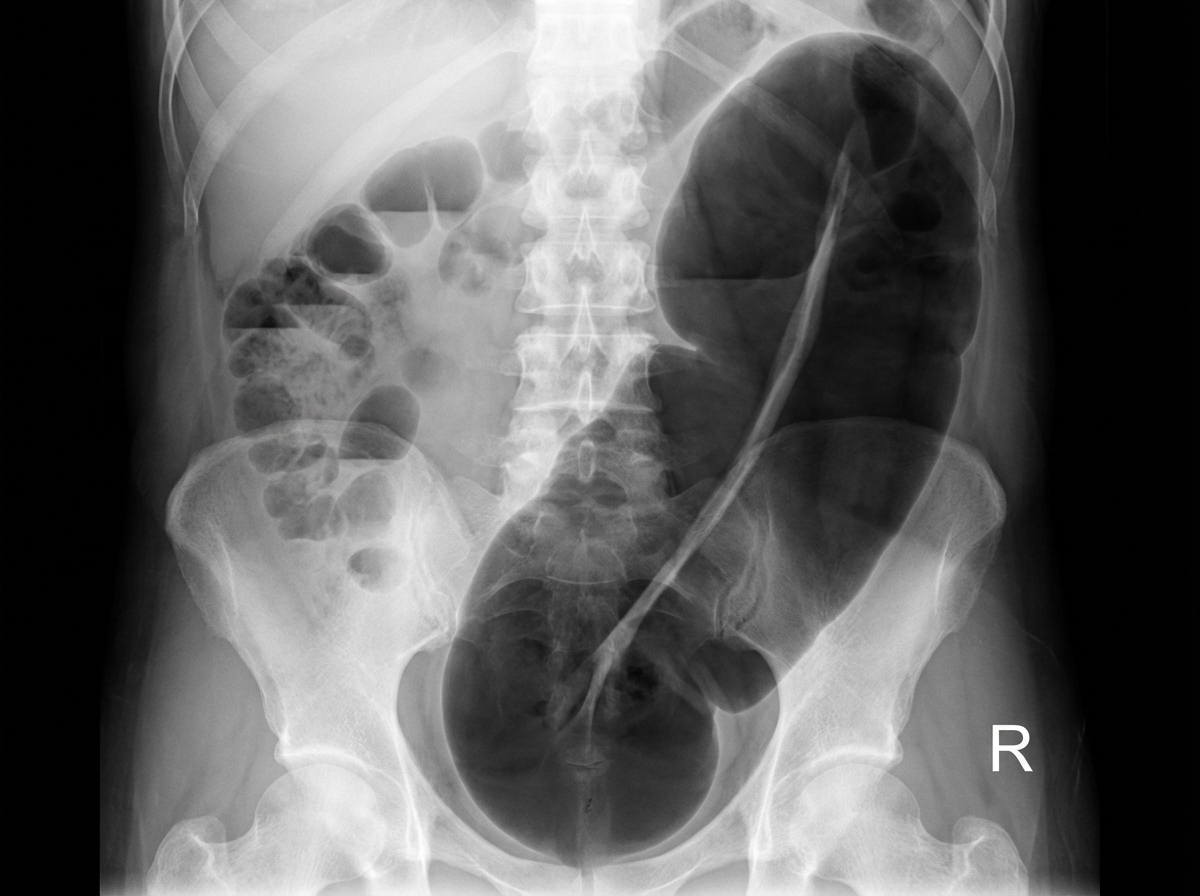
The most appropriate investigation for diagnosing the condition shown in the X-ray is:

Corkscrew appearance on radiography is typically seen in which of the following conditions?
Confluent areas of pancreatic parenchyma that do not demonstrate enhancement after the administration of intravenous contrast material are known as?
A CT scan of acute pancreatitis will show the following features, except:
Which of the following is NOT a feature suggestive of acute cholecystitis on CT abdomen?
What is the investigation of choice for gall bladder stone?
What type of pelvic appearance is this?

Explanation: ### Explanation **1. Why the Correct Answer is Right:** The most common location for an ectopic kidney is the **pelvis**. During embryogenesis, the kidneys normally develop in the pelvic cavity (sacral levels) and ascend to their adult position in the upper lumbar region (T12–L3) by the 9th week of gestation. Renal ectopia occurs when this cephalad migration is interrupted. A **pelvic kidney** is usually found opposite the sacrum or below the aortic bifurcation. It is often smaller, malrotated, and receives its blood supply from adjacent vessels (e.g., internal or common iliac arteries) rather than the abdominal aorta. **2. Analysis of Incorrect Options:** * **Option A (Adjacent to the gallbladder):** While a "high" ectopic kidney (intrathoracic) can occur, it is extremely rare. Ectopic kidneys are almost always found lower than their normal anatomical position, not higher. * **Option B (Attached to the left adrenal gland):** The adrenal glands develop independently from the kidneys. Even in renal agenesis or ectopia, the adrenal gland usually remains in its normal orthotopic position (the "lying down adrenal" sign). * **Option C (Fused laterally with the contralateral kidney):** This describes a specific type of ectopia called **Crossed Fused Ectopia**. While it is a known anomaly, simple pelvic ectopia is statistically more common and is the "expected" default location when the term "ectopic kidney" is used generally. **3. High-Yield Facts for NEET-PG:** * **Most common renal fusion anomaly:** Horseshoe kidney (fused at the lower poles; gets "hooked" under the Inferior Mesenteric Artery). * **Most common renal ectopia:** Pelvic kidney. * **Adrenal Gland Position:** In renal ectopia/agenesis, the adrenal gland is typically present and normally located but appears elongated or "pancake-shaped" on imaging. * **Clinical Significance:** Ectopic kidneys are often asymptomatic but have a higher incidence of **vesicoureteral reflux (VUR)**, nephrolithiasis, and hydronephrosis due to the malrotated pelvis and short ureters.
Explanation: ***Polyarteritis nodosa (PAN)*** - **PAN** typically causes **microaneurysms** and **necrotizing vasculitis** in medium-sized arteries, not stenotic lesions that would produce **parvus tardus** waveforms. - The **parvus tardus pattern** indicates **proximal renal artery stenosis**, which is not characteristic of PAN's pathophysiology involving aneurysmal dilatation rather than narrowing. *Atherosclerosis* - **Atherosclerotic plaques** commonly cause **renal artery stenosis**, especially at the **ostium**, leading to renovascular hypertension and **parvus tardus** waveforms. - This is the most common cause of **renal artery stenosis** in patients over 50 years, though can occur in younger patients with risk factors. *Fibromuscular dysplasia (FMD)* - **FMD** is a leading cause of **renal artery stenosis** in young adults, particularly women, causing the classic **"string of beads"** appearance on angiography. - The **medial fibroplasia** variant creates alternating areas of stenosis and dilatation, resulting in **parvus tardus** waveforms downstream from the stenotic segments. *Takayasu arteritis* - This **large vessel vasculitis** commonly involves the **renal arteries**, causing stenosis through inflammatory wall thickening and fibrosis. - **Takayasu arteritis** can present with **renovascular hypertension** and **parvus tardus** patterns, particularly in young Asian women with systemic inflammatory symptoms.
Explanation: **Explanation:** Ischemic colitis occurs due to a sudden reduction in blood flow to the colon, most commonly at "watershed areas" like the splenic flexure (Griffith’s point). **Why "Dilution of Barium" is the correct answer:** Dilution of barium is a characteristic radiological feature of **Malabsorption syndromes** (like Celiac disease) or **Small Bowel Obstruction**, where excessive intraluminal fluid mixes with the contrast. It is not a feature of ischemic colitis, which primarily involves mural changes rather than hypersecretion or fluid accumulation. **Analysis of Incorrect Options:** * **Thumb printing (Option A):** This is the **most characteristic** early sign of ischemic colitis on a barium enema or CT. It represents localized submucosal hemorrhage and edema, appearing as rounded indentations on the bowel lumen. * **Increased mucosal fold thickness (Option C):** Ischemia leads to inflammatory edema and congestion of the bowel wall, resulting in thickened, blunted, or distorted mucosal folds. * **Serrated mucosa (Option B):** As ischemia progresses, superficial mucosal ulcerations occur. When barium fills these small ulcers, it gives the bowel margin a "serrated" or "saw-tooth" appearance. **High-Yield Clinical Pearls for NEET-PG:** * **Most common site:** Splenic flexure (Griffith’s point) followed by the rectosigmoid junction (Sudeck’s point). * **Gold Standard Diagnosis:** Colonoscopy (shows pale mucosa, petechiae, or "Single Stripe Sign"). * **Imaging:** CT shows "Target Sign" (concentric wall thickening). * **Clinical Presentation:** Sudden onset left-sided abdominal pain followed by bloody diarrhea in an elderly patient with cardiovascular risk factors.
Explanation: ***Barium meal*** - **Barium meal** is the gold standard for diagnosing and classifying **hiatus hernia**, clearly demonstrating the **gastroesophageal junction** position and **stomach herniation** into the thoracic cavity. - It can differentiate between **sliding hiatus hernia** (Type I) and **rolling/paraesophageal hernia** (Type II-IV), which is crucial for management planning. *Computer tomography (CT) scan* - While CT can identify hiatus hernia, it's **not the first-line investigation** and is more expensive with **radiation exposure**. - CT is typically reserved for **complications** like **strangulation** or when **surgical planning** is required. *Chest x-ray* - Though chest X-ray may show the **retrocardiac gas shadow** suggesting hiatus hernia, it's only a **screening tool** and cannot provide definitive diagnosis. - It lacks the **anatomical detail** needed to classify the type of hernia or assess the **gastroesophageal junction** adequately. *Upper GI endoscopy* - Endoscopy is primarily used to assess **mucosal abnormalities** and **complications** like **esophagitis** or **Barrett's esophagus**. - It cannot adequately visualize the **anatomical relationships** and **hernial sac** position that are essential for hiatus hernia diagnosis.
Explanation: **Explanation:** The **corkscrew appearance** (also known as rosary bead esophagus) is the classic radiographic hallmark of **Diffuse Esophageal Spasm (DES)**. This appearance occurs due to high-amplitude, non-peristaltic, uncoordinated tertiary contractions of the esophageal smooth muscle. On a barium swallow, these simultaneous contractions compartmentalize the esophagus into multiple segments, mimicking the spiral shape of a corkscrew. **Analysis of Options:** * **Diffuse Esophageal Spasm (Correct):** Characterized by intermittent chest pain and dysphagia. The uncoordinated contractions lead to the "corkscrew" or "rosary bead" deformity. * **Achalasia Cardia:** Typically presents with a **"Bird’s beak"** or "Rat-tail" appearance due to the failure of the Lower Esophageal Sphincter (LES) to relax and proximal esophageal dilatation. * **Carcinoma Esophagus:** Usually presents with an **"Apple-core"** appearance or an irregular, eccentric filling defect with mucosal destruction (shouldering effect). * **Hiatus Hernia:** Characterized by the protrusion of the stomach through the diaphragmatic hiatus, often appearing as a retrocardiac gas-fluid level or a "Schatzki ring" at the squamocolumnar junction. **High-Yield Clinical Pearls for NEET-PG:** * **Manometry** is the gold standard for diagnosing DES (showing simultaneous, high-amplitude contractions in >20% of swallows). * **Nutcracker Esophagus:** High-pressure peristaltic waves (hypertensive peristalsis) but with normal coordination; barium swallow is usually normal. * **Pseudo-corkscrew appearance** can sometimes be seen in elderly patients (Presbyesophagus) due to tertiary contractions, but it is less severe than in DES.
Explanation: **Explanation:** The core concept in this question is the assessment of pancreatic viability using Contrast-Enhanced Computed Tomography (CECT). **1. Why Pancreatic Necrosis is Correct:** According to the **Revised Atlanta Classification**, pancreatic necrosis is defined as diffuse or focal areas of non-enhancing pancreatic parenchyma. In a normal CECT, the pancreas enhances brightly due to its rich blood supply. The absence of enhancement (typically <30 Hounsfield Units) indicates a lack of perfusion, which is the hallmark of tissue death or necrosis. This is best evaluated 72–96 hours after the onset of symptoms. **2. Why the Other Options are Incorrect:** * **Pseudocyst (A):** This is a circumscribed collection of fluid with a well-defined wall, occurring >4 weeks after *interstitial edematous pancreatitis*. Crucially, it contains no solid/necrotic components. * **Walled-off Pancreatic Necrosis (B):** While WON involves necrosis, it refers specifically to a mature, encapsulated collection of pancreatic/peripancreatic necrosis that has developed a thick inflammatory wall (usually >4 weeks after onset). The question asks for the parenchymal finding itself, not the late-stage encapsulated collection. * **Acute Peripancreatic Fluid Collection (C):** This occurs within the first 4 weeks of *edematous* pancreatitis. It is limited to the peripancreatic spaces and does not involve parenchymal necrosis. **Clinical Pearls for NEET-PG:** * **Gold Standard Imaging:** CECT is the modality of choice for diagnosing and grading the severity of acute pancreatitis. * **Timing:** CECT performed too early (<48 hours) may underestimate the extent of necrosis. * **Balthazar Score:** Used to grade the severity of pancreatitis based on CT findings. * **Infected Necrosis:** Suggested by the presence of **extraluminal gas** within the necrotic area on CT.
Explanation: ### Explanation In the context of **Acute Pancreatitis**, the diagnosis is primarily clinical and biochemical (elevated amylase/lipase). Imaging, specifically Contrast-Enhanced CT (CECT), is the gold standard for assessing severity and complications rather than making the initial diagnosis. **Why "Dilated main pancreatic duct" is the correct answer:** A dilated pancreatic duct is a hallmark feature of **Chronic Pancreatitis**, often caused by ductal strictures or intraductal calculi. In acute pancreatitis, the inflammatory process leads to interstitial edema and swelling of the pancreatic parenchyma, which typically results in the **compression** of the duct rather than its dilation. **Analysis of Incorrect Options:** * **Enlargement of the pancreas:** This is one of the earliest signs of acute pancreatitis due to diffuse or focal inflammatory edema (interstitial edematous pancreatitis). * **Ill-defined outline of the pancreas:** Inflammation causes "shaggy" margins and blurring of the peripancreatic fat planes (fat stranding) due to the release of proteolytic enzymes. * **Poor contrast enhancement:** This indicates areas of **pancreatic necrosis**. Viable pancreatic tissue enhances brightly; lack of enhancement (usually <30 HU) signifies a loss of blood supply and tissue death, which is a critical prognostic factor. **High-Yield Clinical Pearls for NEET-PG:** * **Timing of CT:** CECT is most accurate for assessing necrosis **72 hours** after the onset of symptoms. * **Balthazar Scoring:** A CT-based grading system used to assess the severity of acute pancreatitis based on peripancreatic fluid collections and necrosis. * **Sentinel Loop Sign:** A dilated loop of proximal jejunum seen on X-ray, representing localized ileus near the inflamed pancreas. * **Colon Cut-off Sign:** Abrupt collapse of the colon near the splenic flexure due to inflammatory exudate spreading along the phrenicocolic ligament.
Explanation: **Explanation:** Acute cholecystitis is an inflammatory condition typically caused by cystic duct obstruction. On imaging, the hallmark of acute inflammation is **gallbladder distension** (transverse diameter >4 cm) rather than contraction. **1. Why "Contracted gallbladder" is the correct answer:** A **contracted gallbladder** is a feature of chronic cholecystitis or a post-prandial state. In acute cholecystitis, the gallbladder is almost always **distended** due to the accumulation of mucus and inflammatory exudate behind an obstructed duct (hydrops). **2. Analysis of incorrect options:** * **Pericholecystic fluid (Option A):** This is a specific sign of inflammation or localized perforation and is a classic CT finding in acute cholecystitis. * **Presence of gallstones (Option B):** While CT is not the gold standard for stones (Ultrasound is better), the presence of a stone lodged in the gallbladder neck is the primary inciting factor in 90-95% of cases (calculous cholecystitis). * **Air in the gallbladder wall (Option D):** This signifies **Emphysematous Cholecystitis**, a surgical emergency and a severe variant of acute cholecystitis caused by gas-forming organisms (e.g., *Clostridium perfringens*), common in diabetic patients. **High-Yield Clinical Pearls for NEET-PG:** * **Gold Standard Investigation:** Radionuclide scan (**HIDA scan**)—failure to visualize the gallbladder confirms cystic duct obstruction. * **Investigation of Choice (Initial):** **Ultrasound**, showing wall thickening (>3mm), distension, and a **Positive Sonographic Murphy’s Sign**. * **CT Findings:** Wall thickening, pericholecystic fat stranding, and "rim enhancement" of the gallbladder wall.
Explanation: **Explanation:** **Ultrasound (USG)** is the investigation of choice (gold standard screening tool) for gallbladder stones (cholelithiasis) due to its high sensitivity (>95%) and specificity. It is non-invasive, cost-effective, lacks ionizing radiation, and can detect stones as small as 1-2 mm. On USG, stones typically appear as **hyperechoic (bright) structures** with a characteristic **posterior acoustic shadow** that move with changes in patient position. **Analysis of Incorrect Options:** * **X-ray Abdomen:** Only 10-15% of gallstones are radiopaque (contain enough calcium to be seen). Most stones are cholesterol-based and radiolucent, making X-ray an unreliable screening tool. * **Oral Cholecystography (OCG):** Historically used to assess gallbladder function and stones, it has been entirely replaced by USG. It requires the ingestion of contrast and a functional gallbladder to concentrate it, making it slow and less accurate. * **Intravenous Cholangiography:** Formerly used to visualize the biliary tree, it carries a risk of contrast reactions and is inferior to modern MRCP (Magnetic Resonance Cholangiopancreatography) or USG. **High-Yield Clinical Pearls for NEET-PG:** * **WES Triad:** (Wall-Echo-Shadow) is a USG finding seen when the gallbladder is completely filled with stones. * **Investigation of choice for Acute Cholecystitis:** USG (initial); **HIDA scan** (most sensitive/confirmatory). * **Investigation of choice for Choledocholithiasis (CBD stones):** **ERCP** (Gold standard/Therapeutic); **MRCP** (Best non-invasive diagnostic). * **Sludge:** Low-level echoes without shadowing, often a precursor to stone formation.
Explanation: ***Champagne glass pelvis*** - Characterized by **squared iliac wings**, **narrow pelvic inlet**, and **small sciatic notches**, creating a wine glass appearance on AP radiographs. - Commonly seen in **achondroplasia** and other skeletal dysplasias, representing abnormal bone development. *Corkscrew pelvis* - This is **not a standard radiological classification** term used in pelvic anatomy or radiology. - The term does not correspond to any recognized **pelvic morphological pattern** in medical literature. *Gynecoid pelvis* - Refers to the **normal female pelvic shape** in the **Caldwell-Moloy classification** with rounded pelvic inlet. - Features include **wide pelvic inlet**, **curved sacrum**, and **wide pubic arch**, optimal for childbirth. *None of the above* - The **champagne glass pelvis** is a well-recognized radiological sign, making this option incorrect. - The characteristic appearance is pathognomonic for certain **skeletal dysplasias**, particularly achondroplasia.
Imaging of Liver
Practice Questions
Biliary Tract Imaging
Practice Questions
Pancreatic Imaging
Practice Questions
Spleen and Lymphatic System
Practice Questions
Gastrointestinal Tract Imaging
Practice Questions
Renal and Urinary Tract Imaging
Practice Questions
Adrenal Imaging
Practice Questions
Female Pelvic Imaging
Practice Questions
Male Pelvic Imaging
Practice Questions
Abdominal Trauma Imaging
Practice Questions
Acute Abdomen Imaging
Practice Questions
Imaging of Peritoneal Cavity and Retroperitoneum
Practice Questions
Get full access to all questions, explanations, and performance tracking.
Start For Free