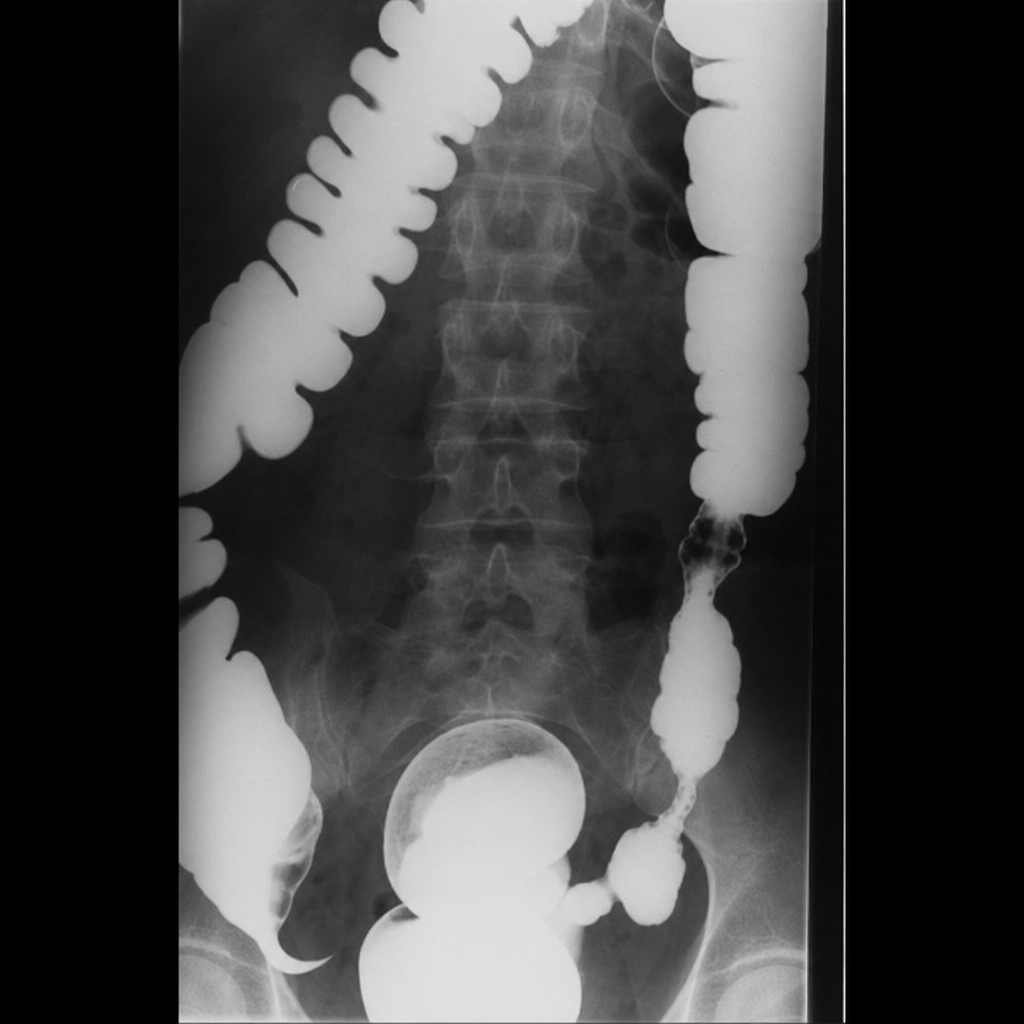
Air in the biliary tract is seen in all of the following conditions except:
The "chain of lakes" appearance on imaging is characteristic of which of the following conditions?
Which radiological method is best for staging cervical carcinoma?
Carman's meniscus sign is diagnostic of –
Which of the following conditions is characterized by the presence of a central dot sign on CT scan?
A 69-year-old man with dysphagia is found to have a benign lesion on barium swallow. What should he be told regarding benign tumors and cysts of the esophagus?
The 'diamond sign' is radiographically observed in which of the following conditions?
A patient with a history of choledocholithiasis presents with elevated conjugated bilirubin. Ultrasound reveals a dilated biliary system up to the terminal pancreas. In case of suspicion of an ampullary obstructive calculus, which of the following investigations would be most sensitive?
A barium swallow shows which of the following findings?

Endometriomas on ultrasound typically appear as?
Explanation: **Explanation:** The presence of air in the biliary tree is known as **pneumobilia**. It occurs when there is an abnormal communication between the biliary system and the gastrointestinal tract or a loss of sphincter integrity. **Why Sclerosing Cholangitis is the correct answer:** Primary Sclerosing Cholangitis (PSC) is a chronic cholestatic liver disease characterized by inflammation, fibrosis, and strictures of the bile ducts. While it causes "beading" of the ducts on imaging (MRCP/ERCP), it does **not** typically involve the formation of a fistula or the reflux of air from the bowel. Therefore, pneumobilia is not a feature of this condition. **Analysis of Incorrect Options:** * **Gallstone Ileus:** This occurs when a large gallstone erodes through the gallbladder wall into the duodenum (cholecystoenteric fistula). Air travels from the gut into the biliary tree, forming part of **Rigler’s Triad** (Pneumobilia, Small bowel obstruction, Ectopic gallstone). * **Carcinoma of the Gallbladder:** Advanced malignancy can cause local invasion and necrosis, leading to a fistula between the gallbladder and adjacent bowel loops (duodenum or colon), resulting in pneumobilia. * **Endoscopic Papillotomy:** During ERCP, the Sphincter of Oddi is often cut (sphincterotomy). This destroys the natural valve mechanism, allowing enteric air to reflux freely into the common bile duct. **NEET-PG High-Yield Pearls:** * **Rigler’s Triad:** Pathognomonic for Gallstone Ileus (Pneumobilia + SBO + Gallstone in iliac fossa). * **Differential Diagnosis of Pneumobilia:** Recent ERCP/Sphincterotomy (most common), Cholecystoenteric fistula, Emphysematous cholecystitis, and Incompetent Sphincter of Oddi. * **Imaging:** On Ultrasound, pneumobilia appears as bright echogenic foci with "dirty" posterior shadowing within the bile ducts. On CT, air is seen in the dependent (anterior) portion of the left lobe of the liver.
Explanation: ### Explanation **Correct Answer: B. Chronic Pancreatitis** The **"chain of lakes"** appearance is a classic radiological sign of **Chronic Pancreatitis**. It refers to the irregular, beaded appearance of the main pancreatic duct caused by alternating segments of **strictures and dilatations**. This occurs due to chronic inflammation, fibrosis, and protein plugging within the ductal system. This sign is most commonly visualized using **ERCP** (Endoscopic Retrograde Cholangiopancreatography) or **MRCP** (Magnetic Resonance Cholangiopancreatography). **Analysis of Incorrect Options:** * **A. Acute Pancreatitis:** Imaging typically shows diffuse or focal enlargement of the gland with peripancreatic fluid collections or fat stranding. The ductal system does not show the chronic "beaded" remodeling seen in this sign. * **C. Carcinoma Pancreas:** Usually presents as a hypodense mass on CT. While it can cause proximal ductal dilatation (the "Double Duct Sign" if the common bile duct is also involved), it typically results in a single point of obstruction rather than alternating strictures. * **D. Strawberry Gallbladder:** This refers to **Cholesterolosis**, where there is an accumulation of cholesterol esters in the lamina propria of the gallbladder wall, giving it a speckled appearance on gross pathology, not a "chain of lakes" on ductal imaging. **High-Yield Clinical Pearls for NEET-PG:** * **Most common cause of Chronic Pancreatitis:** Alcohol (Adults), Cystic Fibrosis (Children). * **Classic Triad:** Pancreatic calcifications (most specific), steatorrhea, and diabetes mellitus. * **Double Duct Sign:** Simultaneous dilatation of the Common Bile Duct (CBD) and Main Pancreatic Duct; highly suggestive of pancreatic head carcinoma. * **Sentinel Loop:** A localized ileus (dilated bowel loop) near the pancreas seen on X-ray in Acute Pancreatitis.
Explanation: **Explanation:** The staging of cervical carcinoma has evolved significantly. While the FIGO staging was traditionally clinical, the 2018 revision now allows the use of advanced imaging to assign the stage. **Why PET-CT is the Correct Answer:** PET-CT (Positron Emission Tomography-Computed Tomography) is considered the superior modality for **staging**, particularly for detecting **extrapelvic disease and lymph node metastasis** (para-aortic and distant nodes). While MRI is excellent for evaluating the local extent of the primary tumor (size and parametrial invasion), PET-CT provides a whole-body assessment, which is crucial for accurate staging and planning radiotherapy or surgery. It has higher sensitivity and specificity than CT or MRI for identifying nodal involvement. **Analysis of Incorrect Options:** * **MRI:** This is the best modality for evaluating **local tumor extent** (T-staging), such as tumor size, vaginal involvement, and parametrial invasion, due to its superior soft-tissue contrast. However, for overall staging (including distant nodes), PET-CT is preferred. * **Sonosalpingography:** This is a specialized ultrasound technique used to evaluate the patency of fallopian tubes in infertility workups; it has no role in cancer staging. * **Doppler USG:** While it can assess vascularity within a mass, it lacks the anatomical detail and systemic reach required for staging cervical malignancy. **High-Yield Clinical Pearls for NEET-PG:** * **Best for Local Staging (Parametrial invasion):** MRI. * **Best for Nodal and Distant Metastasis:** PET-CT. * **FIGO 2018 Update:** Imaging (MRI/CT/PET-CT) is now formally incorporated into the staging system. * **Most common histological type:** Squamous cell carcinoma. * **Primary screening tool:** Pap smear (Cytology) or HPV DNA testing.
Explanation: **Explanation:** **Carman’s meniscus sign** is a classic radiological finding seen during a barium meal study, specifically diagnostic of a **large, malignant gastric ulcer** (Carcinoma of the stomach). The sign occurs when a large ulcer sits on a flat, infiltrated surface. When manual compression is applied during the barium study, the edges of the ulcer (the tumor mass) project into the lumen, while the ulcer crater itself remains filled with barium. This creates a **crescent or meniscus shape**, with the concavity facing the gastric lumen. This is distinct from a benign ulcer, which typically projects beyond the gastric wall. **Analysis of Options:** * **A. Peptic Ulcer:** Benign peptic ulcers typically show the "Hampton’s line" or "Ulcer niche" projecting *outside* the normal contour of the stomach. They do not exhibit the meniscus sign. * **B. Cholecystitis:** This is an inflammatory condition of the gallbladder, usually diagnosed via Ultrasound (showing wall thickening/pericholecystic fluid), not barium studies. * **D. Meconium Ileus:** This is a neonatal intestinal obstruction (often associated with Cystic Fibrosis). Radiologically, it presents with a "soap bubble" appearance (Neuhauser sign) in the right iliac fossa. **High-Yield Clinical Pearls for NEET-PG:** * **Kirklin Complex:** This refers to the "bright rim" or radiolucent zone surrounding the Carman’s meniscus, representing the elevated malignant margin. * **Benign vs. Malignant:** Benign ulcers have smooth margins and radiating mucosal folds that reach the edge of the crater. Malignant ulcers have irregular margins and folds that stop short of the crater. * **Linitis Plastica:** Another presentation of gastric cancer ("Leather bottle stomach") characterized by a rigid, non-distensible stomach on barium swallow.
Explanation: ### Explanation **Correct Answer: A. Caroli's disease** The **"Central Dot Sign"** is a pathognomonic radiological finding on contrast-enhanced CT or MRI for **Caroli’s disease**. * **Mechanism:** Caroli’s disease is characterized by non-obstructive, saccular, or fusiform dilatation of the intrahepatic bile ducts. The "central dot" represents a small **portal vein branch** (and sometimes a hepatic artery branch) that is completely surrounded by these dilated bile ducts. On a cross-sectional contrast scan, the enhancing portal radical appears as a tiny bright dot within the center of the hypoattenuating dilated duct. --- ### Why the other options are incorrect: * **B. Primary Sclerosing Cholangitis (PSC):** Characterized by a **"beaded appearance"** (multifocal strictures and segments of dilatation) of the bile ducts. It does not typically feature the specific intraluminal portal vein configuration seen in Caroli's. * **C. Polycystic Liver Disease:** Presents as multiple, discrete, simple cysts throughout the liver parenchyma. Unlike Caroli’s, these cysts **do not communicate** with the biliary tree and do not surround portal radicals. * **D. Liver Hemangioma:** Shows a characteristic **peripheral globular enhancement** with centripetal fill-in on delayed phases. It is a vascular tumor, not a biliary dilatation. --- ### High-Yield Pearls for NEET-PG: * **Caroli’s Disease vs. Caroli’s Syndrome:** Caroli’s disease involves only the large intrahepatic ducts. **Caroli’s Syndrome** is more common and includes the addition of **Congenital Hepatic Fibrosis** (leading to portal hypertension and splenomegaly). * **Todani Classification:** Caroli’s disease is classified as **Type V** Choledochal cyst. * **Complications:** Patients are at high risk for recurrent pyogenic cholangitis, pigment stones, and **cholangiocarcinoma** (7-15% risk). * **Associations:** Frequently associated with Autosomal Recessive Polycystic Kidney Disease (ARPKD).
Explanation: ### Explanation **1. Why the Correct Answer is Right:** **Leiomyoma** is the most common benign mesenchymal tumor of the esophagus, accounting for approximately 60-70% of all benign esophageal neoplasms. These are slow-growing, intramural, extramucosal lesions typically found in the distal two-thirds of the esophagus. On a **barium swallow**, they classically present as a smooth, crescent-shaped filling defect with "sharp" or "obtuse" angles against the esophageal wall, and the overlying mucosa remains intact (no ulceration). **2. Why the Incorrect Options are Wrong:** * **Option A:** In the esophagus, **malignant tumors (Squamous Cell Carcinoma and Adenocarcinoma) are significantly more common** than benign ones. Benign tumors represent less than 1% of all esophageal neoplasms. * **Option B:** Most benign esophageal tumors are **asymptomatic** and are often discovered incidentally. Symptoms like dysphagia usually only occur when the lesion exceeds 5 cm in diameter, typically in older adults. * **Option C:** A chest X-ray is rarely diagnostic for esophageal lesions unless they are large enough to cause mediastinal widening. **Barium swallow** is the initial screening tool of choice, while **Endoscopic Ultrasound (EUS)** is the gold standard for confirming the intramural nature of the lesion. **3. High-Yield Clinical Pearls for NEET-PG:** * **Most common benign mucosal tumor:** Squamous cell papilloma. * **Most common benign intramural tumor:** Leiomyoma. * **Biopsy Caution:** Biopsy of a suspected leiomyoma during endoscopy is generally **avoided** if surgery is planned, as it causes submucosal scarring, making surgical enucleation difficult and increasing the risk of mucosal perforation. * **Treatment:** Small asymptomatic leiomyomas are monitored; large or symptomatic ones are treated via **surgical enucleation**.
Explanation: **Explanation:** **Congenital Hypertrophic Pyloric Stenosis (CHPS)** is characterized by the hypertrophy of the circular muscle fibers of the pylorus, leading to gastric outlet obstruction. The **'Diamond Sign'** is a specific radiographic finding seen during a Barium swallow/Upper GI series. It represents a transient, diamond-shaped mucosal hypertrophy or a small amount of barium trapped between the thickened muscle folds at the proximal end of the pyloric canal. **Analysis of Options:** * **A. Congenital Pyloric Stenosis (Correct):** In addition to the Diamond sign, other classic radiological signs include the **String sign** (narrowed pyloric canal), **Beak sign** (tapered entrance to the canal), and **Double track sign** (barium trapped between mucosal folds). * **B. Esophageal Atresia:** Characterized by a "blind pouch" on X-ray (with a feeding tube coiled in the neck). If a tracheoesophageal fistula is present, gas will be seen in the abdomen. * **C. Intestinal Obstruction:** Typically presents with dilated bowel loops and multiple air-fluid levels on an erect abdominal X-ray. Specific signs include the "Double Bubble" sign (Duodenal atresia) or "Coffee bean" sign (Sigmoid volvulus). * **D. Colon Cancer:** Classically associated with the **"Apple Core" lesion** (annular constriction) on a Barium enema, particularly in the descending or sigmoid colon. **High-Yield Clinical Pearls for NEET-PG:** * **Clinical Presentation:** Non-bilious, projectile vomiting in a 3–6 week old infant. * **Physical Exam:** Palpable "olive-shaped" mass in the epigastrium and visible gastric peristalsis. * **Metabolic Abnormality:** Hypochloremic, hypokalemic metabolic alkalosis (Paradoxical aciduria). * **Investigation of Choice:** Ultrasonography (Criteria: Pyloric muscle thickness >3-4 mm or canal length >14-16 mm). * **Treatment:** Ramstedt’s Pyloromyotomy.
Explanation: ### Explanation **Correct Answer: D. Endoscopic Ultrasound (EUS)** #### Why EUS is the Correct Choice: In the context of suspected **choledocholithiasis** or **ampullary obstruction**, EUS is currently considered the most sensitive diagnostic modality. Because the EUS probe is placed in the immediate proximity of the duodenum (periampullary region), it provides high-resolution images of the distal common bile duct (CBD) and the ampulla of Vater. It is particularly superior to MRCP for detecting **small stones (<5 mm)** and microlithiasis, which are often missed by other imaging techniques. #### Analysis of Incorrect Options: * **A. Percutaneous Transhepatic Cholangiography (PTC):** This is an invasive procedure typically reserved for dilated intrahepatic ducts when ERCP is not feasible. It is not the first-line investigation for distal CBD stones. * **B. Magnetic Resonance Cholangiopancreatography (MRCP):** While MRCP is highly sensitive (approx. 90-95%) and non-invasive, it has a lower sensitivity than EUS for very small stones or sludge at the terminal end of the CBD. * **C. X-ray Abdomen:** Most gallstones (80-85%) are radiolucent (cholesterol stones). Only about 15% are radio-opaque, making X-ray a very poor screening tool for biliary obstruction. #### NEET-PG High-Yield Pearls: * **Gold Standard (Diagnostic + Therapeutic):** ERCP (Endoscopic Retrograde Cholangiopancreatography). However, due to the risk of pancreatitis, it is not the first-line *diagnostic* test. * **Most Sensitive Diagnostic Test:** EUS (especially for distal CBD/ampullary pathology). * **Best Non-invasive Screening Test:** MRCP. * **Initial Investigation of Choice:** Transabdominal Ultrasound (USG) is always the first step for suspected biliary pathology, though it often fails to visualize the distal CBD due to overlying bowel gas.
Explanation: ***Carcinoma esophagus*** - Shows classic **irregular filling defect** with **shouldering** and **rat-tail** or **apple-core appearance** on barium swallow. - Demonstrates **abrupt luminal narrowing** with **mucosal irregularities** and **asymmetric wall thickening**. *Achalasia cardia* - Presents with characteristic **bird-beak appearance** showing smooth tapering at the gastroesophageal junction. - Associated with **dilated esophageal body** above the narrowed lower esophageal sphincter, unlike the irregular stricture seen in carcinoma. *Nut cracker esophagus* - Primarily a **manometric diagnosis** based on high-amplitude peristaltic contractions (>180 mmHg). - Barium swallow typically appears **normal** or may show mild tertiary contractions, not the filling defect pattern described. *Oesophageal stricture* - Shows **smooth, symmetrical tapering** with regular mucosal outline on barium studies. - Lacks the **irregular shouldering** and **asymmetric narrowing** characteristic of malignant lesions.
Explanation: **Explanation:** **1. Why Option C is Correct:** Endometriomas (also known as "chocolate cysts") are localized forms of endometriosis within the ovary. On ultrasound, the classic appearance is a **well-defined cystic mass** containing **diffuse, homogeneous, low-level internal echoes**. This appearance is often described as a **"ground-glass"** pattern. These echoes represent the hemorrhagic debris and old blood (hemosiderin) that accumulate within the cyst over multiple menstrual cycles. **2. Why Other Options are Incorrect:** * **Options A & B (Solid):** Endometriomas are fluid-filled (blood) structures, not solid tumors. While the echoes can sometimes be dense, they demonstrate **posterior acoustic enhancement**, confirming their cystic nature. * **Option D (Focal hyperechoic internal echoes):** This description is more characteristic of a **Mature Cystic Teratoma (Dermoid cyst)**, which often contains focal hyperechoic components like hair or sebum (Rokitansky nodules), rather than the uniform, diffuse echoes seen in endometriomas. **3. High-Yield Clinical Pearls for NEET-PG:** * **Ground-glass appearance:** The pathognomonic sonographic descriptor for endometrioma. * **Doppler:** Endometriomas typically show **no internal vascularity** on color Doppler (unlike malignant ovarian tumors). * **MRI Appearance:** Shows **"T2 shading"** (high signal on T1 due to blood, and low signal on T2 due to high iron/protein concentration). This is a classic board-exam favorite. * **Differential Diagnosis:** Hemorrhagic corpus luteum cysts can mimic endometriomas but usually resolve over 1–2 menstrual cycles, whereas endometriomas persist.
Imaging of Liver
Practice Questions
Biliary Tract Imaging
Practice Questions
Pancreatic Imaging
Practice Questions
Spleen and Lymphatic System
Practice Questions
Gastrointestinal Tract Imaging
Practice Questions
Renal and Urinary Tract Imaging
Practice Questions
Adrenal Imaging
Practice Questions
Female Pelvic Imaging
Practice Questions
Male Pelvic Imaging
Practice Questions
Abdominal Trauma Imaging
Practice Questions
Acute Abdomen Imaging
Practice Questions
Imaging of Peritoneal Cavity and Retroperitoneum
Practice Questions
Get full access to all questions, explanations, and performance tracking.
Start For Free