General Paresis of the Insane is associated with which condition?
All of the following are features of hallucination EXCEPT:
Loss of insight is seen in which of the following conditions?
Somatic passivity is a feature of which of the following conditions?
A patient with schizophrenia is on neuroleptics. Their psychotic symptoms have improved, but they have developed sadness, talk less, and remain in bed. Which of the following is LEAST likely to be the cause of these new symptoms?
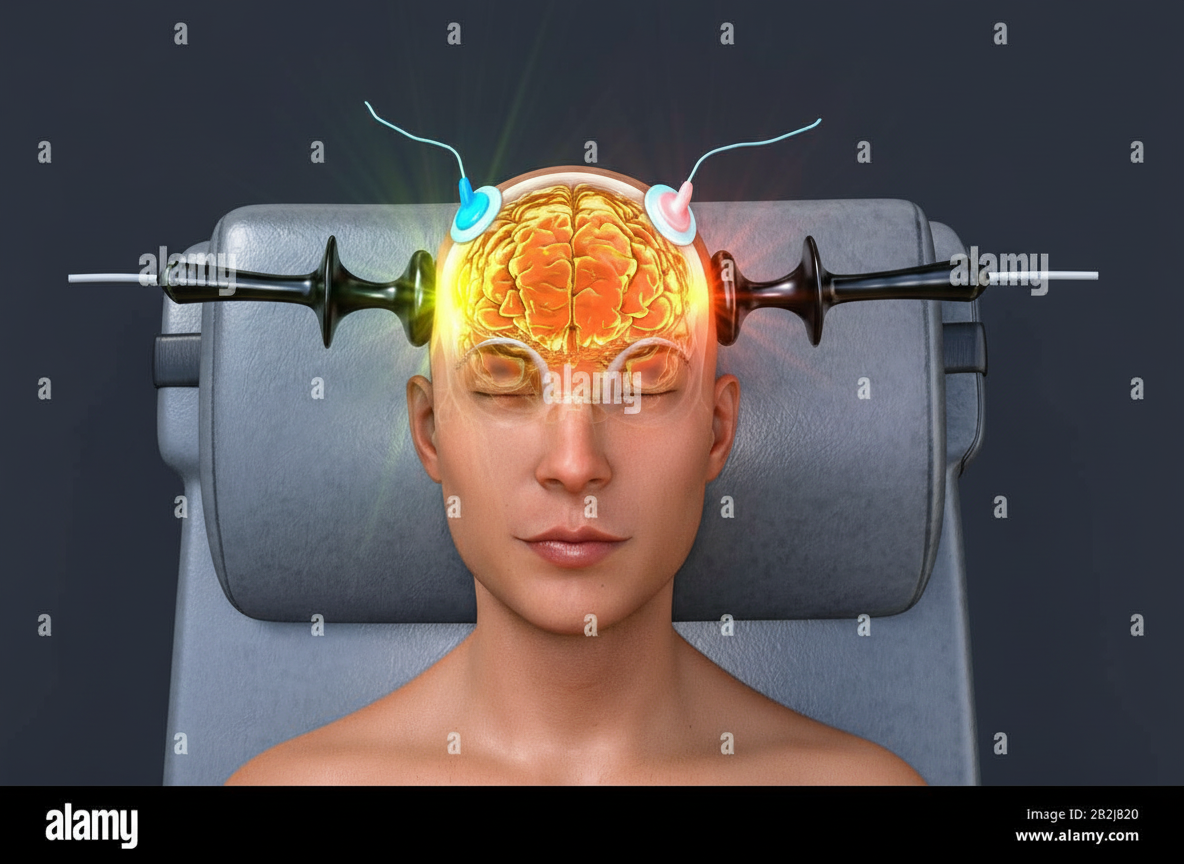
The procedure shown below is used in all of the following illnesses except:
Bleuler's symptoms of schizophrenia include which of the following?
Worst prognosis is seen in which type of schizophrenia?
A 33-year-old male traveling by flight started fighting with an air hostess. The man alleged that the air hostess was his wife, but she had changed her face so she could not be identified. This history is consistent with which of the following syndromes?
A 45-year-old male admits himself to the hospital, stating that the nurse treating him is an imposter, and his wife has replaced her to kill him. What is the most likely diagnosis?
Explanation: **Explanation:** **General Paresis of the Insane (GPI)**, also known as paretic neurosyphilis, is a chronic meningoencephalitis caused by the direct invasion of the brain parenchyma by *Treponema pallidum*. It is a late-stage manifestation of **Tertiary Syphilis**, typically occurring 10–25 years after the initial infection. **Why Tertiary Syphilis is correct:** GPI is characterized by a "constellation of neuropsychiatric symptoms." Clinically, it presents with the **"4 Ps"**: **P**ersonality changes, **P**aresis (weakness), **P**upillary abnormalities (Argyll Robertson pupil), and **P**sychosis (classically **grandiose delusions**). It leads to progressive cognitive decline and frontal lobe syndrome. **Why other options are incorrect:** * **Miliary Tuberculosis:** While TB can cause meningitis or tuberculomas, it does not lead to the specific parenchymal degenerative pattern seen in GPI. * **Vitamin B12 Deficiency:** This causes Subacute Combined Degeneration (SCD) of the spinal cord and "megaloblastic madness" (psychosis/dementia), but it is a nutritional deficiency, not an infectious process. * **Autoimmune Encephalitis:** Conditions like Anti-NMDA receptor encephalitis present with acute psychosis and seizures, but they are mediated by antibodies rather than treponemal infection. **High-Yield Clinical Pearls for NEET-PG:** * **Argyll Robertson Pupil:** The classic sign in neurosyphilis—pupils accommodate but do not react to light ("Prostitute’s Pupil"). * **Diagnosis:** CSF-VDRL is highly specific (though less sensitive); FTA-ABS is often used for confirmation. * **Treatment:** Intravenous Penicillin G is the gold standard. * **Historical Note:** GPI was one of the first psychiatric conditions for which a biological cause was identified.
Explanation: ### Explanation **Hallucinations** are defined as "perceptions in the absence of an external stimulus." They possess the same quality and vividness as real sensory perceptions but are generated internally. #### Why the Question/Answer is Structured This Way: The question asks for the feature that is **NOT** a characteristic of a hallucination (EXCEPT). However, based on standard psychiatric definitions (Jasper’s criteria), **Option D** is actually a *defining* feature of hallucinations. In the context of NEET-PG, there is often a distinction made between **Hallucinations** and **Pseudohallucinations**. * **Option A (Incorrect for Hallucination):** Hallucinations are **involuntary**. They cannot be conjured or dismissed at will. If a perception is under voluntary control, it is an **Imagery**. * **Option B (Incorrect for Hallucination):** True hallucinations occur in **outer objective space** (e.g., hearing a voice coming from the chimney). Perceptions occurring in **inner subjective space** (inside the head) are termed **Pseudohallucinations**. * **Option C (Correct Feature):** Hallucinations are as **vivid** and clear as actual sensory perceptions. * **Option D (Correct Feature):** By definition, hallucinations occur in the **absence of an external stimulus**. (If a stimulus is present but misinterpreted, it is an **Illusion**). *Note: There appears to be a discrepancy in the provided key. Option A and B are the features that are NOT characteristic of true hallucinations. In standard exams, "Occurs in inner subjective space" is the most common "Except" answer for Hallucinations.* --- ### High-Yield Clinical Pearls for NEET-PG: 1. **Jasper’s Criteria for Hallucination:** * Occurs in the absence of external stimuli. * Has the vividness of a real perception. * Located in external (objective) space. * Involuntary (not under subject's control). 2. **Most common hallucination in Schizophrenia:** Auditory (specifically Third Person). 3. **Most common hallucination in Organic Brain Syndrome:** Visual. 4. **Hypnagogic vs. Hypnopompic:** Hypna**go**gic occurs while **go**ing to sleep; Hypnopompic occurs while waking up (seen in Narcolepsy). 5. **Lilliputian Hallucination:** Seeing small people/objects; common in Alcohol Withdrawal/Delirium Tremens.
Explanation: ### Explanation The core concept tested here is the distinction between **Psychosis** and **Neurosis**, specifically regarding the presence or absence of **insight**. **1. Why Schizophrenia is Correct:** Schizophrenia is a prototype of **Psychotic Disorders**. In psychosis, there is a gross impairment in reality testing. The patient is unable to distinguish between subjective experiences (like hallucinations or delusions) and objective reality. Consequently, they lack **insight**—the awareness that their symptoms are part of a mental illness. They typically do not believe they are ill and may refuse treatment. **2. Why the Other Options are Incorrect:** * **Hysteria (Dissociative/Conversion Disorders):** Classified under neurotic/stress-related disorders. While patients may exhibit dramatic physical symptoms without an organic cause, they generally maintain a connection with reality and do not suffer from a primary loss of insight into the fact that something is "wrong" with them. * **Anxiety Disorders:** Patients are acutely aware of their symptoms (palpitations, fear, apprehension). They recognize their distress as abnormal and often seek help voluntarily. * **Obsessive-Compulsive Neurosis (OCD):** A hallmark of OCD is that the patient recognizes their obsessions as **ego-dystonic** (irrational and originating from their own mind). This preservation of insight is what causes the significant distress and struggle against the thoughts. **Clinical Pearls for NEET-PG:** * **Insight Scale:** Insight is not "all-or-none" but is measured on a 6-point scale (ASIST scale). * **Ego-syntonic vs. Ego-dystonic:** Psychotic symptoms (Schizophrenia) are usually *ego-syntonic* (accepted by the ego), whereas neurotic symptoms (OCD) are *ego-dystonic* (rejected by the ego). * **Judgment:** Along with insight, **social and test judgment** are typically impaired in Schizophrenia but preserved in Neuroses.
Explanation: **Somatic Passivity** is a core component of **Schneider’s First Rank Symptoms (SFRS)** of Schizophrenia. It is a delusion of control where the patient experiences their body being influenced or acted upon by an external agency. The patient feels like a passive recipient of bodily sensations (e.g., "electricity is being sent into my limbs by aliens") while being aware that these sensations are not self-initiated. ### Why Paranoid Schizophrenia is Correct: In Paranoid Schizophrenia, "Passivity Phenomena" (including somatic passivity, thought insertion, and made acts/affects) are hallmark features. These symptoms represent a loss of ego boundaries, where the patient cannot distinguish between self-generated actions/sensations and those originating from the outside world. ### Why Other Options are Incorrect: * **Depressive illness:** While severe depression can have psychotic features (delusions of guilt or nihilism), somatic passivity is specific to the "passivity of the will" seen in Schizophrenia. * **Hypochondriasis (Illness Anxiety Disorder):** Patients have a preoccupation with having a serious illness based on a misinterpretation of normal bodily symptoms. Unlike somatic passivity, there is no belief that an external agency is controlling their body. * **Panic disorder:** This involves physical symptoms of autonomic arousal (tachycardia, sweating) and fear of dying, but lacks the delusional external-control element. ### NEET-PG High-Yield Pearls: * **Schneider’s First Rank Symptoms (SFRS):** Remember the mnemonic **"ABCD"** (Auditory hallucinations, Boundary disturbances/Passivity, Control delusions, Delusional perception). * **Somatic Passivity vs. Somatic Hallucination:** In somatic passivity, the emphasis is on the **external agency** controlling the sensation, whereas a somatic hallucination is simply a false sensory perception of the body. * **Diagnostic Weight:** The presence of even one First Rank Symptom in the absence of organic brain disease is highly suggestive of Schizophrenia.
Explanation: ### Explanation The clinical presentation describes a patient whose positive symptoms (hallucinations/delusions) have resolved, but who now exhibits **psychomotor retardation** (sadness, decreased speech, and inactivity). This scenario requires a differential diagnosis between medication side effects, comorbid mood disorders, and the natural progression of schizophrenia. **Why "Reaction to external stimuli" is the LEAST likely cause:** In schizophrenia, a "reaction to external stimuli" typically manifests as agitation, disorganized behavior, or an exacerbation of positive symptoms (e.g., responding to hallucinations). The symptoms described—sadness and inactivity—represent a **withdrawal** from the environment rather than a reactive engagement with it. **Analysis of Incorrect Options:** * **Parkinsonism (Drug-Induced):** Neuroleptics (especially typical antipsychotics) cause dopamine blockade in the nigrostriatal pathway. This can lead to "akinesia" or "bradykinesia," which mimics depression (masked facies, slowed movement, and decreased speech). * **Major Depression:** Post-psychotic depression is a recognized phenomenon where a patient develops a depressive episode following the resolution of an acute psychotic phase. * **Persisting Negative Symptoms:** These are core features of schizophrenia (the "5 A's": Affective flattening, Alogia, Avolition, Anhedonia, Asociality). While positive symptoms respond well to medication, negative symptoms often persist and lead to the described behavior. **Clinical Pearls for NEET-PG:** * **Post-Psychotic Depression:** Always screen for suicide risk in these patients, as insight often returns when psychosis clears, leading to despair. * **Akinesia vs. Depression:** If the symptoms improve with anticholinergics (like Trihexyphenidyl), the cause is likely Parkinsonism. * **Negative Symptoms:** These are the primary cause of long-term disability in schizophrenia and are notoriously resistant to first-generation antipsychotics.
Explanation: ***Dissociative disorder*** - **ECT is not indicated** for dissociative disorders as they are primarily treated with **psychotherapy** and **trauma-focused interventions**. - Dissociative disorders involve disruptions in **consciousness, memory, identity**, and do not respond to **neurobiological interventions** like ECT. *Catatonic schizophrenia* - **ECT is highly effective** for catatonic symptoms, especially **catatonic stupor** and **malignant catatonia**. - Provides rapid relief when **antipsychotics** fail or when **life-threatening complications** like hyperthermia occur. *Treatment-resistant major depressive disorder* - **ECT is the gold standard** for severe depression that fails to respond to **multiple antidepressant trials**. - Shows **response rates of 70-90%** in treatment-resistant cases and is particularly effective for **psychotic depression**. *Severe mania* - **ECT is indicated** for severe manic episodes, especially with **psychotic features** or **catatonic symptoms**. - Used when **mood stabilizers** are ineffective or contraindicated, providing rapid **mood stabilization**.
Explanation: **Explanation:** Eugen Bleuler, a Swiss psychiatrist, coined the term "Schizophrenia" and identified four fundamental symptoms (often called the **4 A’s**) that he believed were present in every case of the disorder. **The 4 A’s of Bleuler include:** 1. **A**ffective Disturbance (Inappropriate or blunted affect) 2. **A**utism (Social withdrawal and living in a private fantasy world) 3. **A**mbivalence (Coexisting opposing emotions/impulses toward the same object) 4. **A**ssociation Loosening (Fragmented thought processes/Formal thought disorder) **Analysis of Options:** * **Option B (Automatism) is the Correct Answer** in the context of this specific question format because it is **NOT** one of Bleuler’s 4 A’s. (Note: In NEET-PG, "include which of the following" questions sometimes ask for the "except" or the "odd one out" depending on the source; here, Automatism is the outlier). Automatism refers to involuntary motor activities and is more commonly associated with epilepsy or dissociative states. * **Options A, C, and D** are all primary (fundamental) symptoms described by Bleuler. **Clinical Pearls for NEET-PG:** * **Fundamental vs. Accessory Symptoms:** Bleuler categorized symptoms into Fundamental (the 4 A’s) and Accessory (Hallucinations and Delusions). He believed accessory symptoms were not essential for diagnosis. * **Schneider’s First Rank Symptoms (FRS):** Unlike Bleuler, Kurt Schneider focused on "First Rank Symptoms" (e.g., audible thoughts, somatic passivity, delusional perception) which were considered pathognomonic for schizophrenia. * **Historical Context:** Bleuler’s "Loosening of Association" is considered the hallmark of the schizophrenic thought disorder.
Explanation: **Explanation:** The prognosis of Schizophrenia is determined by the age of onset, the nature of symptoms (positive vs. negative), and the speed of progression. **Why Simple Schizophrenia is the Correct Answer:** Simple Schizophrenia (ICD-10) is characterized by the early and insidious onset of **negative symptoms** (apathy, withdrawal, loss of drive) without the presence of overt hallucinations or delusions. Because it lacks "florid" psychotic symptoms, it often goes undiagnosed for years. It has a chronic, downhill course with poor response to typical antipsychotics and a very high risk of social drift, making it the subtype with the **worst prognosis**. **Analysis of Incorrect Options:** * **Paranoid Schizophrenia:** This subtype has the **best prognosis**. It typically has a later age of onset, preserved cognitive function, and responds well to medication because it is dominated by positive symptoms (delusions/hallucinations). * **Catatonic Schizophrenia:** This has a **good prognosis** regarding recovery from individual episodes. It shows an excellent and rapid response to Benzodiazepines (Lorazepam) and Electroconvulsive Therapy (ECT). * **Hebephrenic (Disorganized) Schizophrenia:** This has a **poor prognosis** due to early onset and severe personality deterioration, but it is generally considered slightly better than Simple Schizophrenia because the symptoms are more recognizable, allowing for earlier intervention. **NEET-PG High-Yield Pearls:** * **Best Prognosis:** Paranoid Schizophrenia. * **Worst Prognosis:** Simple Schizophrenia (followed by Hebephrenic). * **Good Prognostic Factors:** Late onset, female sex, presence of precipitating factors, acute onset, and predominant positive symptoms. * **Poor Prognostic Factors:** Early onset, male sex, insidious onset, family history, and predominant negative symptoms.
Explanation: ### Explanation The correct answer is **Fregoli syndrome**. **1. Why Fregoli Syndrome is Correct:** Fregoli syndrome is a **delusional misidentification syndrome** where the patient believes that a familiar person (often a perceived persecutor) is following them or present in their environment by taking on the physical appearance of strangers. In this case, the patient believes the air hostess (a stranger) is actually his wife (a familiar person) who has "changed her face." The core psychopathology is the belief that different people are actually a single person in disguise. **2. Why the Other Options are Incorrect:** * **Capgras Syndrome:** This is the "mirror image" of Fregoli. The patient believes a familiar person (e.g., a spouse) has been replaced by an **identical-looking impostor**. Here, the face is the same, but the identity is different. * **Othello Syndrome:** Also known as **pathological jealousy**, this is a delusion that one’s spouse or partner is being unfaithful. It does not involve misidentification of faces. * **de Clerembault Syndrome:** Also known as **Erotomania**, this is the delusion that another person, usually of higher social status or a celebrity, is deeply in love with the patient. **3. High-Yield Clinical Pearls for NEET-PG:** * **Delusional Misidentification Syndromes (DMS):** These are often associated with organic brain lesions (especially in the right hemisphere or bifrontal regions) or schizophrenia. * **Intermetamorphosis:** Another DMS where the patient believes people have swapped physical and psychological identities with each other. * **Syndrome of Subjective Doubles:** The belief that a physical double of oneself exists and is leading an independent life. * **Management:** Treatment typically involves atypical antipsychotics (e.g., Risperidone) and addressing any underlying neurological cause.
Explanation: ### Explanation The correct answer is **Fregoli syndrome**. This is a delusional misidentification syndrome characterized by the belief that different people are actually a single person in disguise. **1. Why Fregoli Syndrome is Correct:** In this clinical scenario, the patient believes a familiar person (his wife) has taken on the appearance of a stranger (the nurse) to follow or harm him. This "hyper-identification" involves the belief that a familiar individual is physically disguised as someone else. It is often associated with paranoid schizophrenia or organic brain injury. **2. Analysis of Incorrect Options:** * **Capgras Syndrome:** This is the opposite of Fregoli. The patient believes a familiar person (e.g., a spouse) has been replaced by an identical-looking **imposter**. In the question, the patient believes the "imposter" is actually his wife in disguise, which points to Fregoli. * **Cotard Syndrome:** Also known as "Walking Corpse Syndrome," the patient suffers from nihilistic delusions, believing they are dead, rotting, or have lost their internal organs or soul. * **Alport Syndrome:** This is a genetic disorder (Type IV collagen defect) characterized by glomerulonephritis, end-stage kidney disease, and hearing loss. It is a renal/ENT condition, not a psychiatric disorder. **3. NEET-PG High-Yield Pearls:** * **Delusional Misidentification Syndromes (DMS):** These are often linked to a disconnection between the visual recognition system and the emotional processing system (amygdala). * **Intermetamorphosis:** A related syndrome where the patient believes people swap identities with each other both physically and psychologically. * **Reduplicative Paramnesia:** The delusional belief that a location has been duplicated or moved to another site. * **Management:** Primarily involves antipsychotics (e.g., Risperidone) and treating any underlying organic cause.
Schizophrenia: Epidemiology and Etiology
Practice Questions
Schizophrenia: Clinical Features
Practice Questions
Schizophrenia: Treatment
Practice Questions
Schizoaffective Disorder
Practice Questions
Delusional Disorders
Practice Questions
Brief Psychotic Disorder
Practice Questions
Substance-Induced Psychotic Disorders
Practice Questions
Psychosis in Medical Conditions
Practice Questions
First Episode Psychosis
Practice Questions
Treatment-Resistant Psychosis
Practice Questions
Rehabilitation in Psychotic Disorders
Practice Questions
Outcome and Prognosis
Practice Questions
Get full access to all questions, explanations, and performance tracking.
Start For Free