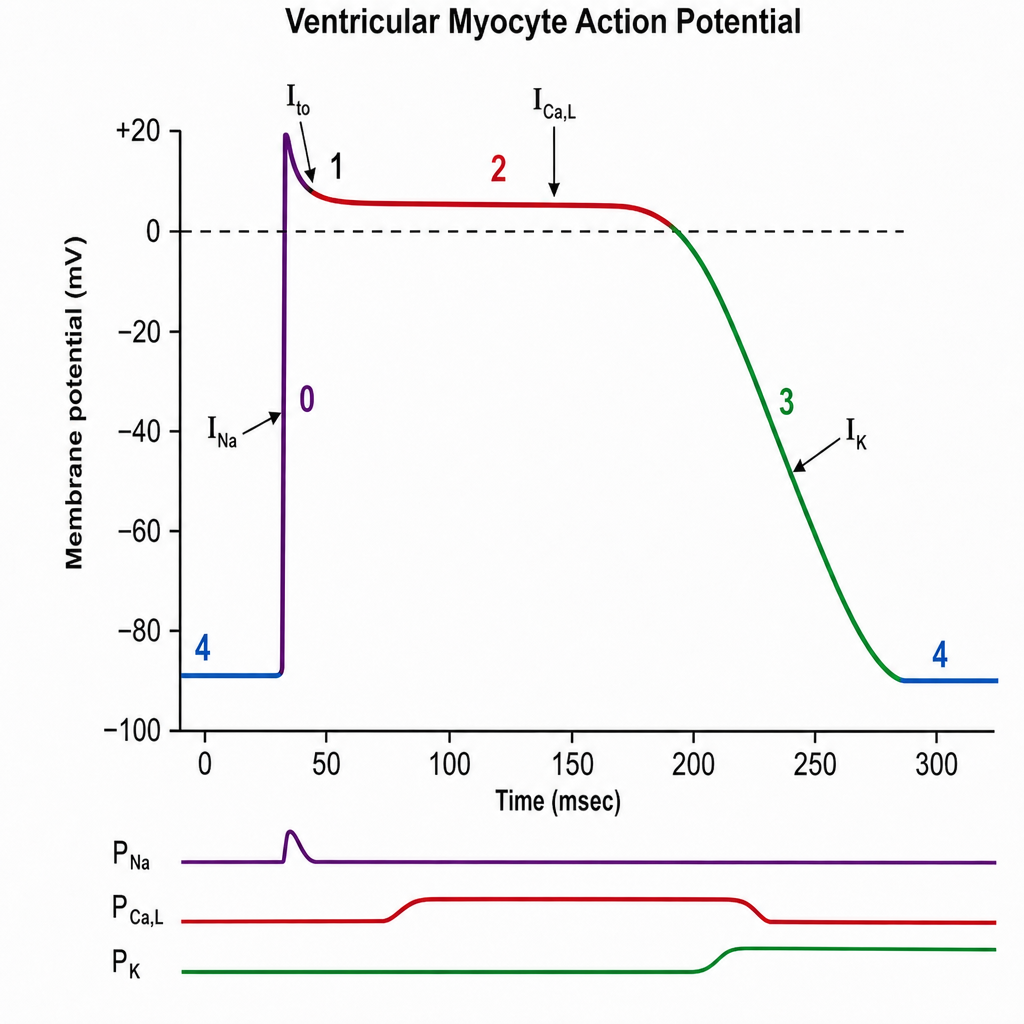
Which of the following is NOT a characteristic of a biphasic action potential of a mixed nerve?
What is a key difference between smooth muscle and skeletal muscle physiology?
A man slept with his head over his forearm. The next morning, he complains of tingling and numbness over the forearm. If this were primarily due to hypoxia affecting nerve fibers, which of the following statements about nerve fiber sensitivity to hypoxia is correct?
What is the consequence of tibial nerve injury/palsy?
What is the fixed length of a myosin filament?
Which of the following is NOT a location where multi-unit smooth muscle is present?
What is the primary factor that determines the resting membrane potential in a nerve fiber?
Tetanic contraction is due to accumulation of?
When the tension in a muscle fibre is maximum, its length is called?
Myosin and actin filaments are kept in place by?
Explanation: ***Two or more positive peaks*** - A **biphasic action potential** of a mixed nerve, when recorded extracellularly, typically consists of two phases: an initial **negative deflection** followed by a **positive deflection**. It does not exhibit multiple positive peaks for a single action potential. - The shape is determined by the propagation of the action potential past two recording electrodes, illustrating the **depolarization and repolarization** of the nerve. *All or none phenomenon* - This is a fundamental characteristic of **individual nerve fibers** and thus applies to the action potentials propagating within a mixed nerve. - If a stimulus reaches a threshold, a full-sized action potential is generated; otherwise, none is generated, regardless of stimulus strength. *Refractory period* - The **refractory period** is a crucial characteristic of nerve excitability, ensuring unidirectional propagation and limiting the frequency of action potentials. - This period, comprising absolute and relative phases, applies to the individual fibers within the mixed nerve. *Recorded on surface* - **Compound action potentials (CAPs)** of mixed nerves are typically recorded extracellularly (on the surface) using electrodes, often seen in nerve conduction studies. - This contrasts with intracellular recordings which measure the potential across the cell membrane directly.
Explanation: ***Troponin is absent in smooth muscle.*** * Smooth muscle contraction is regulated by **calcium-calmodulin complex** and subsequent activation of **myosin light chain kinase (MLCK)**, in contrast to skeletal muscle's reliance on the troponin-tropomyosin system. * **Troponin** is a calcium-binding protein found in skeletal and cardiac muscle, which plays a critical role in regulating muscle contraction by initiating the movement of tropomyosin, thereby exposing myosin-binding sites on actin. *Calcium is required for contraction.* * While calcium is indeed required for contraction in both smooth and skeletal muscle, the **mechanism of its action** differs, making this statement insufficiently discriminative as a *key difference*. * In both muscle types, an increase in intracellular **calcium** initiates the contractile process, but the downstream signaling pathways diverge significantly. *Myosin is essential for contraction.* * **Myosin** is a fundamental motor protein essential for contraction in *all* muscle types, including skeletal, cardiac, and smooth muscle. * This statement highlights a similarity, not a key difference, as **actin-myosin cross-bridge cycling** is the basis of force generation in all muscle tissues. *Potassium is required for contraction.* * **Potassium ions** are crucial for maintaining the resting membrane potential and for repolarization following an action potential, which is necessary for muscle excitability, but they do not directly trigger muscle contraction. * The influx of calcium (or release from intracellular stores) is the direct trigger for contraction, not potassium.
Explanation: ***C fibers are most sensitive to hypoxia, followed by B fibers, and A fibers are least sensitive.*** - **C fibers**, being **unmyelinated** and having relatively small diameters, are more dependent on aerobic metabolism and are therefore most susceptible to the effects of **hypoxia**. - **B fibers** are lightly myelinated and have intermediate sensitivity, while **A fibers** are heavily myelinated and are the most resistant to hypoxia. *All nerve fibers are equally sensitive to hypoxia.* - Nerve fibers vary significantly in their **myelination status** and **metabolic demands**, which directly influences their sensitivity to hypoxia. - This statement is incorrect because nerve fibers exhibit a **differential sensitivity** to metabolic disturbances like hypoxia. *A fibers are most sensitive to hypoxia, followed by B fibers, and C fibers are least sensitive.* - This statement is incorrect as it reverses the actual order of sensitivity; **A fibers** are the **most resistant** to hypoxia due to their high myelination and larger diameter. - **C fibers** are the most sensitive due to their lack of myelin and smaller diameter, making them more vulnerable to metabolic compromise. *B fibers are most sensitive to hypoxia, followed by A fibers, and C fibers are least sensitive.* - This option is incorrect because **C fibers** are known to be the most sensitive to hypoxia, not the least sensitive. - The order presented here misrepresents the sensitivity of nerve fibers to oxygen deprivation.
Explanation: **Loss of plantar flexion** - The **tibial nerve** innervates the muscles of the **posterior compartment of the leg**, which are primarily responsible for **plantar flexion** of the foot. - Injury to this nerve directly impairs the function of muscles like the gastrocnemius, soleus, and tibialis posterior, leading to a significant loss of the ability to point the foot downwards. *Dorsiflexion of foot at ankle joint* - **Dorsiflexion** is primarily mediated by muscles in the **anterior compartment of the leg**, such as the tibialis anterior, which are innervated by the **deep fibular nerve**. - Tibial nerve injury would not directly affect these muscles or their function; rather, it leads to issues with the opposing action. *Loss of sensation of dorsum of foot* - Sensation to the **dorsum of the foot** is primarily supplied by the **superficial fibular nerve** (for most of the dorsum) and the **deep fibular nerve** (for the first web space). - While the tibial nerve provides sensation to the sole of the foot, it does not typically innervate the dorsum. *Paralysis of muscles of anterior compartment of leg* - The muscles of the **anterior compartment of the leg** (e.g., tibialis anterior, extensor digitorum longus, extensor hallucis longus) are innervated by the **deep fibular nerve**. - A tibial nerve injury would paralyze muscles in the posterior compartment, not the anterior compartment.
Explanation: ***1.6 micrometers*** - Myosin filaments, also known as **thick filaments**, are integral components of muscle contraction and have a characteristic fixed length. This length is precisely **1.6 micrometers** in mammalian skeletal muscle. - This consistent length is crucial for the **sliding filament model** of muscle contraction, ensuring proper overlap with actin filaments and efficient force generation. *0.16 nm* - This value is significantly too small; **nanometers (nm)** are typically used for atomic or molecular distances, not for entire protein filaments like myosin. - A myosin filament is composed of hundreds of myosin molecules, making its overall length much larger than a fraction of a nanometer. *16 nm* - While nanometers are used for molecular structures, 16 nm is still too small for a myosin filament. The entire filament is roughly **100 times larger** than this value. - This dimension might be more appropriate for the diameter of a single myosin molecule's head region, but not the entire filament's length. *1.6 mm* - This value is significantly too large; **millimeters (mm)** are visible to the naked eye and represent macroscopic objects. - Muscle filaments are microscopic structures, and a length of 1.6 mm would imply they are many times longer than an entire muscle cell.
Explanation: ***Gut*** - The gut primarily contains **unitary (single-unit) smooth muscle**, characterized by cells connected by **gap junctions** that allow for synchronized contractions (e.g., peristalsis). - This type of smooth muscle exhibits **spontaneous rhythmic contractions** due to pacemaker cells, and its activity is modulated by neural and hormonal inputs rather than requiring individual innervation of each cell. - Multi-unit smooth muscle is **NOT present** in the gut. *Blood vessels* - Many larger blood vessels (e.g., large arteries) contain **multi-unit smooth muscle**, which allows for **fine, graded control** over vascular tone and blood flow. - Each muscle cell is typically **innervated individually**, enabling precise regulation of contraction strength. *Iris* - The iris contains **multi-unit smooth muscle** (e.g., sphincter pupillae and dilator pupillae muscles) which control pupil size. - These muscles require **individual innervation** to allow for very fine and precise movements in response to light intensity changes. *Ciliary muscle* - The ciliary muscle of the eye contains **multi-unit smooth muscle**, which controls the shape of the lens for accommodation (focusing). - These muscle fibers are **individually innervated** to allow precise control of lens curvature for near and far vision.
Explanation: ***Is primarily determined by the equilibrium potential of potassium ions*** - The **resting membrane potential** of a nerve fiber is predominantly set by the efflux of **potassium ions** through leak channels, bringing the membrane potential close to potassium's equilibrium potential. - The high permeability of the nerve membrane to **potassium** at rest means that K+ movement is the most significant factor influencing the potential. *Is equal to the resting potential of cardiac muscle fibers* - **Cardiac muscle fibers** have a distinct resting potential (around -80 to -90 mV) influenced by different ion channels and regulatory mechanisms compared to nerve fibers (around -70 mV). - While both involve potassium currents, their specific conductances and the contribution of other ions differ significantly. *Can be accurately measured using intracellular electrodes* - While **intracellular electrodes** are indeed used to measure the resting membrane potential, this statement describes a measurement method, not the *primary factor* that determines the potential itself. - The method of measurement does not explain the underlying biophysical mechanisms that establish the potential. *Increases with elevated extracellular potassium concentration* - An **elevated extracellular potassium concentration** would make the resting membrane potential *less negative* (depolarize) rather than "increase" it in the typical sense of a more positive value. - This is because a higher external K+ reduces the concentration gradient for potassium efflux, bringing the membrane potential closer to zero.
Explanation: ***Ca<sup>2+</sup>*** - **Tetanic contraction** results from a rapid succession of muscle stimulations, leading to the sustained elevation of **intracellular calcium (Ca<sup>2+</sup>)** levels. - This persistent high Ca<sup>2+</sup> concentration in the sarcoplasm allows for continuous binding to **troponin**, maintaining the activation of cross-bridge cycling. *Na<sup>+</sup>* - **Sodium (Na<sup>+</sup>)** influx is primarily responsible for the **depolarization** of the muscle cell membrane, leading to an **action potential**. - While essential for initiating the contraction, Na<sup>+</sup> accumulation itself does not directly cause the sustained high Ca<sup>2+</sup> levels characteristic of tetany. *K<sup>+</sup>* - **Potassium (K<sup>+</sup>)** efflux is crucial for the **repolarization** of the muscle cell membrane after an action potential. - Accumulation of K<sup>+</sup> in the extracellular space can contribute to muscle fatigue and reduce excitability, but it does not directly lead to tetanic contraction. *Cl<sup>-</sup>* - **Chloride (Cl<sup>-</sup>)** ions play a significant role in stabilizing the resting membrane potential and contributing to muscle **repolarization**, particularly in skeletal muscle. - While important for muscle function, changes in Cl<sup>-</sup> concentration do not directly cause the sustained Ca<sup>2+</sup> release required for tetanic contraction.
Explanation: ***Optimum length*** - This is the muscle length at which the **maximum number of cross-bridges** can form between actin and myosin filaments. - At this length, the sarcomere allows for the **greatest overlap** of thick and thin filaments without excessive stretching or compression, leading to peak tension generation. *Equilibrium length* - This term usually refers to the **resting length** of a muscle fiber when no external forces are acting upon it. - At equilibrium, the tension generated by the muscle may not necessarily be at its maximum. *Initial length* - This is a general term that refers to the **starting length** of a muscle fiber before it contracts or is stretched. - It does not specifically denote the length at which maximum tension is achieved. *None of the options* - This option is incorrect because **optimum length** accurately describes the muscle length yielding maximum tension.
Explanation: ***Titin*** - **Titin** is a large, elastic protein that extends from the **Z-disc to the M-line** in a sarcomere. - It plays a crucial role in maintaining the structural integrity and **passive elasticity** of muscle cells by keeping myosin and actin filaments properly aligned. *Tropomyosin* - **Tropomyosin** is a regulatory protein that wraps around the actin filament, **blocking the myosin-binding sites** in relaxed muscle. - Its primary function is to regulate muscle contraction, not to structurally anchor the filaments in place. *Troponin* - **Troponin** is a complex of three proteins (**troponin I, T, and C**) that is associated with tropomyosin on the actin filament. - It binds **calcium ions**, leading to a conformational change that moves tropomyosin away from the myosin-binding sites, allowing contraction to occur. *Actinin* - **Alpha-actinin** is a protein found in the **Z-disc** that helps to anchor the plus ends of actin filaments to the Z-disc. - While it's involved in actin filament organization, it does not directly keep both myosin and actin filaments in their precise functional arrangement along the length of the sarcomere in the same way titin does.
Resting Membrane Potential
Practice Questions
Action Potential Generation and Propagation
Practice Questions
Neuromuscular Junction
Practice Questions
Skeletal Muscle Contraction
Practice Questions
Smooth Muscle Physiology
Practice Questions
Cardiac Muscle Properties
Practice Questions
Muscle Metabolism and Fatigue
Practice Questions
Motor Unit Function
Practice Questions
Neurotransmitters and Receptors
Practice Questions
Electrophysiological Measurements
Practice Questions
Get full access to all questions, explanations, and performance tracking.
Start For Free