
Neuromuscular Adaptations to Training — MCQs

Which of the following statements is NOT true regarding red muscle fibers?
When the tension becomes great enough, contraction suddenly ceases and the muscle relaxes, this phenomenon is known as:
A 29-year-old man sustains a left femoral fracture in a motorcycle accident. His leg is placed in a plaster cast. After his left leg has been immobilized for 6 weeks, the diameter of the left calf has decreased in size. This change in size is most likely to result from which of the following alterations in his calf muscles?
During moderate exercise, the respiratory rate increases in response to which of the following?
All of the following statements about neuromuscular blockade produced by succinylcholine are true, EXCEPT:
Which hormone, together with the catecholamines, enhances the tone of vascular smooth muscle and assists in elevating blood pressure?
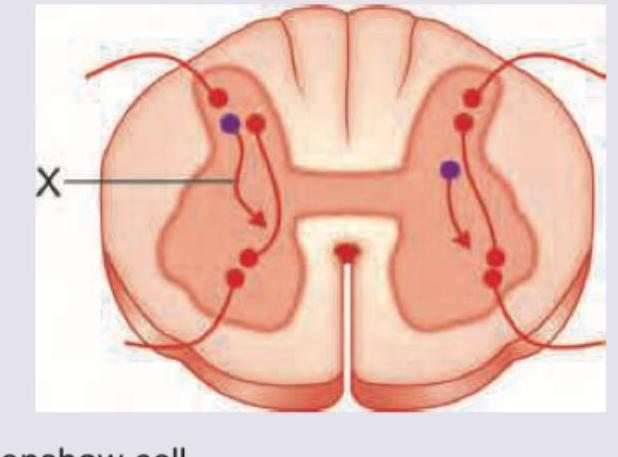
Name the interneuron marked X in colour purple involved in tetanus. (Recent NEET Pattern 2016-17)
A 42-year-old firefighter candidate undergoes VO2 max testing showing 32 mL/kg/min (below required 42 mL/kg/min). His body composition shows 28% body fat. He has normal cardiac function (ejection fraction 60%), hemoglobin 15.2 g/dL, and no respiratory disease. Lactate threshold occurs at 65% of VO2 max. Evaluate the most effective evidence-based training strategy to meet occupational requirements within 12 weeks.
A 38-year-old woman with mitochondrial myopathy due to a complex I deficiency presents with severe exercise intolerance. Her baseline lactate is 3.2 mmol/L (normal <2.0) and rises to 12.8 mmol/L after minimal exercise. Her VO2 max is 18 mL/kg/min. Cardiopulmonary and hematologic evaluations are normal. Evaluate the pathophysiologic mechanism and optimal exercise approach.
A 40-year-old man with chronic heart failure (ejection fraction 30%) undergoes cardiopulmonary exercise testing. His peak VO2 is 14 mL/kg/min with a respiratory exchange ratio of 1.18, indicating maximal effort. His predicted VO2 max is 35 mL/kg/min. Analyze the primary physiologic limitation to his exercise capacity.
Want unlimited practice?
Get full access to all questions, explanations, and performance tracking.
Scan to download app