Which of the following components are included in microcirculation?
What is the duration of the second heart sound (S2)?
What is the definition of preload in the context of cardiac physiology?
Which one of the following is the CORRECT statement regarding coronary blood flow?
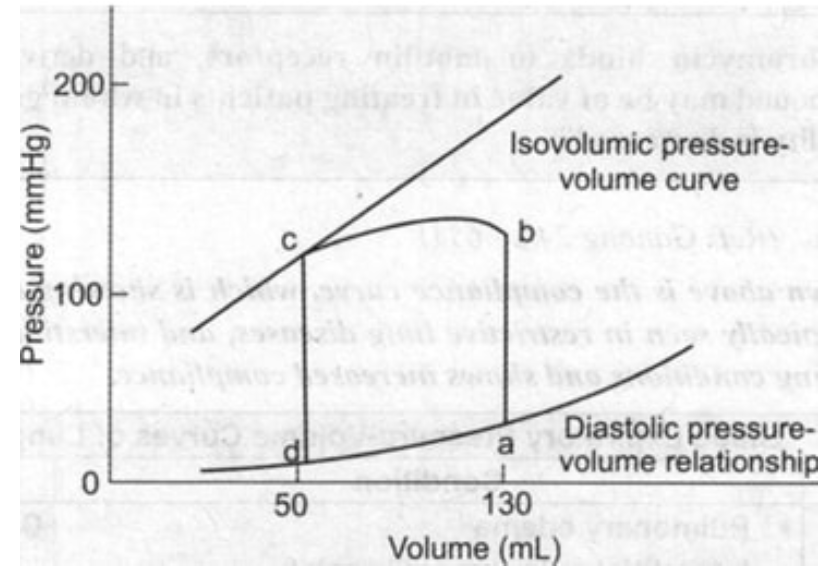
From the given pressure-volume curve, identify the end-diastolic volume (EDV) and end-systolic volume (ESV), then calculate the ejection fraction using the formula EF = (EDV - ESV)/EDV × 100%.
Mean arterial pressure is calculated as:
What does Einthoven's law state regarding the relationship between the electrical potentials of the limb leads?
Mechanism by which Ach decreases heart rate is by:
Volume receptors are primarily located in which of the following?
All of the following about the Bezold-Jarisch reflex are true except
Explanation: ***Capillaries, venules, and arterioles*** - **Microcirculation** is the portion of the **circulatory system** that includes the **smallest blood vessels**, specifically the **arterioles**, **capillaries**, and **venules**. - These vessels are crucial for the **delivery of oxygen** and **nutrients** to tissues and the removal of waste products. *Capillaries* - While **capillaries** are a vital part of **microcirculation** and the primary site of nutrient and waste exchange, they alone do not encompass the entire microcirculatory unit. - The microcirculation also includes the vessels that feed into and drain from the capillaries: the **arterioles** and **venules**. *Aorta* - The **aorta** is the **largest artery** in the body, part of the **macrocirculation**, which distributes blood from the heart to the systemic circulation. - It is not considered part of the **microcirculation** due to its large size and primary function as a high-pressure conduit rather than a site of exchange. *Arteries and veins* - **Arteries** and **veins** are primarily components of the **macrocirculation**, responsible for transporting blood to and from the systemic and pulmonary circuits. - While arterioles and venules (small arteries and veins) are part of the microcirculation, the broader terms "arteries" and "veins" typically refer to the larger vessels and do not exclusively define the microcirculatory network.
Explanation: ***0.08 sec*** - The second heart sound (S2) is composed of two components: A2 (aortic valve closure) and P2 (pulmonic valve closure). The normal duration of S2, encompassing both components, is approximately **0.08 seconds**. - This short duration reflects the rapid closure of the aortic and pulmonic valves at the beginning of **diastole**. *0.15sec* - A duration of **0.15 seconds** for S2 is significantly longer than normal, which could indicate abnormal valve function or conditions causing delayed valve closure. - Such prolonged duration might be observed in conditions like **severe pulmonic stenosis** or **pulmonic hypertension**, which are not the typical duration of a healthy S2. *0.12 sec* - A duration of **0.12 seconds** is also longer than the typical normal range for S2. - While still shorter than 0.15 seconds, it could suggest subtle delays in valve closure or splitting that exceeds the usual physiological splitting. *0.1 sec* - A duration of **0.1 seconds** is slightly prolonged but generally falls within a range that might be considered borderline or indicative of minimal physiological variations. - However, in typical healthy individuals, the S2 duration is closer to 0.08 seconds, making 0.1 seconds less precise for the most common duration.
Explanation: ***Volume of blood in the ventricles at the end of diastole*** - Preload represents the **initial stretching** of the cardiac myocytes prior to contraction, largely determined by the **volume of blood filling the ventricles** at the end of relaxation (diastole). - This **end-diastolic volume** directly correlates with the ventricular muscle fiber length at the start of systole, influencing the force of contraction according to the **Frank-Starling mechanism**. *Volume of blood in the ventricles at the end of systole* - This describes the **end-systolic volume**, which is the amount of blood remaining in the ventricle after it has contracted and ejected blood. - End-systolic volume is a determinant of the **ejection fraction** but does not define preload. *Amount of blood pumped by the heart per beat* - This refers to the **stroke volume**—the volume of blood ejected from the left ventricle with each heartbeat. - While preload influences stroke volume, stroke volume itself is not the definition of preload. *Resistance to blood flow in the arteries* - This describes **afterload**, which is the pressure or resistance the ventricle must overcome to eject blood during systole. - Afterload primarily affects the *force* needed for contraction, rather than the initial stretch or filling volume of the heart.
Explanation: ***Coronary blood flow is directly related to perfusion pressure and inversely related to resistance*** - According to Ohm's law, **blood flow** is directly proportional to the **pressure gradient (perfusion pressure)** and inversely proportional to the **vascular resistance**. - This fundamental principle applies to coronary circulation, meaning higher pressure drives more flow, while higher resistance impedes it. *Coronary blood flow is inversely related to perfusion pressure and directly related to resistance* - This statement contradicts the basic principles of **fluid dynamics** and **Ohm's law**, where a higher pressure gradient generally leads to increased flow. - Direct proportionality to resistance would imply that increased obstruction leads to increased flow, which is physiologically incorrect. *Coronary blood flow is directly related to perfusion pressure and also to resistance* - While a direct relationship with **perfusion pressure** is correct, directly relating flow to **resistance** is incorrect. - Increased resistance, such as that caused by **atherosclerosis**, reduces blood flow, not increases it. *Coronary blood flow is inversely related to both pressure and resistance* - An inverse relationship with **pressure** is incorrect as an increase in the driving pressure should increase flow. - An inverse relationship with **resistance** is correct, but the inverse relationship with pressure makes the entire statement incorrect.
Explanation: ***60%*** - From the pressure-volume loop, the **end-diastolic volume (EDV)** is the volume at point 'a', which is **130 mL**. - The **end-systolic volume (ESV)** is the volume at point 'd', which is **50 mL**. - Using the formula EF = (EDV - ESV) / EDV × 100% = (130 mL - 50 mL) / 130 mL × 100% = 80 mL / 130 mL × 100% = **61.5%**, which rounds to **60%** (the closest option). *40%* - To obtain an ejection fraction of 40%, the ESV would need to be higher, or the EDV lower, than what is indicated by the points 'a' and 'd' on the graph. - (130 - ESV) / 130 = 0.40 => 130 - ESV = 52 => ESV = 78 mL. This isn't consistent with the graph. *50%* - An ejection fraction of 50% would mean that the heart ejected half of its EDV. - (130 - ESV) / 130 = 0.50 => 130 - ESV = 65 => ESV = 65 mL. This value for ESV is not depicted at point 'd'. *55%* - For an ejection fraction of 55%, the calculation would yield a different ESV than what is presented in the curve. - (130 - ESV) / 130 = 0.55 => 130 - ESV = 71.5 => ESV = 58.5 mL. This is not the ESV at point 'd'.
Explanation: ***(SBP+2DBP)/3*** - This formula accurately calculates **mean arterial pressure (MAP)**, emphasizing the longer duration of diastole compared to systole in the cardiac cycle. - The diastolic blood pressure (**DBP**) is weighted twice as much as the systolic blood pressure (**SBP**) to reflect this physiological difference. *(DBP+2SBP)/3* - This formula incorrectly weighs the diastolic pressure less and the systolic pressure more, which does not reflect the **physiological duration of the cardiac cycle**. - While it attempts to average pressures, it does not correctly represent the **mean perfusion pressure**. *(SBP+3DBP)/2* - This formula is inaccurate for calculating MAP as the **denominator should be 3**, not 2, to account for the three components being averaged (one SBP and two DBP). - It also disproportionately weights **DBP** too high relative to the standard physiological formula. *(DBP+3SBP)/2* - This formula is incorrect as it applies an **excessive weighting to SBP** and uses an incorrect denominator. - It would yield a significantly higher and inaccurate value for **mean arterial pressure**.
Explanation: ***I + III = II*** - Einthoven's law describes the relationship between the three **bipolar limb leads** (I, II, and III) in an **electrocardiogram (ECG)**. - It states that the electrical potential of Lead II is equal to the sum of the potentials of Lead I and Lead III (Lead II = Lead I + Lead III). - This can also be expressed as **I + III = II**, which is the **correct mathematical representation** of Einthoven's law. *I - III = II* - This equation is **incorrect** and does not represent Einthoven's law. - The correct relationship involves **addition** of Leads I and III, not subtraction. *I + II + III = 0* - This equation is **incorrect** as written with all positive signs. - Einthoven's law can be rearranged as **I + III - II = 0** (not I + II + III = 0). - The equation shown suggests adding all three leads to get zero, which is **mathematically inconsistent** with the correct formulation (I + III = II). *I + III = avL* - This equation is incorrect and does not relate to Einthoven's law. - **avL (augmented vector left)** is one of the augmented unipolar limb leads calculated as: avL = I - (II/2), not as a direct sum of Leads I and III.
Explanation: ***Delayed diastolic depolarization*** - Acetylcholine (ACh) binding to muscarinic receptors on nodal cells increases **potassium permeability**, leading to a more negative maximal diastolic potential. - This slows the rate of **spontaneous depolarization** (pacemaker potential), thereby delaying the point at which the threshold for an action potential is reached and reducing heart rate. *Prolongation of action potential duration* - ACh typically **shortens** the action potential duration in atrial and nodal cells by increasing potassium efflux, which hyperpolarizes the cell and hastens repolarization. - A prolonged action potential duration would generally lead to a **slower heart rate** by increasing the refractory period, but this is achieved through different ionic mechanisms and is not the primary mechanism of ACh. *Reduction in calcium influx* - While ACh does reduce the inward **calcium current (ICa)** in nodal cells, contributing to a slower heart rate and weaker contractility, this effect primarily influences the upstroke and peak of the action potential. - The more **fundamentally important mechanism** for heart rate reduction is the impact on the pacemaker potential's slope, which is governed by altered ion conductances, predominantly potassium. *Inhibition of sympathetic activity* - ACh acts directly on **muscarinic receptors** on cardiac cells to decrease heart rate, which is a parasympathetic effect. - It does not directly inhibit sympathetic nerve activity but rather **counteracts sympathetic effects** by directly modulating cardiac cell physiology.
Explanation: **Correct: *Right and left atria*** - The **atria** contain **low-pressure baroreceptors** (volume receptors) that primarily sense changes in circulating blood volume. - These receptors respond to stretching of the atrial walls, which occurs with increased blood volume, signaling the need for fluid excretion. *Incorrect: Carotid sinus and aortic arch* - These locations house **high-pressure baroreceptors** that primarily regulate **arterial blood pressure**, not circulating volume. - They respond to changes in the stretch of the arterial walls caused by blood pressure fluctuations. *Incorrect: Renal juxtaglomerular apparatus* - This apparatus primarily senses changes in **renal perfusion pressure** and **sodium delivery** to the distal tubule. - It plays a crucial role in regulating blood pressure and fluid balance through the **renin-angiotensin-aldosterone system (RAAS)**, but its primary role is not as a volume receptor. *Incorrect: Pulmonary arteries only* - While pulmonary baroreceptors exist, they primarily monitor **pulmonary arterial pressure** and do not serve as the main volume receptors for the systemic circulation. - Volume receptors are distributed more broadly within the low-pressure venous system.
Explanation: ***Hypertension*** - The Bezold-Jarisch reflex is characterized by a **triad of responses**: **hypotension**, bradycardia, and apnea or respiratory depression. - **Hypertension** is therefore a finding that would **not be consistent** with the activation of this reflex. - The reflex causes **hypotension** through vasodilation and decreased cardiac output mediated by vagal activation. *Bradycardia* - **Bradycardia** is a classic component of the Bezold-Jarisch reflex, resulting from increased **vagal efferent activity** to the heart. - This response helps to reduce cardiac output and myocardial oxygen demand in the face of perceived noxious stimuli, such as myocardial ischemia. *Capsaicin* - **Capsaicin**, the active component of chili peppers, is known to **activate C-fiber afferents** in the heart and lungs, which are involved in triggering the Bezold-Jarisch reflex. - Experimental administration of capsaicin can reliably induce the components of this reflex through these sensory nerve activations. *Apnea* - The Bezold-Jarisch reflex can induce changes in respiration, typically presenting as **apnea** or **respiratory depression**. - This respiratory inhibition is thought to be mediated by activation of vagal afferents from the cardiopulmonary region. - The reflex causes respiratory **inhibition**, not stimulation.
Cardiac Electrophysiology
Practice Questions
Cardiac Cycle
Practice Questions
Cardiac Output and Its Regulation
Practice Questions
Hemodynamics and Blood Flow
Practice Questions
Arterial System Physiology
Practice Questions
Microcirculation and Lymphatics
Practice Questions
Venous Return and Central Venous Pressure
Practice Questions
Cardiovascular Reflexes
Practice Questions
Regional Circulations
Practice Questions
Cardiovascular Responses to Exercise and Stress
Practice Questions
Get full access to all questions, explanations, and performance tracking.
Start For Free