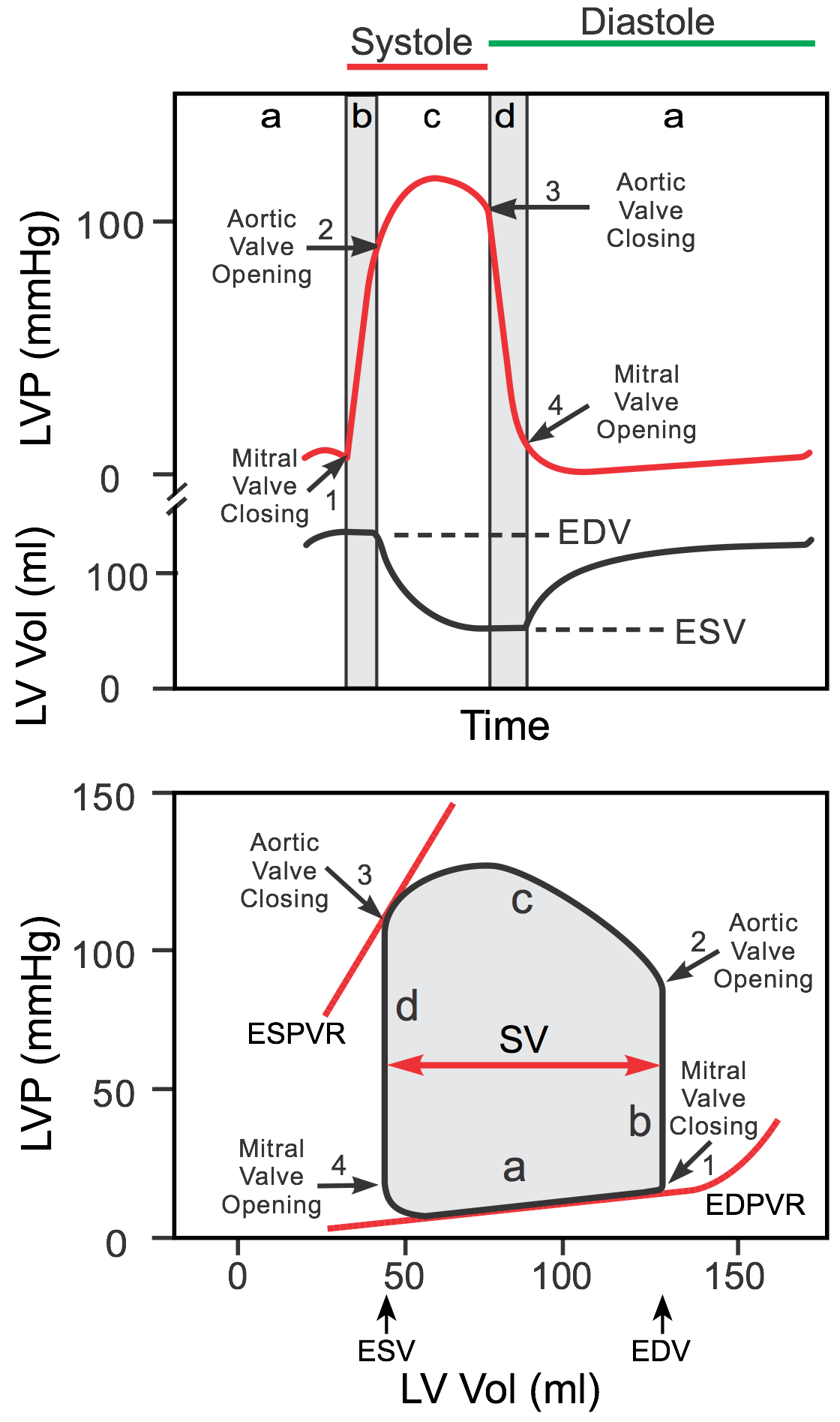
Which part of ventricular action potential corresponds to ST segment in ECG?

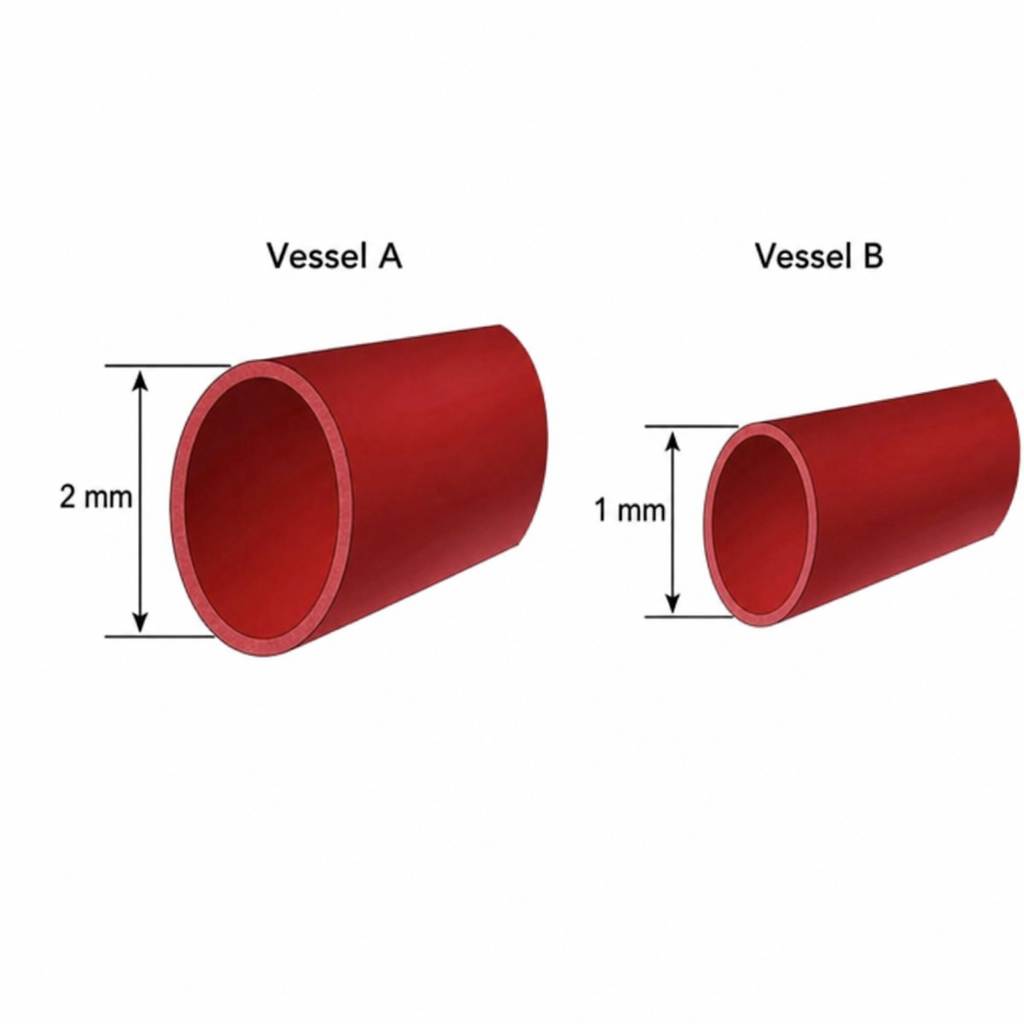
There are two blood vessels shown below. Assuming that pressure along both the vessels is same and both of them follow linear flow pattern, what will be the amount of blood flow in A compared to B?

Compare the two ECG recordings taken before and after activation of low pressure atrial stretch receptors. Which reflex explains the findings?

The structure marked $A$ begins to close by what time frame and due to what cause?

Phonocardiogram tracing is shown below with corresponding ECG. Identify the phase corresponding with $S_{2}$ in phonocardiogram.

Using the quadrant method, if the mean QRS vector in lead I is negative and in lead aVF is positive, what is the axis?
The marked part of the ECG called as 'X' points to which phase of cardiac action potential?

Smoking is considered to be a modifiable risk factor for Coronary Heart Disease. Consider the following statements with regard to possible mechanisms on the basis of which it acts as a risk factor : 1. Nicotine stimulation of adrenergic drive raises the blood pressure and myocardial oxygen demand. 2. It increases carbon monoxide and induces atherogenesis. 3. It leads to fall in protective high density lipoproteins. 4. It reduces the apolipoprotein-B plasma levels. Which of the statements given above are correct ?
Distributive shock is described by which of the following patterns of cardiovascular responses? 1. Vasodilation 2. Reduced peripheral vascular resistance 3. Inadequate 'afterload' 4. Low cardiac output Select the correct answer using the code given below.
Non-cardiac causes of raised central venous pressure include all of the following except:
Explanation: ***Phase 2 (Correct Answer)*** - Phase 2 is the **plateau phase** of the ventricular action potential - Maintained by a balance of inward **calcium current (ICa)** and outward **potassium current (IK)** - Corresponds to the **ST segment** on ECG, representing the period when the entire ventricle is depolarized with no net electrical activity - This phase is responsible for the prolonged contraction of ventricular muscle *Phase 0 (Incorrect)* - Phase 0 is the rapid depolarization phase caused by opening of **fast sodium channels** - Corresponds to the **QRS complex** on ECG, not the ST segment - Represents the initial rapid upstroke of the action potential *Phase 1 (Incorrect)* - Phase 1 is the early rapid repolarization phase - Caused by inactivation of sodium channels and opening of transient outward potassium channels - Represents the brief notch after depolarization, not associated with a specific ECG component *Phase 3 (Incorrect)* - Phase 3 is the rapid repolarization phase caused by opening of **delayed rectifier potassium channels** - Corresponds to the **T wave** on ECG, not the ST segment - Represents the return of membrane potential to resting level
Explanation: ***32 times*** - According to **Poiseuille-Hagen equation**: Q = (ΔP × π × r⁴) / (8 × η × L), where flow is directly proportional to the fourth power of radius and inversely proportional to vessel length. - From the diagram: Vessel A has diameter 2D and length 2L, while Vessel B has diameter d and length l. - **Key interpretation**: For the answer to be 32 times, the diameter of A must be twice that of B (radius_A = 2r), while the length of A is half that of B (length_A = L/2). - **Calculation**: - Q_A ∝ (2r)⁴ / (L/2) = 16r⁴ × 2/L = 32r⁴/L - Q_B ∝ r⁴ / L - **Q_A/Q_B = 32** - This demonstrates the **powerful effect of radius** (fourth power relationship) combined with **inverse length relationship** on blood flow. - **Clinical relevance**: Small changes in vessel diameter cause dramatic changes in blood flow, which is why vasoconstriction/vasodilation are potent mechanisms for regulating tissue perfusion. *Incorrect Option: 4 times* - Would require a different radius-to-length ratio than what's given in the problem. *Incorrect Option: 8 times* - This would result if diameter of A is 2× that of B AND length of A is also 2× that of B (not half). - Calculation: (2r)⁴/(2L) ÷ (r⁴/L) = 16r⁴/2L ÷ r⁴/L = 8 *Incorrect Option: 16 times* - This would occur if radius of A is 2× that of B but both vessels have the same length. - Calculation: (2r)⁴/L ÷ (r⁴/L) = 16
Explanation: ***Bainbridge reflex*** - The Bainbridge reflex, also known as the **atrial reflex**, is an increase in heart rate due to an increase in **central venous pressure**, which activates stretch receptors in the atria. - Activation of these low-pressure receptors signals the medulla to **increase sympathetic stimulation** to the heart, resulting in tachycardia, which is reflected in a faster heart rate on the ECG. *Frank Starling Law* - The Frank-Starling law of the heart describes the relationship between **end-diastolic volume** and the force of contraction. - It states that an increase in venous return stretches the ventricular myocardium, leading to a more forceful ventricular contraction, not primarily affecting heart rate. *Bezold Jarisch Reflex* - This reflex is characterized by a triad of **bradycardia, hypotension, and coronary vasodilation**. - It is triggered by ventricular mechanoreceptors, usually in response to **decreased ventricular filling** or myocardial ischemia. *Vasovagal reflex* - The vasovagal reflex is a common cause of **syncope**, characterized by **bradycardia** and **vasodilation**, leading to a drop in blood pressure. - It is often triggered by emotional stress, pain, or prolonged standing, and results in a **slowing of the heart rate**, not an increase.
Explanation: ***Begins to close at 10-15 hours after birth, due to withdrawal of prostaglandins*** - The structure marked 'A' is the **ductus arteriosus**, which begins **functional closure** at **10-15 hours** after birth when **prostaglandin E2 (PGE2)** levels drop. - **Withdrawal of prostaglandins** is the primary mechanism that initiates closure, along with increased **oxygen tension**, causing smooth muscle constriction in the ductal wall. *Begins to close at 10-15 hours after birth, due to expression of prostaglandins* - **Prostaglandin E2 (PGE2)** actually **maintains patency** of the ductus arteriosus during fetal life, so increased expression would keep it open. - Closure occurs due to **withdrawal** (not expression) of prostaglandins after birth when placental PGE2 production ceases. *Begins to close 4 weeks after birth, due to fall in oxygen concentration* - A **fall in oxygen concentration** would actually **promote ductal patency**, as seen in fetal circulation where low oxygen helps maintain the shunt. - Additionally, **4 weeks** refers to **complete anatomical closure** (fibrosis), not when closure initially begins. *Begins to close 4 weeks after birth, due to rise in oxygen tension* - While **rise in oxygen tension** does contribute to ductal closure, the timing is incorrect for when closure "begins." - **4 weeks** represents **anatomical closure** (complete fibrosis), whereas **functional closure begins** at **10-15 hours** after birth.
Explanation: ***Isovolumetric relaxation*** - **S₂ (second heart sound)** occurs due to closure of the **aortic and pulmonary semilunar valves** at the end of systole, marking the onset of isovolumetric relaxation. - On the **ECG**, S₂ corresponds to the **end of the T wave**, when ventricular pressure drops below aortic pressure causing valve closure. *Isovolumetric contraction* - This phase corresponds to **S₁ (first heart sound)** caused by closure of the **mitral and tricuspid valves** at the beginning of systole. - Occurs on the ECG around the **QRS complex**, not at the timing of S₂. *Rapid ejection* - This phase occurs **between S₁ and S₂** when blood is actively ejected from the ventricles into the aorta and pulmonary artery. - The **semilunar valves are open** during this phase, so no heart sounds are produced. *Rapid ventricular filling* - This phase occurs **after S₂** during early diastole when the **AV valves open** and blood rapidly fills the ventricles. - May be associated with **S₃ gallop** in pathological conditions, but not with S₂.
Explanation: ***Right axis deviation*** - A **negative QRS vector in lead I** indicates that the overall electrical activity of the heart is moving away from the left arm (typically towards the right). - A **positive QRS vector in lead aVF** signifies that the electrical activity is moving towards the feet. When lead I is negative and aVF is positive, the vector points to the **lower right quadrant** of the heart, consistent with right axis deviation. *Normal axis* - A normal axis typically has a **positive QRS deflection in both lead I and lead aVF**, indicating the vector is within the normal range of -30° to +90°. - In this scenario, the negative deflection in lead I immediately rules out a normal axis. *Left axis deviation* - Left axis deviation is characterized by a **positive QRS in lead I** and a **negative QRS in lead aVF**, meaning the vector points to the upper left quadrant. - The given condition (negative lead I, positive aVF) directly contradicts the criteria for left axis deviation. *Extreme axis deviation* - Extreme axis deviation (or "northwest axis") occurs when the QRS is **negative in both lead I and lead aVF**. - The positive QRS in aVF in this case excludes extreme axis deviation.
Explanation: ***Phase 2*** - The **ST segment** (marked as 'X') corresponds to **Phase 2 (plateau phase)** of the ventricular cardiac action potential. - During this phase, **calcium influx** balances **potassium efflux**, creating an **isoelectric line** on the ECG with no net voltage change. *Phase 0* - Represents **rapid depolarization** due to **sodium influx**, corresponding to the **QRS complex** on ECG. - This phase shows a sharp upstroke in action potential, not the flat isoelectric segment marked as 'X'. *Phase 3* - Represents **repolarization** due to **potassium efflux**, corresponding to the **T wave** on ECG. - This phase shows downward deflection on ECG, unlike the flat ST segment marked as 'X'. *Phase 4* - Represents the **resting potential** maintained by **Na+/K+ ATPase pump**, corresponding to the **TP segment** on ECG. - This is the baseline between cardiac cycles, not the ST segment elevation/depression area marked as 'X'.
Explanation: **1, 2 and 3** - **Nicotine** in cigarette smoke stimulates the adrenergic nervous system, leading to increased heart rate, **vasoconstriction**, and elevated blood pressure, which **increases myocardial oxygen demand**. - **Carbon monoxide** from smoking binds to hemoglobin, reducing oxygen delivery to the myocardium, and also contributes to **endothelial damage** and **atherogenesis**. Smoking also **lowers HDL ("good" cholesterol)**, which normally helps remove cholesterol from arteries. *2, 3 and 4* - This option is incorrect because statement 4 is false; smoking typically **increases** apolipoprotein-B levels, associated with increased LDL cholesterol, not reduces them. - While statements 2 and 3 are correct mechanisms, the inclusion of statement 4 makes this option incorrect. *1 and 3 only* - This option is incomplete as it misses the crucial role of **carbon monoxide** in inducing atherogenesis (statement 2), which is a well-established mechanism of smoking-related CHD. - While statements 1 and 3 are correct mechanisms, the absence of statement 2 makes this option less comprehensive. *1 and 2 only* - This option omits the significant effect of smoking on **high-density lipoproteins (HDL)**; smoking is known to cause a **fall in protective HDL levels**, contributing to increased CHD risk. - While statements 1 and 2 are correct mechanisms, the exclusion of statement 3, which is also correct, makes this option incomplete.
Explanation: ***1, 2 and 3*** - Distributive shock is characterized by **widespread vasodilation** (1), leading to a significant **reduction in peripheral vascular resistance/SVR** (2). - The reduced vascular resistance causes **inadequate afterload** (3) on the heart, as afterload is determined by SVR. - Cardiac output is typically **normal or elevated** in early distributive shock as the heart compensates for the low SVR, so statement 4 is NOT characteristic. - Classic examples include septic shock, anaphylactic shock, and neurogenic shock. *1, 2 and 4* - While **vasodilation** (1) and **reduced peripheral vascular resistance** (2) are correct, **low cardiac output** (4) is NOT a defining feature of distributive shock. - In distributive shock, cardiac output is often elevated in the hyperdynamic phase as the heart compensates for decreased SVR. - Low cardiac output is more characteristic of cardiogenic or hypovolemic shock. *1, 3 and 4* - **Vasodilation** (1) and **inadequate afterload** (3) are correct features, but **low cardiac output** (4) is incorrect. - Distributive shock typically presents with normal or increased cardiac output, not decreased. - This combination incorrectly includes low CO while missing the reduced peripheral vascular resistance (2). *2, 3 and 4* - **Reduced peripheral vascular resistance** (2) and **inadequate afterload** (3) are correct, but this option misses the fundamental mechanism of **vasodilation** (1). - Additionally, **low cardiac output** (4) is not a defining characteristic of distributive shock. - Without mentioning vasodilation, the underlying pathophysiology is incomplete.
Explanation: **IMPORTANT NOTE:** This question as originally presented is medically problematic because **hypervolemia is actually a NON-CARDIAC cause** of elevated CVP. All four options listed are non-cardiac causes, making this question flawed. However, if this represents the original UPSC-CMS-2013 answer key, the intended distinction may have been between **systemic/volume-related causes** versus **mechanical/obstructive causes**. ***Hypervolemia (Marked as answer)*** - Hypervolemia (fluid overload) is technically a **non-cardiac, systemic cause** of elevated CVP, not a cardiac cause - It increases CVP by increasing **circulating blood volume** and venous return, without primary cardiac dysfunction - True **cardiac causes** would include right heart failure, tricuspid regurgitation, cardiac tamponade, or constrictive pericarditis - If this was the intended answer, the distinction may be: hypervolemia is a **systemic/volume cause** while the others are **mechanical/obstructive causes** *Abdominal compartment syndrome* - Increases **intra-abdominal pressure** which transmits to the thorax - Mechanically compresses the **inferior vena cava**, impeding venous return - This is clearly a **non-cardiac, mechanical cause** of elevated CVP *Positive pressure ventilation* - Increases **intrathoracic pressure** during mechanical ventilation - Directly opposes venous return to the right atrium - This is a **non-cardiac, mechanical cause** of elevated CVP *Tension pneumothorax* - Causes severe increase in **intrathoracic pressure** from trapped air - Compresses the **vena cavae** and impedes venous return - This is a **non-cardiac, mechanical/obstructive cause** of elevated CVP **Clinical Pearl:** When evaluating elevated CVP, distinguish between cardiac causes (right heart failure, tamponade), mechanical causes (tension pneumothorax, positive pressure ventilation), obstructive causes (SVC syndrome), and volume-related causes (hypervolemia).
Cardiac Electrophysiology
Practice Questions
Cardiac Cycle
Practice Questions
Cardiac Output and Its Regulation
Practice Questions
Hemodynamics and Blood Flow
Practice Questions
Arterial System Physiology
Practice Questions
Microcirculation and Lymphatics
Practice Questions
Venous Return and Central Venous Pressure
Practice Questions
Cardiovascular Reflexes
Practice Questions
Regional Circulations
Practice Questions
Cardiovascular Responses to Exercise and Stress
Practice Questions
Get full access to all questions, explanations, and performance tracking.
Start For Free