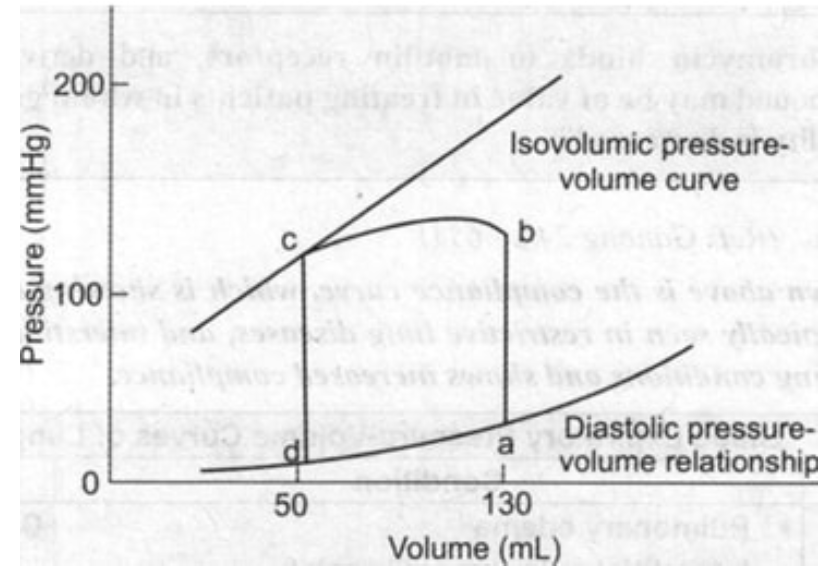
The cardiac output can be determined by all of the following methods except?
Which neurotransmitter is released in the SA node of the heart in response to increased blood pressure?
Which event in the cardiac cycle is responsible for a wave in the Jugular Venous Pulse (JVP)?
Renin plays an important role in which of the following conditions?
Peripheral resistance is best indicated by:
Sympathetic innervation of the heart is by which spinal nerve segments?
Which of the following is the order of activation after stimulation of Purkinje fibers?
What is the normal systolic blood pressure in the right ventricle?
A patient with increased blood pressure and decreased heart rate is likely to have which of the following conditions?
Spurious hypertension is seen in which of the following conditions?
Explanation: **Explanation:** **1. Why Ventilation-perfusion (V/Q) ratio is the correct answer:** The **V/Q ratio** is a physiological parameter used to assess the efficiency of gas exchange in the lungs. It compares the amount of air reaching the alveoli (ventilation) to the amount of blood reaching the alveoli (perfusion). While it involves blood flow (perfusion), it is a **ratio**, not a quantitative measure of the total volume of blood pumped by the heart per minute (Cardiac Output). Therefore, it cannot be used to determine Cardiac Output (CO). **2. Analysis of other options:** * **Fick’s Principle:** This is the "Gold Standard" for measuring CO. It states that the uptake of a substance (usually Oxygen) by an organ is equal to the product of the blood flow to that organ and the arteriovenous concentration difference of that substance. Formula: $CO = \text{O}_2 \text{ consumption} / (A-V \text{ O}_2 \text{ difference})$. * **Thermodilution:** This is the most common clinical method used in ICUs via a **Swan-Ganz catheter**. A cold saline bolus is injected into the right atrium, and the temperature change is measured in the pulmonary artery. The change in temperature over time is inversely proportional to the CO. * **Echocardiography:** A non-invasive method that calculates CO by measuring the **Stroke Volume** (using ventricular dimensions or Doppler flow across the aortic valve) and multiplying it by the Heart Rate ($CO = SV \times HR$). **Clinical Pearls for NEET-PG:** * **Indicator Dilution Method:** Uses **Indocyanine green** (dye) to calculate CO; it follows the same principle as thermodilution. * **Most accurate method:** Fick’s Principle. * **Most common bedside method:** Thermodilution. * **Normal Cardiac Index:** $3.2 \, \text{L/min/m}^2$ (CO adjusted for body surface area).
Explanation: **Explanation:** The correct answer is **Acetylcholine (ACh)**. This response is mediated by the **Baroreceptor Reflex**, a high-yield physiological mechanism for blood pressure regulation. **1. Why Acetylcholine is Correct:** When blood pressure increases, baroreceptors (stretch receptors) in the carotid sinus and aortic arch are stimulated. They send signals to the Nucleus Tractus Solitarius (NTS) in the medulla, which increases **parasympathetic (vagal) outflow** to the heart. The postganglionic parasympathetic fibers release **Acetylcholine** at the SA node. ACh binds to **M2 muscarinic receptors**, leading to: * Opening of K+ channels (hyperpolarization). * Decreased cAMP, slowing the rate of diastolic depolarization. * **Result:** Decreased heart rate (bradycardia) to help lower blood pressure. **2. Why Other Options are Incorrect:** * **Adrenaline & Noradrenaline:** These are sympathetic neurotransmitters/hormones. They are released in response to *decreased* blood pressure (hypotension) or stress to increase heart rate and contractility via β1 receptors. * **Dopamine:** While a precursor to norepinephrine, it is not the primary neurotransmitter involved in the baroreceptor reflex at the SA node. **3. Clinical Pearls for NEET-PG:** * **The "Vagal Tone":** At rest, the heart is under dominant parasympathetic influence via the Vagus nerve (ACh). * **Reflex Bradycardia:** This is the classic response to a sudden rise in BP (e.g., during a Phenylephrine bolus). * **Receptor Mechanism:** M2 receptors are G-protein coupled (Gi), which inhibits Adenylyl Cyclase. * **Afferent Pathways:** Carotid sinus (CN IX - Glossopharyngeal) and Aortic arch (CN X - Vagus). Remember: **"S-I-N"** (Sinus is IX).
Explanation: ### Explanation **1. Why Atrial Systole is Correct:** The **'a' wave** in the Jugular Venous Pulse (JVP) is the first positive deflection and is caused by **atrial systole**. When the right atrium contracts to pump blood into the right ventricle, the pressure within the atrium increases. Since there are no functional valves between the superior vena cava and the right atrium, this pressure is transmitted retrogradely into the internal jugular vein, creating the 'a' wave (a = atrial contraction). **2. Analysis of Incorrect Options:** * **Atrial Diastole (Option B):** During atrial diastole (specifically early diastole), the pressure in the atrium drops as it relaxes and fills. This corresponds to the **'x' descent**, which is a negative deflection, not a wave. * **Ventricular Systole (Option C):** While ventricular systole occurs simultaneously with some JVP components, it is primarily associated with the **'c' wave** (bulging of the tricuspid valve into the atrium) and the **'v' wave** (atrial filling against a closed tricuspid valve). However, the specific 'a' wave is strictly an atrial event. * **Ventricular Diastole (Option D):** Early ventricular diastole, when the tricuspid valve opens, leads to the **'y' descent** as blood flows rapidly from the atrium to the ventricle. **3. High-Yield Clinical Pearls for NEET-PG:** * **Giant 'a' waves:** Seen in conditions with resistance to atrial emptying (e.g., Tricuspid stenosis, Pulmonary hypertension, Right ventricular hypertrophy). * **Cannon 'a' waves:** Occur when the atrium contracts against a closed tricuspid valve (e.g., Complete Heart Block, Junctional rhythms, Ventricular Tachycardia). * **Absent 'a' waves:** A classic finding in **Atrial Fibrillation** (due to lack of coordinated atrial contraction). * **Prominent 'v' waves:** Characteristic of **Tricuspid Regurgitation**.
Explanation: **Explanation:** **Renovascular hypertension** is the correct answer because it is the classic clinical manifestation of the **Renin-Angiotensin-Aldosterone System (RAAS)** activation. The underlying mechanism is typically renal artery stenosis (due to atherosclerosis or fibromuscular dysplasia), which leads to decreased renal perfusion pressure. The juxtaglomerular cells sense this "hypoperfusion" and secrete excess **Renin**. Renin converts Angiotensinogen to Angiotensin I, which is then converted to Angiotensin II (a potent vasoconstrictor) by ACE, leading to systemic hypertension. **Analysis of Incorrect Options:** * **Malignant hypertension:** While RAAS can be secondarily involved due to end-organ damage, the primary pathology is severe arteriolar damage and fibrinoid necrosis. It is a clinical syndrome of extremely high BP (>180/120 mmHg) rather than a renin-dependent etiology. * **Coronary artery disease (CAD):** This is primarily a disease of atherosclerosis and plaque formation in the coronary arteries. While hypertension is a risk factor for CAD, renin is not the primary driver of the disease process itself. * **Essential hypertension:** Also known as primary hypertension, the exact cause is unknown (idiopathic). In many cases, patients actually have "low-renin" hypertension, especially in older populations or certain ethnic groups. **High-Yield Clinical Pearls for NEET-PG:** * **Goldblatt Kidney:** The experimental model for renovascular hypertension. * **Bruit:** A systolic-diastolic abdominal bruit is a highly specific clinical sign for renal artery stenosis. * **ACE Inhibitors:** These are contraindicated in **bilateral** renal artery stenosis because they can cause a precipitous drop in GFR and acute renal failure. * **Hypokalemia:** Excess renin leads to excess aldosterone, which may cause metabolic alkalosis and hypokalemia.
Explanation: **Explanation:** **1. Why Diastolic Blood Pressure (DBP) is the correct answer:** Peripheral resistance (PR) is the resistance offered by the systemic vasculature (primarily the arterioles) to the flow of blood. During diastole, the heart is not ejecting blood; however, the blood pressure does not drop to zero because of the elastic recoil of the large arteries and the resistance offered by the peripheral arterioles. Therefore, **Diastolic Blood Pressure** is the best clinical indicator of peripheral resistance. If arterioles constrict (increasing PR), DBP rises; if they dilate (decreasing PR), DBP falls. **2. Analysis of Incorrect Options:** * **B. Pulse Pressure:** This is the difference between systolic and diastolic pressure ($SBP - DBP$). It is primarily determined by the **stroke volume** and the **compliance (distensibility)** of the arterial tree, rather than peripheral resistance. * **C. Systolic resistance in the aorta:** Systolic pressure is primarily a reflection of cardiac output, stroke volume, and the elasticity of the aorta. Resistance is a property of the microvasculature (arterioles), not the aorta itself. * **D. Mean Arterial Pressure (MAP):** While MAP is the average pressure driving blood to organs, it is a product of both Cardiac Output and Total Peripheral Resistance ($MAP = CO \times TPR$). It is a global hemodynamic parameter rather than a specific indicator of resistance alone. **High-Yield Clinical Pearls for NEET-PG:** * **Resistance Vessels:** Arterioles are known as the primary "resistance vessels" of the body. * **Windkessel Effect:** The elastic recoil of the aorta during diastole that maintains blood flow is called the Windkessel effect. * **Formula:** $TPR = \frac{8\eta L}{\pi r^4}$ (Poiseuille’s Law). Note that resistance is inversely proportional to the **fourth power of the radius**, making vessel diameter the most potent determinant of peripheral resistance.
Explanation: ### Explanation **1. Why T1-T5 is Correct:** The sympathetic supply to the heart follows the general rule of thoracolumbar outflow. The preganglionic sympathetic neurons for the heart originate in the **Intermediolateral (IML) gray column** of the spinal cord segments **T1 to T5** (occasionally T1-T6). These fibers exit via the ventral roots and travel through white rami communicantes to synapse in the cervical and upper thoracic sympathetic chain ganglia. Postganglionic fibers then form the cardiac nerves, which reach the SA node, AV node, and ventricular myocardium to increase heart rate (chronotropy) and force of contraction (inotropy). **2. Why Other Options are Incorrect:** * **T1-T3 (Option A):** While these segments do contribute significantly to the heart, they are incomplete. T1-T3 primarily focus on the head, neck, and upper thoracic viscera, but the cardiac outflow extends down to T5. * **T3-T7 (Option B):** This range starts too low and ends too low. The T1 and T2 segments are crucial for cardiac innervation; T6-T7 are more associated with the upper abdominal viscera via the greater splanchnic nerves. * **L1-L5 (Option D):** Lumbar segments provide sympathetic innervation to the lower limbs, pelvic viscera, and hindgut. They have no role in cardiac innervation. **3. High-Yield Clinical Pearls for NEET-PG:** * **Referred Pain:** Cardiac pain (Angina) is referred to the T1-T5 dermatomes (precordium and inner aspect of the left arm) because the sensory afferents from the heart travel back to the same spinal segments (T1-T5) as the sympathetic nerves. * **Stellate Ganglion:** The fusion of the inferior cervical and first thoracic (T1) ganglia is called the Stellate Ganglion. Blocking this can treat certain arrhythmias or complex regional pain syndromes. * **Parasympathetic Supply:** Unlike the sympathetic system, the parasympathetic supply is via the **Vagus Nerve (CN X)**, which primarily affects the SA and AV nodes (heart rate) rather than the ventricular muscle.
Explanation: ### Explanation The sequence of ventricular depolarization is determined by the anatomical distribution of the specialized conduction system (Bundle of His and Purkinje fibers). **1. Why Option A is Correct:** The electrical impulse travels down the Bundle of His and enters the **Interventricular Septum** first via the left bundle branch. This causes the septum to depolarize from left to right. Following septal activation, the impulse travels through the Purkinje network, which is located in the **sub-endocardial** layer of the ventricular walls. Consequently, the wave of depolarization spreads from the **Endocardium to the Epicardium** (inside to outside). Therefore, the correct sequence is: **Septum → Endocardium → Epicardium.** **2. Why Other Options are Incorrect:** * **Option B & D:** These are incorrect because the septum is always the first part of the ventricular myocardium to depolarize, preceding the free walls of the ventricles. * **Option C:** This describes the sequence of **repolarization**, not depolarization. Ventricular repolarization occurs from the epicardium to the endocardium because the epicardial cells have a shorter action potential duration. **Clinical Pearls & High-Yield Facts for NEET-PG:** * **Septal Vector:** Since the septum depolarizes from left to right, it produces the initial small 'q' wave in lateral leads (V5, V6) and a small 'r' wave in V1. * **Conduction Velocity:** Purkinje fibers have the fastest conduction velocity in the heart (~4 m/s) due to a high density of gap junctions and large fiber diameter. * **Last to Depolarize:** The posterobasal part of the left ventricle and the pulmonary conus are typically the last regions to depolarize. * **Papillary Muscles:** These are activated early in the sequence to ensure the AV valves are braced before full ventricular contraction, preventing regurgitation.
Explanation: **Explanation:** The right ventricle (RV) is a low-pressure pump designed to propel deoxygenated blood into the pulmonary circulation. Unlike the left ventricle, which must overcome high systemic vascular resistance, the RV encounters the low resistance of the pulmonary vascular bed. **1. Why 25 mmHg is correct:** In a healthy adult, the normal **systolic pressure of the right ventricle ranges from 15 to 25 mmHg**, while the diastolic pressure is near zero (0–8 mmHg). Since the pulmonary valve is open during systole, the RV systolic pressure is equal to the Pulmonary Artery Systolic Pressure (PASP). **2. Analysis of Incorrect Options:** * **80 mmHg (Option B):** This represents the normal **diastolic** blood pressure in the systemic circulation (Aorta/Large arteries). * **95 mmHg (Option C):** This is a typical value for the **Mean Arterial Pressure (MAP)** in the systemic circulation. * **120 mmHg (Option D):** This is the normal **systolic** blood pressure of the **left ventricle** and the systemic arteries. The left ventricle is significantly thicker because it must generate roughly five times the pressure of the right ventricle. **3. High-Yield Clinical Pearls for NEET-PG:** * **Pulmonary Hypertension:** Defined as a mean pulmonary artery pressure (mPAP) >20 mmHg at rest. * **Pressure Equivalency:** During systole, RV pressure ≈ Pulmonary Artery pressure. During diastole, RV pressure drops to near zero, while Pulmonary Artery pressure remains higher (~8–10 mmHg) due to the closure of the pulmonary valve. * **Bernoulli Equation:** In echocardiography, RV systolic pressure is often estimated using the Tricuspid Regurgitation (TR) jet velocity: $PASP = 4(V_{TR})^2 + \text{Right Atrial Pressure}$.
Explanation: This question tests your understanding of the **Cushing Reflex**, a classic physiological response to life-threatening increases in intracranial pressure (ICP). ### **Explanation of the Correct Answer** When **Intracranial Pressure (ICP)** increases (Option A), it eventually exceeds the mean arterial pressure (MAP), leading to compression of cerebral blood vessels and cerebral ischemia. To maintain cerebral perfusion, the vasomotor center in the medulla triggers a massive sympathetic discharge. This results in: 1. **Hypertension:** A compensatory rise in systemic blood pressure to "push" blood into the brain against the high ICP. 2. **Bradycardia:** The sudden rise in blood pressure stimulates baroreceptors in the carotid sinus and aortic arch, leading to a reflex increase in vagal (parasympathetic) tone, which slows the heart rate. This combination of **Hypertension, Bradycardia, and Irregular Respiration** is known as the **Cushing’s Triad**. ### **Analysis of Incorrect Options** * **B. Deep sea diving:** This is associated with "Nitrogen Narcosis" or "The Bends" (Decompression Sickness). While it involves pressure changes, it does not characteristically present with the hypertension-bradycardia reflex. * **C & D. Brain/Head tumor:** While a brain tumor *can* cause increased ICP, it is a chronic process. The Cushing reflex is typically an acute, terminal sign of herniation. "Increased ICP" is the more direct physiological mechanism and the superior answer choice in a medical exam context. ### **NEET-PG High-Yield Pearls** * **Cushing Reflex vs. Cushing Syndrome:** Do not confuse them. Cushing Syndrome is hypercortisolism; Cushing Reflex is a CNS response to ICP. * **The Triad:** Hypertension (widened pulse pressure), Bradycardia, and Abnormal Breathing (Cheyne-Stokes). * **Clinical Significance:** The appearance of the Cushing reflex is a late sign of brain herniation and is a neurosurgical emergency. * **Stage of Compensation:** The reflex is an attempt by the body to maintain **Cerebral Perfusion Pressure (CPP)**, where $CPP = MAP - ICP$.
Explanation: **Explanation:** **Spurious hypertension** refers to a false or inaccurate reading of high blood pressure that does not reflect the patient's true intra-arterial pressure. **1. Why Auscultatory Gap is the correct answer:** An **auscultatory gap** is a period of silence between the systolic and diastolic Korotkoff sounds. It typically occurs in patients with severe hypertension or atherosclerosis. If the clinician does not inflate the cuff high enough (above the gap), they may mistake the reappearance of sounds for the true systolic pressure (**underestimation**). However, if the gap is not recognized during deflation, it can lead to an **overestimation of the diastolic pressure** or a misinterpretation of the systolic level, leading to a "spurious" or inaccurate diagnosis of the blood pressure stage. **2. Analysis of Incorrect Options:** * **Small cuff size:** Using a cuff that is too small for the arm circumference leads to **"Cuff Hypertension."** While this is a false elevation, it is a technical error of measurement rather than a physiological phenomenon like the auscultatory gap. * **Thick calcified vessels:** This leads to **"Pseudohypertension"** (Osler’s sign positive). It occurs primarily in the elderly where the rigid arterial wall requires excessive cuff pressure to collapse, leading to falsely high readings. * **Obesity:** Similar to small cuff size, obesity often leads to falsely elevated readings if a standard cuff is used instead of a large/thigh cuff. **High-Yield Clinical Pearls for NEET-PG:** * **Osler’s Maneuver:** Used to detect pseudohypertension; the radial pulse remains palpable even when the cuff is inflated above systolic pressure. * **Prevention of Auscultatory Gap errors:** Always use the **palpatory method** first to estimate systolic pressure before using the auscultatory method. * **White Coat Hypertension:** High BP in the clinic but normal at home (Ambulatory BP monitoring is the gold standard for diagnosis).
Cardiac Electrophysiology
Practice Questions
Cardiac Cycle
Practice Questions
Cardiac Output and Its Regulation
Practice Questions
Hemodynamics and Blood Flow
Practice Questions
Arterial System Physiology
Practice Questions
Microcirculation and Lymphatics
Practice Questions
Venous Return and Central Venous Pressure
Practice Questions
Cardiovascular Reflexes
Practice Questions
Regional Circulations
Practice Questions
Cardiovascular Responses to Exercise and Stress
Practice Questions
Get full access to all questions, explanations, and performance tracking.
Start For Free