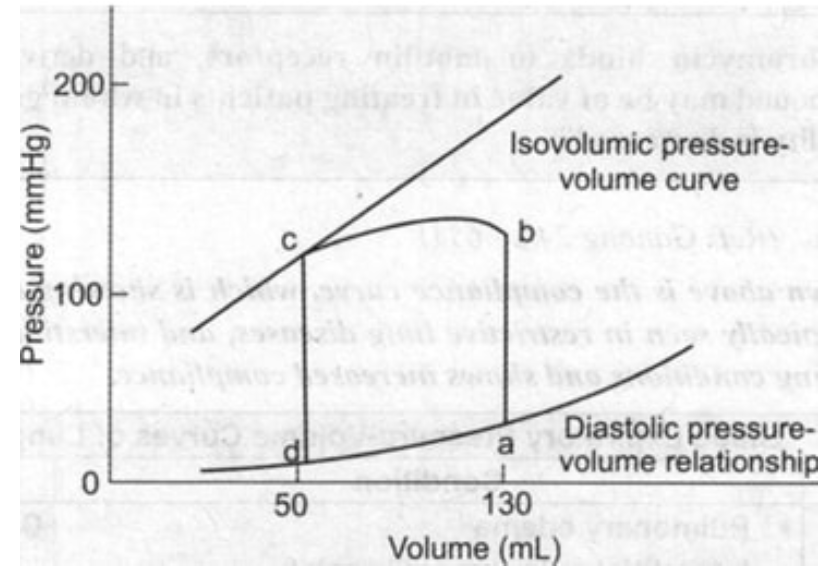
Coronary vasodilatation is caused by which of the following substances?
When a person stands suddenly from a lying down posture, what physiological response occurs?
In a study, dye ABC is used to measure cardiac output and blood volume. If the dye is replaced with a new dye XYZ which diffuses more rapidly out of the capillaries, how would this affect the study measurements?
Which statement is true regarding blood pressure measurement using a sphygmomanometer compared to direct intra-arterial pressure measurements?
What is common between systemic and pulmonary circulation?
Cardiac index is determined by which of the following parameters?
What is perfusion pressure?
Which part of the heart is the last to be repolarized?
The normal P wave is biphasic in which lead?
In circulatory biomechanics, which of the following statements is true?
Explanation: **Explanation:** **1. Why Adenosine is the Correct Answer:** Adenosine is the most potent local metabolic vasodilator of the coronary circulation. According to the **Metabolic Theory of Autoregulation**, when myocardial oxygen demand increases (e.g., during exercise), ATP is broken down into ADP, AMP, and eventually **Adenosine**. Adenosine diffuses out of the myocytes and binds to **A2A receptors** on the vascular smooth muscle of the coronary arterioles. This activates adenylate cyclase, increasing cAMP, which leads to smooth muscle relaxation and significant vasodilation. This mechanism ensures that coronary blood flow matches the metabolic needs of the heart. **2. Analysis of Incorrect Options:** * **Bradykinin & Histamine:** While both are potent vasodilators in the systemic circulation and play roles in inflammation and anaphylaxis, they are not the primary physiological regulators of coronary vascular tone. * **Ergotamine:** This is a vasoconstrictor (specifically an alpha-adrenergic agonist and 5-HT receptor agonist). It is used in treating migraines but is contraindicated in patients with coronary artery disease because it can induce **coronary vasospasm**. **3. NEET-PG High-Yield Clinical Pearls:** * **Coronary Steal Phenomenon:** Potent vasodilators like **Dipyridamole** and Adenosine can cause "steal" by dilating healthy vessels, diverting blood away from already maximally dilated stenotic vessels. * **Diagnostic Use:** Adenosine is the drug of choice (DOC) for the termination of **Paroxysmal Supraventricular Tachycardia (PSVT)** due to its ability to slow AV node conduction. * **Key Regulators:** While Adenosine is the primary metabolic regulator, **Nitric Oxide (NO)** is the primary endothelium-derived relaxant, and **Hypoxia** is the most potent direct stimulus for coronary vasodilation.
Explanation: When a person stands up suddenly, gravity causes approximately 500–1000 mL of blood to pool in the lower extremities. This leads to a transient decrease in venous return, stroke volume, and mean arterial pressure (MAP). **Explanation of the Correct Answer:** To counteract this drop in blood pressure, the **Baroreceptor Reflex** is activated. The decrease in MAP is sensed by baroreceptors in the carotid sinus and aortic arch, leading to a decrease in parasympathetic tone and an **increase in sympathetic outflow**. Sympathetic stimulation causes **venoconstriction** (increased tone of capacitance vessels). Since 60–70% of blood volume resides in the veins, this constriction shifts blood toward the heart, restoring venous return and cardiac output. **Analysis of Incorrect Options:** * **B. Increased efferent discharge from the IX cranial nerve:** The Glossopharyngeal nerve (IX) carries **afferent** (sensory) signals from the carotid sinus to the medulla. In response to hypotension, the *firing rate* of these afferent fibers actually **decreases**, not increases. * **C. Decreased heart rate:** Sympathetic activation leads to an **increase in heart rate** (tachycardia) and myocardial contractility to restore blood pressure. A decrease in heart rate would worsen the hypotension. **High-Yield Clinical Pearls for NEET-PG:** * **Orthostatic Hypotension:** Defined as a drop in systolic BP >20 mmHg or diastolic BP >10 mmHg within 3 minutes of standing. * **The "Buffer Nerve":** The Hering’s nerve (branch of CN IX) and Cyon’s nerve (branch of CN X) are known as buffer nerves because they help minimize fluctuations in BP. * **Initial Response:** The very first compensatory change is an increase in heart rate, followed by peripheral vasoconstriction.
Explanation: ### Explanation The measurement of physiological volumes and flows using dyes relies on the **Indicator Dilution Principle**. **1. Why Option A is Correct:** * **Cardiac Output (CO):** To measure CO (using the Stewart-Hamilton equation), the dye is injected as a bolus into a large vein and its concentration is measured over time in a systemic artery. This process occurs during the **first pass** of the dye through the heart and lungs. Because the transit time is very short (seconds), even a dye that diffuses rapidly (like XYZ) does not have enough time to leak significantly into the interstitial space before the primary curve is recorded. Thus, CO remains accurate. * **Blood Volume (BV):** Measuring BV requires the **Volume of Distribution** principle ($V = Q/C$). This requires the dye to reach a "steady-state" or equilibrium in the plasma. If dye XYZ diffuses rapidly out of the capillaries, its plasma concentration ($C$) will decrease as it enters the interstitium. Since Volume is inversely proportional to concentration ($V \propto 1/C$), a lower plasma concentration leads to a **falsely elevated (altered)** blood volume estimation. **2. Why Other Options are Wrong:** * **Option B & C:** These are incorrect because they suggest CO is altered. As explained, CO measurement depends on the initial transit (first pass), which is too rapid for significant capillary leakage to affect the calculation. * **Option D:** This is incorrect because blood volume estimation strictly requires the indicator to remain within the vascular compartment (e.g., Evans Blue or Radio-iodinated Albumin). A leaky dye violates this fundamental requirement. ### High-Yield Pearls for NEET-PG * **Ideal Indicator for Plasma Volume:** Evans Blue (T-1824) or $I^{131}$-Albumin (they bind to albumin and stay intravascular). * **Ideal Indicator for CO:** Indocyanine Green (remains intravascular and has a short half-life). * **Indicator Dilution Formula:** $CO = \frac{\text{Amount of Dye}}{\text{Average Concentration} \times \text{Duration of Curve}}$. * **Recirculation:** In CO curves, the "downslope" is interrupted by a small hump due to dye recirculating; this is corrected using semi-logarithmic extrapolation.
Explanation: **Explanation:** The correct answer is **B: Sphygmomanometer measurements are more than intravascular pressure.** **1. Why the Correct Answer is Right:** Indirect measurement of blood pressure using a sphygmomanometer (Auscultatory method) typically yields values slightly **higher** than direct intra-arterial measurements. This discrepancy occurs because the external cuff must exert enough pressure to not only overcome the internal luminal pressure but also to overcome the **resistance and elasticity of the vessel wall** and the surrounding soft tissues (the "tissue factor"). Consequently, the pressure required to occlude the artery and subsequently produce Korotkoff sounds is marginally higher than the actual pressure inside the vessel. **2. Why the Incorrect Options are Wrong:** * **Option A:** Measurements are rarely less than intravascular pressure unless there is a significant technical error (e.g., using a cuff that is too large for the arm). * **Option C:** They are almost never exactly equal due to the physical energy required to compress the arterial wall from the outside. * **Option D:** While blood flow affects the *quality* of Korotkoff sounds, the systematic overestimation by sphygmomanometry is primarily a function of vessel wall resistance, not the flow rate itself. **3. NEET-PG High-Yield Clinical Pearls:** * **Cuff Size Rule:** A cuff that is **too small/narrow** will give a **falsely high** reading (overestimation). A cuff that is **too large/wide** will give a **falsely low** reading. * **Gold Standard:** Direct intra-arterial measurement (using a transducer) is the gold standard for accuracy, especially in hemodynamically unstable patients. * **Osler’s Maneuver:** Used to detect "Pseudohypertension" in elderly patients with severely calcified (Mönckeberg's) arteries, where the sphygmomanometer significantly overestimates pressure because the artery is non-compressible.
Explanation: ### Explanation The correct answer is **A. Volume of the circulation per minute.** **1. Why the correct answer is right:** The systemic and pulmonary circulations are arranged in **series**. According to the principle of continuity of flow, the volume of blood pumped by the left ventricle into the systemic circulation must equal the volume pumped by the right ventricle into the pulmonary circulation over time. This volume is the **Cardiac Output (CO)**. If the outputs were unequal, blood would rapidly accumulate in either the lungs or the systemic tissues, leading to immediate circulatory collapse. Under steady-state conditions, CO is approximately 5 L/min for both circuits. **2. Why the incorrect options are wrong:** * **B. Peripheral vascular resistance:** The systemic circulation is a **high-resistance** circuit (due to extensive arteriolar networks), while the pulmonary circulation is a **low-resistance** circuit. Systemic resistance is roughly 7–10 times higher than pulmonary resistance. * **C. Pulse pressure:** Pulse pressure (Systolic – Diastolic) is much higher in the systemic circuit (approx. 120 - 80 = 40 mmHg) compared to the pulmonary circuit (approx. 25 - 10 = 15 mmHg). The right ventricle is thinner and pumps against much lower afterload. * **D. Total vascular capacity:** The systemic circulation holds significantly more blood (approx. 84% of total blood volume, with 64% in systemic veins) compared to the pulmonary circulation (approx. 9%). **3. NEET-PG High-Yield Pearls:** * **Pressure Gradient:** While flow (Q) is equal, the pressure gradient ($\Delta P$) is much higher in systemic circulation. This is explained by Ohm’s Law for fluids: $Q = \Delta P / R$. Since $Q$ is constant, the higher systemic $R$ necessitates a higher $\Delta P$. * **Hypoxic Vasoconstriction:** A unique difference is that pulmonary vessels **constrict** in response to hypoxia (to shunt blood to better-ventilated alveoli), whereas systemic vessels **dilate** to increase oxygen delivery.
Explanation: **Explanation:** **1. Why the correct answer is right:** Cardiac Index (CI) is a hemodynamic parameter that relates the **Cardiac Output (CO)** to an individual's **Body Surface Area (BSA)**. Since people vary significantly in size, a standard cardiac output of 5 L/min might be adequate for a small person but insufficient for a large person. By dividing CO by BSA, we normalize the measurement to the individual's body size, providing a more accurate assessment of whether the heart is meeting the metabolic demands of the tissues. * **Formula:** $CI = \frac{Cardiac Output (CO)}{Body Surface Area (BSA)}$ * **Normal Range:** Approximately $2.5 \text{ to } 4.0 \text{ L/min/m}^2$. **2. Why the incorrect options are wrong:** * **Option B:** Stroke volume is only one component of cardiac output ($CO = SV \times HR$). Using stroke volume alone ignores the heart rate, which is essential for determining total flow. * **Option C:** Body surface area is the denominator, but it cannot determine the index without knowing the heart's actual output (the numerator). * **Option D:** Peripheral resistance (SVR) relates to blood pressure and afterload, not the normalization of flow relative to body size. **3. Clinical Pearls & High-Yield Facts for NEET-PG:** * **Clinical Significance:** A Cardiac Index below $2.2 \text{ L/min/m}^2$ is often used as a diagnostic threshold for **cardiogenic shock**. * **BSA Calculation:** Most commonly calculated using the **Mosteller formula** or DuBois formula. * **Age Factor:** Cardiac Index is highest at age 10 (approx. $4.5 \text{ L/min/m}^2$) and gradually declines with age. * **Key Distinction:** While Cardiac Output measures total flow, Cardiac Index measures **efficiency** relative to size.
Explanation: **Explanation:** **Perfusion pressure** is the pressure gradient that drives blood flow through an organ or a vascular bed. According to **Ohm’s Law** applied to hemodynamics ($Q = \Delta P / R$), the flow ($Q$) is directly proportional to the pressure difference ($\Delta P$) between two points. In the systemic circulation, blood flows from the high-pressure arterial system to the low-pressure venous system. Therefore, the perfusion pressure is defined as the **Arterial–Venous pressure difference** ($P_a - P_v$). * **Why Option C is correct:** For any organ, the net pressure available to push blood through the capillaries is the difference between the inflow (arterial) pressure and the outflow (venous) pressure. * **Why Option A & B are incorrect:** While arterial pressure is the primary driver, it does not account for the "back-pressure" exerted by the venous system. A single pressure point cannot define a gradient. * **Why Option D is incorrect:** Left ventricular pressure fluctuates significantly between systole and diastole and represents the pump's generation of pressure, not the specific gradient across a distal vascular bed. **High-Yield Clinical Pearls for NEET-PG:** 1. **Cerebral Perfusion Pressure (CPP):** A critical exam concept. $CPP = MAP - ICP$ (where MAP is Mean Arterial Pressure and ICP is Intracranial Pressure). If ICP rises, CPP falls, leading to ischemia. 2. **Renal Perfusion Pressure:** Primarily determined by MAP; the kidneys use autoregulation to maintain a constant GFR despite fluctuations in perfusion pressure (between 80–180 mmHg). 3. **Coronary Perfusion Pressure:** Unlike other organs, the left ventricle is perfused mainly during **diastole**. Its perfusion pressure is the difference between Aortic Diastolic Pressure and Left Ventricular End-Diastolic Pressure (LVEDP).
Explanation: **Explanation:** The sequence of cardiac electrical activity is a high-yield concept in physiology. To understand repolarization, one must first understand the sequence of depolarization. **1. Why Apical Endocardium is correct:** * **Depolarization** occurs from **Endocardium to Epicardium** and from **Apex to Base**. Therefore, the apical endocardium is the *first* part of the ventricles to depolarize. * **Repolarization**, however, occurs in the **reverse order** of depolarization. It proceeds from **Epicardium to Endocardium**. This is because the epicardial cells have a shorter action potential duration compared to endocardial cells (due to a higher density of $I_{to}$ potassium channels). * Additionally, repolarization moves from **Base to Apex**. * Since the apical endocardium is the first to depolarize and the last to finish its long action potential, it is the **last part of the heart to be repolarized**. **2. Analysis of Incorrect Options:** * **Apical epicardium:** This depolarizes early but repolarizes before the endocardium due to its shorter action potential duration. * **Epicardium of the base:** This is generally the **first** area to repolarize because repolarization begins at the epicardial surface of the base. * **Endocardium of the base:** While endocardial, the basal region repolarizes before the apical region. **Clinical Pearls for NEET-PG:** * **T-Wave Direction:** Because repolarization occurs in the opposite direction of depolarization (Epicardium $\rightarrow$ Endocardium), the T-wave remains **upright** (positive) in the same leads where the QRS complex is positive. * **Ischemia:** Subendocardial ischemia delays repolarization further, often leading to ST-segment depression or T-wave inversion. * **Sequence Summary:** * Depolarization: Endocardium $\rightarrow$ Epicardium; Apex $\rightarrow$ Base. * Repolarization: Epicardium $\rightarrow$ Endocardium; Base $\rightarrow$ Apex.
Explanation: **Explanation:** The **P wave** represents atrial depolarization. In a normal ECG, the P wave is typically **biphasic in Lead V1**. **Why V1 is correct:** Lead V1 is positioned horizontally over the 4th intercostal space, directly over the right atrium. Atrial depolarization occurs in two stages: 1. **Initial component:** Represents **Right Atrial (RA)** depolarization, moving anteriorly and toward V1 (causing a positive deflection). 2. **Terminal component:** Represents **Left Atrial (LA)** depolarization, moving posteriorly and away from V1 (causing a negative deflection). This dual directionality results in the characteristic "up-and-down" biphasic morphology in V1. **Why other options are incorrect:** * **Lead II (LII):** This is the best lead to visualize P waves. Since the vector of atrial depolarization moves inferiorly and toward the left (parallel to Lead II), the P wave is always **monophasic and positive**. * **aVF:** Similar to Lead II, this is an inferior lead. The depolarization vector moves toward it, resulting in a **positive** P wave. * **aVR:** The depolarization vector moves directly away from this lead (right shoulder). Therefore, the P wave in aVR is normally **inverted (negative)**, not biphasic. **High-Yield Clinical Pearls for NEET-PG:** * **P-mitrale:** A notched, wide P wave in Lead II (seen in Left Atrial Enlargement). * **P-pulmonale:** A tall, peaked P wave (>2.5 mm) in Lead II (seen in Right Atrial Enlargement). * **V1 Significance:** In Left Atrial Enlargement, the terminal negative component of the biphasic P wave in V1 becomes deeper (>1mm) and wider (>0.04s).
Explanation: ### Explanation **Correct Answer: C. Cardiac output is increased in anemia.** In **anemia**, the reduction in hemoglobin concentration leads to two primary physiological changes that increase cardiac output (CO): 1. **Reduced Viscosity:** A lower red blood cell count decreases blood viscosity. According to **Poiseuille’s Law**, decreased viscosity reduces peripheral resistance, facilitating easier blood flow and increasing venous return. 2. **Tissue Hypoxia:** Decreased oxygen-carrying capacity triggers peripheral vasodilation to improve oxygen delivery. This further reduces Total Peripheral Resistance (TPR). Since **CO = Mean Arterial Pressure / TPR**, a significant drop in TPR leads to a "hyperdynamic circulation" and increased cardiac output. **Analysis of Incorrect Options:** * **A & B (Viscosity):** Blood viscosity is primarily determined by the **hematocrit**. In **Anemia** (low RBCs), viscosity **decreases**. In **Polycythemia** (high RBCs), viscosity **increases**, which can lead to sluggish blood flow and increased risk of thrombosis. * **D (Beri-Beri):** Wet Beri-Beri (Thiamine/B1 deficiency) is a classic cause of **High-Output Heart Failure**. Thiamine deficiency leads to systemic vasodilation and impaired cellular metabolism, resulting in an **increased** cardiac output, not a decreased one. **High-Yield Clinical Pearls for NEET-PG:** * **High-Output States:** Remember the mnemonic **"ABCD"**: **A**nemia, **B**eri-Beri/AV malformations, **C**hronic Paget’s disease, and **D**eranged thyroid (Hyperthyroidism). * **Fahraeus-Lindqvist Effect:** In capillaries (vessels <300μm), blood viscosity decreases because RBCs move to the center of the vessel (axial streaming), leaving a plasma layer at the periphery. * **Viscosity & Velocity:** Viscosity is inversely proportional to the velocity of blood flow (non-Newtonian fluid behavior).
Cardiac Electrophysiology
Practice Questions
Cardiac Cycle
Practice Questions
Cardiac Output and Its Regulation
Practice Questions
Hemodynamics and Blood Flow
Practice Questions
Arterial System Physiology
Practice Questions
Microcirculation and Lymphatics
Practice Questions
Venous Return and Central Venous Pressure
Practice Questions
Cardiovascular Reflexes
Practice Questions
Regional Circulations
Practice Questions
Cardiovascular Responses to Exercise and Stress
Practice Questions
Get full access to all questions, explanations, and performance tracking.
Start For Free