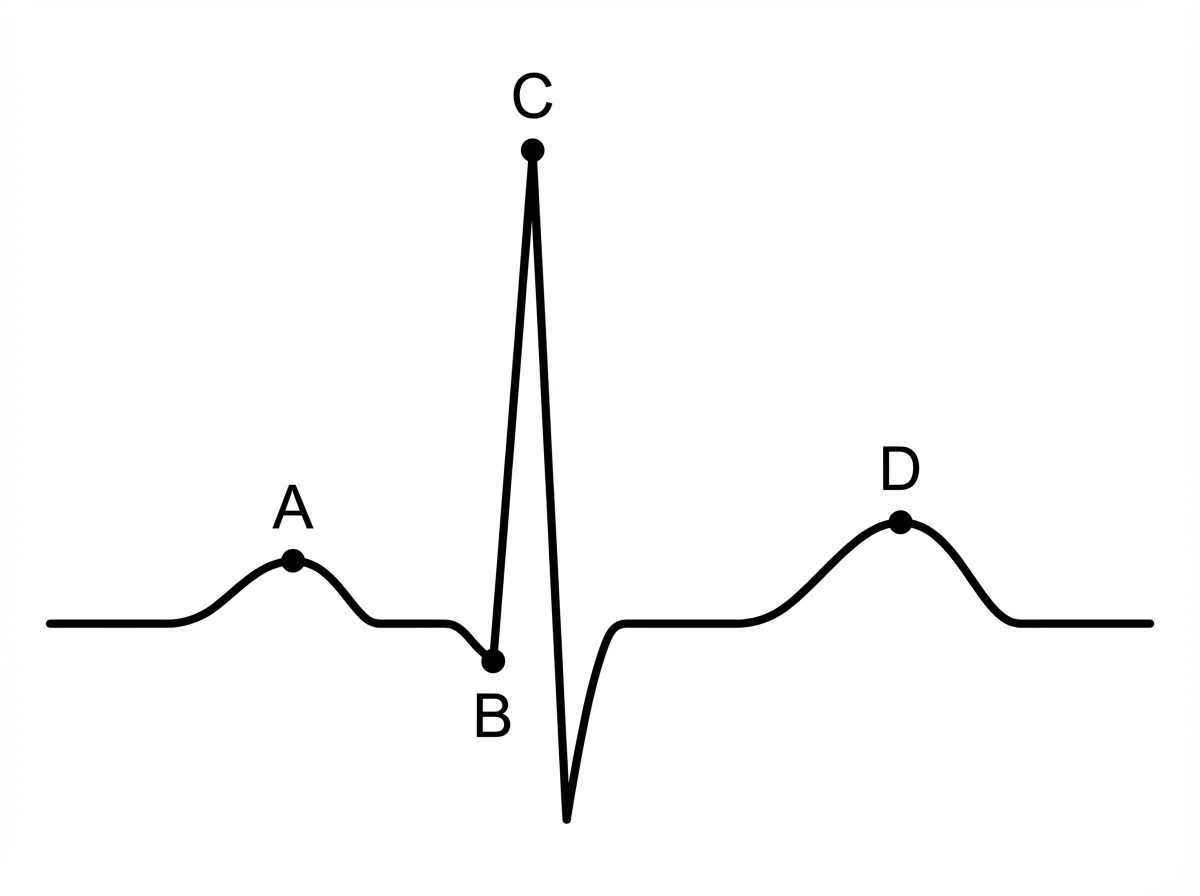
The second heart sound is due to which of the following?
Cardiac output decreases in all the following conditions except?
What is the normal electrical axis of the heart?
Stimulation of the medial portion of the vasomotor center results in which of the following?
Reynolds number describes the relationship between all of the following, EXCEPT:
Which of the following represents a site of local control in blood flow?
Which of the following best describes the Anrep effect?
Which among the following is a false statement about fetal circulation?
What is the largest compliance in the circulatory system?
Closure of the fetal circulatory adjustments occurs functionally in the following sequence?
Explanation: **Explanation** The **second heart sound (S2)** is produced by the vibrations initiated by the sudden **closure of the semilunar valves** (Aortic and Pulmonary valves). This occurs at the beginning of **isovolumetric ventricular relaxation**, marking the end of ventricular systole and the start of diastole. The closure is triggered when the pressure in the great arteries (Aorta and Pulmonary artery) exceeds the pressure in the relaxing ventricles, causing blood to flow back toward the heart and snapping the valve cusps shut. **Analysis of Incorrect Options:** * **Option A (Closure of AV valves):** This produces the **first heart sound (S1)**. It occurs at the onset of ventricular systole (isovolumetric contraction) when the Mitral and Tricuspid valves close. * **Option C (Inflow of blood):** Rapid ventricular filling during early diastole produces the **third heart sound (S3)**. While normal in children, it often indicates volume overload (e.g., heart failure) in adults. * **Option D (Contraction of atria):** Atrial contraction against a stiff, non-compliant ventricle produces the **fourth heart sound (S4)**, which is always pathological (e.g., ventricular hypertrophy). **High-Yield NEET-PG Pearls:** * **Physiological Splitting:** S2 has two components: **A2** (Aortic) and **P2** (Pulmonary). A2 normally precedes P2. During inspiration, the split widens because increased venous return delays the closure of the pulmonary valve. * **Fixed Splitting:** A classic sign of **Atrial Septal Defect (ASD)**. * **Duration:** S2 is higher-pitched and shorter in duration (approx. 0.11 sec) compared to S1.
Explanation: **Explanation:** The correct answer is **Sleep**. Contrary to common assumption, cardiac output (CO) remains **unchanged or shows no significant decrease** during normal sleep. While the heart rate and blood pressure may drop due to increased parasympathetic tone, the stroke volume often increases slightly to compensate, maintaining a stable cardiac output. **Analysis of Options:** * **Sleep (Correct):** Standard physiological teaching (e.g., Guyton, Ganong) states that CO does not decrease during sleep. It is one of the few resting states where CO remains stable despite a lower metabolic rate. * **Heart Disease:** Conditions like myocardial infarction, valvular heart disease, or heart failure directly impair the heart's pumping ability (contractility), leading to a decrease in CO. * **Sitting from Supine:** When moving from a lying to a sitting or standing position, gravity causes blood to pool in the lower extremities (venous pooling). This reduces venous return (preload), which, according to the Frank-Starling law, decreases stroke volume and CO by approximately 20-30%. * **Arrhythmias:** Tachyarrhythmias (due to shortened diastolic filling time) and bradyarrhythmias (due to low heart rate) both result in a reduction of effective cardiac output. **High-Yield NEET-PG Pearls:** * **CO Increases in:** Anxiety, eating (digestion), exercise, pregnancy, high altitude, and anemia (hyperdynamic circulation). * **CO Decreases in:** Rapid arrhythmias, hemorrhage, and sudden change in posture (supine to standing). * **Formula:** $CO = \text{Stroke Volume} \times \text{Heart Rate}$. * **Index:** Cardiac Index is CO per square meter of body surface area (Normal: $3.2 \, \text{L/min/m}^2$).
Explanation: ### Explanation **1. Understanding the Correct Answer (A: -30 to +90 degrees)** The electrical axis of the heart represents the net direction of the ventricular depolarization wave (QRS complex) in the frontal plane. In a healthy individual, the heart is positioned anatomically with the apex pointing downward and to the left. Because the left ventricle is significantly more muscular than the right, the mean electrical vector is pulled toward it. Most international guidelines (including Guyton and Ganong) define the normal range as **-30° to +90°**. Some texts extend this to +110°, but for NEET-PG, -30° to +90° is the standard accepted range. **2. Analysis of Incorrect Options** * **B (+90 to +120 degrees):** This represents **Right Axis Deviation (RAD)**. It is commonly seen in right ventricular hypertrophy (RVH), pulmonary embolism, or in thin, tall individuals. * **C (+120 to -30 degrees):** This range encompasses **Extreme Axis Deviation** (also known as "No Man's Land" or Northwest axis), typically seen in ventricular tachycardia or severe emphysema. * **D (+60 to -60 degrees):** This is an arbitrary range that does not align with standard physiological definitions of the cardiac axis. **3. Clinical Pearls for NEET-PG** * **Left Axis Deviation (LAD):** Axis < -30°. Causes: Left Anterior Fascicular Block (LAFB), Left Ventricular Hypertrophy (LVH), or inferior wall MI. * **Right Axis Deviation (RAD):** Axis > +90°. Causes: Right Ventricular Hypertrophy (RVH), Left Posterior Fascicular Block (LPFB), or lateral wall MI. * **Quick Rule of Thumb:** * Normal Axis: QRS is positive (upright) in both Lead I and Lead aVF. * LAD: QRS is positive in Lead I and negative in Lead aVF ("Leaving" each other). * RAD: QRS is negative in Lead I and positive in Lead aVF ("Reaching" for each other).
Explanation: ### Explanation The **Vasomotor Center (VMC)**, located bilaterally in the reticular substance of the medulla and lower third of the pons, is functionally divided into three distinct areas: the vasoconstrictor area, the vasodilator area, and the sensory area. **1. Why the Correct Answer is Right:** The **medial portion** of the VMC corresponds to the **inhibitory (depressor) area**. When stimulated, it sends inhibitory signals to the lateral (pressor) areas of the VMC. This inhibition results in: * **Decreased Sympathetic Outflow:** Leading to peripheral vasodilation and decreased myocardial contractility. * **Increased Parasympathetic (Vagal) Tone:** Via the nucleus ambiguus and dorsal motor nucleus of the vagus. The net effect of reduced contractility and a lower heart rate is a **decrease in Cardiac Output (CO)**. **2. Why the Incorrect Options are Wrong:** * **A & B (Increased Peripheral Resistance & Blood Pressure):** These are functions of the **lateral (pressor) portion** of the VMC. Stimulation of the lateral area increases sympathetic discharge, causing vasoconstriction (increased resistance) and a subsequent rise in blood pressure. * **C (Increased Heart Rate):** Stimulation of the medial area increases vagal activity, which leads to **bradycardia** (decreased heart rate), not tachycardia. **3. High-Yield Facts for NEET-PG:** * **Location:** The VMC is primarily in the **Medulla Oblongata**. * **Sensory Input:** The **Nucleus Tractus Solitarius (NTS)** in the sensory area receives input from the glossopharyngeal (IX) and vagus (X) nerves regarding baroreceptor status. * **Neurotransmitter:** The inhibitory signals from the medial area to the lateral area are primarily mediated by **GABA**. * **Baroreceptor Reflex:** An increase in BP stimulates the NTS, which then excites the medial (inhibitory) area to lower BP and heart rate.
Explanation: **Explanation:** The **Reynolds number (Re)** is a dimensionless quantity used in fluid dynamics to predict whether blood flow is **laminar** (silent, streamlined) or **turbulent** (noisy, chaotic). It is mathematically expressed by the formula: $$Re = \frac{\rho \cdot v \cdot d}{\eta}$$ Where: * **$\rho$ (Rho):** Density of the fluid * **$v$:** Velocity of flow * **$d$:** Diameter of the vessel * **$\eta$ (Eta):** Viscosity of the fluid **Why "Direction of flow" is the correct answer:** The Reynolds number determines the **nature** or **type** of flow (laminar vs. turbulent) based on physical properties and velocity. It does not provide information regarding the vector or direction in which the fluid is moving. **Analysis of Incorrect Options:** * **A. Viscosity:** Inversely proportional to Re. A decrease in viscosity (e.g., severe anemia) increases Re, predisposing to turbulence. * **B. Density:** Directly proportional to Re. Higher density increases the inertial forces of the fluid. * **C. Velocity:** Directly proportional to Re. This is the most dynamic variable; as velocity increases (e.g., during exercise), flow is more likely to become turbulent. **Clinical Pearls for NEET-PG:** * **Critical Threshold:** If $Re < 2000$, flow is usually laminar. If $Re > 3000$, flow is turbulent. * **Anemia & Murmurs:** In anemia, blood viscosity decreases ($\downarrow \eta$), leading to an increased Reynolds number. This causes functional "hemic" murmurs due to turbulent flow. * **Bruits:** Turbulence in large arteries (like the carotid) caused by narrowing (decreased $d$ but significantly increased $v$) creates sounds called bruits. * **Korotkoff Sounds:** These sounds heard during BP measurement are a result of turbulent flow created by the partial occlusion of the brachial artery.
Explanation: ### Explanation The regulation of blood flow is governed by two primary mechanisms: **Local (Intrinsic) Control** and **Humoral/Neural (Extrinsic) Control**. **Why Option A (Skin) is the Correct Answer:** In the context of this specific question, the **Skin** is a classic example where blood flow is heavily influenced by local factors, specifically for **thermoregulation**. While the skin has significant sympathetic innervation (extrinsic), it is unique because it utilizes local mechanisms like **Arteriovenous (AV) Shunts**. When body temperature rises, local metabolic changes and direct heat action cause these shunts to close and superficial vessels to dilate, diverting blood to the surface to dissipate heat. In many NEET-PG contexts, the skin's role in local temperature-mediated vasodilation is a primary focus. **Analysis of Incorrect Options:** * **B. Muscle:** While skeletal muscle has strong local metabolic control (autoregulation) during exercise (via lactate, adenosine, K+), at rest, it is primarily under **extrinsic sympathetic tone**. * **C. Splanchnic vessels:** These are the primary reservoirs for systemic blood pressure regulation and are predominantly controlled by the **Autonomic Nervous System (Extrinsic)**. * **D. Cerebrum:** The brain is the gold standard for **Autoregulation** (metabolic control via CO₂). However, in the hierarchy of "local control" as a physiological concept, the brain and heart are often categorized under "Autoregulation," whereas the skin is the classic example of "Local Control for non-nutritive purposes" (thermoregulation). **High-Yield Clinical Pearls for NEET-PG:** * **Most potent local vasodilator in the Brain:** Carbon Dioxide (CO₂). * **Most potent local vasodilator in the Heart:** Adenosine. * **Most potent local vasodilator in Skeletal Muscle (during exercise):** Lactate, Adenosine, and K⁺. * **Triple Response of Lewis:** A local skin response (Red reaction, Flare, Wheal) mediated by histamine, independent of the CNS.
Explanation: ### Explanation The **Anrep effect** is an intrinsic autoregulation mechanism of the heart where an **increase in afterload** (e.g., a sudden rise in aortic pressure) leads to a gradual **increase in myocardial contractility** (inotropism). #### 1. Why the Correct Answer is Right When afterload increases, the left ventricle initially cannot eject the full stroke volume, leading to an increase in end-systolic volume. This stretches the myocardial fibers (Frank-Starling mechanism). However, over the next 1–2 minutes, a secondary response occurs: the **Anrep effect**. * **Mechanism:** The increased wall tension activates stretch-activated sodium-hydrogen exchangers ($NHE-1$). This leads to an accumulation of intracellular $Na^+$, which subsequently slows the $Na^+/Ca^{2+}$ exchanger ($NCX$). The resulting increase in **intracellular calcium** levels enhances contractility, allowing the heart to maintain stroke volume despite the higher pressure. #### 2. Why Other Options are Wrong * **Option A:** Increased preload actually *increases* contractility (Frank-Starling Law), not decreases it. * **Option C & D:** These options confuse contractility (systolic function) with relaxation (diastolic function). While the **Bowditch effect** (Treppe phenomenon) and Anrep effect deal with inotropy, they are not primarily defined by changes in relaxation phases. #### 3. Clinical Pearls for NEET-PG * **Frank-Starling vs. Anrep:** Frank-Starling is an **instantaneous** response to preload (heterometric autoregulation). The Anrep effect is a **delayed** response to afterload (homeometric autoregulation). * **Bowditch Effect (Treppe Phenomenon):** An increase in heart rate leads to increased contractility due to the inability of $Na^+/K^+$ ATPase to keep up, leading to calcium accumulation. * **Key Mediator:** Remember that the Anrep effect is mediated by **intracellular Calcium** secondary to $Na^+/H^+$ exchange.
Explanation: In fetal circulation, the oxygenation pattern is unique because the placenta, not the lungs, serves as the organ of gas exchange. ### **Explanation of the Correct Option (D)** Statement D is **false** because the **Inferior Vena Cava (IVC) has a higher oxygen saturation (approx. 67-70%) than the Superior Vena Cava (approx. 40%)**. This is because the IVC receives highly oxygenated blood (80% saturation) directly from the umbilical vein via the ductus venosus. In contrast, the SVC carries deoxygenated blood returning from the fetal head and upper extremities. ### **Analysis of Incorrect Options** * **Option A:** **True.** The ductus venosus shunts oxygenated blood from the umbilical vein directly into the IVC, bypassing the hepatic circulation. It carries the highest oxygen saturation in the fetal system. * **Option B:** **True.** In the fetus, the heart works in parallel rather than in series. Because the lungs are collapsed and the ductus arteriosus is wide open, the pressures in the right and left ventricles are essentially equal. * **Option C:** **True.** Due to the anatomical positioning of the **Crista Dividens**, the oxygen-rich blood from the IVC is preferentially shunted through the Foramen Ovale into the Left Atrium and then to the ascending aorta, ensuring the developing brain receives the most oxygenated blood. ### **NEET-PG High-Yield Pearls** * **Highest $PO_2$:** Umbilical Vein ($PO_2 \approx 30-35$ mmHg; Saturation $\approx 80\%$). * **Lowest $PO_2$:** Umbilical Arteries ($PO_2 \approx 18-20$ mmHg; Saturation $\approx 55\%$). * **The Shunts:** There are three major shunts: Ductus Venosus (bypasses liver), Foramen Ovale (bypasses lungs), and Ductus Arteriosus (bypasses lungs). * **Closure:** The Foramen Ovale closes functionally at birth due to increased left atrial pressure. The Ductus Arteriosus closes functionally within 10-15 hours due to increased $O_2$ and decreased Prostaglandin $E_2$.
Explanation: **Explanation:** **1. Why Veins are the Correct Answer:** Compliance (or capacitance) is defined as the change in volume per unit change in pressure ($C = \Delta V / \Delta P$). In the circulatory system, **veins** have the highest compliance—approximately **24 times** that of arteries. This is due to their thin, distensible walls and larger luminal diameters. Because of this high compliance, veins can accommodate large volumes of blood (about 60-70% of total blood volume) with minimal increases in pressure, acting as the body’s primary **blood reservoir**. **2. Why Other Options are Incorrect:** * **Arteries & Aorta:** These are "resistance" and "conduit" vessels, respectively. They have thick, muscular, and elastic walls designed to withstand high pressures. Consequently, they are much stiffer (less compliant) than veins. A small increase in arterial volume leads to a significant rise in pressure. * **Capillaries:** While numerous, individual capillaries have very small diameters and lack the distensible wall structure required for high compliance. Their primary function is exchange, not storage. **3. NEET-PG High-Yield Pearls:** * **Capacitance Vessels:** Veins are known as capacitance vessels, while arterioles are known as resistance vessels. * **Formula:** Compliance is the inverse of **Elastance** ($E = 1/C$). As age increases or in conditions like atherosclerosis, arterial compliance decreases (vessels become stiffer). * **Sympathetic Effect:** Sympathetic stimulation decreases venous compliance (venoconstriction), shifting blood from the peripheral veins into the heart to increase stroke volume (Frank-Starling mechanism). * **Specific Ratio:** Systemic veins are about 8 times more distensible than systemic arteries, and their volume is 3 times larger, leading to the 24x total compliance figure.
Explanation: **Explanation:** The transition from fetal to neonatal circulation involves the functional closure of three major shunts. This process is triggered by the newborn’s first breath and the clamping of the umbilical cord. 1. **Ductus Venosus (First):** Upon clamping the umbilical cord, the flow from the umbilical vein ceases immediately. This leads to a sudden drop in pressure within the ductus venosus, causing it to collapse and close functionally within **minutes** of birth. 2. **Foramen Ovale (Second):** As the lungs expand, pulmonary vascular resistance drops, and blood flow to the lungs increases. This significantly raises the pressure in the **Left Atrium**. Simultaneously, the loss of placental flow decreases pressure in the Right Atrium. The pressure gradient reverses, pushing the septum primum against the septum secundum, functionally closing the foramen ovale within **minutes to hours**. 3. **Ductus Arteriosus (Third):** This shunt closes due to the rise in arterial oxygen tension ($PaO_2$) and a decrease in circulating prostaglandins ($PGE_2$). While the process begins early, functional closure is typically completed within **10 to 15 hours** (up to 24-48 hours) after birth. **Why other options are incorrect:** Options B, C, and D are incorrect because they misorder the physiological triggers. The Ductus Arteriosus is always the last to close functionally because it requires a sustained rise in oxygen levels to constrict the muscular wall, whereas the Ductus Venosus and Foramen Ovale respond almost instantly to mechanical pressure changes. **High-Yield Clinical Pearls for NEET-PG:** * **Anatomical Closure:** Takes much longer (Ductus venosus: 1 week; Foramen ovale: months; Ductus arteriosus: 1–3 months). * **Remnants:** Ductus venosus becomes **Ligamentum venosum**; Ductus arteriosus becomes **Ligamentum arteriosum**. * **Pharmacology:** **Indomethacin** (NSAID) is used to close a Patent Ductus Arteriosus (PDA) by inhibiting prostaglandins, while **Alprostadil** ($PGE_1$) is used to keep it open in cyanotic heart diseases.
Cardiac Electrophysiology
Practice Questions
Cardiac Cycle
Practice Questions
Cardiac Output and Its Regulation
Practice Questions
Hemodynamics and Blood Flow
Practice Questions
Arterial System Physiology
Practice Questions
Microcirculation and Lymphatics
Practice Questions
Venous Return and Central Venous Pressure
Practice Questions
Cardiovascular Reflexes
Practice Questions
Regional Circulations
Practice Questions
Cardiovascular Responses to Exercise and Stress
Practice Questions
Get full access to all questions, explanations, and performance tracking.
Start For Free