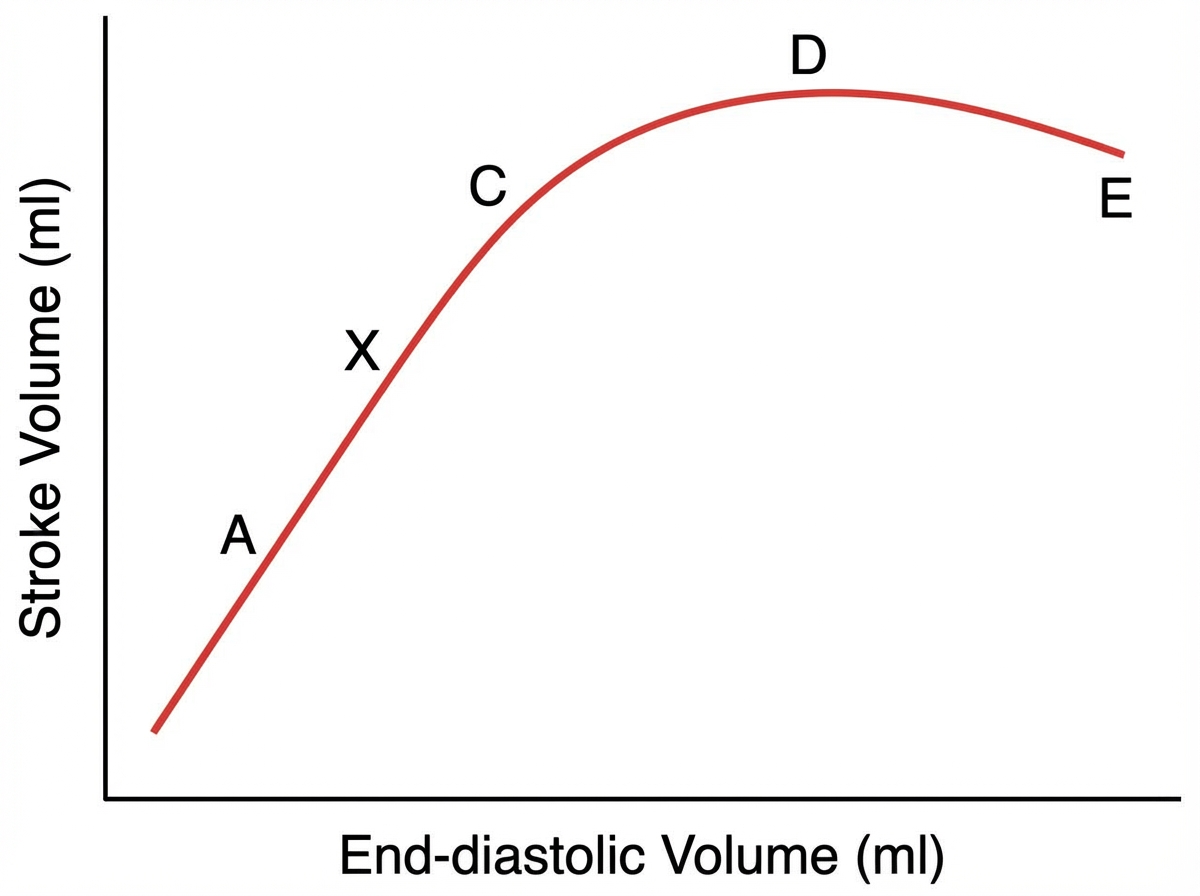
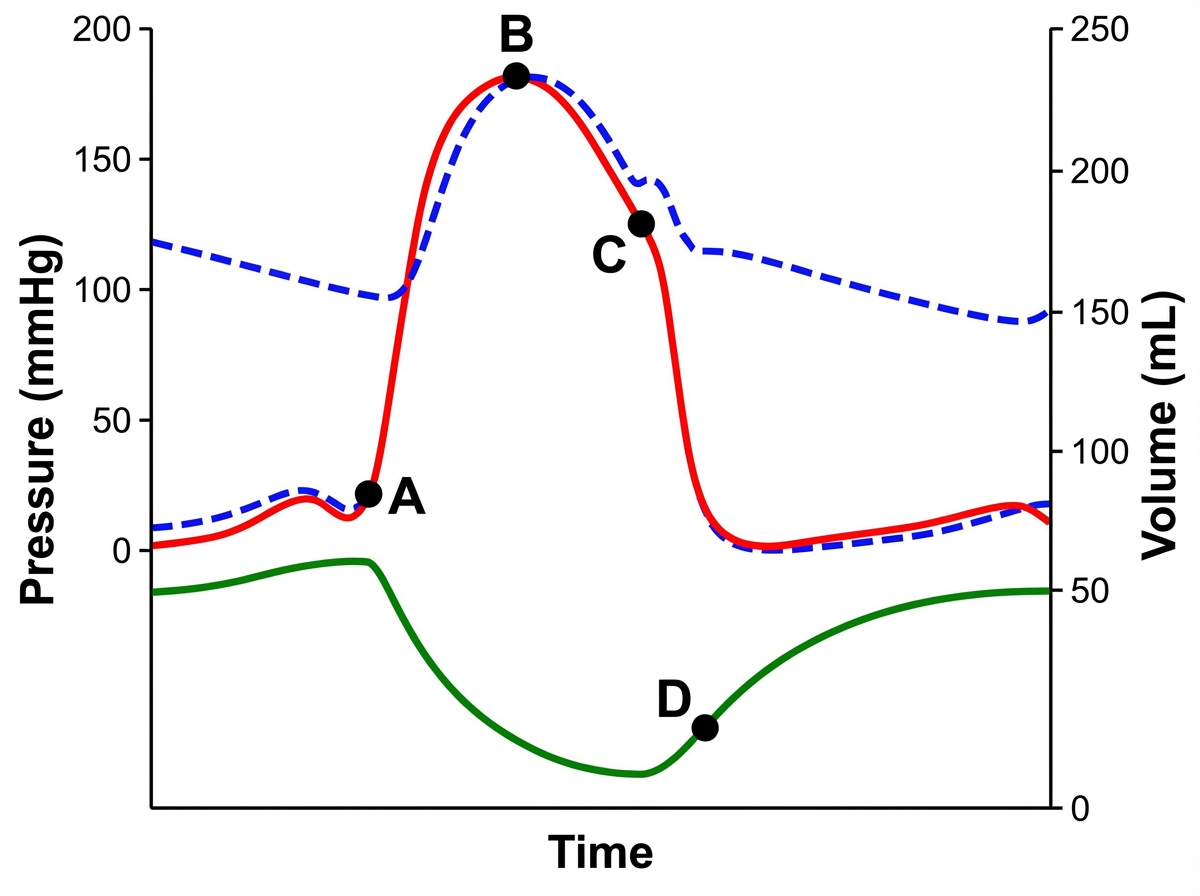
All of the following are obligate coronary vasodilators except?
A person stands up. Compared with the recumbent position, what happens to the cardiovascular system 1 minute after standing?
At rest, blood flow is maximum in which organ?
Poiseuille-Hagen law is related to which of the following?
Which of the following statements regarding the SA node is false?
Blood turbulence is increased in which of the following situations?
Which of the following is not a feature of cardiac muscle?
Which of the following is NOT an ECG finding of hypokalemia?
Which heart sound is produced during the closure of the semilunar valves?
Second heart sound (S2) occurs during which phase of the cardiac cycle?
Explanation: **Explanation:** The regulation of coronary blood flow is primarily governed by local metabolic factors. An **obligate vasodilator** is a substance or condition that consistently produces vasodilation under physiological and pharmacological conditions. **Why Acetylcholine (Option D) is the correct answer:** Acetylcholine is considered a **conditional vasodilator**, not an obligate one. Its effect depends entirely on the integrity of the vascular endothelium: * **Intact Endothelium:** Acetylcholine stimulates the release of Nitric Oxide (EDRF), leading to vasodilation. * **Damaged Endothelium (e.g., Atherosclerosis):** Acetylcholine acts directly on the muscarinic receptors ($M_3$) of the vascular smooth muscle, causing **vasoconstriction**. In the context of NEET-PG, this "dual action" makes it the exception among the listed obligate vasodilators. **Analysis of Incorrect Options:** * **Nitroglycerine (Option A):** A potent exogenous donor of Nitric Oxide. It acts directly on smooth muscle to cause vasodilation regardless of endothelial health. * **Nitric Oxide (Option B):** The primary endogenous gasotransmitter that mediates smooth muscle relaxation via the cGMP pathway. It is a fundamental vasodilator. * **Hypoxia and Hypercapnia (Option C):** These are the most potent **metabolic regulators** of coronary flow. Decreased $O_2$ and increased $CO_2$ (along with Adenosine) are obligate triggers for coronary vasodilation to meet myocardial oxygen demand. **High-Yield Clinical Pearls for NEET-PG:** * **Most potent metabolic vasodilator:** Adenosine (followed by Hypoxia). * **Coronary Steal Phenomenon:** Occurs with potent vasodilators (like Dipyridamole) where blood is diverted from ischemic zones to non-ischemic zones. * **Endothelial Dysfunction Test:** Intracoronary acetylcholine injection is used in the cath lab to diagnose Prinzmetal (variant) angina; it triggers spasm in diseased segments but dilation in healthy ones.
Explanation: **Explanation:** When a person moves from a recumbent (lying down) to a standing position, the primary physiological challenge is **gravity**. **1. Why the Correct Answer is Right:** Upon standing, gravity causes blood to pool in the highly distensible (compliant) veins of the lower extremities. Approximately 500–1000 mL of blood shifts downward. This increases the **volume of blood in the leg veins**, leading to an increase in capillary hydrostatic pressure and subsequent dependent edema if prolonged. **2. Why the Incorrect Options are Wrong:** * **Cardiac Preload (C):** Due to venous pooling in the legs, venous return to the heart decreases. This leads to a **decrease** in end-diastolic volume (preload), not an increase. * **Cardiac Contractility (D):** The drop in preload reduces mean arterial pressure, triggering the **baroreceptor reflex**. This reflex increases sympathetic outflow, which **increases** heart rate and myocardial contractility to compensate for the reduced stroke volume. * **Skin Blood Flow (A):** Sympathetic activation causes peripheral vasoconstriction (via $\alpha_1$ receptors) to maintain blood pressure. This results in **decreased** blood flow to the skin and splanchnic circulation. **High-Yield NEET-PG Pearls:** * **The Baroreceptor Reflex:** This is the immediate compensatory mechanism for orthostatic hypotension. It results in increased Total Peripheral Resistance (TPR) and Heart Rate. * **Orthostatic Hypotension:** Defined as a drop in systolic BP >20 mmHg or diastolic BP >10 mmHg within 3 minutes of standing. * **Muscle Pump:** Contraction of leg muscles (e.g., walking) is the most effective way to counteract venous pooling by compressing deep veins and propelling blood toward the heart.
Explanation: **Explanation:** The correct answer is **Kidney**. In medical physiology, blood flow to organs is analyzed in two ways: absolute flow (mL/min) and specific flow (mL/min per 100g of tissue). At rest, the **Kidneys** receive the highest absolute blood flow among the options provided, accounting for approximately **20-25% of the total Cardiac Output** (about 1100–1200 mL/min). This high flow is not required for the metabolic demands of the renal tissue itself, but rather to maintain a high Glomerular Filtration Rate (GFR) for effective waste excretion and electrolyte balance. **Analysis of Incorrect Options:** * **Heart:** While the heart has a high oxygen extraction rate, it only receives about **4-5%** of cardiac output (250 mL/min) at rest. * **Brain:** The brain receives approximately **13-15%** of cardiac output (750 mL/min). It is sensitive to flow changes but receives less than the kidneys. * **Skin:** Cutaneous blood flow is highly variable for thermoregulation but remains low (approx. **5%**) under resting, thermoneutral conditions. **High-Yield NEET-PG Pearls:** 1. **Highest Absolute Flow:** Liver (approx. 1500 mL/min via Hepatic artery + Portal vein), followed closely by the Kidneys. *Note: If Liver is not an option, Kidney is the standard answer.* 2. **Highest Specific Flow (per 100g):** **Carotid Body** (2000 mL/min/100g), followed by the Kidney (400 mL/min/100g). 3. **Highest Oxygen Extraction (A-V O2 difference):** **Heart** (extracts ~75% of delivered oxygen). 4. **Skeletal Muscle:** Receives the highest percentage of cardiac output **during heavy exercise** (up to 80%), though it receives only 15-20% at rest.
Explanation: **Explanation:** The **Poiseuille-Hagen Law** (often simply called Poiseuille’s Law) describes the relationship between the flow rate of a fluid, the pressure gradient, and the resistance within a cylindrical tube. In physiology, it is the fundamental principle governing the **rate of blood flow** through the vascular system. The law is expressed by the formula: **$Q = \frac{\Delta P \cdot \pi \cdot r^4}{8 \cdot \eta \cdot L}$** *(Where $Q$ = Flow rate, $\Delta P$ = Pressure gradient, $r$ = Radius, $\eta$ = Viscosity, and $L$ = Length)* **Why the correct answer is right:** The equation demonstrates that the rate of blood flow ($Q$) is directly proportional to the pressure difference and the **fourth power of the radius**. This makes the vessel radius the most significant determinant of blood flow and peripheral resistance. **Analysis of incorrect options:** * **A. Airflow resistance:** While Poiseuille’s law can technically apply to laminar airflow in the airways, it is primarily categorized under hemodynamics in medical physiology. Airflow is more commonly associated with **Rohrer’s equation** or the **Reynolds number** (to determine turbulence). * **C. Measurement of blood pressure:** Blood pressure is measured using sphygmomanometry (Korotkoff sounds). While Poiseuille’s law helps explain *why* pressure changes (due to resistance), it is not a method for measurement. **High-Yield Clinical Pearls for NEET-PG:** 1. **The Power of 4:** Because flow is proportional to $r^4$, doubling the radius increases the blood flow **16-fold**. This is why small changes in arteriolar diameter (vasoconstriction/dilation) have massive effects on systemic blood pressure. 2. **Viscosity ($\eta$):** Blood flow is inversely proportional to viscosity. In **Polycythemia**, increased viscosity decreases flow; in **Anemia**, decreased viscosity increases flow. 3. **Laminar vs. Turbulent Flow:** Poiseuille’s law applies only to **laminar flow**. If flow becomes turbulent (high Reynolds number), resistance increases significantly.
Explanation: ### Explanation **1. Why Option A is the correct (False) statement:** The Sinoatrial (SA) node is anatomically located in the **upper part of the sulcus terminalis**, at the junction of the **superior vena cava and the right atrium**. It is subepicardial in location. It is **not** located near the ascending aorta. Understanding the precise anatomical landmarks of the conduction system is high-yield for NEET-PG, as questions often swap the SVC junction with the aorta or the inferior vena cava. **2. Analysis of Incorrect Options (True statements):** * **Option B:** The SA node consists of **specialized nodal cardiac muscle fibers** (P-cells) that are smaller than ordinary atrial myocytes and contain fewer myofibrils. * **Option C:** In approximately **60% of individuals**, the SA node is supplied by the **SA nodal artery**, which is a branch of the **Right Coronary Artery (RCA)**. In the remaining 40%, it arises from the Left Circumflex Artery. * **Option D:** The SA node is the **primary pacemaker** of the heart because it possesses the highest intrinsic rate of spontaneous depolarization (60–100 bpm), thereby initiating the cardiac conduction cycle. **3. Clinical Pearls & High-Yield Facts:** * **Prepotential (Pacemaker Potential):** The SA node's resting membrane potential is unstable. The "funny" sodium current ($I_f$) is responsible for the spontaneous diastolic depolarization. * **Blood Supply:** Occlusion of the RCA (often in Inferior Wall MI) can lead to SA node dysfunction and sinus bradycardia. * **Innervation:** While it initiates its own impulses, the SA node is richly supplied by the Vagus nerve (parasympathetic) and sympathetic fibers to modulate the heart rate.
Explanation: ### Explanation The occurrence of blood turbulence is governed by **Reynold’s Number (Re)**, a dimensionless quantity used to predict whether blood flow is laminar or turbulent. The formula is: $$Re = \frac{\rho \cdot v \cdot d}{\eta}$$ *(Where $\rho$ = density, $v$ = velocity, $d$ = vessel diameter, and $\eta$ = viscosity)* Turbulence increases when the Reynold’s number exceeds **2000–3000**. **Why Anemia is the Correct Answer:** In anemia, two primary factors drive turbulence: 1. **Decreased Viscosity ($\eta$):** Due to a lower concentration of red blood cells, the blood becomes "thinner." Since viscosity is in the denominator, a decrease in $\eta$ leads to an increase in $Re$. 2. **Increased Velocity ($v$):** To compensate for low oxygen-carrying capacity, the heart increases cardiac output (hyperdynamic circulation), raising the flow velocity. The combination of low viscosity and high velocity significantly predisposes the patient to turbulent flow, often manifesting clinically as **hemic murmurs**. **Analysis of Incorrect Options:** * **Polycythemia (C):** This condition involves an overproduction of RBCs, which significantly **increases blood viscosity**. Higher viscosity stabilizes flow and decreases the Reynold’s number, making turbulence less likely. * **Multiple Myeloma (A) & Leukemia (B):** Both conditions typically lead to **hyperviscosity syndromes**. In Multiple Myeloma, excess paraproteins (immunoglobulins) increase plasma viscosity. In Leukemia, a massive increase in the white blood cell count (leukostasis) increases viscosity. Both would decrease the likelihood of turbulence compared to anemia. **High-Yield Clinical Pearls for NEET-PG:** * **Bruit:** Turbulent flow in an artery that can be heard via a stethoscope (e.g., Carotid bruit). * **Thrills:** Turbulent flow that is palpable on the skin surface. * **Critical Velocity:** The velocity at which laminar flow converts to turbulent flow. * **Most common site of turbulence:** The proximal aorta and pulmonary artery during ejection.
Explanation: **Explanation:** The correct answer is **A. Tetany**. **1. Why Tetany is not a feature of cardiac muscle:** Tetany is a state of sustained muscular contraction caused by high-frequency stimulation. Cardiac muscle is **incapable of tetany** due to its **long absolute refractory period (ARP)**, which lasts almost as long as the entire mechanical contraction (systole). Because the muscle cannot be re-excited until it has started to relax, summation of contractions is impossible. This is a vital protective mechanism that ensures the heart always has time to relax and fill with blood between beats. **2. Analysis of Incorrect Options:** * **B. All or none phenomenon:** Cardiac muscle functions as a **functional syncytium** due to gap junctions. If a stimulus is above threshold, the entire myocardium (atrial or ventricular) contracts as a single unit. * **C. Pacemaker potential:** Also known as "pre-potential," this is a characteristic of specialized auto-rhythmic cells (like the SA node). It involves a slow spontaneous depolarization (primarily via $I_f$ "funny" sodium channels) that allows the heart to beat intrinsically. * **D. Length-tension relationship:** This is the basis of the **Frank-Starling Law**. Within physiological limits, an increase in initial muscle fiber length (Preload) leads to an increase in the force of contraction. **High-Yield Clinical Pearls for NEET-PG:** * **ARP Duration:** In ventricular muscle, the ARP is approximately **250 ms**, compared to only 1–3 ms in skeletal muscle. * **Calcium Source:** Unlike skeletal muscle, cardiac muscle relies on **Extracellular Calcium** entering through L-type calcium channels (Trigger Calcium) for Calcium-Induced Calcium Release (CICR). * **Metabolism:** Cardiac muscle is strictly aerobic and has a very high mitochondrial density.
Explanation: **Explanation:** In hypokalemia (low serum potassium), the resting membrane potential of cardiac cells becomes more negative (hyperpolarized), and the duration of the action potential increases. This primarily affects the **repolarization phase** of the cardiac cycle, leading to characteristic ECG changes. **Why ST elevation is the correct answer:** Hypokalemia typically causes **ST-segment depression**, not elevation. ST elevation is a hallmark of myocardial infarction (STEMI), Prinzmetal angina, or pericarditis. In hypokalemia, the delayed repolarization results in a downward shift of the ST segment. **Analysis of incorrect options (Findings seen in Hypokalemia):** * **Flat T waves (Option C) & Absent T waves (Option A):** As potassium levels drop, the T wave amplitude decreases. It first becomes flattened and may eventually disappear or become inverted as the repolarization process is impaired. * **Prominent U wave (Option D):** This is the most characteristic finding. The U wave (representing delayed repolarization of Purkinje fibers) becomes larger than the T wave, often creating a "pseudo-prolonged QT interval" (actually a QU interval). **NEET-PG High-Yield Pearls:** 1. **Hypokalemia Sequence:** T-wave flattening → ST depression → Prominent U waves → Prolonged PR interval. 2. **Hyperkalemia Sequence:** Tall tented T waves → Loss of P wave → Widened QRS → "Sine wave" pattern → Asystole. 3. **The "QU" Interval:** In hypokalemia, the T and U waves may fuse, leading to a false diagnosis of long QT syndrome. 4. **Clinical Risk:** Hypokalemia increases the risk of Digoxin toxicity and can trigger Torsades de Pointes.
Explanation: **Explanation:** The cardiac cycle produces distinct sounds primarily due to the vibration of tissues and blood following the closure of heart valves. **Why "Dub" is correct:** The second heart sound (**S2**), phonetically described as **"Dub,"** is produced by the sudden closure of the **semilunar valves** (Aortic and Pulmonary valves) at the beginning of ventricular diastole. When the pressure in the ventricles falls below the pressure in the great arteries, blood attempts to flow back into the heart, snapping the semilunar cusps shut. This creates high-frequency vibrations that characterize S2. **Analysis of Incorrect Options:** * **A. Lub:** This refers to the first heart sound (**S1**). It is caused by the closure of the **Atrioventricular (AV) valves** (Mitral and Tricuspid) at the onset of ventricular systole. It is longer and lower-pitched than S2. * **C. Lub Dub:** This represents a complete cardiac cycle (S1 followed by S2), rather than a specific sound associated with a single valve event. * **D. Lub Dub Shhh:** The "Shhh" sound typically represents a **cardiac murmur**, which is caused by turbulent blood flow due to valvular stenosis or regurgitation, rather than normal physiological valve closure. **High-Yield Clinical Pearls for NEET-PG:** * **Physiological Splitting:** S2 is often heard as two components (**A2 followed by P2**) during inspiration because increased venous return delays the closure of the pulmonary valve. * **Duration:** S1 lasts ~0.14 seconds, while S2 is shorter, lasting ~0.11 seconds. * **Best Listening Area:** S2 is best heard at the base of the heart (2nd intercostal space). * **S3 & S4:** These are usually pathological in adults; S3 is associated with rapid ventricular filling (ventricular gallop), and S4 is associated with atrial contraction against a stiff ventricle (atrial gallop).
Explanation: **Explanation:** The **Second Heart Sound (S2)** is produced by the closure of the semilunar valves (Aortic and Pulmonary) at the end of ventricular systole. **1. Why Protodiastole is Correct:** Protodiastole is the very first stage of ventricular diastole, lasting approximately 0.04 seconds. It represents the brief interval between the end of ventricular contraction and the closure of the semilunar valves. As the ventricles begin to relax, intraventricular pressure drops below the pressure in the aorta and pulmonary artery. This pressure gradient causes a brief reversal of blood flow toward the heart, which snaps the semilunar valves shut, generating the **S2** sound. **2. Why the Other Options are Incorrect:** * **Isovolumetric Relaxation:** This phase begins *immediately after* the semilunar valves close. During this stage, all four valves are closed, and ventricular pressure falls rapidly without any change in volume. * **First Rapid Filling:** This occurs after the AV valves open (when ventricular pressure falls below atrial pressure). It is associated with the **S3** heart sound, not S2. * **Diastasis:** This is the period of slow ventricular filling. It is the longest phase of the cardiac cycle and occurs before atrial contraction. **High-Yield Clinical Pearls for NEET-PG:** * **S2 Splitting:** S2 has two components: **A2** (Aortic) and **P2** (Pulmonary). Physiological splitting occurs during inspiration because increased venous return delays P2. * **Fixed Splitting of S2:** A classic sign of **Atrial Septal Defect (ASD)**. * **Hanging-edge effect:** The delay between the crossover of pressure and actual valve closure is what defines the protodiastolic period. * **Duration of Cardiac Cycle:** At a heart rate of 75 bpm, the total cycle is 0.8s (Systole 0.3s, Diastole 0.5s). Protodiastole is the shortest phase of diastole.
Cardiac Electrophysiology
Practice Questions
Cardiac Cycle
Practice Questions
Cardiac Output and Its Regulation
Practice Questions
Hemodynamics and Blood Flow
Practice Questions
Arterial System Physiology
Practice Questions
Microcirculation and Lymphatics
Practice Questions
Venous Return and Central Venous Pressure
Practice Questions
Cardiovascular Reflexes
Practice Questions
Regional Circulations
Practice Questions
Cardiovascular Responses to Exercise and Stress
Practice Questions
Get full access to all questions, explanations, and performance tracking.
Start For Free