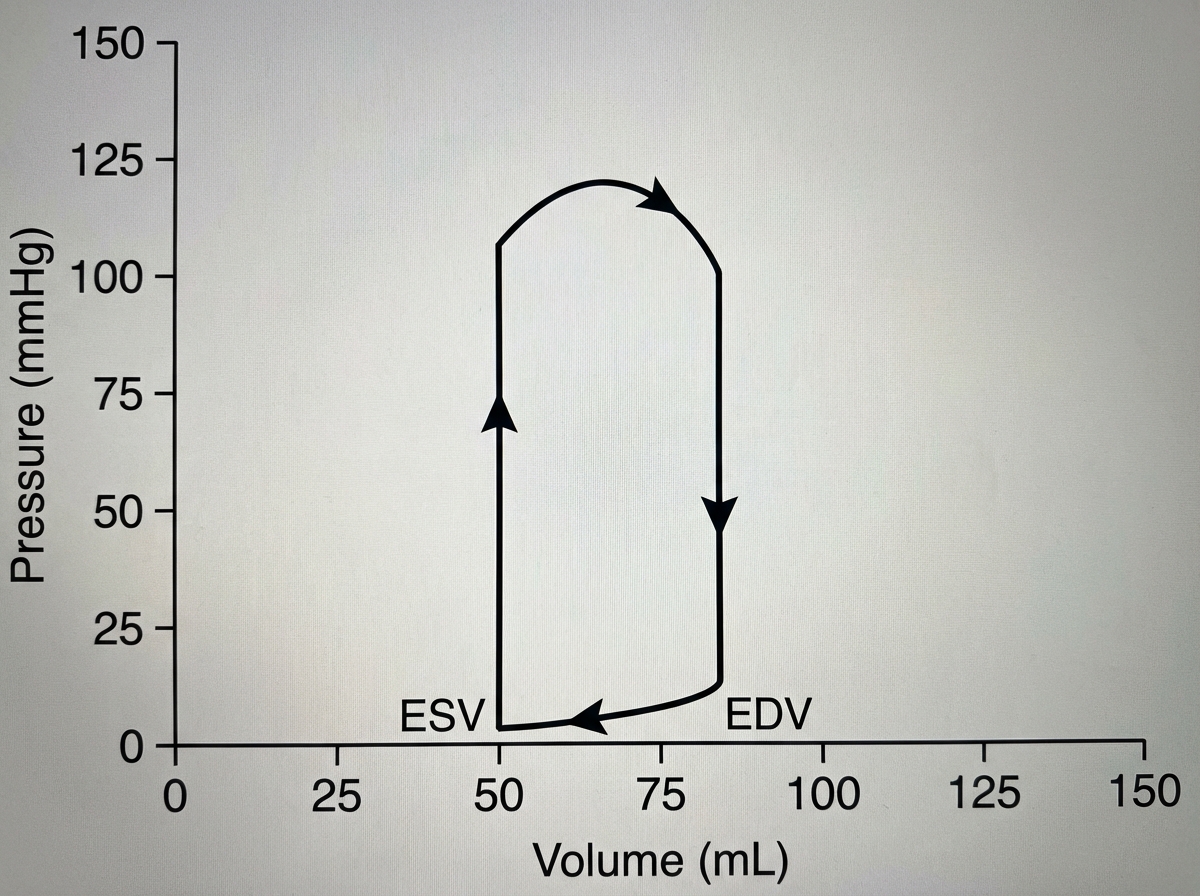
At rest, what amount of oxygen is transferred from blood to tissues?
Which of the following is NOT a feature of T wave changes in ECG in hypokalemia?
What causes the normal atrioventricular (AV) delay of 0.1 seconds?
Chemoreceptors operate between which pressure range?
Blood flow through a vessel varies directly with which of the following?
All of the following statements about the third heart sound (S3) are true, except?
In a patient with a cardiac output of 5 liters/min and a body surface area of 1.7 square meters, what is the cardiac index?
Greatest resistance in peripheral blood circulation is due to:
What is the autonomic supply to the SA node?
What is the mean circulatory filling pressure?
Explanation: ### Explanation The correct answer is **A. 250 ml/min**. **1. Why it is correct:** Oxygen consumption ($VO_2$) at rest is determined by the difference between the arterial oxygen content and the venous oxygen content, multiplied by the Cardiac Output (Fick’s Principle). * **Arterial $O_2$ content ($CaO_2$):** ~20 ml/dL * **Mixed Venous $O_2$ content ($CvO_2$):** ~15 ml/dL * **Arteriovenous $O_2$ difference:** 5 ml/dL (meaning 5 ml of $O_2$ is extracted for every 100 ml of blood). * **Resting Cardiac Output:** ~5 L/min (50 dL/min). * **Calculation:** $50 \text{ dL/min} \times 5 \text{ ml/dL} = \mathbf{250 \text{ ml/min}}$. **2. Why the other options are incorrect:** * **B (500 ml/min):** This value is too high for resting conditions but may be seen during light-to-moderate physical activity. * **C & D (750–1000 ml/min):** These values represent oxygen delivery ($DO_2$) rather than consumption. Total oxygen delivery to tissues at rest is approximately 1000 ml/min ($20 \text{ ml/dL} \times 50 \text{ dL/min}$). Only about 25% of this delivered oxygen is actually extracted by tissues at rest. **3. High-Yield Clinical Pearls for NEET-PG:** * **Utilization Coefficient:** At rest, this is approximately **0.25 (25%)**, meaning tissues extract only a quarter of the available oxygen. During strenuous exercise, this can increase to 75–85%. * **The Heart Exception:** The myocardium is the most efficient extractor; it has a high resting extraction ratio (~70–80%), meaning it cannot significantly increase extraction during stress and must rely on increasing coronary blood flow. * **Basal Metabolic Rate (BMR):** $VO_2$ is a primary surrogate measure for BMR.
Explanation: **Explanation:** In **hypokalemia** (low serum potassium levels), the resting membrane potential of cardiac cells becomes more negative, and the duration of the action potential increases. This primarily affects the repolarization phase (Phase 3), leading to characteristic ECG changes. **Why "Tall T wave" is the correct answer:** Tall, peaked T waves are a hallmark of **Hyperkalemia**, not hypokalemia. In hyperkalemia, the increased extracellular potassium increases the conductance of delayed rectifier K+ channels, shortening the action potential and causing the T wave to become narrow and "tented." Therefore, a tall T wave is NOT a feature of hypokalemia. **Analysis of other options (Features of Hypokalemia):** * **Flat T wave:** As potassium levels drop (typically <3.0 mEq/L), the T wave amplitude decreases, becoming flattened. * **Inverted T wave:** In severe hypokalemia, the T wave may become completely inverted due to altered repolarization sequences. * **Peaked T wave:** While "peaked" usually refers to hyperkalemia, some texts use it to describe the prominent **U waves** seen in hypokalemia, which can sometimes be mistaken for T waves. However, in the context of this question, "Tall/Peaked T waves" as a primary morphology is the classic differentiator for hyperkalemia. **NEET-PG High-Yield Pearls for Hypokalemia ECG:** 1. **ST-segment depression:** Often the first sign. 2. **Decreased T wave amplitude:** Flattening or inversion. 3. **Prominent U waves:** The most characteristic sign (best seen in V2-V4). 4. **Apparent Prolonged QU interval:** Often mistaken for a long QT interval because the T and U waves fuse. 5. **Mnemonic:** "Hypo-low" (Low ST, Low T, but High U).
Explanation: The **AV nodal delay** (approximately 0.1 seconds) is a critical physiological mechanism that allows the atria to finish contracting and empty blood into the ventricles before ventricular systole begins. ### Why Option C is Correct The primary reason for the slow conduction through the AV node is a **decrease in the number of gap junctions** between the myocytes in the nodal tissue. Gap junctions are low-resistance bridges (composed of connexins) that allow ions to flow between cells. A lower density of these junctions increases the longitudinal resistance to current flow, thereby slowing the velocity of the action potential. Additionally, the fibers in the AV node are smaller in diameter, further increasing resistance. ### Why Other Options are Incorrect * **Option A:** While the rate of rise ($V_{max}$) of the action potential is slower in the AV node (due to calcium-dependent depolarization), the delay is primarily a function of cell-to-cell connectivity, not just the amplitude of the firing. * **Option B:** While electrical resistance is involved, it is specifically the **increased resistance at the cell-to-cell junctions** (due to fewer gap junctions) rather than the internal resistance of the myocyte cytoplasm itself. * **Option D:** Tight junctions (zonula occludens) function as barriers to prevent fluid movement between cells; they do not play a role in electrical conduction. Electrical coupling is the exclusive domain of gap junctions. ### High-Yield NEET-PG Pearls * **Total Delay:** The total delay from the SA node to the ventricles is **0.16 seconds** (0.03s to reach AV node + 0.13s total nodal/bundle delay). * **Conduction Velocity:** The AV node has the **slowest** conduction velocity (~0.01–0.05 m/s), while the Purkinje system has the **fastest** (~2–4 m/s). * **Autonomic Influence:** Parasympathetic (vagal) stimulation increases the AV delay (negative dromotropy) by further decreasing conduction velocity.
Explanation: **Explanation:** The peripheral chemoreceptors (located in the carotid and aortic bodies) are primarily sensitive to a decrease in $PO_2$, an increase in $PCO_2$, and a decrease in pH. However, they also play a crucial role in blood pressure regulation through the **Chemoreceptor Reflex**. **Why Option B is Correct:** The chemoreceptor reflex is not active under normal physiological blood pressure. It is considered an "emergency mechanism" that kicks in when the Mean Arterial Pressure (MAP) falls below the threshold of the baroreceptor reflex. Specifically, when blood pressure drops below **80–100 mm Hg**, blood flow to the chemoreceptor bodies decreases, leading to local hypoxia and hypercapnia within the receptors. This stimulates the vasomotor center to cause peripheral vasoconstriction, helping to raise blood pressure. The reflex is most potent and active between **40 and 100 mm Hg**. **Analysis of Incorrect Options:** * **Option A:** While chemoreceptors are active below 90 mm Hg, this range is too narrow. They remain functional and vital down to 40 mm Hg. * **Options C & D:** These ranges (70–150 and 70–220 mm Hg) are more characteristic of the **Baroreceptor Reflex**, which is the primary short-term regulator of blood pressure. Baroreceptors are most sensitive at a MAP of around 100 mm Hg and operate between 60 and 180 mm Hg. **High-Yield Clinical Pearls for NEET-PG:** * **Hierarchy of Reflexes:** Baroreceptors are the "First line of defense" (60–180 mm Hg), Chemoreceptors are the "Second line" (40–100 mm Hg), and the **CNS Ischemic Response** is the "Last ditch stand" (active below 60 mm Hg, most powerful below 20 mm Hg). * **Location:** Carotid bodies are located at the bifurcation of the common carotid artery (innervated by Hering’s nerve/CN IX); Aortic bodies are in the aortic arch (innervated by CN X). * **Key Stimulus:** The most potent stimulus for peripheral chemoreceptors is a **decrease in $PO_2$** (hypoxia).
Explanation: ### Explanation The relationship between blood flow, pressure, and resistance is defined by **Ohm’s Law of Hemodynamics**, which is expressed by the formula: **$Q = \Delta P / R$** *(Where $Q$ = Blood Flow, $\Delta P$ = Pressure Gradient, and $R$ = Resistance)* **Why the Correct Answer is Right:** According to the formula, blood flow ($Q$) is **directly proportional** to the pressure difference ($\Delta P$) between the two ends of a vessel. This means that as the pressure gradient increases, the volume of blood flowing through the vessel per unit of time also increases. Pressure is the driving force that overcomes resistance to maintain circulation. **Why the Other Options are Wrong:** To understand the incorrect options, we look at **Poiseuille’s Equation**, which defines Resistance ($R$): $R = \frac{8\eta L}{\pi r^4}$ *(Where $\eta$ = Viscosity, $L$ = Length, and $r$ = Radius)* * **A. Resistance:** Flow is **inversely proportional** to resistance ($Q \propto 1/R$). Higher resistance leads to decreased flow. * **B. Viscosity ($\eta$):** Flow is **inversely proportional** to viscosity. For example, in polycythemia (increased viscosity), blood flow decreases. * **C. Length of the vessel ($L$):** Flow is **inversely proportional** to the length. The longer the vessel, the greater the friction and resistance, which reduces flow. --- ### High-Yield Clinical Pearls for NEET-PG * **The Radius Factor:** The most critical determinant of blood flow is the **vessel radius ($r$)**. Since $Q \propto r^4$, doubling the radius increases blood flow **16-fold**. This is the physiological basis for how arterioles control systemic vascular resistance. * **Series vs. Parallel:** Resistance is highest in the **arterioles** (the "stopcocks" of circulation). * **Turbulent Flow:** When the **Reynolds number** exceeds 2000-3000, flow becomes turbulent (producing murmurs or bruits), and the linear relationship between flow and pressure gradient is lost.
Explanation: ### Explanation The third heart sound (S3) is a low-pitched, mid-diastolic sound that occurs during the **rapid ventricular filling phase**. It is caused by the sudden deceleration of blood flow into a compliant or dilated ventricle, leading to vibrations of the ventricular walls. **1. Why Option A is the "Except" (Correct Answer):** The question asks for the statement that is **not** true. However, Option A ("Occurs due to rapid ventricular filling") is a **true** statement regarding the physiology of S3. In the context of "Except" questions in NEET-PG, if the provided key marks A as the answer, it implies a technicality in the question's phrasing or a focus on the pathological vs. physiological nature. *Note: In standard physiology, S3 is indeed caused by rapid filling; if this is the designated answer, it suggests the question intended to ask for a false statement, but all options provided are technically true.* **2. Analysis of Other Options:** * **Option B (Mitral Regurgitation):** True. MR causes volume overload of the left ventricle. The increased volume returning to the ventricle during diastole creates a loud S3. * **Option C (ASD):** True. ASD leads to right-sided volume overload. The increased flow across the tricuspid valve during the rapid filling phase produces a right-sided S3. * **Option D (VSD):** True. Large VSDs cause left-to-right shunting, leading to increased pulmonary venous return and left ventricular volume overload, which manifests as an S3. **3. Clinical Pearls for NEET-PG:** * **Physiological S3:** Normal in children, young adults (<40 years), and during pregnancy. * **Pathological S3 (Ventricular Gallop):** The most specific sign of **Left Ventricular Failure** (CHF). * **Best heard:** At the apex with the **bell** of the stethoscope in the left lateral decubitus position. * **Kussmaul’s Sign:** S3 associated with Constrictive Pericarditis is often called a **Pericardial Knock**. * **Mnemonic:** S3 occurs after S2 (S1-S2-S3) and sounds like the cadence of "Ken-tuck-y."
Explanation: ### Explanation **1. Understanding the Correct Answer (A)** The **Cardiac Index (CI)** is a hemodynamic parameter that relates the Cardiac Output (CO) to a patient’s Body Surface Area (BSA). It is a more accurate clinical indicator than cardiac output alone because it accounts for the individual's body size. The formula for Cardiac Index is: $$\text{Cardiac Index (CI)} = \frac{\text{Cardiac Output (CO)}}{\text{Body Surface Area (BSA)}}$$ **Calculation:** * Given CO = 5 L/min * Given BSA = 1.7 m² * $CI = 5 / 1.7 \approx 2.94 \text{ L/min/m}^2$ Rounding to the nearest whole number, the answer is **3 L/min/m²**. **2. Analysis of Incorrect Options** * **Option B (4 L/min/m²):** This value is higher than the calculated result and represents a hyperdynamic state (e.g., sepsis or thyrotoxicosis). * **Option C (5 L/min/m²):** This incorrectly equates the Cardiac Output value with the Cardiac Index, ignoring the BSA correction. * **Option D (2.5 L/min/m²):** While this is within the lower limit of the normal physiological range, it does not match the mathematical calculation provided in the prompt. **3. Clinical Pearls & High-Yield Facts** * **Normal Range:** The normal Cardiac Index is typically **2.5 to 4.0 L/min/m²**. * **Clinical Significance:** A CI below **2.2 L/min/m²** is a diagnostic hallmark of **cardiogenic shock**. * **BSA Calculation:** In clinical practice, BSA is most commonly calculated using the **Mosteller formula** or the **DuBois formula**. * **NEET-PG Tip:** Remember that while CO changes with posture and exercise, the CI allows for a standardized comparison between a small child and a large adult.
Explanation: **Explanation:** The correct answer is **Arterioles**. Resistance to blood flow is governed by **Poiseuille’s Law**, which states that resistance is inversely proportional to the fourth power of the radius ($R \propto 1/r^4$). Arterioles are known as the **"resistance vessels"** of the body. While they have a smaller radius than arteries, their primary significance lies in their thick layer of smooth muscle. This allows them to undergo significant changes in diameter (vasoconstriction and vasodilation) under the influence of the sympathetic nervous system and local metabolites. This high muscular-to-lumen ratio creates the greatest drop in mean arterial pressure (approximately 50-60 mmHg) across the entire circulatory circuit. **Why other options are incorrect:** * **Arteries:** These are "conduit vessels" with large radii; therefore, they offer very low resistance to flow. * **Capillaries:** Although an individual capillary has a smaller radius than an arteriole, the **total cross-sectional area** of the capillary bed is massive. Because they are arranged in parallel, the total resistance offered by capillaries is lower than that of arterioles. * **Veins:** These are "capacitance vessels" that hold about 60-70% of the blood volume. They have thin walls and large lumens, offering minimal resistance. **NEET-PG High-Yield Pearls:** * **Site of maximum pressure drop:** Arterioles. * **Site of maximum total cross-sectional area:** Capillaries. * **Site of slowest blood flow velocity:** Capillaries (essential for nutrient exchange). * **Major determinant of Total Peripheral Resistance (TPR):** Arteriolar tone.
Explanation: **Explanation:** The Sinoatrial (SA) node is the primary pacemaker of the heart, located in the right atrium. While it possesses intrinsic automaticity, its firing rate is modulated by the **Autonomic Nervous System (ANS)**. **1. Why Option B is Correct:** The SA node receives a rich supply of sympathetic fibers (primarily via the right stellate ganglion). Sympathetic stimulation releases **Norepinephrine**, which acts on **$\beta_1$ receptors**. This increases the slope of the prepotential (pacemaker potential) by increasing $I_f$ (funny current) and $I_{Ca}$ (calcium current), leading to a faster heart rate (**positive chronotropic effect**). Thus, the sympathetic supply is strictly **excitatory** to the heart's rate. **2. Why Other Options are Incorrect:** * **Option A:** While the parasympathetic system (via the Vagus nerve) does supply the SA node, its effect is **inhibitory** (slowing the heart rate). * **Options C & D:** These are incorrect because the ANS does not have a singular effect. The sympathetic system is excitatory, while the parasympathetic system is inhibitory. They work antagonistically to maintain cardiovascular homeostasis. **Clinical Pearls for NEET-PG:** * **Vagal Tone:** At rest, the heart is under dominant parasympathetic (vagal) influence. This is why the resting heart rate (~70 bpm) is lower than the intrinsic SA node rate (~100 bpm). * **Right vs. Left:** The **Right Vagus** nerve primarily supplies the **SA node** (affects rate), while the **Left Vagus** primarily supplies the **AV node** (affects conduction velocity). * **Neurotransmitters:** Sympathetic = Norepinephrine ($\beta_1$ receptors); Parasympathetic = Acetylcholine ($M_2$ receptors).
Explanation: **Explanation:** **Mean Circulatory Filling Pressure (MCFP)** is a measure of the "fullness" of the entire circulatory system. It represents the pressure that would exist in the cardiovascular system if the heart were to stop and the pressures in all segments (arteries, capillaries, and veins) were allowed to equilibrate. 1. **Why Option D is Correct:** When the heart stops beating, the pressure gradient between the arterial and venous sides disappears. Blood redistributes from the high-pressure arterial system to the high-capacitance venous system until a uniform pressure is reached throughout the circuit. This equilibrium pressure is the MCFP (normally about **7 mmHg**). It is a key determinant of venous return; the higher the MCFP, the greater the pressure gradient driving blood back to the right atrium. 2. **Why Other Options are Incorrect:** * **Option A:** This describes a pressure gradient across the systemic and pulmonary circuits, not a static filling pressure. * **Option B:** This refers to the total systemic pressure gradient (Mean Arterial Pressure minus Central Venous Pressure), which drives organ perfusion during an active heartbeat. * **Option C:** Mean atrial pressure is a localized measurement. While Right Atrial Pressure (RAP) opposes venous return, MCFP is the force that promotes it. **High-Yield Clinical Pearls for NEET-PG:** * **Determinants:** MCFP is primarily influenced by **blood volume** and **venous tone** (vascular capacity). * **Shifts:** MCFP increases with fluid infusion or sympathetic stimulation (venoconstriction) and decreases with hemorrhage or spinal anesthesia (venodilation). * **Venous Return Equation:** Venous Return = (MCFP - RAP) / Resistance to Venous Return. * **Mean Systemic Filling Pressure (MSFP):** Often used interchangeably with MCFP, though technically MSFP excludes the pulmonary circulation. Numerically, they are almost identical.
Cardiac Electrophysiology
Practice Questions
Cardiac Cycle
Practice Questions
Cardiac Output and Its Regulation
Practice Questions
Hemodynamics and Blood Flow
Practice Questions
Arterial System Physiology
Practice Questions
Microcirculation and Lymphatics
Practice Questions
Venous Return and Central Venous Pressure
Practice Questions
Cardiovascular Reflexes
Practice Questions
Regional Circulations
Practice Questions
Cardiovascular Responses to Exercise and Stress
Practice Questions
Get full access to all questions, explanations, and performance tracking.
Start For Free