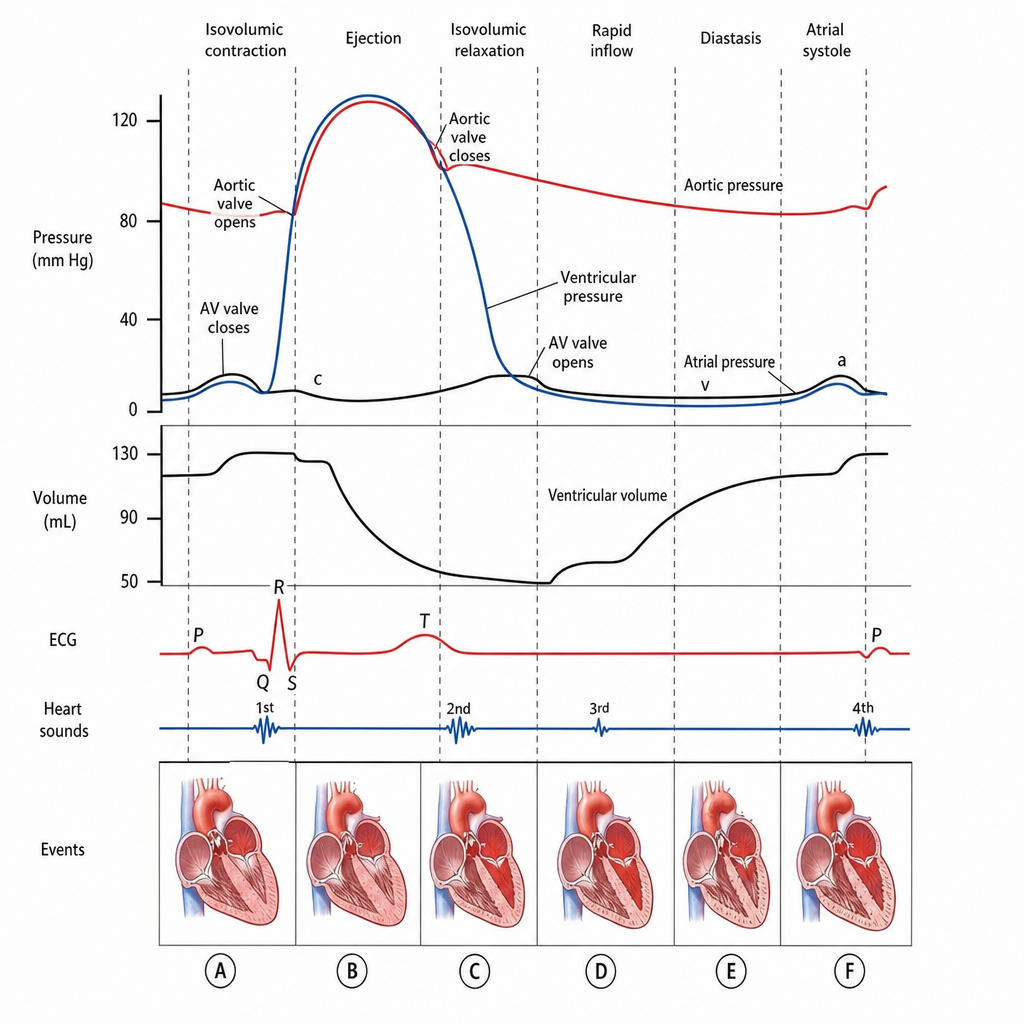
Which of the following factors is associated with a decrease in chronic hypertension?
Which part of the cardiac conduction system conducts electrical impulses the fastest?
The "incisura" of the arterial pulse corresponds to:
Which wave in the jugular venous pulse represents the atrial relaxation?
The isovolumic relaxation phase of the cardiac cycle ends with which event?
Preload to the heart depends upon which of the following?
What does the PR interval in an ECG denote?
Which of the following statements regarding Purkinje fibers is true?
The 'vulnerable period' during cardiac excitation coincides with which of the following?
During shock, which organ is spared from vasoconstriction?
Explanation: **Explanation:** **Correct Answer: C. Nitric Oxide** Nitric Oxide (NO) is a potent endogenous **vasodilator** synthesized from L-arginine by the enzyme endothelial Nitric Oxide Synthase (eNOS). In the cardiovascular system, NO diffuses into vascular smooth muscle cells, activating soluble guanylyl cyclase, which increases cGMP levels. This leads to smooth muscle relaxation and vasodilation, thereby **decreasing peripheral resistance and blood pressure**. In chronic hypertension, there is often "endothelial dysfunction" characterized by reduced NO bioavailability; conversely, increasing NO levels or sensitivity helps counteract hypertensive states. **Why other options are incorrect:** * **A & B (Aldosterone & Angiotensin II):** These are key components of the Renin-Angiotensin-Aldosterone System (RAAS). Angiotensin II is a powerful vasoconstrictor, and Aldosterone promotes sodium and water retention. Both factors **increase** blood pressure and are primary drivers of chronic hypertension. * **D (Reduced sympathetic nerve activity):** While reduced sympathetic activity would lower blood pressure, it is **not typically "associated" with the pathophysiology of chronic hypertension**. In fact, chronic hypertension is characterized by *increased* sympathetic drive (sympatho-excitation), which contributes to sustained elevation of vascular tone. **High-Yield Clinical Pearls for NEET-PG:** * **Mechanism of NO:** Acts via the **cGMP pathway** (unlike many hormones that use cAMP or IP3). * **Pharmacology Link:** Drugs like Nitroglycerin and Sodium Nitroprusside act as "Nitric Oxide donors" to treat hypertensive emergencies. * **ANP/BNP:** Like NO, Atrial Natriuretic Peptide also works via cGMP to decrease blood pressure through vasodilation and natriuresis.
Explanation: **Explanation:** The speed of electrical conduction in the heart varies significantly across different tissues to ensure coordinated contraction. The **Purkinje fibers** exhibit the fastest conduction velocity in the heart, measured at approximately **2.0 to 4.0 m/s**. **Why Purkinje fibers are the fastest:** This high velocity is due to a high density of **gap junctions** (low electrical resistance) and a large fiber diameter. Rapid conduction is physiologically essential to ensure that the entire ventricular myocardium depolarizes almost simultaneously, allowing for a synchronized and forceful ventricular contraction (systole). **Analysis of Incorrect Options:** * **Sinoatrial Node (SAN):** The primary pacemaker. It has a relatively slow conduction velocity (~0.05 m/s) as its main role is impulse generation, not rapid transmission. * **Atrioventricular Node (AVN):** This is the **slowest** part of the conduction system (~0.01 to 0.05 m/s). This "AV nodal delay" is crucial as it allows the atria to finish contracting and filling the ventricles before ventricular contraction begins. * **Bundle of His:** While faster than the AV node (~1.0 m/s), it serves as the intermediary bridge and does not reach the peak speeds seen in the terminal Purkinje system. **High-Yield NEET-PG Pearls:** * **Order of Conduction Velocity (Fastest to Slowest):** **P**urkinje > **A**tria > **V**entricles > **A**V Node (Mnemonic: **"He Purks At Ventricles"** or **P-A-V-A**). * **Order of Pacemaker Rate (Highest to Lowest):** SA Node (70-80 bpm) > AV Node (40-60 bpm) > Purkinje fibers (15-40 bpm). * The delay at the AV node is approximately **0.13 seconds**.
Explanation: ### Explanation The **incisura** (also known as the dicrotic notch) is a sharp downward deflection followed by a small upward wave seen in the **aortic pressure curve**. **1. Why Option B is Correct:** The incisura occurs at the end of ventricular systole. As the left ventricle stops contracting, intraventricular pressure drops below aortic pressure. This causes a brief backflow of blood toward the heart, which snaps the **aortic valve closed**. This sudden cessation of backflow and the elastic recoil of the aorta create a momentary pressure fluctuation, manifesting as the incisura. It marks the transition from systole to diastole. **2. Why the Other Options are Incorrect:** * **Option A (First heart sound):** S1 is caused by the closure of the AV valves (Mitral and Tricuspid) at the beginning of systole, long before the incisura occurs. * **Option C (Isovolumetric relaxation):** While the incisura occurs just at the *start* of this phase, the incisura itself is specifically the mechanical signature of valve closure, not the entire phase of relaxation. * **Option D (Third heart sound):** S3 occurs during the rapid filling phase of early diastole, well after the aortic valve has closed. **3. High-Yield NEET-PG Pearls:** * **Incisura vs. Dicrotic Notch:** In central aortic pressure tracings, it is called the **incisura**. In peripheral arterial pulse tracings (like the radial artery), it is referred to as the **dicrotic notch**. * **Timing:** The incisura coincides with the **Second Heart Sound (S2)** on phonocardiography. * **Clinical Correlation:** In **Aortic Regurgitation**, the incisura is often absent or poorly defined because the valve fails to close properly, preventing the characteristic pressure rebound.
Explanation: ### Explanation The **Jugular Venous Pulse (JVP)** reflects the pressure changes in the right atrium during the cardiac cycle. Understanding the correlation between these waves and the mechanical events of the heart is crucial for NEET-PG. **Why Option D is Correct:** The **'x' descent** (specifically the $x_1$ descent) represents **atrial relaxation**. As the right atrium relaxes after contraction, the pressure within it drops, leading to the first downward deflection in the JVP. This is followed by the $x_2$ descent, which occurs during ventricular systole as the tricuspid valve is pulled downward toward the apex, further decreasing atrial pressure. **Why Other Options are Incorrect:** * **A wave:** Represents **atrial contraction**. It occurs just before the first heart sound (S1) and the 'p' wave on an ECG. * **C wave:** Represents the **bulging of the tricuspid valve** into the right atrium during the onset of ventricular systole (isovolumetric contraction). * **V wave:** Represents **passive atrial filling** against a closed tricuspid valve during ventricular systole. **High-Yield Clinical Pearls for NEET-PG:** * **Giant 'a' waves:** Seen in Tricuspid Stenosis, Pulmonary Hypertension, and Pulmonary Stenosis. * **Cannon 'a' waves:** Occur when the atrium contracts against a closed tricuspid valve (e.g., Complete Heart Block, Ventricular Tachycardia). * **Absent 'a' wave:** Characteristic of **Atrial Fibrillation**. * **Prominent 'v' wave:** Classic sign of **Tricuspid Regurgitation** (often associated with a "systolic thrill" in the neck). * **Friedreich’s Sign:** A steep 'y' descent seen in Constrictive Pericarditis.
Explanation: ### Explanation **1. Why Option B is Correct:** Isovolumic relaxation is the period during early diastole when the ventricles are relaxing, but the volume remains constant because all four heart valves are closed. This phase begins with the **closure of the semilunar valves** (Aortic/Pulmonary) and ends when the ventricular pressure drops below the atrial pressure. At this precise crossover point, the **Atrioventricular (AV) valves open**, allowing blood to flow from the atria into the ventricles, marking the start of the rapid filling phase. **2. Why the Other Options are Incorrect:** * **Option A (Peak of 'C' waves):** The 'c' wave in the jugular venous pulse occurs during **isovolumic contraction**, caused by the bulging of the tricuspid valve into the right atrium. * **Option C (Closure of the semilunar valve):** This event marks the **beginning** of the isovolumic relaxation phase, not the end. * **Option D (Beginning of the 'T' wave):** The T wave on an ECG represents ventricular repolarization. It begins during the **ejection phase**; the end of the T wave roughly coincides with the closure of the semilunar valves. **3. NEET-PG High-Yield Pearls:** * **Pressure Changes:** During isovolumic relaxation, ventricular pressure falls precipitously, but ventricular volume is at its lowest (End-Systolic Volume). * **Heart Sounds:** The **S2 heart sound** marks the beginning of this phase. * **JVP Correlation:** The **'v' wave** in the JVP reaches its peak just before the AV valves open (at the end of isovolumic relaxation). * **Duration:** It is the shortest phase of diastole but is highly energy-dependent (requires ATP for calcium reuptake into the sarcoplasmic reticulum).
Explanation: **Explanation:** **Preload** is defined as the initial stretching of the cardiac myocytes prior to contraction. According to the **Frank-Starling Law**, the force of heart contraction is directly proportional to the initial length of the muscle fiber. In a clinical context, preload is represented by the **End-Diastolic Volume (EDV)**. **Why Stroke Volume is the correct answer:** While EDV is the most accurate measure of preload, the options provided require identifying the most direct physiological consequence. According to the Frank-Starling mechanism, an increase in preload leads to an increase in **Stroke Volume (SV)**. In many physiological models and exam patterns, SV is used as a surrogate marker or a direct dependent variable of preload. As preload increases, the stroke volume increases (up to a physiological limit), making it the most appropriate choice among the given options. **Analysis of Incorrect Options:** * **A. End-diastolic pressure:** While related to EDV, pressure is not the same as volume. Due to changes in ventricular compliance (e.g., hypertrophy), pressure may rise without a corresponding increase in fiber stretch (preload). * **B. End-systolic pressure:** This is more closely related to **Afterload** and the contractility of the heart, representing the state after the blood has been ejected. * **D. Cardiac output:** While CO depends on SV (CO = SV × HR), it is a global measure of pump function influenced by heart rate and autonomic tone, making it less specific to preload than SV itself. **Clinical Pearls for NEET-PG:** * **Preload markers:** Left Ventricular End-Diastolic Volume (LVEDV) is the gold standard; Central Venous Pressure (CVP) is a clinical proxy for right-sided preload. * **Factors increasing Preload:** Hypervolemia, valvular regurgitation, and horizontal positioning. * **Factors decreasing Preload:** Diuretics, nitrates (venodilators), and hemorrhage.
Explanation: **Explanation:** The **PR interval** represents the time taken for an electrical impulse to travel from the SA node, through the atria, and across the AV node to the ventricles. It is measured from the beginning of the P wave to the beginning of the QRS complex. **1. Why the Correct Answer is Right:** The PR interval encompasses **atrial depolarization** (represented by the P wave) and the subsequent **AV nodal delay**. The AV nodal delay is a physiological pause that allows the ventricles to fill completely with blood before they contract. Therefore, the PR interval is the definitive marker of the time required for atrial activation and the conduction delay at the AV node. **2. Why Incorrect Options are Wrong:** * **Option A (Isovolumetric contraction):** This occurs during the early phase of ventricular systole, corresponding to the **QRS complex** and the beginning of the ST segment, after the PR interval has ended. * **Option B (Isovolumetric relaxation):** This occurs during early ventricular diastole, following the closure of the semilunar valves, which corresponds to the period after the **T wave**. **Clinical Pearls for NEET-PG:** * **Normal Duration:** 0.12 to 0.20 seconds (3–5 small squares). * **Short PR Interval:** Seen in **WPW Syndrome** (due to bundle of Kent bypassing the AV node) and Lown-Ganong-Levine syndrome. * **Prolonged PR Interval:** The hallmark of **First-degree Heart Block** (>0.20s). * **PR Segment vs. Interval:** The PR *segment* is the isoelectric line between the end of the P wave and the start of the QRS; it represents the AV nodal delay specifically. The *interval* includes the P wave.
Explanation: ### Explanation **Correct Answer: C. Purkinje fibers have a conduction velocity four times that of cardiac muscle.** **1. Why Option C is Correct:** Purkinje fibers are specialized conducting fibers that ensure the rapid, synchronous contraction of the ventricles. They possess the **highest conduction velocity** in the heart, measuring approximately **1.5 to 4.0 m/s**. In contrast, the conduction velocity of ventricular muscle is about **0.3 to 0.5 m/s**. Therefore, Purkinje fibers conduct impulses roughly **4 to 6 times faster** than ordinary cardiac muscle. This high speed is attributed to a high density of gap junctions and a large fiber diameter. **2. Why Other Options are Incorrect:** * **Option A:** Purkinje fibers are **not myelinated**. Myelin is a characteristic of the peripheral and central nervous systems. Purkinje fibers are modified cardiac muscle cells, not neurons. * **Option B:** The action potential duration in Purkinje fibers is actually **longer** than that of ventricular muscle, not shorter. This prolonged refractory period acts as a safety mechanism to prevent premature impulses (ectopics) from re-entering the conducting system. **3. NEET-PG High-Yield Pearls:** * **Conduction Velocity Hierarchy (Fastest to Slowest):** **P**urkinje fibers > **A**tria > **V**entricles > **A**V Node (**Mnemonic: "He Purks At Ventricles"**). * **AV Node Delay:** The slowest conduction occurs at the AV node (approx. 0.01 - 0.05 m/s), allowing for adequate ventricular filling. * **Pacemaker Hierarchy:** SA Node (60-100 bpm) > AV Node (40-60 bpm) > Purkinje system (15-40 bpm). * **Glycogen Content:** Purkinje fibers contain more glycogen and fewer myofibrils than ordinary cardiac myocytes, making them more resistant to hypoxia.
Explanation: ### Explanation The **vulnerable period** of the cardiac cycle refers to a brief interval during ventricular repolarization when the heart is highly susceptible to life-threatening arrhythmias (like Ventricular Fibrillation) if stimulated by an ectopic beat or external electrical shock. **1. Why "Peak of T wave" is correct:** Electrophysiologically, the vulnerable period coincides with the **middle and final third of the T wave** (specifically the peak and the descending limb). At this moment, some ventricular myocardial cells have fully repolarized, while others are still in their Relative Refractory Period (RRP). This **inhomogeneity of excitability** allows for re-entry circuits to form. If an impulse occurs here (the **R-on-T phenomenon**), it can trigger disorganized, rapid firing leading to fibrillation. **2. Why other options are incorrect:** * **PR interval:** Represents the time taken for atrial depolarization and AV nodal delay. It occurs during the resting phase of the ventricles, not repolarization. * **J-point:** This is the junction between the end of the QRS complex and the start of the ST segment. It represents the beginning of the plateau phase (Phase 2) of the action potential, where the heart is in the Absolute Refractory Period (ARP) and cannot be re-excited. * **U wave:** Thought to represent repolarization of the Purkinje fibers or papillary muscles. While associated with hypokalemia, it is not the primary vulnerable window for ventricular fibrillation. **3. NEET-PG High-Yield Pearls:** * **R-on-T Phenomenon:** A clinical scenario where a premature ventricular contraction (PVC) falls on the T wave of the preceding beat, often precipitating Torsades de Pointes or VF. * **Commotio Cordis:** Sudden death caused by a blunt, non-penetrating blow to the chest occurring exactly during the vulnerable period (T wave peak). * **Refractory Periods:** Remember that the **Absolute Refractory Period** ends mid-way through the T wave, transitioning into the **Relative Refractory Period** (the vulnerable window).
Explanation: In the state of shock, the body initiates a **compensatory sympathetic response** (mediated by catecholamines) to maintain blood pressure and prioritize perfusion to vital organs. This is known as the **"centralization of circulation."** ### Why the Heart is Spared The heart and the brain are the two primary organs spared from vasoconstriction during shock. This occurs due to: 1. **Autoregulation:** The coronary arteries have robust local metabolic autoregulatory mechanisms. When myocardial oxygen demand is high, local vasodilators (like adenosine, $H^+$, and $K^+$) override sympathetic vasoconstriction. 2. **Receptor Distribution:** While peripheral vessels are rich in $\alpha_1$ receptors (causing vasoconstriction), coronary vessels have a higher functional density of $\beta_2$ receptors, which promote vasodilation. ### Why Other Options are Incorrect * **Skin (A):** One of the first organs to undergo vasoconstriction via $\alpha_1$ receptors to divert blood to the core. This results in the clinical sign of "cold, clammy skin." * **Kidney (C):** Intense renal vasoconstriction occurs to preserve systemic BP. This reduces Glomerular Filtration Rate (GFR), leading to oliguria, a hallmark of progressing shock. * **Liver (D):** Splanchnic vasoconstriction reduces blood flow to the liver and gastrointestinal tract to prioritize the heart and brain. ### High-Yield NEET-PG Pearls * **The "Vital Duo":** In shock, blood flow is maintained only to the **Heart** and **Brain**. * **Coronary Perfusion:** Occurs primarily during **diastole**. In tachycardic shock states, the shortening of diastole can paradoxically threaten heart perfusion despite the lack of vasoconstriction. * **Irreversible Shock:** Occurs when prolonged vasoconstriction leads to tissue hypoxia, release of lysosomal enzymes, and "multi-organ dysfunction syndrome" (MODS).
Cardiac Electrophysiology
Practice Questions
Cardiac Cycle
Practice Questions
Cardiac Output and Its Regulation
Practice Questions
Hemodynamics and Blood Flow
Practice Questions
Arterial System Physiology
Practice Questions
Microcirculation and Lymphatics
Practice Questions
Venous Return and Central Venous Pressure
Practice Questions
Cardiovascular Reflexes
Practice Questions
Regional Circulations
Practice Questions
Cardiovascular Responses to Exercise and Stress
Practice Questions
Get full access to all questions, explanations, and performance tracking.
Start For Free