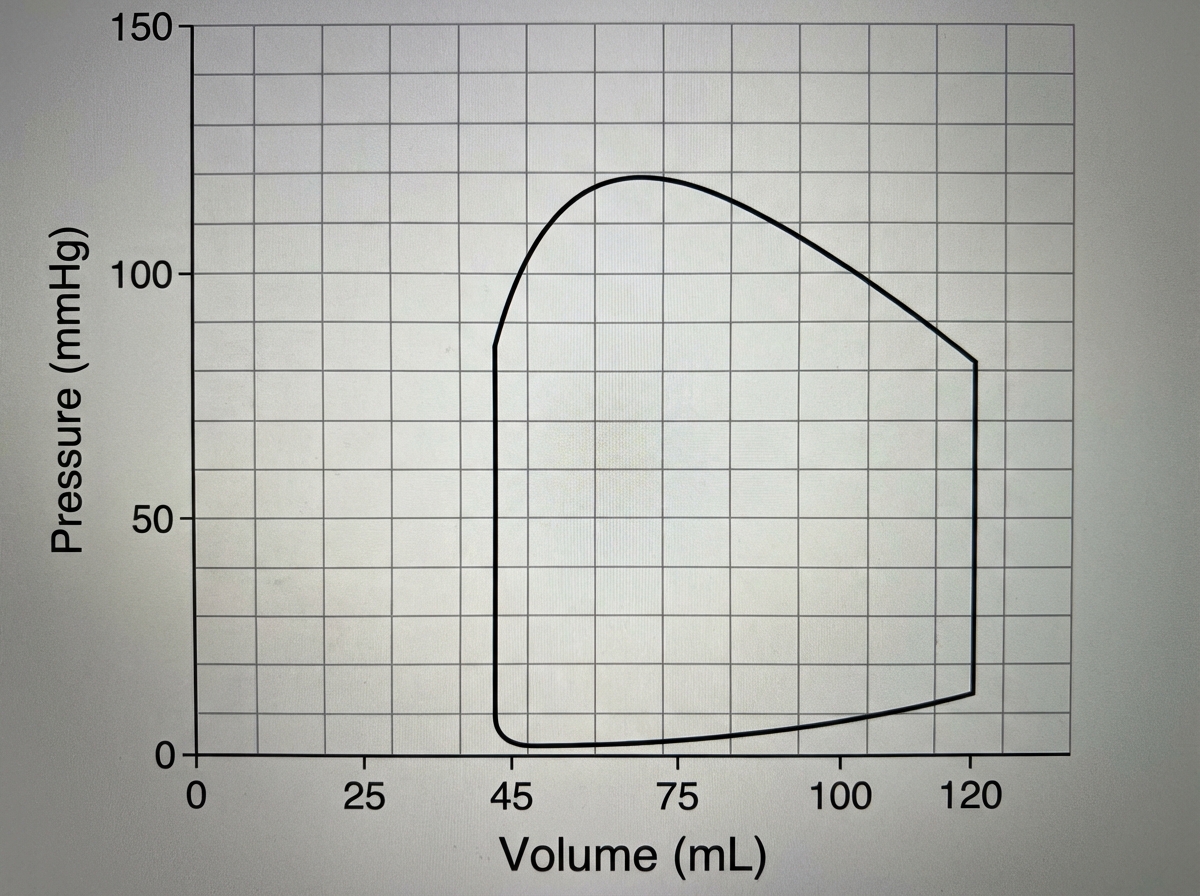
Korotkoff sounds are produced due to which of the following phenomena?
Preload is determined by which of the following?
Baroreceptors are located in which of the following structures?
Windkessel effect is seen in which type of blood vessel?
Conversion of fibrinogen to fibrin is catalyzed by which enzyme?
Atrial depolarization in an ECG is represented by which wave?
Binding of O2 to hemoglobin reduces its affinity for CO2 by which effect?
Thrombomodulin I is produced by all of the following EXCEPT?
What is the half-life of factor VIII?
Which of the following factors does not increase cardiac output?
Explanation: **Explanation:** The production of Korotkoff sounds is a fundamental concept in clinical blood pressure measurement. **Why Turbulent Flow is Correct:** Under normal conditions, blood flows through arteries in a **laminar (streamline)** fashion, which is silent. When a sphygmomanometer cuff is inflated above systolic pressure, the artery is occluded. As the cuff is slowly deflated, the pressure drops just below the systolic level, allowing blood to jet through the partially constricted vessel. This high-velocity blood flow becomes **turbulent**, causing vibrations in the arterial wall that we hear as **Korotkoff sounds**. Once the cuff pressure falls below diastolic pressure, the artery remains fully open, laminar flow resumes, and the sounds disappear. **Analysis of Incorrect Options:** * **A. Streamline flow:** Also known as laminar flow, this is silent. It occurs when blood moves in parallel layers without disruption. * **B. Increased viscosity:** Viscosity actually *decreases* the likelihood of turbulence (as per Reynolds number). Higher viscosity makes flow more stable and silent. * **C. Murmur:** While both involve turbulence, "murmurs" specifically refer to sounds produced within the heart or great vessels due to valvular defects or septal openings, not the peripheral arterial sounds heard during BP measurement. **High-Yield Clinical Pearls for NEET-PG:** * **Reynolds Number ($Re$):** Determines the transition from laminar to turbulent flow. $Re = (\text{Density} \times \text{Velocity} \times \text{Diameter}) / \text{Viscosity}$. Turbulence typically occurs when $Re > 2000$. * **Phase I Korotkoff:** First appearance of clear tapping sounds (Systolic BP). * **Phase V Korotkoff:** Disappearance of sounds (Diastolic BP in adults). * **Auscultatory Gap:** A period of silence between Phase I and II, often seen in hypertensive patients; failure to recognize it can lead to underestimating systolic BP.
Explanation: ### Explanation **1. Why End-Diastolic Volume (EDV) is Correct:** Preload is defined as the **degree of stretch** on the ventricular myocardial fibers at the end of diastole, just before contraction begins. According to the **Frank-Starling Law**, the force of ventricular contraction is proportional to the initial length of the muscle fiber. In a clinical and physiological context, the most direct surrogate measure for this initial stretch is the **End-Diastolic Volume (EDV)**—the amount of blood remaining in the ventricle at the end of the filling phase. As EDV increases, the ventricular walls stretch further, increasing the preload. **2. Why the Other Options are Incorrect:** * **End-Systolic Volume (ESV):** This is the volume of blood remaining in the ventricle *after* contraction. While ESV can influence the subsequent filling phase, it represents the heart's "emptiness" rather than the "stretch" before contraction. * **Ventricular Ejection Volume (Stroke Volume):** This is the volume of blood pumped out during one beat (EDV - ESV). Stroke Volume is a *result* of preload, contractility, and afterload, rather than being the determinant of preload itself. **3. Clinical Pearls & High-Yield Facts for NEET-PG:** * **Determinants of Preload:** Preload is primarily influenced by **venous return**. Factors increasing preload include exercise, hypervolemia, and deep inspiration. * **Preload vs. Afterload:** While Preload is "stretch" (EDV), **Afterload** is the "resistance" the heart must pump against (represented by Mean Arterial Pressure or Total Peripheral Resistance). * **Clinical Measurement:** In clinical practice, Central Venous Pressure (CVP) is often used as an estimate of right ventricular preload, while Pulmonary Capillary Wedge Pressure (PCWP) estimates left ventricular preload. * **LaPlace’s Law:** Wall tension (Preload) is proportional to (Pressure × Radius) / (2 × Wall Thickness).
Explanation: **Explanation:** The **Carotid Sinus** is the correct answer because it is a specialized neuroanatomical structure specifically designed for **baroreception** (pressure sensing). It is a localized dilation at the bifurcation of the Common Carotid Artery (at the level of the upper border of the thyroid cartilage). These receptors are **stretch-sensitive mechanoreceptors** that respond to changes in arterial wall tension. When blood pressure rises, the firing rate of the glossopharyngeal nerve (CN IX) increases, leading to a reflex decrease in sympathetic outflow and an increase in parasympathetic tone to lower blood pressure. **Why other options are incorrect:** * **Carotid Body (Option A):** This is a **chemoreceptor**, not a baroreceptor. It is located behind the carotid bifurcation and senses changes in arterial $PO_2$, $PCO_2$, and pH. * **Aortic Body (Option C):** Similar to the carotid body, these are peripheral **chemoreceptors** located on the arch of the aorta. While the **Aortic Arch** contains baroreceptors, the Aortic *Body* is dedicated to chemical sensing. **High-Yield Clinical Pearls for NEET-PG:** * **Innervation:** Carotid sinus baroreceptors are supplied by the **Hering’s nerve** (branch of CN IX), while Aortic arch baroreceptors are supplied by the **Aortic nerve** (branch of CN X). * **Sensitivity:** The carotid sinus is more sensitive than the aortic arch; it responds to pressures between **60–180 mmHg**. * **Clinical Correlation:** **Carotid Sinus Hypersensitivity** can lead to syncope during minor stimulation (e.g., shaving or wearing a tight collar) due to excessive vagal discharge. * **Resetting:** In chronic hypertension, baroreceptors "reset" to a higher set point, meaning they maintain the high pressure rather than correcting it.
Explanation: **Explanation:** The **Windkessel effect** refers to the ability of large elastic arteries (like the Aorta) to act as a pressure reservoir. 1. **Why Option A is correct:** During ventricular systole, the large elastic arteries distend to accommodate the stroke volume, storing potential energy in their elastic walls. During diastole, when the heart is relaxing and the aortic valve is closed, these walls undergo **elastic recoil**. This recoil converts potential energy back into kinetic energy, squeezing the blood forward. This ensures a **continuous blood flow** to the periphery even during diastole and prevents systolic blood pressure from rising too high or diastolic pressure from falling too low. 2. **Why other options are incorrect:** * **Capillaries:** These are exchange vessels with no elastic tissue; flow here is slow and non-pulsatile. * **Capacitance vessels:** This term refers to **Veins**, which hold the majority of blood volume (approx. 60-70%) due to high distensibility but do not exhibit the Windkessel recoil effect. * **Venules:** These are small collecting vessels that lead from capillaries to veins and lack the significant elastic component required for this effect. **High-Yield Clinical Pearls for NEET-PG:** * **Compliance:** The Windkessel effect is dependent on arterial compliance. In **Atherosclerosis** or aging, compliance decreases (vessels stiffen), leading to an increase in pulse pressure. * **Resistance Vessels:** Arterioles are known as resistance vessels (the primary site of peripheral resistance), whereas large arteries are **Conductance/Elastic vessels**. * **Dichrotic Notch:** The elastic recoil of the aorta contributes to the formation of the dicrotic notch on the arterial pressure waveform.
Explanation: **Explanation:** The conversion of fibrinogen to fibrin is the final step of the common pathway in the coagulation cascade. **1. Why Thrombin is correct:** Thrombin (Activated Factor II) is a serine protease that acts directly on the soluble plasma protein **fibrinogen (Factor I)**. It cleaves fibrinopeptides from the fibrinogen molecule, converting it into **fibrin monomers**. These monomers then spontaneously polymerize to form a loose fibrin mesh (the blood clot). **2. Why the other options are incorrect:** * **Prothrombin (Factor II):** This is the inactive zymogen precursor of thrombin. It must be converted to thrombin by the prothrombinase complex (Xa, Va, Ca²⁺, and phospholipids) before it can act on fibrinogen. * **Factor XIII (Fibrin Stabilizing Factor):** While Factor XIII is involved in this stage, it does not catalyze the conversion itself. Instead, it acts *after* thrombin has formed fibrin monomers to create covalent cross-links between them, stabilizing the clot into a "hard" clot. * **Kallikrein:** This enzyme is part of the kinin system and the intrinsic pathway (activating Factor XII). It also converts plasminogen to plasmin (fibrinolysis), which is the opposite of clot formation. **NEET-PG High-Yield Pearls:** * **Thrombin’s Dual Role:** Thrombin is unique because it acts as a pro-coagulant (converting fibrinogen to fibrin) but also as an anti-coagulant when bound to **thrombomodulin**, where it activates Protein C. * **Vitamin K Dependency:** Factors II, VII, IX, and X require Vitamin K for γ-carboxylation. * **Rate-limiting step:** The formation of the prothrombinase complex is often considered the critical step in the common pathway.
Explanation: **Explanation:** The correct answer is **A. P wave**. In the cardiac cycle, the **P wave** represents **atrial depolarization**. This electrical event is initiated by the SA node (the primary pacemaker) and spreads through the internodal pathways to both the right and left atria. This depolarization precedes atrial contraction (atrial systole). **Analysis of Incorrect Options:** * **B. QRS complex:** Represents **ventricular depolarization**. It is larger than the P wave because the ventricular muscle mass is significantly greater than the atrial mass. Note: Atrial repolarization occurs during this time but is masked by the QRS complex. * **C. T wave:** Represents **ventricular repolarization**. It is a positive deflection because the last cells to depolarize (epicardium) are the first to repolarize. * **D. U wave:** A small wave following the T wave, thought to represent the repolarization of **Purkinje fibers** or papillary muscles. **High-Yield Clinical Pearls for NEET-PG:** * **P wave duration:** Normally <0.12 seconds (3 small squares). * **P mitrale:** A notched, wide P wave in Lead II, indicating **Left Atrial Enlargement** (often due to Mitral Stenosis). * **P pulmonale:** A tall, peaked P wave (>2.5 mm) in Lead II, indicating **Right Atrial Enlargement** (often due to Cor Pulmonale). * **Absent P waves:** Classically seen in **Atrial Fibrillation** (replaced by f-waves) or Hyperkalemia (atrial standstill).
Explanation: **Explanation:** The correct answer is **B. Haldane effect**. The **Haldane Effect** describes how the oxygenation of hemoglobin in the lungs promotes the dissociation of carbon dioxide ($CO_2$). When $O_2$ binds to hemoglobin, the molecule becomes more acidic. This conformational change reduces its affinity for $CO_2$ and causes the release of $H^+$ ions. These $H^+$ ions then react with bicarbonate ($HCO_3^-$) to form carbonic acid, which dissociates into $H_2O$ and $CO_2$, allowing $CO_2$ to be exhaled. Essentially, **$O_2$ displacement of $CO_2$** occurs in the lungs. **Analysis of Incorrect Options:** * **A. Bohr’s Effect:** This is the opposite physiological process occurring at the **tissue level**. It describes how increased $CO_2$ and $H^+$ (acidity) decrease hemoglobin’s affinity for $O_2$, facilitating oxygen unloading to metabolically active tissues. * **C. Chloride Shift (Hamburger Phenomenon):** This refers to the exchange of bicarbonate ($HCO_3^-$) for chloride ($Cl^-$) ions across the RBC membrane to maintain electrical neutrality during $CO_2$ transport. * **D. Ohm’s Effect:** This is a distractor related to physics (Ohm’s Law: $V=IR$). In cardiovascular physiology, a similar principle applies to hemodynamics ($Q = \Delta P/R$), but it has no relation to gas binding. **High-Yield Clinical Pearls for NEET-PG:** * **Mnemonic:** **H**aldane effect happens in the **H**eart/Lungs (Oxygenation helps $CO_2$ release); **B**ohr effect happens in the **B**ody tissues (Acidity helps $O_2$ release). * The Haldane effect is quantitatively more important in promoting $CO_2$ transport than the Bohr effect is in promoting $O_2$ transport. * In patients with chronic COPD, administering high-flow oxygen can worsen hypercapnia partly due to the Haldane effect (displacing $CO_2$ from hemoglobin into the blood).
Explanation: **Explanation:** Thrombomodulin is a high-affinity transmembrane receptor for thrombin, primarily expressed on the surface of vascular endothelial cells. Its primary physiological role is to convert thrombin from a procoagulant enzyme into an anticoagulant activator. When thrombin binds to thrombomodulin, it activates **Protein C**, which then inactivates Factors Va and VIIIa, thereby inhibiting clot formation. **Why Cerebral Circulation is the Correct Answer:** While thrombomodulin is expressed by the endothelium of most blood vessels throughout the body (including the splanchnic, skin, and muscle beds), it is **notably absent or expressed at extremely low levels** in the microvasculature of the **brain (cerebral circulation)**. This regional deficiency is a critical physiological feature; it is believed that the brain relies on different mechanisms for hemostasis, and the lack of thrombomodulin may contribute to the high risk of fibrin deposition and thrombosis in certain cerebrovascular pathologies. **Analysis of Incorrect Options:** * **Splanchnic, Skin, and Muscle circulation:** These are major systemic vascular beds where endothelial cells express high levels of thrombomodulin to maintain a thromboresistant surface and prevent intravascular coagulation under normal physiological conditions. **High-Yield Clinical Pearls for NEET-PG:** * **Mechanism:** Thrombin + Thrombomodulin complex → Activates Protein C → Inactivates Factors Va & VIIIa (with Protein S as a cofactor). * **Soluble Thrombomodulin:** Can be measured in plasma as a marker of widespread endothelial damage (e.g., in DIC or severe sepsis). * **Location Exception:** Remember that the **Cerebral microvessels** and the **Placental syncytiotrophoblasts** (in specific contexts) are the high-yield exceptions regarding standard endothelial expression patterns.
Explanation: ### Explanation **Correct Answer: B. 8-12 hours** **Medical Concept:** Factor VIII (Anti-hemophilic factor) is a critical glycoprotein in the intrinsic pathway of the coagulation cascade. It acts as a cofactor for Factor IXa in the activation of Factor X. In the circulation, Factor VIII is non-covalently bound to **von Willebrand Factor (vWF)**, which stabilizes it and protects it from rapid proteolytic degradation. The biological half-life of Factor VIII in a healthy individual is typically **8 to 12 hours**. This duration is clinically significant as it dictates the dosing frequency (usually twice daily) for replacement therapy in patients with Hemophilia A. **Analysis of Incorrect Options:** * **A. 2-4 hours:** This is too short for Factor VIII. However, the half-life of Factor VII (the shortest of all clotting factors) is approximately 4–6 hours. * **C. 6 minutes:** This is extremely short and does not correspond to any major clotting factor. For comparison, the half-life of Epinephrine in plasma is roughly 1–3 minutes. * **D. 60 days:** This is far too long for plasma proteins. This duration is more characteristic of the lifespan of certain cells or the half-life of specific drugs/isotopes. **High-Yield Clinical Pearls for NEET-PG:** * **Shortest Half-life:** Factor VII (4–6 hours). This is why the Prothrombin Time (PT) is the first to prolong in acute liver failure or Vitamin K deficiency. * **Longest Half-life:** Factor XIII (approx. 5–10 days) or Fibrinogen (3–5 days). * **Site of Synthesis:** Unlike most clotting factors synthesized solely in the liver, Factor VIII is primarily produced in the **sinusoidal endothelial cells** of the liver and extrahepatic endothelial cells. * **Hemophilia A:** An X-linked recessive deficiency of Factor VIII. Replacement therapy aims to maintain trough levels above 1% to prevent spontaneous bleeding.
Explanation: **Explanation:** Cardiac Output (CO) is the product of **Stroke Volume (SV)** and **Heart Rate (HR)** ($CO = SV \times HR$). Stroke volume is further determined by three primary factors: Preload, Afterload, and Contractility. **Why Afterload is the correct answer:** **Afterload** is defined as the resistance against which the heart must pump to eject blood (primarily determined by systemic vascular resistance). According to the **force-velocity relationship**, as afterload increases, the velocity of muscle shortening decreases. This leads to an increase in End-Systolic Volume (ESV) and a subsequent **decrease in Stroke Volume**. Therefore, an increase in afterload reduces cardiac output, making it the only factor among the options that does not increase it. **Why the other options are incorrect:** * **Preload:** According to the **Frank-Starling Law**, an increase in venous return (preload) increases the initial stretching of cardiomyocytes, leading to a more forceful contraction and increased Stroke Volume. * **Heart Rate:** Since $CO = SV \times HR$, an increase in heart rate (within physiological limits) directly increases cardiac output. * **Myocardial Contractility:** An increase in inotropy (e.g., via sympathetic stimulation) allows the heart to eject a larger fraction of its volume, increasing Stroke Volume and CO. **High-Yield Clinical Pearls for NEET-PG:** * **LaPlace’s Law:** Wall Tension = $(Pressure \times Radius) / (2 \times Wall\ Thickness)$. This explains why the heart hypertrophies in response to chronic high afterload (hypertension). * **Anrep Effect:** A sudden increase in afterload causes a small, delayed increase in inotropy to compensate for the initial drop in SV. * **Bowditch Effect (Treppe):** An increase in heart rate leads to increased force of contraction due to calcium accumulation in the sarcoplasm.
Cardiac Electrophysiology
Practice Questions
Cardiac Cycle
Practice Questions
Cardiac Output and Its Regulation
Practice Questions
Hemodynamics and Blood Flow
Practice Questions
Arterial System Physiology
Practice Questions
Microcirculation and Lymphatics
Practice Questions
Venous Return and Central Venous Pressure
Practice Questions
Cardiovascular Reflexes
Practice Questions
Regional Circulations
Practice Questions
Cardiovascular Responses to Exercise and Stress
Practice Questions
Get full access to all questions, explanations, and performance tracking.
Start For Free