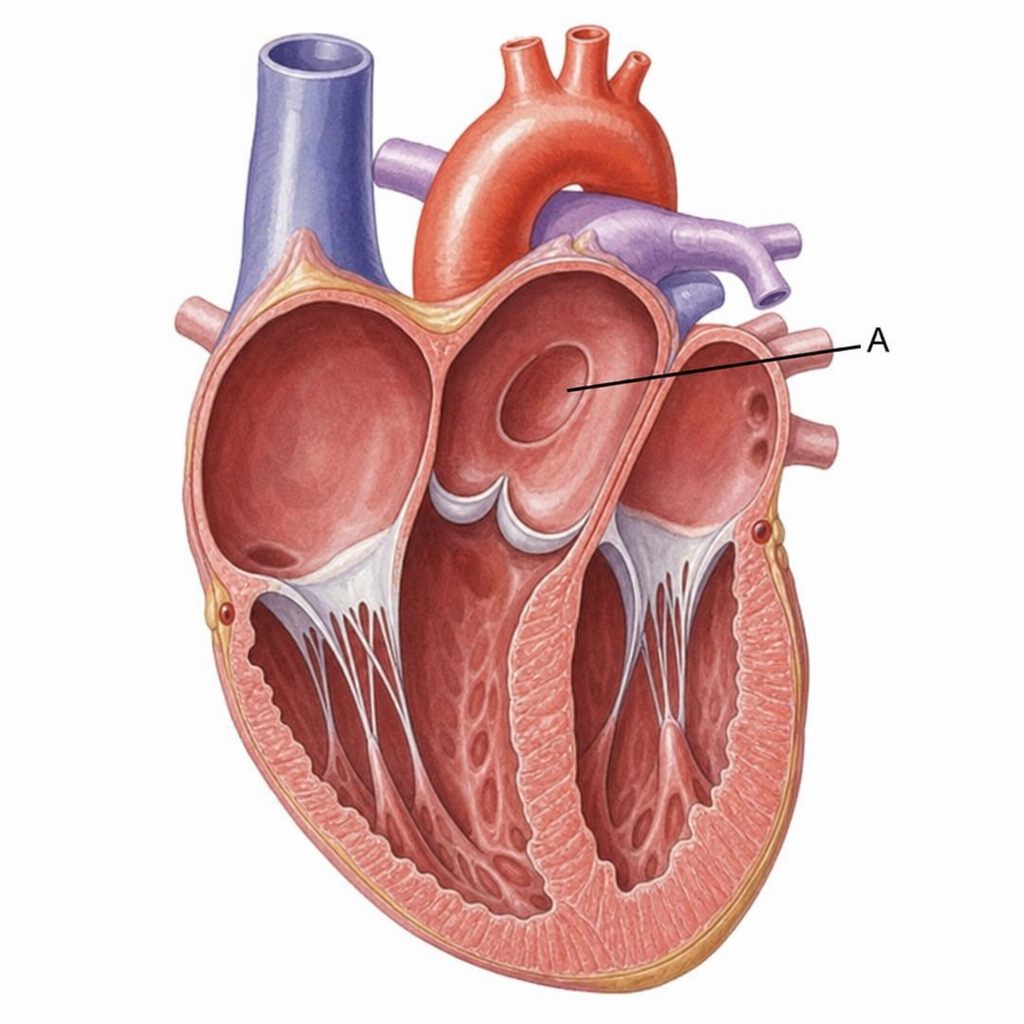
What is the most important function of the microcirculation?
Which of the following changes do NOT occur in the vessels in Raynaud's disease?
Isovolumetric relaxation precedes which of the following events in the cardiac cycle?
What is the primary site of red blood cell formation in a healthy 20-year-old male?
The right atrium chronic overload is indicated by a P wave of more than what amplitude?
What is pulse pressure?
Which of the following is true regarding cardiac oxygen demand?
What is the chemical structure of hemoglobin?
What is the primary role of the baroreceptor reflex?
A hospitalized patient has an ejection fraction of 0.4, a heart rate of 95 beats/min, and a cardiac output of 3.5 L/min. What is the patient's end-diastolic volume?
Explanation: **Explanation** The microcirculation, consisting of arterioles, capillaries, and venules, serves as the functional unit of the cardiovascular system. **1. Why Option A is Correct:** The primary physiological objective of the entire circulatory system is to maintain the internal environment of tissues. The microcirculation—specifically the **capillaries**—is the only site where the vessel walls are thin enough (single layer of endothelial cells) to allow for the **exchange of nutrients, gases (O₂, CO₂), and metabolic waste products** between the blood and the interstitial fluid. This process occurs primarily via diffusion, driven by concentration gradients. **2. Why Other Options are Incorrect:** * **Option B:** While filtration occurs (governed by Starling forces), it is a mechanism to facilitate exchange and maintain fluid balance, not the "most important" ultimate function. * **Option C:** Regulation of vascular resistance is primarily the function of **arterioles** (the "resistance vessels"). While part of the microcirculation, this is a means to control blood flow rather than the end goal of the system. * **Option D:** Autoregulation is a local control mechanism (myogenic or metabolic) to keep blood flow constant, but it serves to ensure that the primary function—exchange—can occur uninterrupted. **Clinical Pearls for NEET-PG:** * **Starling’s Hypothesis:** Net filtration is determined by the balance of Hydrostatic and Oncotic pressures. * **Pre-capillary Sphincters:** These are the ultimate regulators of flow into specific capillary beds; they are not innervated but respond to local metabolic factors (e.g., ↑CO₂, ↓O₂). * **Vaso-motion:** The intermittent flow of blood through capillaries due to the alternate contraction and relaxation of metarterioles and sphincters.
Explanation: **Explanation:** Raynaud’s disease is characterized by episodic digital vasospasm, typically triggered by cold or emotional stress. The pathophysiology follows a classic **triphasic color change** sequence, which helps identify the incorrect option. **Why "Hyperfusion" is the correct answer:** In Raynaud’s, the primary pathology is intense **vasoconstriction** (ischemia), not increased blood flow. While there is a phase of "Reactive Hyperemia" (redness) during recovery, the term "Hyperfusion" is not a standard physiological process in this disease. Furthermore, the question likely uses "Hyperfusion" as a distractor for "Hyperemia." In the context of the options provided, the other three represent the classic clinical stages or consequences of the vasospastic attack. **Analysis of Incorrect Options:** * **Asphyxia (Cyanosis):** This is the second stage of the Raynaud’s phenomenon. As the initial vasospasm (pallor) persists, capillaries dilate, and stagnant deoxygenated blood leads to a blue discoloration (asphyxia/cyanosis). * **Recovery (Rubor):** This is the final stage. Once the vasospasm relaxes, there is a rush of oxygenated blood into the capillaries (reactive hyperemia), leading to a red color and the resolution of the episode. * **Syncope (Local Syncope/Pallor):** In clinical physiology, "local syncope" refers to the initial stage of Raynaud’s where intense vasoconstriction of the arterioles leads to a "dead white" or blanched appearance of the fingers. **High-Yield Clinical Pearls for NEET-PG:** * **Triphasic Response:** White (Pallor/Syncope) → Blue (Cyanosis/Asphyxia) → Red (Hyperemia/Recovery). * **Primary vs. Secondary:** Raynaud’s **Disease** is primary (idiopathic), usually bilateral and symmetric. Raynaud’s **Phenomenon** is secondary to underlying conditions, most commonly **Systemic Sclerosis (Scleroderma)**. * **Drug of Choice:** Calcium Channel Blockers (e.g., Nifedipine) are the first-line treatment for reducing the frequency of vasospastic attacks.
Explanation: ### Explanation **Concept Overview:** The cardiac cycle is a continuous loop. To determine what follows or precedes a specific phase, one must visualize the sequence: Atrial Systole → Isovolumetric Contraction → Ventricular Ejection → **Isovolumetric Relaxation** → Ventricular Filling (Passive & Active). **Why "Ventricular Ejection" is the Correct Answer:** The question asks what event is **preceded** by isovolumetric relaxation. In a cyclical process, the end of one cycle leads directly into the start of the next. Isovolumetric relaxation is the final phase of ventricular systole/early diastole. Once it ends, the AV valves open, leading to ventricular filling. After filling and atrial contraction, the next major mechanical event in the subsequent cycle is **Ventricular Ejection** (following isovolumetric contraction). *Note: While "Ventricular Filling" is the immediate next step, among the given options, the cycle progresses toward the next Ejection phase.* **Analysis of Incorrect Options:** * **B. Ventricular relaxation:** Isovolumetric relaxation *is* a part of ventricular relaxation; it does not precede it. * **C. Atrial contraction:** This occurs at the very end of ventricular diastole (the "A" wave of the venous pulse). While it follows isovolumetric relaxation, the mechanical "goal" the cycle is moving toward is the next ejection. * **D. Atrial relaxation:** This occurs simultaneously with ventricular contraction (isovolumetric contraction and ejection), long before the next isovolumetric relaxation phase begins. **NEET-PG High-Yield Pearls:** * **Isovolumetric Relaxation:** All valves (Semilunar and AV) are **closed**. It is the period between the closure of the aortic valve (S2) and the opening of the mitral valve. * **Volume vs. Pressure:** During this phase, ventricular **volume remains constant** (at End-Systolic Volume), but ventricular **pressure falls** precipitously. * **S2 Heart Sound:** Marks the beginning of isovolumetric relaxation. * **Dicrotic Notch:** Seen on the aortic pressure curve, it is caused by the closure of the aortic valve just before this phase starts.
Explanation: ### Explanation **1. Why "Flat bones" is correct:** In a healthy adult (post-puberty), the active red bone marrow (hematopoietic marrow) is restricted to the **axial skeleton** and specific flat bones. These include the vertebrae, sternum, ribs, pelvis (iliac crest), and the skull. By age 20, the peripheral marrow in long bones has largely been replaced by inactive yellow marrow (fat). Therefore, the flat bones and the proximal ends of the humerus and femur are the primary sites of erythropoiesis. **2. Why the other options are incorrect:** * **Long bones:** While the shafts of long bones (e.g., tibia, fibula) are active sites of RBC production in children, they undergo "marrow recession" and are replaced by yellow marrow by age 20. * **Liver:** This is the primary site of erythropoiesis during the **second trimester** (hepatic stage) of fetal development. In adults, the liver only produces RBCs in pathological states (extramedullary hematopoiesis). * **Yolk sac:** This is the **first** site of erythropoiesis, occurring during the first few weeks of embryonic life (mesoblastic stage). **3. High-Yield NEET-PG Pearls:** * **Timeline of Erythropoiesis:** * *0–2 months:* Yolk sac * *2–7 months:* Liver (and spleen) * *5–9 months:* Bone marrow (becomes the dominant site by birth) * **Clinical Site for Biopsy:** In adults, the **posterior superior iliac spine (pelvis)** is the preferred site for bone marrow aspiration/biopsy because it is a flat bone that remains hematopoietically active throughout life. * **Extramedullary Hematopoiesis:** If the bone marrow fails (e.g., Myelofibrosis), the liver and spleen may resume RBC production, often leading to hepatosplenomegaly.
Explanation: **Explanation:** In a standard ECG, the **P wave** represents atrial depolarization. The first half of the P wave corresponds to right atrial (RA) activation, while the second half corresponds to left atrial (LA) activation. **1. Why 2.5 mm is correct:** Right atrial enlargement (RAE) or chronic overload leads to an increase in the voltage of the first component of the P wave. This results in a tall, peaked P wave, traditionally known as **P-pulmonale**. The diagnostic criteria for RAE in a standard ECG (at 10mm/mV calibration) is a P wave amplitude **> 2.5 mm** in the inferior leads (II, III, and aVF). Because the enlargement is vertical (voltage) rather than horizontal (time), the duration of the P wave usually remains within the normal limit (< 0.12s). **2. Why the other options are incorrect:** * **3.5 mm, 4.5 mm, and 5.5 mm:** These values are significantly higher than the established diagnostic threshold. While a P wave could theoretically reach these heights in severe pathology, the standard medical definition for "indicating" RA overload begins at the 2.5 mm cutoff. Using these higher values would result in very low sensitivity, missing most cases of RA hypertrophy. **High-Yield Clinical Pearls for NEET-PG:** * **P-pulmonale:** Tall, peaked P waves (>2.5 mm) in Lead II; commonly seen in COPD, Pulmonary Hypertension, and Tricuspid Stenosis. * **P-mitrale:** Broad, notched (M-shaped) P waves (>0.12s) in Lead II; indicates **Left Atrial Enlargement**, commonly seen in Mitral Stenosis. * **V1 Lead:** In RAE, the initial positive deflection of the P wave in V1 is > 1.5 mm. In LAE, the terminal negative deflection is > 1 mm deep and > 0.04s wide (Morris Index).
Explanation: ### Educational Explanation **Pulse Pressure (PP)** is defined as the numerical difference between the Systolic Blood Pressure (SBP) and the Diastolic Blood Pressure (DBP). **1. Why Option C is Correct:** The formula for Pulse Pressure is: **PP = SBP – DBP**. Physiologically, it represents the force that the heart generates each time it contracts. It is determined primarily by two factors: * **Stroke Volume (SV):** An increase in SV increases PP. * **Arterial Compliance:** A decrease in compliance (stiffening of arteries) increases PP. **2. Analysis of Incorrect Options:** * **Options A, B, and D:** These are mathematically incorrect distractors. They attempt to mimic the formula for **Mean Arterial Pressure (MAP)**, which is $DBP + 1/3 (SBP - DBP)$ or $DBP + 1/3 (Pulse Pressure)$. None of these options represent a standard physiological measurement. **3. Clinical Pearls & High-Yield Facts for NEET-PG:** * **Normal Value:** Approximately 40 mmHg (based on a standard BP of 120/80 mmHg). * **Widened Pulse Pressure (High PP):** Seen in conditions with increased stroke volume or decreased peripheral resistance, such as **Aortic Regurgitation** (classic "water-hammer pulse"), Hyperthyroidism, Patent Ductus Arteriosus (PDA), and Atherosclerosis (due to stiffening). * **Narrowed Pulse Pressure (Low PP):** Seen in conditions where stroke volume is decreased, such as **Aortic Stenosis**, Heart Failure, Cardiac Tamponade, and Hypovolemic Shock. * **MAP Calculation:** Remember that MAP is closer to DBP because the heart spends more time in diastole (2/3 of the cardiac cycle) than in systole (1/3).
Explanation: ### Explanation **Correct Answer: A. Directly proportional to mean arterial pressure** **The Concept:** Myocardial oxygen consumption ($MVO_2$) is primarily determined by the **tension** developed in the ventricular wall. According to the **Law of Laplace** ($Tension = \frac{Pressure \times Radius}{2 \times Thickness}$), the heart must generate higher pressure to overcome increased afterload (Mean Arterial Pressure). This "pressure work" (isovolumetric contraction) is metabolically expensive, requiring significantly more oxygen than "volume work" (stroke volume). Therefore, $MVO_2$ is directly proportional to the Mean Arterial Pressure (MAP). **Analysis of Incorrect Options:** * **B. Inversely proportional to heart rate:** This is incorrect. $MVO_2$ is **directly proportional** to heart rate. An increase in heart rate increases the number of contractions per minute, leading to higher cumulative energy expenditure and oxygen demand. * **C. Inversely proportional to cardiac work:** This is incorrect. Cardiac work (Total Work = Pressure-Volume Work) is the primary driver of oxygen demand. As work increases, oxygen consumption must increase to provide the necessary ATP. * **D. Has a constant relation to the external work:** This is incorrect. The heart is an inefficient pump (only about 10-25% efficient). The relationship is not constant because **pressure work** (e.g., in hypertension or aortic stenosis) increases $MVO_2$ much more drastically than **volume work** (e.g., in exercise or mitral regurgitation). **High-Yield Clinical Pearls for NEET-PG:** 1. **Determinants of $MVO_2$:** The three most important factors are **Heart Rate**, **Wall Tension** (Afterload/MAP), and **Contractility**. 2. **Double Product (Rate-Pressure Product):** Calculated as $HR \times Systolic\ BP$. It is a clinical surrogate used to estimate myocardial oxygen demand during exercise testing. 3. **Efficiency:** The heart is more efficient at handling volume loads than pressure loads. This explains why patients with hypertension develop Left Ventricular Hypertrophy (LVH) faster than those with simple volume overload.
Explanation: ### Explanation **1. Understanding the Correct Answer (Option C):** Hemoglobin (Hb) is a complex **tetrameric** protein found in red blood cells. Its structure is defined by two main components: * **Globin:** This consists of **four polypeptide chains**. In a normal adult (HbA), these are two alpha ($\alpha$) and two beta ($\beta$) chains. * **Heme:** Each polypeptide chain is non-covalently bound to one heme group. Therefore, a single hemoglobin molecule contains **four heme groups**. * **Iron Content:** Each heme group contains one atom of ferrous iron ($Fe^{2+}$) at its center, which can bind one molecule of $O_2$. Thus, one Hb molecule can transport a total of **four $O_2$ molecules**. **2. Why Other Options are Incorrect:** * **Option A:** Two polypeptide chains would describe a dimeric structure, which is only a subunit of the functional hemoglobin tetramer. * **Option B:** While it correctly identifies the four chains, it underestimates the heme groups. Each chain must have its own heme to be functional in oxygen transport. **3. NEET-PG High-Yield Clinical Pearls:** * **T and R States:** Hemoglobin exists in two states: the **T (Tense)** state (low affinity for $O_2$, deoxygenated) and the **R (Relaxed)** state (high affinity for $O_2$, oxygenated). * **Cooperativity:** The binding of the first $O_2$ molecule increases the affinity for subsequent $O_2$ molecules, resulting in the characteristic **Sigmoid-shaped** Oxygen-Hemoglobin Dissociation Curve. * **Adult vs. Fetal Hb:** HbA ($\alpha_2\beta_2$) is the dominant adult form. HbF ($\alpha_2\gamma_2$) is the fetal form, which has a higher affinity for $O_2$ because it binds 2,3-BPG less strongly. * **Iron State:** Iron must remain in the **Ferrous ($Fe^{2+}$)** state to bind oxygen. If oxidized to the **Ferric ($Fe^{3+}$)** state, it forms **Methemoglobin**, which cannot carry oxygen.
Explanation: ### Explanation **1. Why Option A is Correct:** The baroreceptor reflex is the body's most rapid mechanism for maintaining arterial blood pressure. It functions as a **negative feedback loop** designed for **short-term regulation** (seconds to minutes). When blood pressure rises, baroreceptors in the carotid sinus and aortic arch increase their firing rate to the Nucleus Tractus Solitarius (NTS), leading to a compensatory decrease in heart rate and peripheral resistance. Conversely, it prevents sudden drops in pressure during postural changes (e.g., standing up). **2. Why the Other Options are Incorrect:** * **Option B:** While the reflex *can* increase heart rate, this only occurs when blood pressure **decreases**. The primary role of the reflex is the regulation itself, not just the tachycardic response. * **Option C:** Baroreceptor afferents actually **excite** neurons in the **Nucleus Tractus Solitarius (NTS)** of the medulla. The NTS then modulates other centers to lower blood pressure. * **Option D:** Increased baroreceptor activity **inhibits** the **Rostral Ventrolateral Medulla (RVLM)**. The RVLM is the primary source of sympathetic outflow; inhibiting it leads to vasodilation and a drop in blood pressure. **3. High-Yield Clinical Pearls for NEET-PG:** * **Location:** Carotid sinus (innervated by Glossopharyngeal nerve, CN IX) and Aortic arch (innervated by Vagus nerve, CN X). * **Resetting:** Baroreceptors "reset" to a higher threshold in chronic hypertension, making them ineffective for long-term pressure control. * **Carotid Sinus Massage:** Clinically used to terminate Paroxysmal Supraventricular Tachycardia (PSVT) by mimicking high pressure and triggering a reflex increase in vagal tone. * **Long-term Regulation:** Unlike the baroreflex, long-term BP control is primarily managed by the **Renin-Angiotensin-Aldosterone System (RAAS)** and renal fluid volume control.
Explanation: ### Explanation To solve this problem, we must apply the fundamental relationships between Cardiac Output (CO), Heart Rate (HR), Stroke Volume (SV), and Ejection Fraction (EF). **Step 1: Calculate Stroke Volume (SV)** Cardiac Output is the product of Stroke Volume and Heart Rate ($CO = SV \times HR$). * $SV = \frac{CO}{HR}$ * $SV = \frac{3.5 \text{ L/min}}{95 \text{ beats/min}} = 0.0368 \text{ L}$ or approximately **36.8 mL**. **Step 2: Calculate End-Diastolic Volume (EDV)** Ejection Fraction is the fraction of the EDV that is ejected during one systole ($EF = \frac{SV}{EDV}$). * $EDV = \frac{SV}{EF}$ * $EDV = \frac{36.8 \text{ mL}}{0.4} = \mathbf{92 \text{ mL}}$. #### Analysis of Options: * **A (14 mL):** Incorrect. This value does not correlate with any standard physiological parameter in this context. * **B (37 mL):** Incorrect. This represents the **Stroke Volume (SV)**, not the EDV. * **C (55 mL):** Incorrect. This represents the **End-Systolic Volume (ESV)** ($EDV - SV = 92 - 37 = 55 \text{ mL}$). * **D (92 mL):** **Correct.** This is the total volume of blood in the ventricle at the end of diastole. #### Clinical Pearls for NEET-PG: 1. **Normal Values:** Normal EF is typically **55–70%**. An EF of 0.4 (40%) indicates reduced systolic function (e.g., Heart Failure with reduced Ejection Fraction - HFrEF). 2. **Preload:** EDV is the primary clinical surrogate for **Preload**. According to the Frank-Starling Law, an increase in EDV leads to an increase in SV (within physiological limits). 3. **Gold Standard:** While echocardiography is commonly used, **Cardiac MRI** is the gold standard for measuring ventricular volumes and EF.
Cardiac Electrophysiology
Practice Questions
Cardiac Cycle
Practice Questions
Cardiac Output and Its Regulation
Practice Questions
Hemodynamics and Blood Flow
Practice Questions
Arterial System Physiology
Practice Questions
Microcirculation and Lymphatics
Practice Questions
Venous Return and Central Venous Pressure
Practice Questions
Cardiovascular Reflexes
Practice Questions
Regional Circulations
Practice Questions
Cardiovascular Responses to Exercise and Stress
Practice Questions
Get full access to all questions, explanations, and performance tracking.
Start For Free