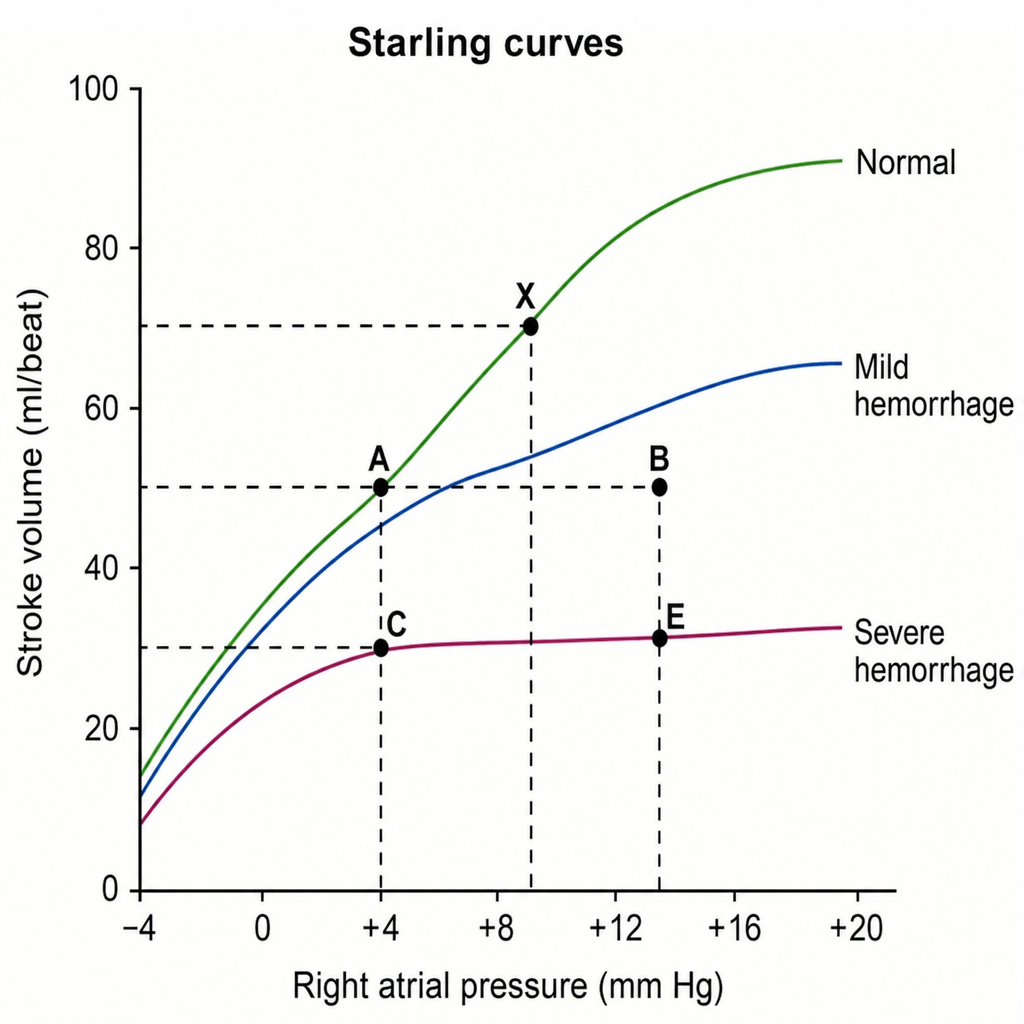
What is the initial physiological response to decreased blood volume?
Baroreceptor stimulation produces which of the following effects?
The electrocardiogram is most effective in detecting a decrease in which of the following?
What causes the 'Y' descent on the jugular venous pulse (IVP)?
What is the normal oxygen tension of mixed venous blood?
What is the normal portal venous pressure?
Consider the following statements: I. Experimental hypertension can be produced by stimulating the sinoaortic nerves. II. Sino-aortic nerves normally stimulate the vasomotor center. Of these statements:
Atrioventricular nodal delay is due to?
Cardiac output increases due to:
The aortic component of the second heart sound is best heard at which anatomical location?
Explanation: **Explanation:** The initial physiological response to decreased blood volume (hypovolemia) is mediated by the **Baroreceptor Reflex**. When blood volume drops, venous return and stroke volume decrease, leading to a reduction in mean arterial pressure. This is sensed by high-pressure baroreceptors in the **carotid sinus** and **aortic arch**. 1. **Why "Increased Heart Rate" is correct:** In response to decreased stretch, baroreceptors reduce their firing rate to the nucleus tractus solitarius (NTS). This triggers a compensatory **increase in sympathetic outflow** and a decrease in parasympathetic tone. The resulting release of norepinephrine acts on $\beta_1$ receptors in the SA node, causing **tachycardia**. This is the earliest clinical sign of compensatory shock (Class I/II hemorrhage) aimed at maintaining cardiac output ($CO = HR \times SV$). 2. **Why other options are incorrect:** * **Tachypnea:** While respiratory rate increases in shock due to metabolic acidosis or sympathetic stimulation, it typically follows the initial cardiovascular adjustments. * **Hypotension:** This is a **late sign** of volume loss. Blood pressure is maintained initially by compensatory vasoconstriction and tachycardia. Hypotension usually signifies Class III hemorrhage (30-40% loss). * **Disorientation:** This indicates cerebral hypoperfusion and is a sign of **decompensated (Class IV) shock**. **High-Yield Clinical Pearls for NEET-PG:** * **Shock Index:** Ratio of Heart Rate to Systolic BP (Normal: 0.5–0.7). An index >0.9 suggests significant occult hypovolemia. * **Reverse Baroreceptor Reflex:** In severe, sudden hemorrhage, the **Bezold-Jarisch reflex** may paradoxically cause bradycardia. * **Class I Hemorrhage:** Up to 15% loss; HR is usually <100 bpm; BP is maintained. Tachycardia (>100 bpm) typically begins in **Class II**.
Explanation: **Explanation:** The baroreceptor reflex is the body’s primary rapid-response mechanism for maintaining blood pressure homeostasis. Baroreceptors are stretch-sensitive mechanoreceptors located in the **carotid sinus** (via Glossopharyngeal nerve) and the **aortic arch** (via Vagus nerve). **1. Why Option A is Correct:** When blood pressure rises, the increased stretch on these receptors increases their firing rate to the **Nucleus Tractus Solitarius (NTS)** in the medulla. This triggers two simultaneous responses: * **Stimulation of the Parasympathetic system:** Increases vagal tone to the SA node, leading to **decreased heart rate (bradycardia)**. * **Inhibition of the Sympathetic system:** Inhibits the Vasomotor Center, leading to **vasodilation** (decreased peripheral resistance) and **decreased cardiac contractility**, which collectively result in **decreased blood pressure**. **2. Why Other Options are Incorrect:** * **Option B:** This describes the response to *decreased* baroreceptor firing (e.g., during hemorrhage or standing up), which triggers a compensatory sympathetic surge. * **Option C:** Baroreceptor stimulation *inhibits* sympathetic outflow; therefore, contractility decreases, not increases. * **Option D:** While decreased contractility *does* occur, Option A is the more comprehensive and "best" answer as it encompasses the hallmark effects on both heart rate and systemic pressure. **High-Yield Clinical Pearls for NEET-PG:** * **Carotid Sinus Massage:** Mimics high pressure, stimulating the baroreflex to slow the heart rate; used clinically to terminate Paroxysmal Supraventricular Tachycardia (PSVT). * **Resetting:** Baroreceptors "reset" to a higher threshold in chronic hypertension, making them ineffective for long-term BP regulation. * **Location:** Carotid sinus is at the bifurcation of the common carotid artery; Aortic arch receptors respond only to *increases* in BP, whereas carotid receptors respond to both increases and decreases.
Explanation: **Explanation:** The electrocardiogram (ECG) is a recording of the electrical activity of the heart over time. It is the gold standard for detecting **myocardial ischemia**, which occurs when there is a **decrease in coronary blood flow**. **Why Coronary Blood Flow is Correct:** When coronary blood flow decreases (due to atherosclerosis or vasospasm), the myocardium becomes hypoxic. This alters the repolarization process of the cardiac myocytes, leading to characteristic electrical shifts. These are visible on an ECG as **ST-segment changes** (elevation or depression) and **T-wave inversions**. Because the ECG directly reflects the electrical consequences of reduced perfusion, it is the most effective bedside tool for diagnosing conditions like Angina Pectoris and Myocardial Infarction. **Why Other Options are Incorrect:** * **A. Ventricular Contractility:** This is a mechanical property (inotropy). While ischemia can lead to poor contractility, the ECG only measures electrical activity. Contractility is best assessed via Echocardiography (Ejection Fraction). * **B. Mean Blood Pressure:** This is a hemodynamic parameter measured using a sphygmomanometer or arterial line. The ECG does not provide data on pressure gradients. * **C. Total Peripheral Resistance (TPR):** TPR is a function of systemic arteriolar constriction. It is a calculated value ($TPR = MAP / CO$) and cannot be detected by cardiac electrical leads. **High-Yield Clinical Pearls for NEET-PG:** * **ST-Elevation (STEMI):** Indicates transmural (full-thickness) ischemia. * **ST-Depression/T-wave Inversion:** Indicates subendocardial ischemia. * **Prinzmetal Angina:** Characterized by transient ST-elevation due to coronary artery vasospasm. * **J-Point:** The junction between the end of the QRS complex and the start of the ST segment; it is the reference point for measuring ST-segment deviation.
Explanation: ### Explanation The **Jugular Venous Pulse (JVP)** reflects pressure changes in the right atrium. The **'y' descent** represents the rapid emptying of the right atrium into the right ventricle. **Why the correct answer is right:** The 'y' descent occurs immediately after the 'v' wave. During the late stage of ventricular systole, the tricuspid valve is closed, and the right atrium fills with blood (v-wave). Once the right ventricular pressure falls below the right atrial pressure at the beginning of diastole, the **tricuspid valve opens**. This allows blood to flow passively and rapidly from the atrium into the ventricle, leading to a sudden drop in atrial pressure, which manifests as the 'y' descent. **Analysis of Incorrect Options:** * **Atrial relaxation:** This corresponds to the **'x' descent**, which occurs as the atrium relaxes following the 'a' wave. * **Closure of the right ventricle:** Ventricular contraction (systole) actually causes the 'c' wave (due to the tricuspid valve bulging into the atrium) and the 'x' descent. It does not cause the 'y' descent. * **Opening of the left ventricle:** The JVP specifically reflects **right-sided** heart dynamics. While the mitral valve opens simultaneously, it does not directly produce the jugular venous waves. **Clinical Pearls for NEET-PG:** * **Rapid/Steep 'y' descent:** Seen in **Constrictive Pericarditis** (Friedreich’s sign) and Tricuspid Regurgitation. * **Slow/Absent 'y' descent:** Seen in **Cardiac Tamponade** (due to high intrapericardial pressure preventing rapid filling) and Tricuspid Stenosis. * **Cannon 'a' waves:** Occur during complete heart block or ventricular tachycardia when the atrium contracts against a closed tricuspid valve.
Explanation: **Explanation:** The oxygen tension ($PO_2$) of mixed venous blood represents the average partial pressure of oxygen in the blood returning to the right side of the heart after systemic tissues have extracted oxygen. **1. Why 40 mm Hg is correct:** In a healthy resting individual, arterial blood enters systemic capillaries with a $PO_2$ of approximately **95–100 mm Hg**. As blood passes through the tissues, oxygen diffuses down its concentration gradient. Under resting conditions, the tissues extract about 25% of the delivered oxygen. By the time the blood reaches the venous end and mixes in the right atrium/ventricle (mixed venous blood), the $PO_2$ has dropped to **40 mm Hg**. This corresponds to an oxygen saturation ($SvO_2$) of approximately **75%**. **2. Why other options are incorrect:** * **25 mm Hg:** This value is too low for resting mixed venous blood. It may be seen in states of extreme physical exertion or severe cardiogenic shock where tissue oxygen extraction is maximal. * **55 mm Hg:** This is higher than the normal venous $PO_2$. Such values might be seen in pathological states like cyanide poisoning (where tissues cannot utilize oxygen) or high-output shunting. * **70 mm Hg:** This is significantly higher than normal venous levels and is closer to the $PO_2$ of arterial blood in patients with mild lung disease or elderly individuals. **High-Yield NEET-PG Pearls:** * **Site of Measurement:** Mixed venous blood is best sampled from the **Pulmonary Artery** (using a Swan-Ganz catheter) because it ensures complete mixing of blood from the superior vena cava, inferior vena cava, and coronary sinus. * **$P_{50}$ Value:** The $PO_2$ at which hemoglobin is 50% saturated is **26.6 mm Hg**. * **Arteriovenous Oxygen Difference:** Normally, this is about **5 mL of $O_2$ per 100 mL** of blood. * **Coronary Sinus:** Note that the $PO_2$ in the coronary sinus is much lower (~20 mm Hg) because the myocardium has the highest oxygen extraction rate in the body.
Explanation: **Explanation:** The portal venous system is a low-pressure system that drains blood from the gastrointestinal tract and spleen to the liver. The **normal portal venous pressure ranges between 5 and 10 mmHg**. This pressure is slightly higher than the systemic venous pressure (Central Venous Pressure: 0–8 mmHg) to ensure a pressure gradient that facilitates blood flow through the hepatic sinusoids into the inferior vena cava. * **Why Option A is correct:** 5–10 mmHg is the physiological range. Portal hypertension is clinically defined when this pressure exceeds **10 mmHg**, and complications like varices typically develop when the pressure (or the Hepatic Venous Pressure Gradient) exceeds **12 mmHg**. * **Why Options B, C, and D are incorrect:** These values represent pathological states. Pressures of 10–15 mmHg indicate mild portal hypertension. Values above 15 mmHg, and especially 20–35 mmHg, represent severe portal hypertension often seen in advanced cirrhosis, leading to life-threatening complications like esophageal variceal hemorrhage and ascites. **High-Yield Clinical Pearls for NEET-PG:** 1. **HVPG (Hepatic Venous Pressure Gradient):** This is the gold standard for assessing portal pressure. It is the difference between the wedged hepatic venous pressure and the free hepatic venous pressure. Normal HVPG is **1–5 mmHg**. 2. **Clinically Significant Portal Hypertension (CSPH):** Defined as an HVPG **≥ 10 mmHg**. 3. **Risk of Variceal Bleed:** Increases significantly when HVPG is **> 12 mmHg**. 4. **Portal Vein Formation:** Formed by the union of the **Superior Mesenteric Vein** and the **Splenic Vein** behind the neck of the pancreas.
Explanation: **Explanation:** This question tests the understanding of the **Baroreceptor Reflex** and its role in blood pressure regulation. **1. Why Statement I is True:** The sinoaortic nerves (the Hering’s nerve from the carotid sinus and the aortic nerve from the aortic arch) are known as **"buffer nerves."** Under normal conditions, they carry inhibitory impulses to the vasomotor center (VMC). If these nerves are chronically stimulated or, more commonly in experimental models, **denervated** (sinoaortic denervation), the VMC is released from its constant inhibition. This results in a massive increase in sympathetic outflow, leading to **neurogenic hypertension**. **2. Why Statement II is False:** The sinoaortic nerves do **not** stimulate the vasomotor center; they **inhibit** it. When blood pressure rises, baroreceptors fire more frequently. these impulses reach the Nucleus Tractus Solitarius (NTS) in the medulla, which then inhibits the vasoconstrictor area of the VMC and excites the vagal center (Cardioinhibitory Center). This dual action results in vasodilation and bradycardia to lower blood pressure. Therefore, the normal physiological role is inhibitory, not stimulatory. **Incorrect Options:** * **B & C:** Incorrect because they assume Statement II is true. * **D:** Incorrect because Statement I is a well-documented experimental method to induce hypertension. **High-Yield Clinical Pearls for NEET-PG:** * **Buffer Nerves:** CN IX (Glossopharyngeal) carries signals from the Carotid Sinus; CN X (Vagus) carries signals from the Aortic Arch. * **Receptor Type:** Baroreceptors are "stretch receptors," not direct pressure receptors. * **Resetting:** In chronic hypertension, baroreceptors "reset" to a higher threshold, meaning they stop opposing the high BP, which is why they don't cure long-term hypertension. * **Inverse Relationship:** Increased baroreceptor discharge = Decreased Sympathetic outflow = Decreased BP.
Explanation: ### Explanation The **AV nodal delay** (approximately 0.1 second) is a critical physiological pause that allows the atria to finish contracting and emptying blood into the ventricles before ventricular contraction begins. **1. Why "Less gap junctions" is correct:** The speed of electrical conduction in cardiac tissue is directly proportional to the density of **gap junctions** (connexins). Gap junctions are low-resistance ion channels that allow the action potential to spread between cells. The AV node has a significantly **lower density of gap junctions** compared to other cardiac tissues, creating high electrical resistance. Additionally, the AV nodal fibers have a small diameter and a more negative resting membrane potential, both of which contribute to the slow conduction velocity (0.01 to 0.05 m/s). **2. Why other options are incorrect:** * **B. More tight junctions:** Tight junctions (zonula occludens) serve as barriers to prevent leakage between cells; they do not facilitate electrical conduction. * **C. Intercalated discs:** These are the complex structures that join cardiac cells together. While they *contain* gap junctions, the presence of intercalated discs itself does not cause a delay; rather, it is the specific *scarcity* of gap junctions within these discs at the AV node that causes the delay. * **D. Prolonged refractory period:** While the AV node does have a long refractory period (protecting ventricles from high atrial rates), this determines the *frequency* of impulses that can pass through, not the *velocity* of a single impulse (the delay). **Clinical Pearls & High-Yield Facts:** * **Conduction Velocity Sequence:** Purkinje fibers (Fastest: 4 m/s) > Atria/Ventricles (0.3–1 m/s) > AV Node (Slowest: 0.01–0.05 m/s). **(Mnemonic: He Parked At Venture Avenue)**. * **ECG Correlation:** The AV nodal delay is represented by the **PR segment**. * **Autonomic Influence:** Sympathetic stimulation increases conduction (shortens delay), while Parasympathetic (Vagal) stimulation decreases conduction (lengthens delay).
Explanation: **Explanation:** Cardiac output (CO) is the product of Stroke Volume and Heart Rate. Stroke volume is primarily determined by **preload**, which is directly dependent on venous return. **Why Option A is Correct:** A **decrease in intrathoracic pressure** (which occurs during normal inspiration) creates a "suction effect" within the thoracic cavity. This negative pressure is transmitted to the thin-walled vena cava and right atrium, increasing the pressure gradient between the peripheral veins and the heart. This enhances **venous return** (Frank-Starling mechanism), leading to an increase in end-diastolic volume and, subsequently, cardiac output. **Why the Other Options are Incorrect:** * **B. Decrease in blood volume:** A reduction in total blood volume (e.g., hemorrhage) reduces the mean systemic filling pressure and venous return, leading to a decrease in cardiac output. * **C. Decreased ventricular compliance:** Compliance refers to the "stretchability" of the ventricle. Decreased compliance (seen in ventricular hypertrophy or restrictive cardiomyopathy) impairs diastolic filling, thereby reducing stroke volume and CO. * **D. Decreased mean systemic filling pressure (MSFP):** MSFP is the primary driving force for venous return. A decrease in MSFP (due to vasodilation or hypovolemia) narrows the pressure gradient to the right atrium, reducing cardiac output. **High-Yield Clinical Pearls for NEET-PG:** * **Respiratory Pump:** Inspiration increases venous return to the right heart but slightly decreases stroke volume from the left heart (due to increased pulmonary vascular capacity). However, the overall effect of decreased intrathoracic pressure is a boost in systemic venous return. * **Valsalva Maneuver:** Forced expiration against a closed glottis *increases* intrathoracic pressure, which *decreases* venous return and cardiac output (Phase II). * **Formula:** Venous Return = (MSFP - Right Atrial Pressure) / Resistance to Venous Return.
Explanation: **Explanation:** The second heart sound (S2) is produced by the closure of the semilunar valves (Aortic and Pulmonary) at the beginning of ventricular diastole. **Why the correct answer is right:** The **Aortic area** is traditionally located in the **second right intercostal space**, immediately adjacent to the sternum. Anatomically, the second rib articulates with the sternum at the **Sternal Angle (Angle of Ludwig)**. Therefore, the space immediately below this landmark to the right is the correct auscultatory site for the aortic component (A2). Sound is best heard here because the ascending aorta is closest to the chest wall at this point. **Analysis of Incorrect Options:** * **Infraclavicular region:** This area is typically used to auscultate for bruits (e.g., subclavian artery stenosis) or breath sounds, but not heart valves. * **Apex:** This is the **Mitral area** (5th left intercostal space, mid-clavicular line), where the first heart sound (S1) is loudest. * **Second intercostal space to the left:** This is the **Pulmonary area**, where the pulmonary component (P2) of the second heart sound is best heard. **High-Yield Clinical Pearls for NEET-PG:** * **Physiological Splitting:** S2 normally splits during inspiration (A2 precedes P2) because increased venous return to the right heart delays pulmonary valve closure. * **Reverse/Paradoxical Splitting:** Seen in conditions like Left Bundle Branch Block (LBBB) or Aortic Stenosis, where A2 is delayed and occurs after P2. * **Erb’s Point:** Located at the 3rd left intercostal space; it is often considered the best place to hear the murmurs of aortic regurgitation.
Cardiac Electrophysiology
Practice Questions
Cardiac Cycle
Practice Questions
Cardiac Output and Its Regulation
Practice Questions
Hemodynamics and Blood Flow
Practice Questions
Arterial System Physiology
Practice Questions
Microcirculation and Lymphatics
Practice Questions
Venous Return and Central Venous Pressure
Practice Questions
Cardiovascular Reflexes
Practice Questions
Regional Circulations
Practice Questions
Cardiovascular Responses to Exercise and Stress
Practice Questions
Get full access to all questions, explanations, and performance tracking.
Start For Free