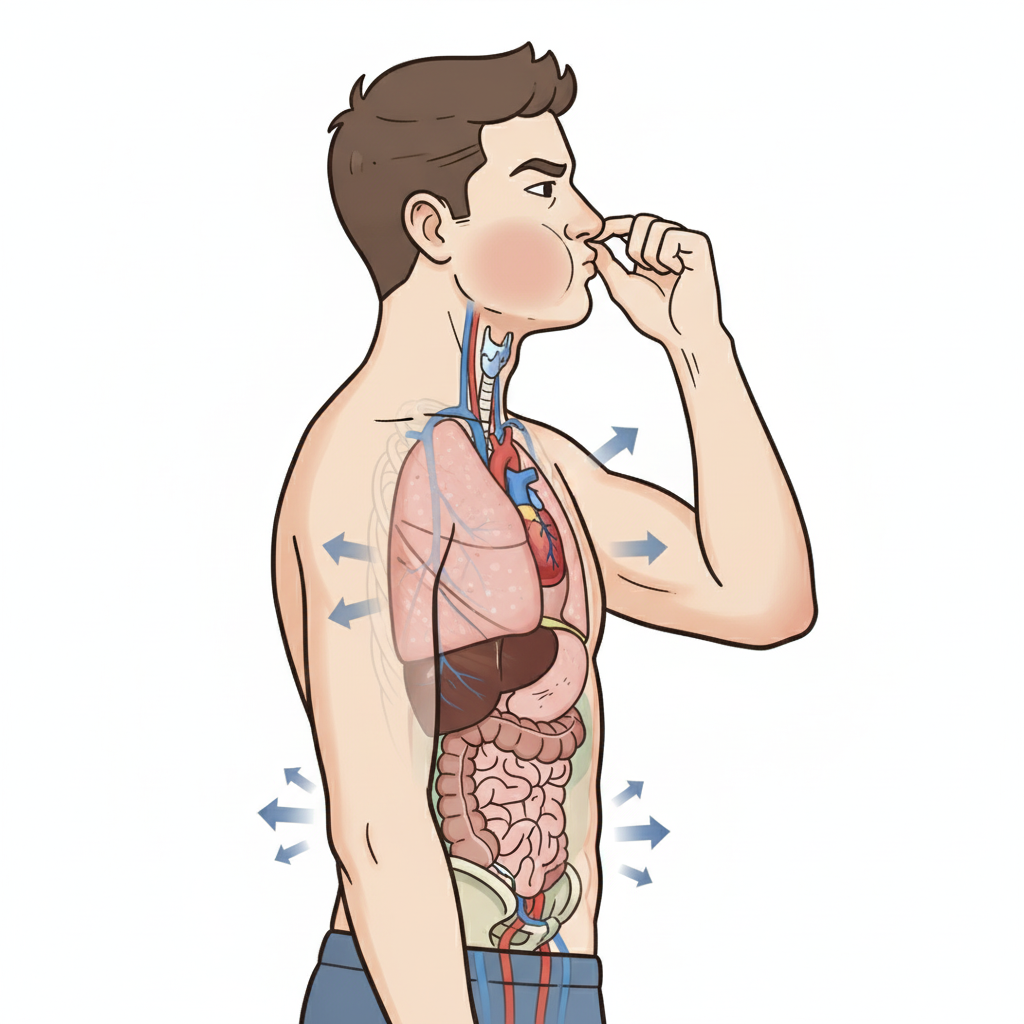
Which maneuver is generally not performed early before chest compressions in basic life support outside the hospital?
During the first 3-4 months of gestation, by which structure are erythrocytes formed?
A 55-year-old man underwent an ECG at an annual physical. The net deflection in standard limb lead I was -1.2 millivolts, and in standard limb lead II, it was +1.2 millivolts. What is the mean electrical axis of his QRS?
What is the formula for calculating Mean Blood Pressure?
What is the normal delay in the AV node?
The tendency for turbulent flow is greatest in which of the following?
Which structure receives the afferent fibers for blood pressure control?
What part of the cardiac conduction system exhibits the slowest impulse conduction?
What is the normal pH of human semen?
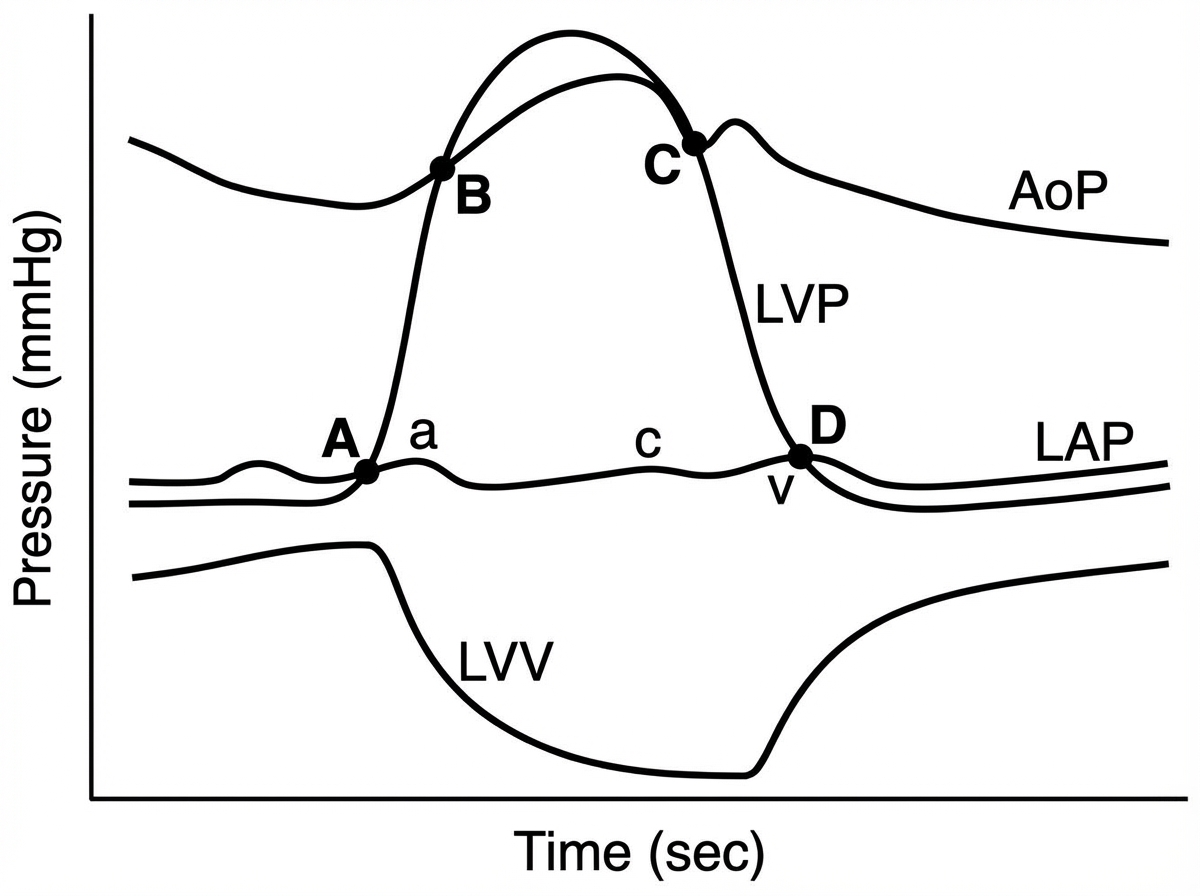
Left ventricular systole corresponds to which of the following?
Explanation: In Basic Life Support (BLS) for out-of-hospital cardiac arrest, the primary goal is to maintain perfusion and oxygenation until advanced care arrives. The current AHA/ERC guidelines emphasize the **C-A-B (Compressions, Airway, Breathing)** sequence. **Why Electrical Cardioversion is the correct answer:** Electrical cardioversion is a synchronized shock used to treat hemodynamically unstable tachyarrhythmias (like SVT or AFib) where a pulse is present. In a BLS scenario involving an unresponsive patient without a pulse, the priority is **Defibrillation** (unsynchronized shock), not cardioversion. Furthermore, advanced electrical therapy requires professional equipment and diagnostic interpretation, making it inappropriate to perform "early" or as part of the initial BLS maneuvers before starting compressions. **Explanation of Incorrect Options:** * **A. Call for help:** This is the first step in the BLS algorithm. Activating the Emergency Medical Service (EMS) ensures that advanced life support is on the way. * **B. Obtain airway:** After starting chest compressions (in the C-A-B sequence), opening the airway (Head-tilt/Chin-lift) is essential to prepare for rescue breaths. * **C. Ventilation:** Providing rescue breaths (30:2 ratio) is a core component of BLS to ensure oxygenation of the blood being circulated by compressions. **High-Yield Clinical Pearls for NEET-PG:** * **Sequence Change:** The sequence changed from A-B-C to **C-A-B** to minimize delays in starting chest compressions. * **Compression Depth:** 2–2.4 inches (5–6 cm) in adults. * **Compression Rate:** 100–120 beats per minute. * **Defibrillation vs. Cardioversion:** Defibrillation is for pulseless VT/VF; Cardioversion is for unstable patients with a pulse. * **AED:** If an Automated External Defibrillator (AED) is available, it should be used as soon as possible, but it is distinct from manual cardioversion.
Explanation: **Explanation:** The process of blood cell formation (hematopoiesis) in the fetus occurs in distinct chronological stages, often referred to as the "Mesoblastic," "Hepatic," and "Myeloid" periods. **1. Why Yolk Sac is Correct:** The **Mesoblastic stage** is the earliest phase of hematopoiesis. It begins around the 3rd week of gestation within the **yolk sac** (specifically in the blood islands). This remains the primary site of erythrocyte production during the first trimester (up to 3–4 months), producing nucleated red blood cells containing embryonic hemoglobins (Gower 1, Gower 2, and Portland). **2. Analysis of Incorrect Options:** * **Liver (Option B):** The **Hepatic stage** begins around the 6th week and peaks between the 3rd and 6th months. While the liver is the *dominant* site during the second trimester, the yolk sac initiates the process in the first 3-4 months. * **Spleen (Option C):** The spleen contributes to hematopoiesis primarily between the 3rd and 7th months of gestation, acting as a secondary lymphoid and myeloid organ during the hepatic phase. * **Bone Marrow (Option D):** The **Myeloid stage** begins in the 4th to 5th month as ossification occurs. The bone marrow becomes the definitive and primary site of hematopoiesis only during the last trimester and throughout postnatal life. **High-Yield Clinical Pearls for NEET-PG:** * **Sequence Mnemonic:** **"Young Liver Emphasizes Silly Blood"** (Yolk sac → Liver → Spleen → Bone marrow). * **Hb Transition:** Embryonic Hb (Yolk sac) → Fetal Hb/HbF (Liver/Spleen) → Adult Hb/HbA (Bone Marrow). * **Extramedullary Hematopoiesis:** In certain pathological states (e.g., Thalassemia, Myelofibrosis), the liver and spleen can resume their fetal hematopoietic function in adults.
Explanation: ### Explanation The mean electrical axis of the QRS complex represents the average direction of ventricular depolarization. To determine the axis using standard limb leads, we apply **Einthoven’s Law** and the **Hexaxial Reference System**. **1. Why +120 degrees is correct:** * **Lead I:** The net deflection is **-1.2 mV**. Since Lead I runs from the right arm to the left arm (0°), a negative deflection indicates the vector is pointing away from the left arm, toward the **right side** of the patient’s chest. * **Lead II:** The net deflection is **+1.2 mV**. Lead II is oriented at +60°. A positive deflection means the vector is moving toward this electrode. * **Calculation:** When Lead I is negative and Lead II is positive, the axis must fall in the **Right Axis Deviation (RAD)** quadrant (+90° to +180°). Specifically, if the magnitude in Lead I (-1.2) and Lead II (+1.2) is equal, the vector sits exactly halfway between the negative pole of Lead I (180°) and the positive pole of Lead II (+60°). The midpoint between 180° and 60° is **+120°**. **2. Why the other options are incorrect:** * **-30 degrees:** This represents Left Axis Deviation (LAD). It would require a positive Lead I and a negative Lead II/aVF. * **+30 degrees:** This is a normal axis. It would require both Lead I and Lead II to be positive. * **+60 degrees:** This is the direction of Lead II. If the axis were +60°, Lead I would be positive (approx. +0.6 mV) and Lead III would also be positive. **Clinical Pearls for NEET-PG:** * **Normal Axis:** -30° to +90°. * **Right Axis Deviation (+90° to +180°):** Commonly seen in Right Ventricular Hypertrophy (RVH), Left Posterior Fascicular Block (LPFB), and pulmonary embolism. * **Left Axis Deviation (-30° to -90°):** Seen in Left Ventricular Hypertrophy (LVH) and Left Anterior Fascicular Block (LAFB). * **Quick Rule:** If Lead I is negative and aVF is positive, it is Right Axis Deviation.
Explanation: ### Explanation The correct answer is **A. Cardiac Output x Total Peripheral Resistance.** **1. Underlying Medical Concept** Mean Arterial Pressure (MAP) is the average pressure in a patient's arteries during one cardiac cycle. It is governed by the hemodynamic version of **Ohm’s Law** ($V = I \times R$), where: * **Voltage (V)** corresponds to the Pressure Gradient (Mean Arterial Pressure). * **Current (I)** corresponds to Blood Flow (Cardiac Output). * **Resistance (R)** corresponds to Total Peripheral Resistance (TPR). Therefore, **MAP = CO × TPR**. This formula highlights that blood pressure is determined by how much blood the heart pumps and the degree of constriction in the systemic vasculature. **2. Analysis of Incorrect Options** * **Option B (CO x HR):** This is incorrect. Heart Rate is already a component of Cardiac Output ($CO = SV \times HR$). Multiplying them again has no physiological basis. * **Option C (HR x TPR):** This is incorrect. Heart rate alone does not determine the volume of blood flow; the volume ejected per beat (Stroke Volume) must also be considered. * **Option D (SV x Total Peripheral Resistance):** This is incorrect. Stroke volume represents only a single beat. To calculate mean pressure over time, the frequency of beats (Heart Rate) must be included. **3. NEET-PG High-Yield Pearls** * **Clinical Estimation:** In clinical practice, MAP is often estimated using the formula: **MAP = Diastolic BP + 1/3 (Pulse Pressure)**. This is because the heart spends more time in diastole (approx. 2/3) than systole (1/3). * **Organ Perfusion:** A MAP of **>65 mmHg** is generally required to maintain adequate tissue perfusion to vital organs (especially the kidneys and brain). * **TPR Determinant:** The primary site of peripheral resistance in the cardiovascular system is the **arterioles**.
Explanation: The correct answer is **0.13 seconds**. ### **Explanation of the Correct Answer** The **AV nodal delay** is a critical physiological pause in the cardiac conduction system. The total delay from the time the impulse enters the atria until it reaches the ventricles is approximately **0.16 seconds**. This is divided into two parts: 1. **0.03 seconds:** The time taken for the impulse to travel from the SA node to the AV node. 2. **0.13 seconds:** The actual delay within the **AV node and AV bundle** (specifically 0.09s in the AV node itself and 0.04s in the penetrating AV bundle). The primary purpose of this delay is to allow the atria sufficient time to contract and empty their blood into the ventricles (atrial kick) before ventricular contraction begins, ensuring optimal stroke volume. ### **Analysis of Incorrect Options** * **A. 0.2 seconds:** This is the upper limit of a normal **PR interval**. A delay of this length within the AV node itself would be considered pathological (1st-degree heart block). * **C. 0.01 seconds:** This is too short. Such a brief delay would result in simultaneous atrial and ventricular contraction, leading to inefficient filling and reduced cardiac output. * **D. 0.3 seconds:** This is significantly prolonged and represents a high-grade conduction block. ### **High-Yield NEET-PG Pearls** * **Cause of Delay:** The delay is due to the small size of nodal fibers, slow-response action potentials (calcium-dependent), and a **decreased number of gap junctions** between cells. * **PR Interval:** Represents the total time from atrial depolarization to the start of ventricular depolarization (Normal: 0.12–0.20s). * **Velocity:** The AV node has the **slowest conduction velocity** (0.01–0.05 m/s) in the heart, while Purkinje fibers have the fastest (1.5–4.0 m/s).
Explanation: **Explanation:** The tendency for blood flow to become turbulent is determined by **Reynolds number (Re)**. The formula for Reynolds number is: **Re = (ρ × v × d) / η** *(Where ρ = density, v = velocity, d = diameter, and η = viscosity)* Turbulence occurs when Re exceeds a critical value (usually >2000). While a large diameter (d) increases Re, **velocity (v)** is the most dynamic factor in this context. **Why Arterioles are the correct answer:** Arterioles are the primary **resistance vessels** of the systemic circulation. According to the Law of Continuity, velocity is inversely proportional to the total cross-sectional area. Although individual arterioles are small, the transition from large arteries to the narrower arteriolar lumen, combined with high pressure gradients, can lead to high local velocities. Furthermore, the abrupt changes in vessel caliber and branching patterns at the arteriolar level significantly predispose the flow to turbulence compared to the slow, laminar flow of capillaries. **Analysis of Incorrect Options:** * **Large Artery (e.g., Aorta):** While the diameter is large, the flow is generally streamlined (laminar) under resting conditions, though it can become turbulent during high cardiac output. * **Small Artery:** These have lower velocities than arterioles and more stable flow patterns. * **Capillary:** Despite having the smallest individual diameter, the **total cross-sectional area** of the capillary bed is the largest in the body. Consequently, the velocity of blood flow in capillaries is the **lowest** (approx. 0.03 cm/sec), making turbulence physically impossible. **High-Yield NEET-PG Pearls:** 1. **Velocity vs. Area:** Velocity is lowest in capillaries (maximal area) and highest in the aorta (minimal area). 2. **Bruits and Murmurs:** These are clinical manifestations of turbulent flow. 3. **Anemia & Turbulence:** In anemia, blood viscosity (η) decreases, which increases the Reynolds number, leading to "hemic murmurs" due to increased turbulence.
Explanation: ### Explanation The control of blood pressure via the baroreceptor reflex is a classic high-yield topic in cardiovascular physiology. **Why Nucleus Tractus Solitarius (NTS) is Correct:** The **Nucleus Tractus Solitarius (NTS)**, located in the medulla, serves as the **primary sensory relay station** for cardiovascular reflexes. Afferent fibers from high-pressure baroreceptors (Carotid sinus via Glossopharyngeal nerve and Aortic arch via Vagus nerve) terminate in the NTS. Once stimulated by an increase in blood pressure, the NTS activates inhibitory pathways to decrease sympathetic outflow and excitatory pathways to increase parasympathetic tone. **Analysis of Incorrect Options:** * **Nucleus Ambiguus (A):** This is the primary site for **parasympathetic (vagal) outflow** to the heart. While it is part of the reflex arc, it receives input *from* the NTS rather than receiving the initial afferent fibers. * **Rostral Ventrolateral Medulla (RVLM) (B):** This is the **"pressor area"** responsible for maintaining basal sympathetic tone. It is inhibited by the baroreflex to lower blood pressure. * **Caudal Ventrolateral Medulla (CVLM) (D):** This acts as an intermediary. The NTS excites the CVLM, which in turn inhibits the RVLM, leading to a decrease in sympathetic activity. **Clinical Pearls for NEET-PG:** * **The "Sensory" Rule:** Remember **S**olitarius for **S**ensory. It receives taste (CN VII, IX, X), baroreceptors, and chemoreceptors. * **The "Motor" Rule:** Remember **A**mbiguus for **A**fferent-motor (parasympathetic) to the heart. * **Baroreceptor Resetting:** In chronic hypertension, the baroreceptors "reset" to a higher threshold, meaning the NTS requires a higher pressure to trigger the inhibitory reflex. * **Location:** All these structures are located in the **Medulla Oblongata**, which is the vital center for vasomotor control.
Explanation: ### Explanation The correct answer is **B. Atrioventricular (AV) node**. **Why the AV Node is the Slowest:** The conduction velocity in the AV node is approximately **0.01 to 0.05 m/sec**. This physiological slowness is primarily due to three factors: 1. **Small diameter** of the transitional fibers. 2. **Fewer gap junctions** between cells, increasing electrical resistance. 3. **Slow-response action potentials** mediated by calcium channels rather than fast sodium channels. This delay (the **AV nodal delay**) is crucial as it allows the atria to complete their contraction and empty blood into the ventricles before ventricular systole begins, ensuring optimal cardiac output. **Analysis of Incorrect Options:** * **A. SA Node:** While it has a slow conduction velocity (~0.05 m/sec), it is slightly faster than the AV node. Its primary role is as the pacemaker, not a conduction delay point. * **C. Bundle of His:** Conduction speed increases here (~1 m/sec) to begin the rapid distribution of the impulse to the ventricles. * **D. Purkinje Fibers:** This is the **fastest** part of the conduction system (~4 m/sec). High velocity is necessary to ensure nearly simultaneous contraction of the entire ventricular myocardium. **High-Yield NEET-PG Pearls:** * **Fastest Conduction:** Purkinje fibers (due to large diameter and high density of gap junctions). * **Slowest Conduction:** AV node (specifically the N-region). * **Highest Rhythmicity/Automaticity:** SA node (the dominant pacemaker). * **Total AV Nodal Delay:** Approximately **0.13 seconds** (Total delay from SA node to ventricles is ~0.16s). * **Clinical Correlation:** Drugs like Beta-blockers and Calcium Channel Blockers (Verapamil/Diltiazem) further slow AV conduction, which is useful in controlling heart rate during Atrial Fibrillation.
Explanation: **Explanation:** The normal pH of human semen is slightly alkaline, typically ranging from **7.2 to 8.0**, with **7.4** being the standard physiological value. This alkalinity is crucial for neutralizing the acidic environment of the male urethra (due to residual urine) and the female vaginal tract (pH ~3.5–4.5). An alkaline medium is essential for maintaining sperm motility and viability. **Breakdown of Options:** * **Option C (7.4):** This is the correct physiological average. The alkalinity is primarily contributed by secretions from the **seminal vesicles**, which make up about 60-70% of the total ejaculate volume and contain bicarbonate. * **Option A (7.0):** This is neutral. A pH of 7.0 or lower is considered abnormal (acidic) for semen and often indicates a blockage or congenital absence of the seminal vesicles. * **Option B (7.2):** While 7.2 is the lower limit of the normal range according to WHO criteria, 7.4 is the more representative physiological mean for healthy semen. * **Option D (7.8):** Although 7.8 falls within the normal range (7.2–8.0), it is on the higher end and less commonly cited as the "standard" value compared to 7.4. **High-Yield Clinical Pearls for NEET-PG:** * **Prostatic Fluid:** Unlike seminal vesicle fluid, prostatic fluid is slightly **acidic (pH ~6.5)** but contains citric acid and acid phosphatase. * **Low Semen pH (<7.0):** Associated with **obstructive azoospermia** or bilateral absence of the vas deferens (as seen in Cystic Fibrosis). * **High Semen pH (>8.0):** Often suggests an acute **infection** of the accessory glands (prostatitis or vesiculitis). * **Coagulation & Liquefaction:** Semen initially clots due to fibrinogen (from seminal vesicles) and liquefies within 20-30 minutes due to **PSA (Prostate-Specific Antigen)**.
Explanation: ### Explanation **Correct Answer: D. Atrial diastole** **Why it is correct:** The cardiac cycle is a coordinated sequence of electrical and mechanical events. Ventricular systole begins immediately after atrial systole ends. While the ventricles are contracting to pump blood into the aorta and pulmonary artery, the atria must be in a state of relaxation (**Atrial Diastole**) to allow for venous return from the vena cavae and pulmonary veins. In a standard cardiac cycle of 0.8 seconds, ventricular systole lasts approximately 0.3 seconds, all of which occurs during the 0.7-second duration of atrial diastole. **Why the other options are incorrect:** * **A. ST segment in ECG:** While the ST segment represents the plateau phase of ventricular action potentials (ventricular depolarization), the *entirety* of ventricular systole actually spans from the peak of the R wave to the end of the T wave. * **B. Right ventricular diastole:** The heart functions as a syncytium; the left and right ventricles contract and relax **simultaneously**. Therefore, left ventricular systole corresponds to right ventricular systole, not diastole. * **C. P wave in ECG:** The P wave represents atrial depolarization, which triggers **atrial systole**. Ventricular systole occurs later, following the QRS complex. **High-Yield Clinical Pearls for NEET-PG:** * **Duration:** Atrial systole (0.1s), Atrial diastole (0.7s); Ventricular systole (0.3s), Ventricular diastole (0.5s). * **First Heart Sound (S1):** Occurs at the beginning of ventricular systole due to the closure of AV valves (Mitral and Tricuspid). * **Isovolumetric Contraction:** The first phase of ventricular systole where all valves are closed, and pressure rises sharply without a change in volume. * **Atrial Filling:** Occurs entirely during atrial diastole, which coincides with ventricular systole and the early-to-mid phases of ventricular diastole.
Cardiac Electrophysiology
Practice Questions
Cardiac Cycle
Practice Questions
Cardiac Output and Its Regulation
Practice Questions
Hemodynamics and Blood Flow
Practice Questions
Arterial System Physiology
Practice Questions
Microcirculation and Lymphatics
Practice Questions
Venous Return and Central Venous Pressure
Practice Questions
Cardiovascular Reflexes
Practice Questions
Regional Circulations
Practice Questions
Cardiovascular Responses to Exercise and Stress
Practice Questions
Get full access to all questions, explanations, and performance tracking.
Start For Free