What is the shelf life of a drug?
Alkalinization of urine is done for which of the following types of drugs?
Which of the following medications can cause oral contraceptive failure?
Which of the following statements regarding drug action is true?
A drug has a bioavailability of 80% and a volume of distribution of 10 L. Calculate the loading dose required to achieve a plasma concentration of 0.6 mg/L.
Which of the following receptors acts the slowest?
Which route of administration provides 100% bioavailability?
A 70 kg man was given a drug in a dose of 100 mg/kg body weight. Its half-life is 10 hours, and the initial plasma concentration is 1.9 mg/ml. Which of the following statements is true?
Brinzolamide is a?
A loading dose of 25 mg was administered to achieve a plasma concentration of 0.5 mg/L. If the volume of distribution is 40 L, what is the bioavailability?
Explanation: **Explanation:** **1. Why Option A is Correct:** In pharmacokinetics and pharmaceutical science, **shelf life** (also known as the expiration dating period) is defined as the time interval during which a drug product is expected to remain within the approved specifications for identity, strength, quality, and purity, provided it is stored under defined conditions. Legally and scientifically, the shelf life determines the **expiration date** printed on the packaging. Most drugs are considered to have reached the end of their shelf life when the active ingredient concentration falls below **90%** of its original potency ($t_{90}$). **2. Why the Other Options are Incorrect:** * **Option B:** This is incorrect because shelf life and the expiration dating period are synonymous terms used by regulatory bodies (like the FDA or CDSCO) to define the drug's stability window. * **Option C:** Shelf life does **not** mean 100% degradation. A drug is deemed "expired" even if only 10% of the active ingredient has degraded, as it no longer meets the therapeutic threshold. * **Option D:** While some drugs (like Tetracyclines) can become toxic after expiration (causing Fanconi Syndrome), expiration is primarily defined by a **loss of efficacy** rather than the immediate onset of toxicity. **3. NEET-PG High-Yield clinical Pearls:** * **Storage Conditions:** Shelf life is highly dependent on temperature, light, and humidity. This is why "Cold Chain" maintenance is critical for vaccines (e.g., Polio vaccine). * **Order of Kinetics:** Most drug degradation during storage follows **Zero-order or First-order kinetics**, depending on the formulation. * **Exception to the Rule:** **Tetracycline** is a classic exam favorite; using it past its shelf life can lead to **Fanconi Syndrome** (proximal renal tubular acidosis) due to the degradation product, epianhydrotetracycline.
Explanation: This question tests the concept of **Ion Trapping**, which is based on the principle that only non-ionized (lipid-soluble) drugs can cross biological membranes, while ionized (water-soluble) drugs are trapped and excreted. ### 1. Why Weak Acid Drugs is Correct According to the Henderson-Hasselbalch principle, weak acids become **ionized** (charged) in an **alkaline medium**. When the urine is alkalinized (e.g., using Sodium Bicarbonate), weak acid drugs like **Salicylates (Aspirin)** or **Barbiturates** lose their lipid solubility. They become "trapped" in the renal tubules, preventing reabsorption back into the blood and significantly increasing their renal clearance. ### 2. Why Other Options are Wrong * **Weak Base Drugs:** These are better excreted in **acidic urine** (e.g., using Ammonium Chloride). In alkaline urine, they remain non-ionized and are easily reabsorbed. Examples include Amphetamines and Morphine. * **Strong Acidic/Basic Drugs:** These drugs are almost completely ionized at all physiological pH levels. Their excretion is generally independent of urinary pH changes, making alkalinization clinically irrelevant for their clearance. ### 3. NEET-PG High-Yield Clinical Pearls * **Drug of Choice for Alkalinization:** Intravenous **Sodium Bicarbonate** ($NaHCO_3$). * **Classic Indications:** Salicylate (Aspirin) poisoning and Phenobarbital overdose. * **The "Like Dissolves Like" Rule:** To keep a drug in the blood (reabsorption), match the pH (Acid in Acid). To kick a drug out (excretion), mismatch the pH (**Acid in Base**). * **Acetazolamide:** While it alkalinizes urine, it is rarely used for toxicological excretion because it can cause systemic acidosis, which may worsen the toxicity of certain drugs like aspirin.
Explanation: The correct answer is **Rifampicin**. The primary mechanism behind oral contraceptive (OCP) failure is the induction of hepatic microsomal enzymes, specifically the **Cytochrome P450 (CYP3A4)** system [1]. **Why Rifampicin is correct:** Rifampicin is one of the most potent **enzyme inducers** known [4]. It increases the metabolism of the estrogenic component (Ethinylestradiol) of OCPs in the liver. This leads to significantly lower plasma concentrations of the hormones, falling below the therapeutic threshold required to suppress ovulation, thereby resulting in contraceptive failure. **Analysis of Incorrect Options:** * **Penicillin:** While some older theories suggested that broad-spectrum antibiotics might interfere with the enterohepatic circulation of estrogens by altering gut flora, clinical studies have shown that most antibiotics (including Penicillins) do not significantly reduce OCP efficacy. * **Chloroquine:** This is an antimalarial that does not possess significant enzyme-inducing properties and does not interfere with OCP metabolism. * **Metronidazole:** This is an antiprotozoal/antibacterial that is actually an **enzyme inhibitor** (specifically of CYP2C9). While it can cause a Disulfiram-like reaction with alcohol, it does not cause OCP failure. **High-Yield Clinical Pearls for NEET-PG:** * **Other Enzyme Inducers (The "GPRS Cell Phone" Mnemonic):** **G**riseofulvin, **P**henytoin, **R**ifampicin, **S**moking, **C**arbamazepine, **P**henobarbitone [2], [3]. All of these can potentially cause OCP failure [3]. * **Management:** Patients on Rifampicin should be advised to use an alternative or additional method of contraception (e.g., barrier methods) during and for 4 weeks after stopping the drug. * **Exception:** Rifabutin is a less potent inducer than Rifampicin but still requires caution.
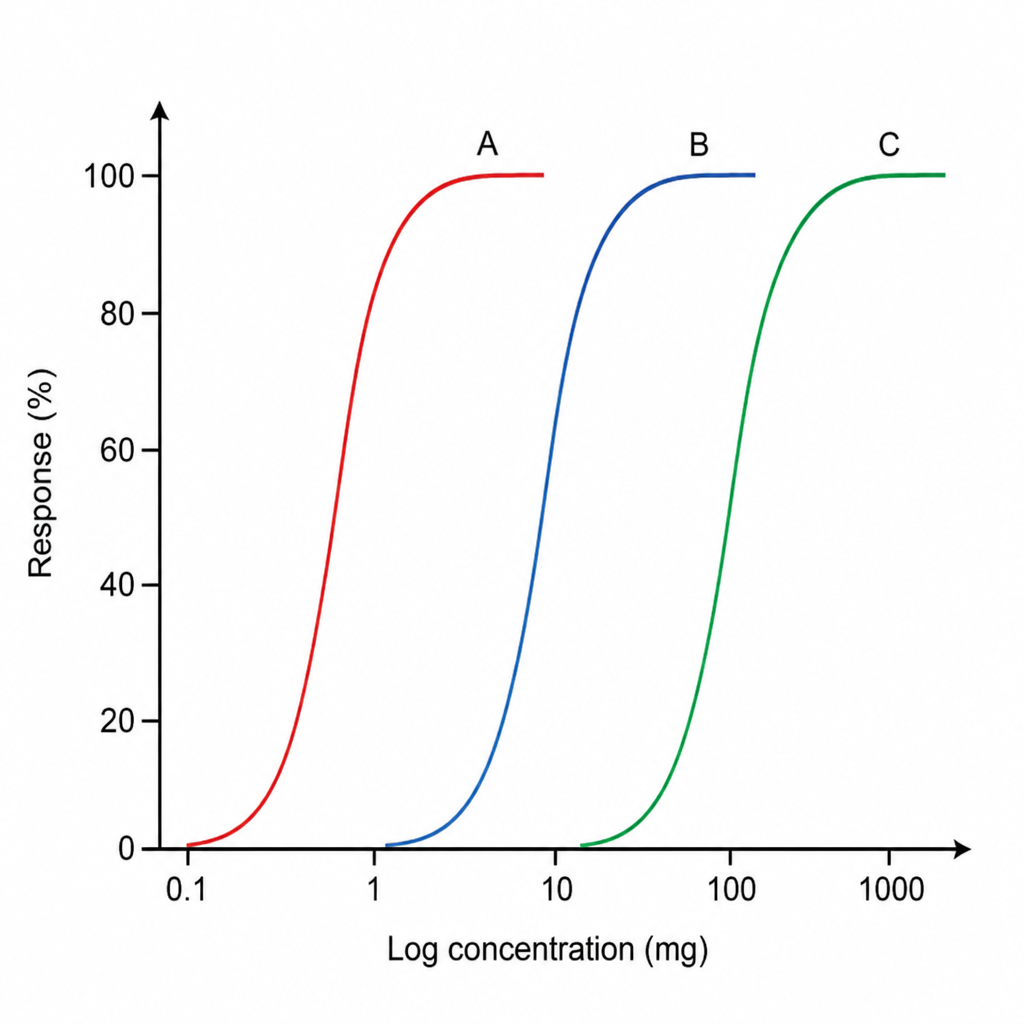
Explanation: ### Explanation **1. Why Option A is Correct:** In clinical practice, **efficacy** is the most important parameter of drug action. Efficacy (or maximal efficacy) refers to the maximum therapeutic effect a drug can produce, regardless of the dose. For example, if Patient X has severe pain, a drug with high efficacy (like Morphine) will provide relief, whereas a drug with low efficacy (like Aspirin) may never reach that level of pain control, no matter how much the dose is increased. **Potency**, on the other hand, refers to the amount of drug (dose) required to produce a specific intensity of effect. A "more potent" drug simply requires a smaller dose (e.g., 5mg vs. 500mg) to achieve the same result. Since we can easily adjust the dose or tablet size, potency is rarely a limiting factor in treatment, making efficacy the clinically superior metric. **2. Why Other Options are Incorrect:** * **Option B:** Potency is primarily of academic interest and helps in determining the dose for a prescription. It does not dictate the ultimate therapeutic success. A highly potent drug that lacks efficacy is useless for severe pathology. * **Option C:** While both are pharmacological properties, they are not "equally" important in a clinical setting. Efficacy determines the "ceiling effect" of treatment, which is the primary concern for a physician. **3. NEET-PG High-Yield Pearls:** * **Dose-Response Curve (DRC):** On a graph, **Potency** is represented by the position of the curve along the **X-axis** (left = more potent), while **Efficacy** is represented by the height on the **Y-axis**. * **Clinical Rule:** A drug that is more efficacious is often preferred over one that is merely more potent. * **ED50:** The dose that produces a response in 50% of individuals is used to measure potency.
Explanation: ### Explanation **1. Understanding the Correct Answer (C: 7.5 mg)** The **Loading Dose (LD)** is the initial dose given to rapidly achieve the desired steady-state plasma concentration ($C_p$). The fundamental formula for calculating the loading dose is: $$LD = \frac{V_d \times C_p}{F}$$ * **$V_d$ (Volume of Distribution):** 10 L * **$C_p$ (Target Plasma Concentration):** 0.6 mg/L * **$F$ (Bioavailability):** 80% or 0.8 (This must be accounted for if the drug is not given intravenously). **Calculation:** $$LD = \frac{10 \text{ L} \times 0.6 \text{ mg/L}}{0.8}$$ $$LD = \frac{6 \text{ mg}}{0.8} = 7.5 \text{ mg}$$ **2. Why Incorrect Options are Wrong** * **Option B (0.48 mg) & D (48 mg):** These result from mathematical errors or misplacing decimal points. 48 mg is the result of multiplying all numbers ($10 \times 0.6 \times 8$) without considering the division by bioavailability. * **Option A (0.75 mg):** This is a decimal error. While the digits are correct, the magnitude is off by a factor of 10. **3. NEET-PG Clinical Pearls & High-Yield Facts** * **Loading Dose vs. Maintenance Dose:** Remember that **Loading Dose** depends primarily on the **Volume of Distribution ($V_d$)**, whereas the **Maintenance Dose** depends on **Clearance ($CL$)**. * **Bioavailability ($F$):** For IV administration, $F = 1$. If the question does not specify the route but provides $F$, always include it in the denominator. * **Steady State:** It takes approximately **4 to 5 half-lives** to reach steady-state concentration. A loading dose bypasses this delay, which is critical in emergencies (e.g., Lidocaine for arrhythmias or Digoxin for heart failure). * **Vd Concept:** A high $V_d$ (> 42L) suggests the drug is sequestered in tissues (lipophilic), while a low $V_d$ suggests the drug remains in the plasma (large molecules or highly protein-bound).
Explanation: **Explanation:** The speed of a receptor's response is determined by its **mechanism of signal transduction**. Receptors are categorized into four types based on their latency (time to effect): 1. **Mineralocorticoid Receptor (Correct):** This is a **Type 4 (Nuclear/Intracellular) receptor**. These receptors act as ligand-regulated transcription factors. When a hormone (like Aldosterone) binds, the receptor-ligand complex translocates to the nucleus to alter gene expression and protein synthesis. Because this involves transcription and translation, the response takes **hours to days**, making it the slowest class of receptors. **Why the other options are incorrect:** * **Beta 1 and M2 Receptors (Options A & B):** These are **Type 2 (G-Protein Coupled Receptors - GPCRs)**. They work via second messengers (cAMP, IP3/DAG). Their response time is in **seconds**, which is significantly faster than nuclear receptors but slower than ion channels. * **Tyrosine Kinase Receptor (Option C):** This is a **Type 3 (Enzyme-linked) receptor** (e.g., Insulin receptor). These involve a phosphorylation cascade and typically act within **minutes to hours**. **High-Yield NEET-PG Pearls:** * **Fastest Receptors:** Type 1 (Inotropic/Ligand-gated ion channels) like Nicotinic (Nm/Nn) or GABA-A receptors. They act in **milliseconds**. * **Slowest Receptors:** Type 4 (Nuclear). Examples include Steroids (Glucocorticoids, Mineralocorticoids), Thyroid hormones (T3/T4), Vitamin D, and Retinoic acid. * **Memory Aid:** The further the signal has to travel (from membrane → cytoplasm → nucleus → DNA → Protein), the slower the response.
Explanation: **Explanation:** **1. Why Intravenous (IV) is Correct:** Bioavailability ($F$) is defined as the fraction of an administered dose of unchanged drug that reaches the systemic circulation. When a drug is administered **Intravenously**, it bypasses all absorption barriers and the "first-pass metabolism" in the liver. The entire dose enters the bloodstream immediately; therefore, by definition, the bioavailability of the IV route is **100% ($F = 1.0$)**. This makes it the gold standard for emergencies where a rapid onset of action is required. **2. Why Other Options are Incorrect:** * **Oral:** This route typically has the lowest and most variable bioavailability due to incomplete absorption from the GI tract and significant **First-Pass Metabolism** (pre-systemic elimination) in the gut wall and liver. * **Rectal:** While it partially bypasses the liver (the lower rectum drains into the systemic circulation via inferior vena cava), absorption is often erratic and incomplete, leading to <100% bioavailability. * **Subcutaneous:** Drugs must diffuse through connective tissue and capillaries to reach the circulation. While usually higher than oral, it is still <100% due to local degradation or slow absorption. **3. NEET-PG High-Yield Pearls:** * **Definition:** Bioavailability is calculated by comparing the **Area Under the Curve (AUC)** of a specific route to the AUC of the IV route: $F = \frac{AUC_{oral}}{AUC_{IV}} \times 100$. * **First-Pass Effect:** Major sites are the **Liver** (most common) and **Gut** (e.g., Tyramine, Midazolam). * **Exceptions:** Some oral drugs like **Warfarin, Diazepam, and Digoxin** have nearly 100% bioavailability despite being given orally. * **Clinical Note:** Drugs with high first-pass metabolism (e.g., Nitroglycerin, Lignocaine) cannot be given orally and require sublingual or IV routes.
Explanation: ### Explanation **1. Why Option C is Correct** The question provides the **half-life ($t_{1/2}$)** of the drug as 10 hours. In pharmacokinetics, the elimination rate constant ($k$) represents the fraction of a drug removed per unit of time [1]. The relationship between half-life and the elimination rate constant is defined by the formula: $k = \frac{0.693}{t_{1/2}}$ Plugging in the values: $k = \frac{0.693}{10 \text{ hours}} = 0.0693 \text{ hr}^{-1}$ This indicates that approximately 6.93% of the drug is eliminated every hour. **2. Why Other Options are Incorrect** * **Option D:** This is a decimal point error ($6.93$ vs $0.0693$). Such distractors are common in NEET-PG to test calculation accuracy. * **Options A & B (Clearance):** To calculate Clearance ($CL$), we first need the Volume of Distribution ($V_d$). * Total Dose = $100 \text{ mg/kg} \times 70 \text{ kg} = 7000 \text{ mg}$. * $V_d = \frac{\text{Dose}}{\text{Plasma Concentration}} = \frac{7000 \text{ mg}}{1.9 \text{ mg/ml}} \approx 3684 \text{ ml}$ or $3.68 \text{ L}$. * $CL = k \times V_d = 0.0693 \times 3.68 \approx 0.25 \text{ L/hr}$. Neither 0.02 nor 0.2 L/hr is the precise value, making these options mathematically incorrect. **3. Clinical Pearls & High-Yield Facts** * **First-Order Kinetics:** Most drugs follow first-order kinetics, where a **constant fraction** of the drug is eliminated per unit time ($k$ is constant) [1]. * **Zero-Order Kinetics:** A **constant amount** of drug is eliminated (e.g., Phenytoin, Alcohol, Salicylates at high doses) [1]. Here, $t_{1/2}$ is not constant. * **Steady State:** It takes approximately **4 to 5 half-lives** to reach steady-state concentration ($C_{ss}$) and the same amount of time to completely eliminate a drug from the body. * **Formula Recap:** $CL = V_d \times k$ and $t_{1/2} = \frac{0.693 \times V_d}{CL}$.
Explanation: **Brinzolamide** is a potent inhibitor of the enzyme **Carbonic Anhydrase II (CA-II)**, primarily used in the management of open-angle glaucoma and ocular hypertension [1].1. **Why Option C is Correct:** Brinzolamide acts as a **noncompetitive reversible inhibitor**. In noncompetitive inhibition, the drug binds to an allosteric site (a site other than the active site) or the enzyme-substrate complex. This reduces the maximum velocity ($V_{max}$) of the reaction without changing the affinity ($K_m$) of the enzyme for its substrate. The binding is **reversible**, meaning the drug dissociates from the enzyme over time, which is characteristic of most sulfonamide-derived carbonic anhydrase inhibitors (CAIs).2. **Why Other Options are Incorrect:** * **Option A:** Competitive inhibitors bind to the active site and increase $K_m$. While Brinzolamide is specific, its kinetics do not follow the competitive model where increasing substrate concentration overcomes inhibition. * **Option B & D:** Irreversible inhibition involves covalent bonding (e.g., Aspirin or Organophosphates), leading to a permanent loss of enzyme function until new enzymes are synthesized. Brinzolamide binds non-covalently, making it reversible.**High-Yield Clinical Pearls for NEET-PG:** * **Mechanism in Glaucoma:** By inhibiting CA-II in the ciliary processes, it decreases the formation of bicarbonate ions, subsequently reducing aqueous humor secretion and Intraocular Pressure (IOP) [1].* **Comparison:** Compared to **Dorzolamide** (another topical CAI), Brinzolamide is a suspension that is often reported to cause less ocular stinging/burning but may cause transient blurred vision.* **Side Effects:** Common side effects include a bitter taste (dysgeusia) and local irritation.* **Contraindication:** As a sulfonamide derivative, it should be used with caution in patients with known **sulfa allergies**.
Explanation: ### Explanation **1. Understanding the Correct Answer (C: 80%)** The core concept here is the relationship between **Loading Dose (LD)**, **Volume of Distribution (Vd)**, **Target Plasma Concentration (Cp)**, and **Bioavailability (F)**. The standard formula for Loading Dose is: $$LD = \frac{Cp \times Vd}{F}$$ To find the Bioavailability (F), we rearrange the formula: $$F = \frac{Cp \times Vd}{LD}$$ **Calculation:** * Target Concentration (Cp) = 0.5 mg/L * Volume of Distribution (Vd) = 40 L * Administered Dose (LD) = 25 mg $$F = \frac{0.5 \text{ mg/L} \times 40 \text{ L}}{25 \text{ mg}}$$ $$F = \frac{20 \text{ mg}}{25 \text{ mg}} = 0.8$$ To express this as a percentage: $0.8 \times 100 = \mathbf{80\%}$. **2. Why Other Options are Incorrect** * **A (40%), B (50%), and D (70%):** These values do not satisfy the pharmacokinetic equation. If the bioavailability were 40% or 50%, the achieved plasma concentration would be significantly lower than 0.5 mg/L for the same dose, as more of the drug would be "lost" before reaching systemic circulation. **3. Clinical Pearls & High-Yield Facts for NEET-PG** * **Loading Dose:** It is used to achieve the **Steady State Concentration (Css)** rapidly. It depends primarily on the **Volume of Distribution** and is independent of the drug's half-life ($t_{1/2}$). * **Maintenance Dose:** This is used to maintain the Css and depends primarily on the **Clearance (CL)** of the drug. * **Bioavailability (F):** For intravenous (IV) administration, $F = 1$ (or 100%). For any other route (oral, IM, etc.), $F$ is usually $< 1$ due to incomplete absorption or first-pass metabolism. * **Vd Concept:** A drug with a high Vd (e.g., Digoxin, Chloroquine) is sequestered in tissues and requires a higher loading dose to achieve target plasma levels.
Absorption and Bioavailability
Practice Questions
Drug Distribution and Protein Binding
Practice Questions
Biotransformation and Metabolism Pathways
Practice Questions
Renal and Non-renal Excretion
Practice Questions
Compartment Models
Practice Questions
Dose-Response Relationships
Practice Questions
Drug Efficacy and Potency
Practice Questions
Drug Tolerance and Tachyphylaxis
Practice Questions
Population Pharmacokinetics
Practice Questions
Pharmacokinetic Variability
Practice Questions
Get full access to all questions, explanations, and performance tracking.
Start For Free