A drug has 40% absorption and a hepatic extraction ratio of 0.6. What is the bioavailability of this drug?
All of the following are enzyme inducers of cytochrome P450 EXCEPT?
Which of the following is an ionotropic receptor?
What is Hoffmann's elimination?
Which of the following is NOT a phase 1 metabolic reaction?
Which of the following is NOT true about protease inhibitors?
Amount of drug left in the body after four plasma half-lives is:
Gentamicin is not given orally because:
Which of the following is a characteristic of a highly ionized drug?
What is the best method to study the response of a wide number of drugs in a population?
Explanation: ### Explanation **1. Understanding the Concept (Why A is Correct)** Bioavailability ($F$) is the fraction of an administered dose of unchanged drug that reaches the systemic circulation. When a drug is given orally, it must first be absorbed across the gut wall and then pass through the liver (first-pass metabolism) before reaching the systemic blood flow. The formula for bioavailability is: **$F = f \times (1 - ER)$** * **$f$ (Absorption):** The fraction of the dose absorbed from the gut (40% or 0.4). * **$ER$ (Extraction Ratio):** The fraction of the drug removed by the liver during its first pass. * **$(1 - ER)$:** The fraction that escapes hepatic metabolism (Hepatic Bioavailability). **Calculation:** * Absorption ($f$) = 0.4 * Extraction Ratio ($ER$) = 0.6 * Fraction escaping the liver = $1 - 0.6 = 0.4$ * **$F = 0.4 \times 0.4 = 0.16$ or 16%** **2. Analysis of Incorrect Options** * **B (24%):** This is the result of multiplying the absorption (0.4) by the extraction ratio (0.6). This represents the fraction of the dose metabolized by the liver, not the fraction that reaches the circulation. * **C (20%):** This is a distractor often chosen by students who incorrectly average the two numbers or use incorrect ratios. * **D (28%):** This value does not correlate with any standard pharmacokinetic calculation using the provided figures. **3. High-Yield Clinical Pearls for NEET-PG** * **IV Route:** By definition, the bioavailability of a drug administered intravenously is **100% ($F=1$)**. * **First-Pass Effect:** Drugs with a high hepatic extraction ratio (e.g., **Propranolol, Nitroglycerin, Lidocaine, Morphine**) have low oral bioavailability and require significantly higher oral doses compared to IV doses. * **Clinical Significance:** If a patient has liver cirrhosis, the extraction ratio decreases, leading to a potential increase in the bioavailability of high-ER drugs, necessitating dose reduction to avoid toxicity.
Explanation: **Explanation:** The Cytochrome P450 (CYP450) system is the primary pathway for hepatic drug metabolism. Drugs that interact with this system are classified as either **Inducers** (increase enzyme activity, leading to decreased plasma levels of co-administered drugs) or **Inhibitors** (decrease enzyme activity, leading to potential toxicity). **Why Erythromycin is the Correct Answer:** **Erythromycin** is a classic **Enzyme Inhibitor**. It binds to the CYP3A4 enzyme, preventing the metabolism of other drugs like Theophylline or Warfarin. In the context of this question, it is the "exception" because it does not induce enzymes. **Analysis of Incorrect Options (Enzyme Inducers):** * **Phenytoin (A):** A potent inducer of CYP3A4 and CYP2C9. It often necessitates dose adjustments for oral contraceptives and anticoagulants. * **Rifampicin (B):** One of the most powerful known enzyme inducers. It significantly reduces the half-life of many drugs, including HIV protease inhibitors and steroids. * **Isoniazid (C):** This is a high-yield "trap" for students. While Isoniazid is primarily known as an **inhibitor**, it acts as a **potent inducer of CYP2E1** (the enzyme that metabolizes Paracetamol into toxic NAPQI). In the context of standard NEET-PG questions, if grouped with Rifampicin and Phenytoin, it is often categorized by its inducing effect on specific sub-families. **NEET-PG High-Yield Pearls:** To remember these for the exam, use these popular mnemonics: 1. **Enzyme Inducers (GPRS Cell Phone):** **G**riseofulvin, **P**henytoin/Phenobarbitone, **R**ifampicin, **S**moking, **C**arbamazepine. 2. **Enzyme Inhibitors (VITAMINS K):** **V**alproate, **I**soniazid (general), **T**rimethoprim, **A**miodarone, **M**acrolides (Erythromycin/Clarithromycin), **I**traconazole, **N**ilotinib, **S**ulfonamides, **K**etoconazole. 3. **Note:** Azithromycin is the only Macrolide that does **not** significantly inhibit CYP450.
Explanation: **Explanation:** Receptors are classified into four main families based on their signaling mechanism. The **Nicotinic cholinergic receptor (Option B)** is the classic example of an **Ionotropic receptor** (Ligand-gated ion channel). When acetylcholine binds to these receptors, it causes a conformational change that opens a central pore, allowing the rapid influx of cations (primarily $Na^+$). This results in immediate depolarization, making these receptors responsible for very fast synaptic transmission (milliseconds). **Analysis of Incorrect Options:** * **Muscarinic cholinergic receptor (Option A):** These are **G-Protein Coupled Receptors (GPCRs)** or metabotropic receptors. They act via second messengers like $IP_3/DAG$ or by inhibiting Adenylyl Cyclase, resulting in slower responses compared to ionotropic receptors. * **Glucocorticoid receptor (Option C):** These are **Intracellular/Nuclear receptors**. Being lipid-soluble, steroids pass through the cell membrane to bind these receptors, which then act as transcription factors to alter gene expression. This process takes hours to days. * **Insulin receptor (Option D):** This is an **Enzyme-linked receptor** (specifically, Receptor Tyrosine Kinase). Binding of insulin triggers autophosphorylation of tyrosine residues, initiating a phosphorylation cascade. **High-Yield Clinical Pearls for NEET-PG:** * **Fastest acting receptors:** Ionotropic (e.g., GABA-A, NMDA, 5-HT3). * **Slowest acting receptors:** Nuclear receptors (e.g., Thyroid, Steroids, Vit D). * **Nicotinic Subtypes:** $N_M$ (found at the Neuromuscular Junction) and $N_N$ (found in Autonomic Ganglia and Adrenal Medulla). * **Key Mnemonic:** All autonomic ganglia (both sympathetic and parasympathetic) use Nicotinic ($N_N$) receptors.
Explanation: ### Explanation **Hoffmann’s elimination** is a unique pharmacokinetic process where a drug undergoes spontaneous non-enzymatic degradation in the plasma and tissues. **1. Why Option D is Correct:** Hoffmann’s elimination refers to the **inactivation of a drug by molecular rearrangement** (spontaneous degradation). This process is strictly dependent on **physiological pH and temperature**, rather than metabolic enzymes or organ function. The most classic example in pharmacology is **Atracurium**, a neuromuscular blocking agent. It breaks down into inactive metabolites (like laudanosine) without requiring the liver or kidneys [1]. **2. Why Other Options are Incorrect:** * **Option A:** Inactivation by enzymes (e.g., Cytochrome P450) is the standard route for most drugs (biotransformation) [3], but Hoffmann’s elimination is specifically **non-enzymatic**. * **Option B & C:** These refer to **Excretion** (renal or biliary). Hoffmann’s elimination is a form of **Elimination** (the process of ending a drug's action), which in this case occurs via chemical breakdown within the blood itself [2], not through organ-based removal. **3. NEET-PG High-Yield Pearls:** * **Drug of Choice:** **Cisatracurium** is an isomer of atracurium that also undergoes Hoffmann’s elimination. It is preferred because it produces less laudanosine (which can cause seizures) and triggers less histamine release [4]. * **Clinical Significance:** Because these drugs do not rely on the liver or kidneys, they are the **muscle relaxants of choice in patients with hepatic or renal failure.** * **Factors Affecting Rate:** The rate of Hoffmann’s elimination increases with **hyperthermia** and **alkalosis** (high pH), and decreases with hypothermia and acidosis.
Explanation: **Explanation:** Drug metabolism (biotransformation) typically occurs in two distinct phases to make lipophilic drugs more water-soluble for excretion. **Why Conjugation is the Correct Answer:** **Conjugation** is the hallmark of **Phase II reactions**. Unlike Phase 1, which involves functionalization, Phase II involves the attachment (conjugation) of an endogenous hydrophilic moiety (like glucuronic acid, sulfate, or glycine) to the drug or its Phase I metabolite. This significantly increases water solubility, usually rendering the metabolite inactive and ready for renal or biliary excretion. **Why the other options are incorrect:** * **Oxidation (A):** The most common Phase I reaction, primarily mediated by the Cytochrome P450 (CYP450) enzyme system. It involves the addition of oxygen or removal of hydrogen. * **Reduction (B):** A Phase I reaction involving the addition of hydrogen or removal of oxygen (e.g., chloramphenicol metabolism). * **Hydrolysis (C):** A Phase I reaction where a molecule is split by the addition of water, common for drugs with ester or amide bonds (e.g., Aspirin, Procaine). **High-Yield Clinical Pearls for NEET-PG:** * **Phase I (Functionalization):** Includes Oxidation, Reduction, Hydrolysis, Cyclization, and Decyclization. It introduces or exposes a functional group (-OH, -NH2, -SH). * **Phase II (Conjugation):** Includes Glucuronidation (most common), Acetylation, Methylation, and Sulfation. * **Exception to Rule:** Most Phase II metabolites are inactive, but **Morphine-6-glucuronide** is a potent analgesic. * **Microsomal vs. Non-microsomal:** Glucuronidation is the only Phase II reaction carried out by microsomal enzymes (UGTs); all other Phase II reactions are non-microsomal.
Explanation: **Explanation:** The correct answer is **D**. This statement is incorrect because Protease Inhibitors (PIs) are primarily **inhibitors** of the CYP3A4 enzyme, not inducers. Among the PIs, **Ritonavir** is the most potent inhibitor of CYP3A4, a property utilized in "Ritonavir boosting" to increase the plasma concentrations of other PIs (like Lopinavir). Saquinavir, in fact, has the lowest inhibitory potential among the group and does not cause significant induction. **Analysis of other options:** * **Option A:** PIs are indeed substrates for **P-glycoprotein (P-gp)**, an efflux transporter encoded by the **MDR1 gene**. This transporter limits their absorption in the gut and penetration into the CNS, contributing to "sanctuary sites" where the virus can persist. * **Option B:** PIs undergo extensive **hepatic oxidative metabolism**, primarily via the CYP3A4 isoenzyme. This is why their bioavailability is highly variable and dependent on liver function. * **Option C:** Because PIs (especially Ritonavir) strongly inhibit CYP3A4, they significantly interfere with the metabolism of co-administered drugs (e.g., statins, benzodiazepines, and rifampin), leading to potential toxicity. **High-Yield Clinical Pearls for NEET-PG:** * **Ritonavir:** Used as a "pharmacokinetic enhancer" (booster) rather than for its own antiviral effect at low doses. * **Metabolic Side Effects:** PIs are classically associated with **Lipodystrophy** (buffalo hump), hyperlipidemia, and insulin resistance (hyperglycemia). * **Atazanavir:** Known for causing unconjugated hyperbilirubinemia (jaundice) but is preferred because it has the least impact on lipid profiles. * **Tipranavir:** Associated with a risk of intracranial hemorrhage.
Explanation: ### Explanation **Concept: The Principle of Elimination Half-life ($t_{1/2}$)** The plasma half-life is the time required for the concentration of a drug in the body to be reduced by exactly one-half (50%). This follows **First-order kinetics**, where a constant *fraction* of the drug is eliminated per unit of time. To calculate the amount of drug remaining after $n$ half-lives, we use the formula: **Amount remaining = $100 \times (1/2)^n$** * **After 1 half-life:** $100\% \div 2 = 50\%$ * **After 2 half-lives:** $50\% \div 2 = 25\%$ * **After 3 half-lives:** $25\% \div 2 = 12.5\%$ * **After 4 half-lives:** $12.5\% \div 2 = \mathbf{6.25\%}$ **Analysis of Incorrect Options:** * **Option B (12.50%):** This is the amount remaining after **three** half-lives. * **Option C (25%):** This is the amount remaining after **two** half-lives. * **Option D (50%):** This is the amount remaining after **one** half-life. --- ### High-Yield Clinical Pearls for NEET-PG 1. **Steady State Concentration ($C_{ss}$):** It takes approximately **4 to 5 half-lives** for a drug to reach steady state during continuous administration. 2. **Complete Elimination:** For practical purposes, a drug is considered "completely" eliminated from the body after **5 half-lives** (at which point 96.8% is cleared). 3. **Fixed Fraction vs. Fixed Amount:** In **First-order kinetics** (most drugs), a constant *fraction* is lost. In **Zero-order kinetics** (e.g., Alcohol, Phenytoin at high doses, Aspirin), a constant *amount* is lost regardless of plasma concentration. 4. **Rule of Thumb:** * 1 $t_{1/2}$ = 50% cleared * 2 $t_{1/2}$ = 75% cleared * 3 $t_{1/2}$ = 87.5% cleared * 4 $t_{1/2}$ = 93.75% cleared (leaving 6.25% remaining)
Explanation: **Explanation:** **1. Why Option D is Correct:** Gentamicin is an **Aminoglycoside**. Chemically, aminoglycosides are highly **polar, polycationic compounds**. Due to their strong positive charge and high water solubility (lipophobicity), they cannot cross the lipid bilayer of the intestinal epithelium. Consequently, they have **negligible oral absorption** (less than 1%) and must be administered parenterally (IM or IV) for systemic infections. **2. Analysis of Incorrect Options:** * **Option A:** Gentamicin does not cause significant direct irritation or ulceration of the gastric mucosa. Its primary toxicities are systemic (nephrotoxicity and ototoxicity) following parenteral use. * **Option B:** While some drugs interfere with absorption, this is not the reason Gentamicin is avoided orally. In fact, oral Neomycin (another aminoglycoside) is sometimes used specifically to "sterilize" the gut because it stays within the lumen. * **Option C:** Gentamicin is actually quite stable at various pH levels. It is not destroyed by gastric acid; it simply fails to cross the intestinal membranes. **3. NEET-PG High-Yield Pearls:** * **Exceptions for Oral Use:** Aminoglycosides (like Neomycin or Paromomycin) are given orally *only* for local action within the gut, such as **Hepatic Encephalopathy** (to kill ammonia-producing bacteria) or **gut sterilization** before colorectal surgery. * **Excretion:** Because they are not metabolized and are highly water-soluble, they are excreted unchanged via **glomerular filtration**. * **Spectrum:** They are primarily effective against **Aerobic Gram-negative bacilli**. They require oxygen for transport into the bacterial cell, making them ineffective against anaerobes.
Explanation: ### Explanation The ionization state of a drug is a primary determinant of its pharmacokinetic profile. This question tests the fundamental principle that **"Lipid-soluble (non-ionized) drugs cross membranes, while water-soluble (ionized) drugs stay in the compartment."** **1. Why Option D is Correct:** Highly ionized drugs are **water-soluble (polar)**. Because they do not easily cross the lipid bilayer of the renal tubular epithelium, they cannot be reabsorbed back into the systemic circulation after glomerular filtration. Consequently, they remain trapped in the renal tubule and are excreted in the urine. **2. Why the Other Options are Incorrect:** * **Option A:** Only non-ionized, lipid-soluble drugs can dissolve in and accumulate in cellular lipids. Ionized drugs are repelled by the hydrophobic core of the lipid bilayer. * **Option B:** The placental barrier is a lipid membrane. Highly ionized drugs (e.g., Heparin, Neuromuscular blockers) do not cross the placenta easily, making them generally safer for the fetus compared to lipophilic drugs (e.g., Warfarin). * **Option C:** Absorption from the intestine requires a drug to cross the mucosal lipid membrane. Ionized drugs have poor oral bioavailability and often require parenteral administration (e.g., Aminoglycosides). **3. High-Yield Clinical Pearls for NEET-PG:** * **Ion Trapping:** This principle is used in toxicology. To hasten the excretion of an **acidic drug** (e.g., Aspirin), we **alkalinize the urine** with Sodium Bicarbonate. This increases the ionization of the drug in the renal tubule, preventing reabsorption. * **Rule of Thumb:** * **Ionized** = Water soluble = Renal excretion = Poor CNS/Placental penetration. * **Non-ionized** = Lipid soluble = Hepatic metabolism = Good CNS/Placental penetration. * **Aminoglycosides** are a classic example of highly ionized drugs; they are not absorbed orally and do not cross the Blood-Brain Barrier (BBB).
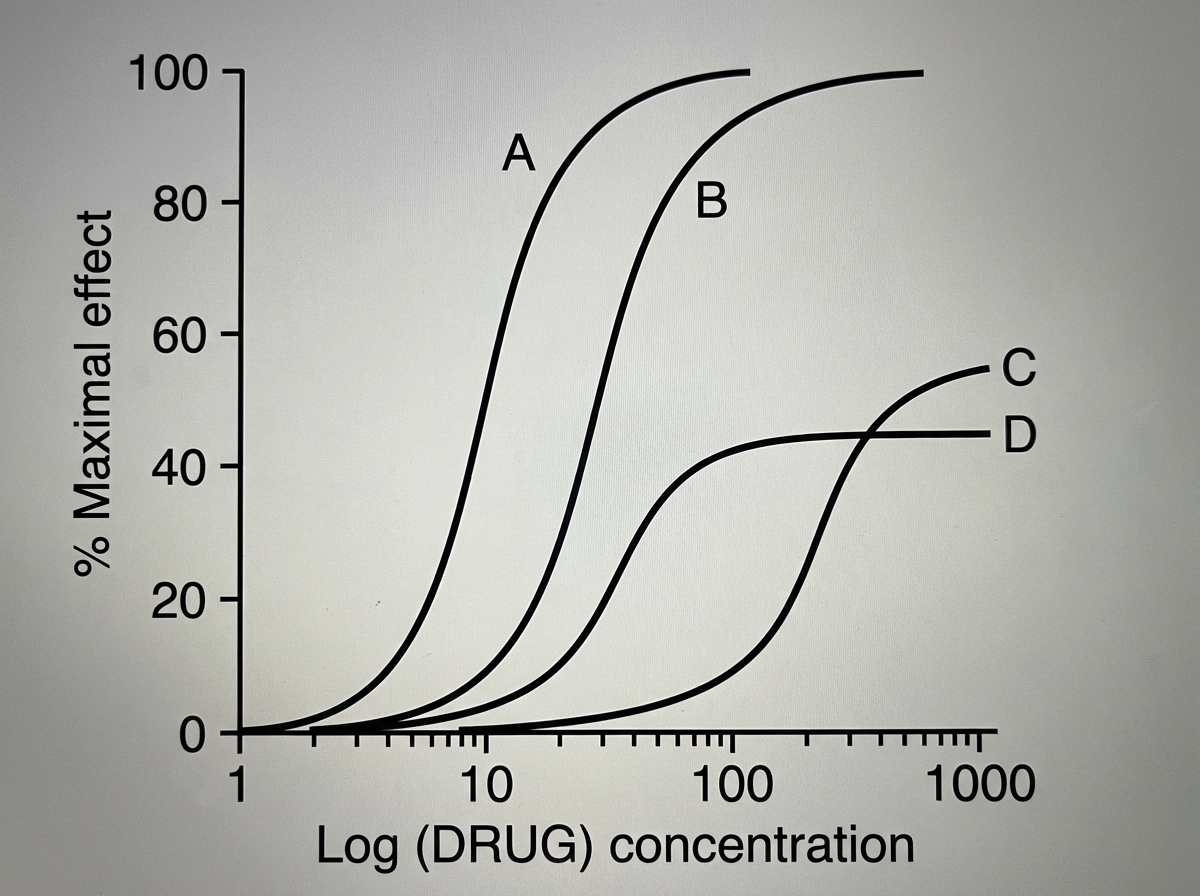
Explanation: **Explanation:** The **Dose-Response Curve (DRC)** is the fundamental pharmacological tool used to represent the relationship between the dose of a drug and the magnitude of the effect it produces. In a population study, we specifically use the **Quantal Dose-Response Curve**. This curve plots the fraction of the population that shows a specific "all-or-none" response (e.g., relief of headache, sleep, or death) against the log dose. It is the gold standard for evaluating drug safety, potency, and efficacy across a diverse group of individuals. **Analysis of Options:** * **A. Dose Response Curve (Correct):** It allows for the determination of the **ED50** (Median Effective Dose), which is the dose at which 50% of the population exhibits the desired therapeutic effect. It accounts for biological variation within a population. * **B. Lethal Dose Response Curve:** While this is a type of quantal DRC, it specifically measures toxicity and mortality (**LD50**). It is not the "best method" for studying the general therapeutic response of a wide range of drugs; its use is restricted to safety and toxicology studies. * **C. Absorbed Dose and Response Curve:** This is not a standard pharmacological term. Pharmacodynamics focuses on the relationship between the concentration at the receptor site (or administered dose) and the effect, rather than just the absorbed fraction. **High-Yield Clinical Pearls for NEET-PG:** * **Potency:** Determined by the position of the DRC along the X-axis (leftward shift = higher potency). * **Efficacy (Maximal Response):** Determined by the height of the DRC (the peak of the curve). * **Therapeutic Index (TI):** Calculated using the Quantal DRC as **LD50 / ED50**. A higher TI indicates a safer drug. * **Slope:** A steep DRC slope indicates that a small increase in dose may lead to a large increase in response or toxicity (e.g., Warfarin, Digoxin).
Absorption and Bioavailability
Practice Questions
Drug Distribution and Protein Binding
Practice Questions
Biotransformation and Metabolism Pathways
Practice Questions
Renal and Non-renal Excretion
Practice Questions
Compartment Models
Practice Questions
Dose-Response Relationships
Practice Questions
Drug Efficacy and Potency
Practice Questions
Drug Tolerance and Tachyphylaxis
Practice Questions
Population Pharmacokinetics
Practice Questions
Pharmacokinetic Variability
Practice Questions
Get full access to all questions, explanations, and performance tracking.
Start For Free