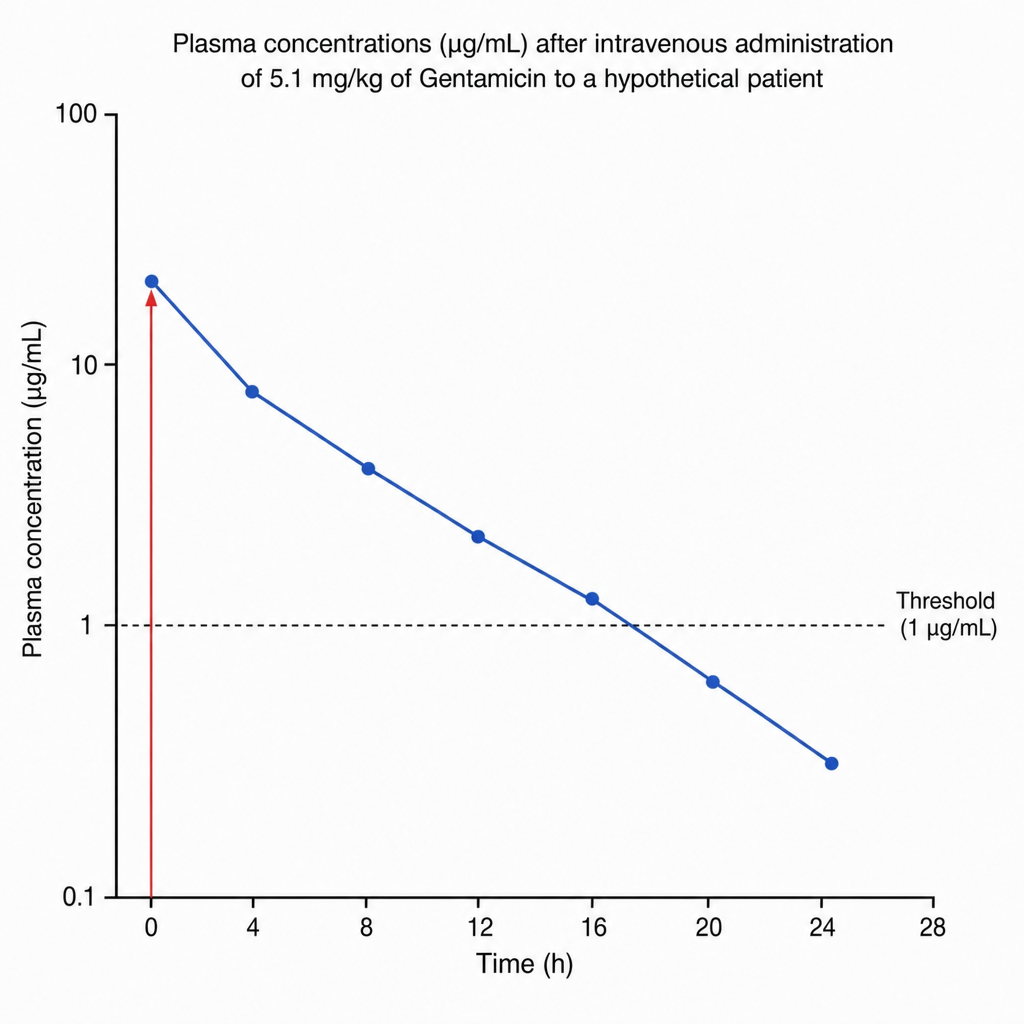
Therapeutic Drug Monitoring (TDM) is indicated for which of the following drugs?
All the following drugs are given by sublingual route EXCEPT:
Proton Pump Inhibitors cause prolonged suppression of acid secretion despite having a short half-life because of which of the following reasons?
Which of the following drugs has the least oral bioavailability?
Which of the following properties of a drug will enable it to be used in low concentrations?
Side effects of a drug arise due to the interactions of the drug with molecules other than its intended target. These effects can be minimized by maximizing the drug's?
Which of the following drugs used in the management of bronchial asthma follows zero-order kinetics?
The pharmacokinetics of Paroxetine include its ability to be easily absorbed after oral administration in healthy volunteers even after food is ingested. Which of the following is TRUE regarding Paroxetine's pharmacokinetics?
Which drug is excreted unchanged in the urine?
Which of the following most accurately describes the transmembrane signaling process involved in the steroid hormone action?
Explanation: **Explanation** **Therapeutic Drug Monitoring (TDM)** is a clinical practice where the plasma concentration of a drug is measured to maintain it within a specific "therapeutic window." It is typically indicated for drugs with a narrow therapeutic index, high inter-individual pharmacokinetic variability, or a direct correlation between plasma levels and toxicity [1]. **Why Metformin is the Correct Answer (in the context of NOT requiring TDM):** Metformin is an oral hypoglycemic agent used for Type 2 Diabetes. It has a **wide therapeutic index**, and its efficacy is monitored clinically by measuring blood glucose levels and HbA1c, rather than plasma drug concentrations [4]. Therefore, TDM is **not** indicated for Metformin. **Analysis of Incorrect Options (Drugs requiring TDM):** * **Theophylline:** A bronchodilator with a narrow therapeutic window [1]. Toxicity (arrhythmias, seizures) can occur at levels only slightly higher than therapeutic doses. * **Lithium:** Used in Bipolar Disorder; it has an extremely narrow therapeutic range (0.6–1.2 mEq/L). Levels >1.5 mEq/L are toxic, necessitating frequent monitoring. * **Phenytoin:** An antiepileptic that exhibits **zero-order (saturation) kinetics** at therapeutic doses [2]. Small dose increases can lead to disproportionately large increases in plasma levels and toxicity (ataxia, nystagmus) [3]. **High-Yield Clinical Pearls for NEET-PG:** * **Indications for TDM:** Narrow therapeutic index (Digoxin, Aminoglycosides), non-linear kinetics (Phenytoin), or drugs where toxicity is difficult to distinguish from the disease (Theophylline) [1], [2]. * **TDM is NOT required for:** Drugs with easily measurable physiological markers (e.g., BP for Antihypertensives, INR for Warfarin, Blood sugar for Metformin/Insulin) [4]. * **Sampling Time:** TDM is usually performed at **steady state** (after 4–5 half-lives) using "trough" concentrations (just before the next dose) [1].
Explanation: **Explanation:** The correct answer is **Isosorbide-5-mononitrate (ISMN)**. The sublingual route is chosen for drugs that require a rapid onset of action or those that undergo extensive **first-pass metabolism** in the liver. By bypassing the portal circulation, these drugs enter the systemic circulation directly via the sublingual venous plexus. * **Isosorbide-5-mononitrate (Option D):** This is the active metabolite of Isosorbide dinitrate. It has **100% oral bioavailability** and does not undergo significant first-pass metabolism. Therefore, it is administered orally (tablets) for the chronic prophylaxis of angina, not for acute relief. * **Glyceryl trinitrate (GTN) and Isosorbide dinitrate (ISDN) (Options A & C):** Both are organic nitrates used for the acute termination of an angina attack. They undergo massive first-pass metabolism (low oral bioavailability), making the sublingual route essential for rapid absorption and immediate effect. * **Buprenorphine (Option B):** This is a potent opioid used for pain and opioid de-addiction. It undergoes significant first-pass metabolism if swallowed; hence, it is commonly formulated as a sublingual tablet to ensure therapeutic systemic levels. **High-Yield Clinical Pearls for NEET-PG:** 1. **Nitrate of choice for acute angina:** Sublingual Glyceryl trinitrate (Nitroglycerin). 2. **Longest acting nitrate:** Isosorbide-5-mononitrate (due to its high bioavailability and long half-life). 3. **Other drugs given sublingually:** Nifedipine (historically for hypertensive emergencies, though now discouraged), Desmopressin, and certain triptans (Zolmitriptan). 4. **Advantage:** Avoids gastric acid degradation and hepatic first-pass effect.
Explanation: ### Explanation **Correct Option: D. They inhibit the proton pump irreversibly.** The duration of action of a drug is usually determined by its plasma half-life ($t_{1/2}$). However, Proton Pump Inhibitors (PPIs) like Omeprazole are a classic exception. Although they have a short plasma half-life (approx. 1–2 hours), their effect lasts for 24–48 hours. This is because PPIs form a **covalent disulfide bond** with the $H^+/K^+$-ATPase enzyme (the proton pump) on the luminal surface of gastric parietal cells. This **irreversible inhibition** means that acid secretion can only resume once the cell synthesizes **new pump molecules**, a process that takes significant time. **Analysis of Incorrect Options:** * **Option A:** While PPIs are pro-drugs activated in an acidic environment, this activation is rapid, not gradual, and does not explain the prolonged duration of action. * **Option B:** PPIs do concentrate in the acidic canaliculi (ion trapping), but this is a transient phase of their pharmacokinetics. The long-term effect is due to the chemical bond formed, not just their physical presence. * **Option C:** Enteric coating is used to protect the acid-labile drug from gastric acid so it can be absorbed in the alkaline duodenum; it is not a "sustained-release" mechanism for prolonged action. **High-Yield Clinical Pearls for NEET-PG:** * **Hit-and-Run Drugs:** PPIs are the prototype of "hit-and-run" drugs—drugs whose effect persists long after they have been cleared from the plasma. * **Administration:** PPIs should be taken **30–60 minutes before a meal** (usually breakfast) because the number of $H^+/K^+$-ATPase pumps at the canalicular surface is maximal after a fast. * **Drug of Choice (DOC):** PPIs are the DOC for Peptic Ulcer Disease (PUD), GERD, and Zollinger-Ellison Syndrome.
Explanation: **Explanation:** The correct answer is **d-tubocurarine (Option A)**. **1. Why d-tubocurarine is correct:** Bioavailability is the fraction of an administered drug that reaches the systemic circulation in an unchanged form. **d-tubocurarine** is a quaternary ammonium compound. Due to its strong positive charge, it is highly ionized at all physiological pH levels. Highly ionized drugs are **lipid-insoluble**, meaning they cannot cross the lipid bilayer of the gastrointestinal tract. Consequently, its oral bioavailability is nearly **zero**, necessitating intravenous administration for its effect as a neuromuscular blocker. **2. Why the other options are incorrect:** * **Morphine (B):** While morphine undergoes significant **first-pass metabolism** in the liver (reducing its bioavailability to ~25-30%), it is still absorbed from the gut and can be administered orally for chronic pain management. * **Ampicillin (C):** This is an acid-stable penicillin. Although its absorption is incomplete and can be decreased by food, it has a bioavailability of approximately 30-50%, making it effective via the oral route. * **Phenytoin (D):** This antiepileptic drug has high oral bioavailability (approx. 70-90%), though it exhibits slow and variable absorption. **3. Clinical Pearls for NEET-PG:** * **Quaternary Ammonium Compounds:** Drugs like d-tubocurarine, neostigmine, and ipratropium are permanently charged; they do not cross the GI tract or the Blood-Brain Barrier (BBB). * **First-Pass Effect:** High first-pass metabolism (e.g., Nitroglycerin, Lidocaine, Morphine) is a common reason for low bioavailability, but **poor lipid solubility** (e.g., Aminoglycosides, d-tubocurarine) results in the *least* oral absorption. * **Bioavailability (F):** For IV administration, F = 100% (or 1). For all other routes, F < 1.
Explanation: **Explanation:** The correct answer is **High stability (Option D)**. In pharmacokinetics, the concentration of a drug required to maintain a therapeutic effect is heavily influenced by its **half-life and metabolic stability**. A drug with high stability is resistant to rapid degradation by hepatic enzymes (like Cytochrome P450) or renal excretion. Because it remains in the systemic circulation for a longer duration, it can achieve and maintain the desired therapeutic effect even when administered in **low concentrations** or infrequent doses. **Analysis of Incorrect Options:** * **High Affinity (A):** Affinity refers to the strength of binding between a drug and its receptor. While high affinity means a drug can bind even at low concentrations, it does not dictate the overall concentration required in the body if the drug is rapidly metabolized. * **High Specificity (B):** Specificity refers to the drug’s ability to bind to a particular receptor type. High specificity reduces side effects (off-target binding) but does not inherently allow for lower dosing concentrations; it relates more to the *quality* of the effect rather than the *quantity* of the drug needed. * **Low Specificity (C):** This usually leads to more side effects and often requires higher doses to ensure enough drug reaches the intended target site. **NEET-PG High-Yield Pearls:** * **Potency vs. Efficacy:** Potency (related to affinity) determines the *dose* required for an effect, but **Stability** determines the *maintenance* of that concentration over time. * **Steady State:** It takes approximately 4–5 half-lives to reach a steady-state concentration. Drugs with high stability (long half-lives) reach this state slowly but sustain it longer. * **Clinical Example:** Drugs like **Amlodipine** or **Digitoxin** have high stability/long half-lives, allowing for once-daily dosing at relatively low concentrations compared to rapidly metabolized alternatives.
Explanation: ### Explanation **1. Why Specificity is the Correct Answer:** Specificity refers to a drug’s ability to interact with a **single, specific target** (receptor, enzyme, or transporter) rather than multiple different targets. Side effects often occur because a drug binds to "off-target" receptors (e.g., a drug intended for $\beta_1$ receptors in the heart also binding to $\beta_2$ receptors in the lungs). By maximizing **specificity**, the drug interacts only with the intended molecular target, thereby minimizing unintended biological responses and reducing side effects. **2. Why Other Options are Incorrect:** * **Affinity:** This refers to the strength of the bond between a drug and its receptor. A drug can have high affinity for multiple receptors (low specificity), which would actually increase the likelihood of side effects. * **Solubility:** This describes how well a drug dissolves in a solvent (water or lipids). While it affects absorption and distribution, it does not dictate which specific molecule the drug will bind to. * **Hydrophobicity:** This relates to lipid solubility. While high hydrophobicity allows a drug to cross the blood-brain barrier or cell membranes easily, it does not ensure that the drug will only hit the intended target; in fact, it may increase side effects by allowing the drug to reach unintended compartments (like the CNS). **3. High-Yield Clinical Pearls for NEET-PG:** * **Selectivity vs. Specificity:** In pharmacology, no drug is truly "specific" (acting on only one target); most are "selective" (preferring one target over others). As the dose increases, selectivity is often lost. * **Therapeutic Index (TI):** A measure of drug safety ($TI = TD_{50} / ED_{50}$). Drugs with high specificity usually have a wider therapeutic index. * **Example:** **Atenolol** is a cardioselective $\beta_1$ blocker. It has higher specificity for the heart than Propranolol (non-selective), making it safer for patients with asthma.
Explanation: **Explanation:** **Theophylline** is the correct answer because it exhibits **capacity-limited elimination**, also known as **Zero-order kinetics**, at higher therapeutic or toxic concentrations. While most drugs follow first-order kinetics (where a constant fraction of the drug is eliminated per unit time), zero-order kinetics implies that a **constant amount** of the drug is eliminated regardless of its plasma concentration. This occurs because the metabolic enzymes in the liver become saturated. Consequently, even a small dose increase can lead to a disproportionate rise in plasma levels, increasing the risk of toxicity (narrow therapeutic index). **Analysis of Incorrect Options:** * **Salbutamol (A):** A short-acting beta-2 agonist (SABA) that follows first-order kinetics. It is primarily used as a rescue inhaler. * **Phenytoin (B):** While Phenytoin **does** follow zero-order kinetics (saturation kinetics), the question specifically asks for a drug used in the **management of bronchial asthma**. Phenytoin is an anti-epileptic. * **Tiotropium (C):** A long-acting muscarinic antagonist (LAMA) used in COPD and asthma that follows first-order kinetics. **NEET-PG High-Yield Pearls:** * **Mnemonic for Zero-Order Kinetics:** "**WATT P**a**S**" – **W**arfarin (at high doses), **A**lcohol (Ethanol), **T**heophylline, **T**olbutamide, **P**henytoin, and **S**alicylates (Aspirin). * Theophylline has a narrow therapeutic range (**10–20 µg/mL**). Toxicity manifests as severe vomiting, cardiac arrhythmias, and seizures. * In zero-order kinetics, the **half-life (t½) is not constant**; it increases as the plasma concentration increases.
Explanation: ### Explanation **Correct Option: C** The core pharmacokinetic concept here is the **Volume of Distribution ($V_d$)**. Paroxetine, a Selective Serotonin Reuptake Inhibitor (SSRI), is highly lipophilic. Drugs with high lipid solubility and high tissue binding capacity distribute extensively into peripheral tissues (fat, muscle, and organs). Consequently, the concentration of the drug remaining in the plasma (systemic circulation) is extremely low. For Paroxetine, the $V_d$ is so large that **less than 1%** of the total body load is present in the blood at any given time. **Analysis of Incorrect Options:** * **Options A & B:** These are the physiological opposites of Paroxetine’s behavior. If a drug resided mainly in systemic circulation (Low $V_d$), it would typically be highly water-soluble or highly protein-bound (e.g., Warfarin). Paroxetine’s extensive tissue sequestration means very little remains in the plasma. * **Option D:** This is factually incorrect. Paroxetine undergoes extensive hepatic metabolism, but approximately **64%** of the dose is eliminated via the **kidneys** (urine) as metabolites, while the remainder is excreted in feces. **NEET-PG High-Yield Pearls:** * **Volume of Distribution Formula:** $V_d = \text{Total amount of drug in body} / \text{Plasma concentration}$. * **Clinical Correlation:** Drugs with high $V_d$ (like Paroxetine, Digoxin, or Chloroquine) are **not** easily removed by hemodialysis because most of the drug is hidden in the tissues, not the blood. * **SSRI Metabolism:** Most SSRIs (except Citalopram/Escitalopram) are potent inhibitors of the **CYP2D6** enzyme, leading to significant drug-drug interactions (e.g., increasing levels of TCAs or Beta-blockers).
Explanation: **Explanation:** The correct answer is **Furosemide**. **1. Why Furosemide is correct:** Furosemide is a potent loop diuretic that acts on the thick ascending limb of the Henle’s loop. A significant portion of furosemide (approximately 60–90%) is excreted **unchanged in the urine** via glomerular filtration and active tubular secretion through the organic anion transport system. This is clinically significant because the drug must reach the tubular lumen to exert its diuretic effect. **2. Why the other options are incorrect:** * **Verapamil:** This calcium channel blocker undergoes extensive **first-pass metabolism** in the liver. It is primarily excreted as metabolites in the urine, with less than 5% excreted unchanged. * **Propranolol:** A highly lipid-soluble beta-blocker, propranolol is almost entirely metabolized by the **liver** (oxidation and glucuronidation). It has a high first-pass effect, and negligible amounts are excreted unchanged. * **Thiopentone:** This is an ultra-short-acting barbiturate. Its action is terminated by **redistribution** from the brain to muscle and fat, but it is ultimately metabolized almost completely by the liver before excretion. **3. NEET-PG High-Yield Pearls:** * **Lipid Solubility vs. Excretion:** Highly lipid-soluble drugs (like Propranolol and Thiopentone) are easily reabsorbed in the renal tubules and must be metabolized into polar (water-soluble) compounds by the liver to be excreted. * **Water-Soluble Drugs:** Drugs excreted unchanged in the urine are typically polar/water-soluble. Other examples include **Atenolol, Digoxin, Ethambutol, and Aminoglycosides**. * **Dose Adjustment:** Drugs excreted unchanged in the urine require strict dose reduction in patients with **Renal Failure** to prevent toxicity.
Explanation: ### Explanation **1. Why Option C is Correct:** Steroid hormones (e.g., Glucocorticoids, Estrogen, Testosterone) are **lipophilic (lipid-soluble)** molecules. This property allows them to easily diffuse across the lipid bilayer of the cell membrane. Once inside, they bind to specific **intracellular receptors** (located in the cytoplasm or nucleus). The hormone-receptor complex then translocates to the nucleus, binds to specific DNA sequences called **Hormone Response Elements (HREs)**, and regulates gene transcription. This process is slow in onset but has long-lasting effects. **2. Why Other Options are Incorrect:** * **Option A (Tyrosine Kinase):** This mechanism is used by **Insulin** and various growth factors (EGF, PDGF). These receptors have intrinsic enzymatic activity. * **Option B (G-Proteins):** This is the mechanism for **GPCRs**, the largest receptor family. It is used by catecholamines, glucagon, and many peptide hormones. It involves second messengers like cAMP or $IP_3/DAG$. * **Option D (Ion Channels):** This describes **Ligand-gated ion channels** (Ionotropic receptors), used by fast-acting neurotransmitters like Acetylcholine (Nicotinic), GABA-A, and Glutamate. **3. NEET-PG High-Yield Pearls:** * **Mnemonic for Intracellular Receptors:** **"VET CAP"** – **V**itamin D, **E**strogen, **T**hyroid hormone ($T_3/T_4$), **C**ortisone (Glucocorticoids), **A**ldosterone, **P**rogesterone. * **Exception:** While most steroid receptors are cytoplasmic, **Thyroid hormone receptors** are constitutively located in the **nucleus**. * **Time Lag:** Because steroid action involves protein synthesis, there is a characteristic **lag period** (minutes to hours) before the clinical effect is seen. This explains why steroids are not the first-line treatment for acute status asthmaticus.
Absorption and Bioavailability
Practice Questions
Drug Distribution and Protein Binding
Practice Questions
Biotransformation and Metabolism Pathways
Practice Questions
Renal and Non-renal Excretion
Practice Questions
Compartment Models
Practice Questions
Dose-Response Relationships
Practice Questions
Drug Efficacy and Potency
Practice Questions
Drug Tolerance and Tachyphylaxis
Practice Questions
Population Pharmacokinetics
Practice Questions
Pharmacokinetic Variability
Practice Questions
Get full access to all questions, explanations, and performance tracking.
Start For Free