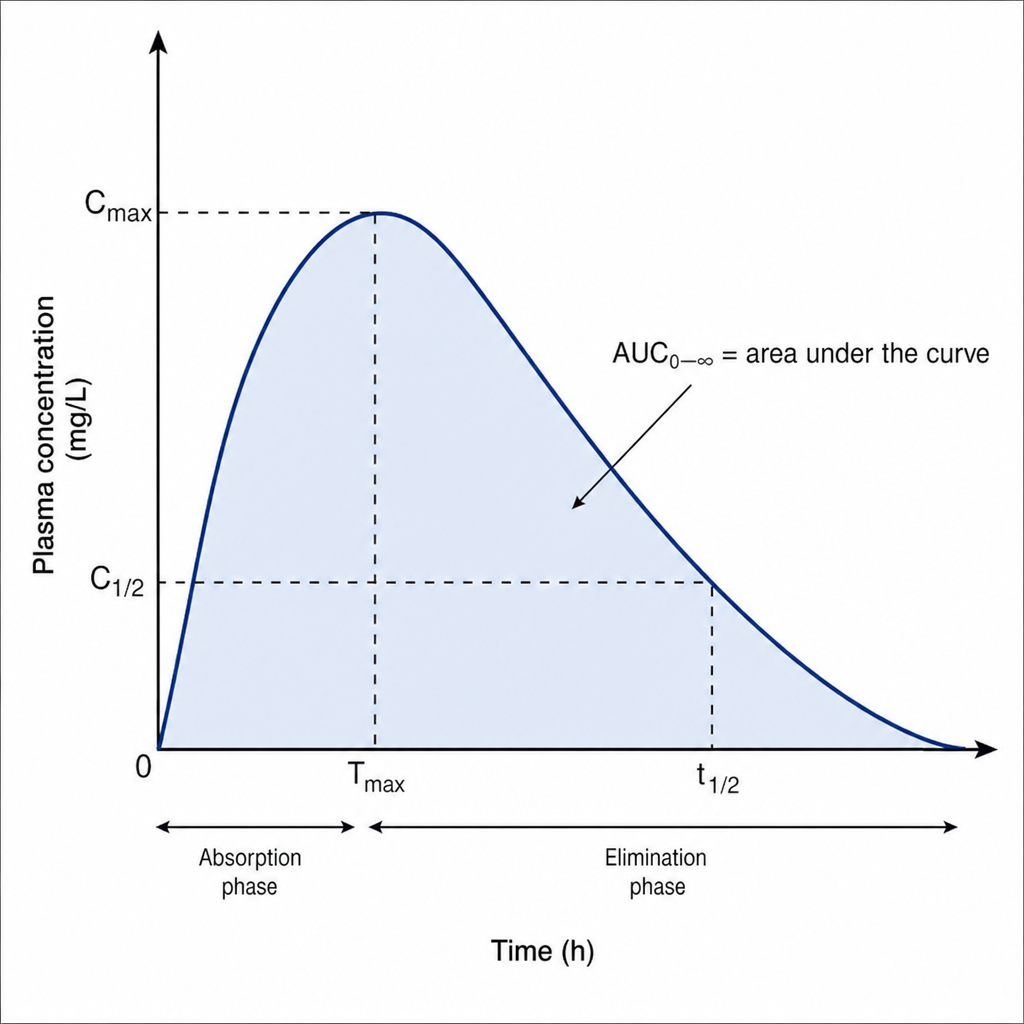
The action of intravenous thiopentone is terminated by which mechanism?
Chloramphenicol is metabolized by:
Which of the following drugs has a narrow therapeutic index?
A dose-response curve of diazepam was produced alone and in the presence of flumazenil. Which of the following is true regarding the effect of flumazenil on the graph?
Which class of antibiotics exhibits time-dependent killing?
Which of the following drugs is least likely to require dosage adjustment in renal dysfunction?
What is the half-life of lithium?
Which drug possesses antagonistic action at histamine, serotonin, and muscarinic receptors?
Which one of the following drugs does not have an active metabolite?
A drug following first-order kinetics is administered by constant intravenous infusion at a rate of 10 mg/min. Its steady-state plasma concentration is 2 mg/L. If the dose rate is increased to 20 mg/min, what will be the new steady-state plasma concentration?
Explanation: ### Explanation **Correct Option: C. Redistribution** Thiopentone is a highly lipid-soluble ultra-short-acting barbiturate [1]. When administered intravenously, it rapidly crosses the blood-brain barrier and reaches peak concentrations in the brain (a highly perfused organ) within seconds, leading to immediate induction of anesthesia [5]. However, its action is terminated not by metabolism, but by **redistribution** [1], [3]. As the plasma concentration falls, the drug diffuses out of the brain and moves into less perfused but larger volume tissues, such as skeletal muscles and eventually adipose tissue [1]. This shift lowers the concentration in the brain below the threshold for anesthesia, causing the patient to wake up within 5–10 minutes [2]. **Why other options are incorrect:** * **A. Rapid renal excretion:** Thiopentone is highly lipophilic and undergoes extensive tubular reabsorption; therefore, renal excretion of the unchanged drug is negligible. * **B & D. Oxidation and Conjugation:** While thiopentone is eventually metabolized in the liver (primarily via oxidation), the rate of metabolism is slow (~10–15% per hour) [3]. Metabolism is responsible for the ultimate elimination of the drug from the body, but it is too slow to account for the rapid recovery from a single induction dose [1]. **High-Yield Clinical Pearls for NEET-PG:** * **Context-Sensitive Half-time:** Thiopentone has a long elimination half-life. If given as a repeated infusion, the "storage" sites (fat) become saturated, and recovery then depends on metabolism rather than redistribution, leading to prolonged recovery times [3], [4]. * **Hanging-over effect:** Due to its slow metabolism and gradual release from fat stores, patients often experience post-operative drowsiness [2]. * **Contraindication:** It is strictly contraindicated in **Acute Intermittent Porphyria** as it induces ALA synthase.
Explanation: **Explanation:** The metabolism of Chloramphenicol primarily occurs in the liver through **Phase II metabolic reactions**, specifically **Glucuronide conjugation**. The enzyme **UDP-glucuronosyltransferase (UGT)** catalyzes the attachment of glucuronic acid to the drug, converting it into an inactive, water-soluble metabolite that is subsequently excreted by the kidneys. **Why other options are incorrect:** * **Oxidation (Option A):** This is a Phase I reaction (mediated by Cytochrome P450 enzymes). While many drugs undergo oxidation, Chloramphenicol bypasses significant Phase I metabolism in favor of direct conjugation. * **Acetylation (Option B):** This is a Phase II reaction used for drugs like Isoniazid, Hydralazine, and Sulfonamides (remembered by the mnemonic **SHIP**). Chloramphenicol is not a substrate for N-acetyltransferase. **High-Yield Clinical Pearls for NEET-PG:** 1. **Gray Baby Syndrome:** This is the most critical clinical correlation. Neonates, especially premature ones, have immature hepatic **UGT enzymes** and low renal filtration rates. This leads to the accumulation of unconjugated chloramphenicol, causing mitochondrial toxicity, abdominal distension, cyanosis (gray color), and circulatory collapse. 2. **Enzyme Inhibition:** Chloramphenicol is a potent **microsomal enzyme inhibitor**. It can increase the plasma levels of drugs like Phenytoin, Warfarin, and Tolbutamide, leading to toxicity. 3. **Bone Marrow Toxicity:** Apart from its metabolism, remember it causes dose-related bone marrow suppression and idiosyncratic **Aplastic Anemia**.
Explanation: **Explanation:** The **Therapeutic Index (TI)** is the ratio of the dose that produces toxicity to the dose that produces the clinically desired effect ($TI = TD_{50} / ED_{50}$). A **narrow therapeutic index** indicates that the margin between the effective dose and the toxic dose is very small, requiring precise dosing and frequent monitoring. **Why Lithium is Correct:** Lithium is a classic example of a drug with a very narrow therapeutic index (0.6 to 1.2 mEq/L). Levels above 1.5 mEq/L can lead to severe toxicity (tremors, ataxia, seizures). Because its therapeutic range is so close to its toxic range, **Therapeutic Drug Monitoring (TDM)** is mandatory to ensure patient safety. **Analysis of Incorrect Options:** * **Desipramine:** While Tricyclic Antidepressants (TCAs) can be toxic in overdose, they generally have a wider safety margin compared to Lithium. * **Penicillin:** This is a "large therapeutic index" drug. It is remarkably safe even at very high doses (except in cases of hypersensitivity/allergy), as it targets bacterial cell walls which humans do not possess. * **Diazepam:** Benzodiazepines have a high therapeutic index. Even massive ingestions rarely cause fatal respiratory depression unless combined with other CNS depressants like alcohol. **NEET-PG High-Yield Pearls:** * **Mnemonic for Narrow Therapeutic Index drugs:** "**W**arfarin, **T**heophylline, **D**igoxin, **L**ithium, **P**henytoin" (**W**ith **T**he **D**og **L**ucy **P**laying). * Other notable NTI drugs: Aminoglycosides, Carbamazepine, Cyclosporine, and Amphotericin B. * Drugs with a high TI (e.g., Penicillin, Paracetamol) are generally safer and do not require routine TDM.
Explanation: ### Explanation **Concept: Competitive Antagonism** The interaction between **Diazepam** (a benzodiazepine agonist) and **Flumazenil** (a benzodiazepine antagonist) is the classic example of **competitive (reversible) antagonism**. 1. **Why Option A is Correct:** In competitive antagonism, both the agonist and the antagonist compete for the same binding site on the receptor (GABA-A receptor). * **Potency:** Because the antagonist occupies some receptors, a higher concentration of the agonist (Diazepam) is required to achieve the same effect. This shifts the Dose-Response Curve (DRC) to the **right**, indicating a **decrease in potency** (increase in $EC_{50}$). * **Efficacy:** Since the binding is reversible, the inhibitory effect of Flumazenil can be completely overcome by increasing the dose of Diazepam. Therefore, the maximal response ($E_{max}$) remains unchanged, meaning there is **no effect on efficacy**. 2. **Why Other Options are Incorrect:** * **Option B:** This describes **Non-competitive antagonism**. Non-competitive antagonists bind to allosteric sites or bind irreversibly, reducing the total number of available receptors and thus lowering the maximal response (efficacy). * **Option C:** This would imply no interaction at all. * **Option D:** This is characteristic of a **Non-competitive antagonist** where the $E_{max}$ is reduced but the $EC_{50}$ might remain unchanged. ### NEET-PG High-Yield Pearls * **Flumazenil** is the specific antidote for Benzodiazepine overdose but is **not** effective for Barbiturate or Alcohol toxicity. * **Competitive Antagonist:** Parallel shift of DRC to the right; $V_{max}$ (Efficacy) unchanged; $K_m$ (Potency) decreased. * **Non-competitive Antagonist:** Downward shift of DRC; $V_{max}$ (Efficacy) decreased; $K_m$ (Potency) usually unchanged. * **Inverse Agonist at BZD receptor:** Beta-carbolines (produce anxiety/seizures).
Explanation: **Explanation:** The efficacy of antibiotics is determined by their pharmacodynamic profile, specifically the relationship between drug concentration and the Minimum Inhibitory Concentration (MIC). **1. Why Linezolid is Correct:** Linezolid belongs to the class of antibiotics that exhibit **Time-dependent killing**. For these drugs, the clinical efficacy is best predicted by the **T > MIC** (the duration of time the serum concentration remains above the MIC). Increasing the concentration far above the MIC does not increase the rate or extent of killing; instead, maintaining a steady concentration over time is key. Other examples include Beta-lactams (Penicillins, Cephalosporins) and Macrolides. **2. Why the Other Options are Incorrect:** * **Aminoglycosides (Option A):** These exhibit **Concentration-dependent killing**. Their efficacy is determined by the **Peak Concentration (Cmax) / MIC** ratio. The higher the peak concentration, the more rapid and extensive the bacterial killing. * **Fluoroquinolones (Option B):** These also exhibit concentration-dependent killing (specifically the **AUC/MIC** ratio). Like aminoglycosides, higher concentrations lead to better clinical outcomes. * **Option D:** Incorrect because Aminoglycosides and Fluoroquinolones follow a different killing kinetic than Linezolid. **High-Yield Clinical Pearls for NEET-PG:** * **Post-Antibiotic Effect (PAE):** Concentration-dependent drugs (Aminoglycosides) typically have a long PAE, allowing for **once-daily dosing** despite short half-lives. * **Dosing Strategy:** For time-dependent drugs (like Beta-lactams), **continuous or extended infusions** are often more effective than bolus dosing to maximize the T > MIC. * **Memory Trick:** * **C**oncentration-dependent: **C**inolones (Fluoroquinolones), **A**minoglycosides, **D**aptomycin (**CAD**). * **T**ime-dependent: **T**etracyclines (sometimes), **L**inezolid, **B**eta-lactams (**TLB**).
Explanation: **Explanation:** The primary factor determining whether a drug requires dosage adjustment in renal dysfunction is its **route of elimination**. Drugs primarily excreted unchanged by the kidneys require dose reduction to prevent toxicity, whereas drugs metabolized by the liver or excreted via bile do not. **Why Clindamycin is the Correct Answer:** Clindamycin is a lincosamide antibiotic that undergoes extensive **hepatic metabolism**. It is converted into inactive metabolites (such as clindamycin sulfoxide) which are then excreted in the bile and feces. Only about 10% of the drug is excreted unchanged in the urine. Therefore, its plasma half-life is not significantly altered in renal failure, making it safe to use without routine dosage adjustment. **Why the Other Options are Incorrect:** * **Amikacin:** As an aminoglycoside, it is highly polar and excreted almost 100% unchanged via glomerular filtration. It is nephrotoxic and requires strict dose adjustment based on creatinine clearance. * **Vancomycin:** This glycopeptide is primarily excreted unchanged by the kidneys. Accumulation leads to ototoxicity and nephrotoxicity; thus, it requires "nomogram-based" dosing or therapeutic drug monitoring (TDM) in renal failure. * **Ciprofloxacin:** While it has some hepatic metabolism, a significant portion (40-50%) is excreted unchanged in the urine. Dose reduction is recommended when $CrCl < 30 \text{ mL/min}$. **NEET-PG High-Yield Pearls:** * **"Liver-only" Antibiotics:** Remember the mnemonic **"Doxy-Clinda-Cef-Ery"** (Doxycycline, Clindamycin, Ceftriaxone, Erythromycin) as drugs generally safe in renal failure. * **Doxycycline** is the tetracycline of choice in renal failure because it is excreted via the gut (biliary). * **Ceftriaxone** is primarily eliminated via biliary excretion, unlike most other cephalosporins.
Explanation: **Explanation:** **Lithium** is the gold standard mood stabilizer used in the treatment of Bipolar Affective Disorder (BPAD). Understanding its pharmacokinetics is crucial for NEET-PG due to its narrow therapeutic index. 1. **Why 24 hours is correct:** The elimination half-life ($t_{1/2}$) of lithium in a healthy adult with normal renal function is approximately **24 hours** (ranging typically from 18 to 30 hours). Because it takes 4 to 5 half-lives to reach a steady-state plasma concentration, lithium requires about 5 days of consistent dosing before therapeutic drug monitoring (TDM) can be accurately performed. 2. **Analysis of Incorrect Options:** * **8 hours:** This is too short for lithium. Drugs with this half-life (like Morphine) require frequent dosing. * **16 hours:** While some sources suggest a range starting at 18 hours, 24 hours is the standard "textbook" value used for clinical calculations and exam purposes. * **36 hours:** This represents the upper limit often seen in elderly patients or those with renal impairment, but it is not the standard physiological half-life. **High-Yield Clinical Pearls for NEET-PG:** * **Excretion:** Lithium is excreted almost entirely by the **kidneys**. It is handled similarly to Sodium; it is reabsorbed in the proximal convoluted tubule (PCT). * **Drug Interactions:** Thiazide diuretics, NSAIDs, and ACE inhibitors increase lithium levels by increasing proximal reabsorption, potentially leading to toxicity. * **Therapeutic Window:** 0.6–1.2 mEq/L (Prophylaxis/Maintenance) and 0.8–1.5 mEq/L (Acute Mania). Toxicity usually occurs above 1.5–2.0 mEq/L. * **Monitoring:** Samples for TDM should be drawn **12 hours post-dose** (trough levels).
Explanation: ### Explanation **Correct Answer: C. Cyproheptadine** **Mechanism and Rationale:** Cyproheptadine is a unique pharmacological agent known for its **broad-spectrum receptor antagonism**. It primarily acts as a potent **H1-receptor antagonist** (First-generation antihistamine). However, it is distinct because it also possesses significant **5-HT2 (Serotonin) receptor blocking** properties and **Anticholinergic (Muscarinic)** activity. Due to this triple-action profile, it is clinically used for conditions beyond simple allergies, such as: * **Serotonin Syndrome:** As an antidote to block excess serotonin. * **Appetite Stimulation:** By blocking 5-HT2 receptors in the hypothalamus. * **Dumping Syndrome:** To control post-gastrectomy symptoms. --- **Analysis of Incorrect Options:** * **A. Promethazine:** While it has strong H1-blocking and significant anticholinergic/alpha-blocking properties, it lacks clinically significant serotonin antagonism. It is primarily used for motion sickness and as a sedative. * **B. Terfenadine:** This is a second-generation antihistamine. It is highly selective for H1 receptors and lacks significant muscarinic or serotonergic activity. (Note: It was withdrawn globally due to cardiotoxicity/Torsades de pointes). * **C. Hydroxyzine:** A first-generation antihistamine with high H1 affinity and significant sedative/anxiolytic properties. While it has some anticholinergic effects, it does not possess the potent serotonin antagonism characteristic of Cyproheptadine. --- **NEET-PG High-Yield Pearls:** 1. **Drug of Choice (DOC):** Cyproheptadine is the preferred drug for managing **Serotonin Syndrome**. 2. **Side Effects:** Like other first-generation antihistamines, it causes significant sedation and "atropine-like" side effects (dry mouth, blurred vision, urinary retention). 3. **Appetite:** It is often tested as the drug used to treat **anorexia** or promote weight gain in children due to its 5-HT2 antagonism.
Explanation: **Explanation The correct answer is **Lisinopril**. **1. Why Lisinopril is correct:** Most ACE inhibitors are **prodrugs** (e.g., Enalapril, Ramipril) that require hepatic conversion into their active "-at" forms (Enalaprilat, Ramiprilat) [2]. However, **Lisinopril** and **Captopril** are the two notable exceptions; they are already in their active form when administered and do not undergo metabolism to form active metabolites [1]. Lisinopril is excreted unchanged by the kidneys. **2. Analysis of Incorrect Options:** * **Diazepam:** This benzodiazepine has a very long half-life because it is metabolized into several active metabolites, including **Nordiazepam** (desmethyldiazepam) and **Oxazepam**. * **Propranolol:** This non-selective beta-blocker undergoes significant first-pass metabolism to form **4-hydroxypropranolol**, which possesses beta-blocking activity. * **Allopurinol:** Used in gout, Allopurinol is rapidly metabolized by xanthine oxidase to its active metabolite, **Alloxanthine (Oxypurinol)**. Alloxanthine has a much longer half-life and is responsible for the sustained inhibition of uric acid synthesis. **3. NEET-PG High-Yield Pearls:** * **ACE Inhibitor Mnemonic:** All ACE inhibitors are prodrugs except **C**aptopril and **L**isinopril (Remember: "**C**heck **L**iver" – these two don't need the liver for activation). * **Active Metabolites to Remember:** * Morphine $\rightarrow$ Morphine-6-glucuronide (more potent) * Spironolactone $\rightarrow$ Canrenone * Amitriptyline $\rightarrow$ Nortriptyline * Codeine $\rightarrow$ Morphine * Lisinopril is preferred in patients with liver disease because it does not require hepatic activation [1].
Explanation: ### Explanation **1. Why Option B is Correct:** The core concept here is **First-Order Kinetics**. In first-order kinetics, the rate of elimination is directly proportional to the plasma concentration [1]. For a drug administered by constant intravenous infusion, the steady-state concentration ($C_{ss}$) is determined by the formula: $\text{Dose Rate} = ext{Clearance (CL)} \times C_{ss}$ Rearranging this: $C_{ss} = \frac{\text{Dose Rate}}{\text{CL}}$ [2]. In first-order kinetics, **Clearance (CL) remains constant** regardless of the dose [1]. Therefore, $C_{ss}$ is directly proportional to the infusion rate. * Initial state: 10 mg/min results in 2 mg/L. * New state: The dose rate is doubled (20 mg/min). * Result: The $C_{ss}$ must also double. $2 \text{ mg/L} \times 2 = \mathbf{4 \text{ mg/L}}$. **2. Why Other Options are Incorrect:** * **Option A (6 mg/L):** This would imply a non-linear, disproportionate increase, which is not seen in first-order kinetics. * **Option C (3 mg/L):** This suggests a sub-proportional increase, which does not align with the linear relationship of first-order elimination. * **Option D (1 mg/L):** This would imply that increasing the dose decreases the concentration, which is physiologically impossible under these parameters. **3. Clinical Pearls & High-Yield Facts for NEET-PG:** * **Steady State:** It takes approximately **4 to 5 half-lives ($t_{1/2}$)** to reach steady state, regardless of the dose or infusion rate. * **Zero-Order Kinetics:** If a drug follows zero-order kinetics (e.g., Phenytoin, Ethanol, Aspirin at high doses), doubling the dose can lead to a massive, unpredictable increase in $C_{ss}$ because the elimination mechanisms are saturated [1]. * **Clearance:** In first-order kinetics, Clearance is constant; in zero-order kinetics, Clearance decreases as plasma concentration increases [1].
Absorption and Bioavailability
Practice Questions
Drug Distribution and Protein Binding
Practice Questions
Biotransformation and Metabolism Pathways
Practice Questions
Renal and Non-renal Excretion
Practice Questions
Compartment Models
Practice Questions
Dose-Response Relationships
Practice Questions
Drug Efficacy and Potency
Practice Questions
Drug Tolerance and Tachyphylaxis
Practice Questions
Population Pharmacokinetics
Practice Questions
Pharmacokinetic Variability
Practice Questions
Get full access to all questions, explanations, and performance tracking.
Start For Free