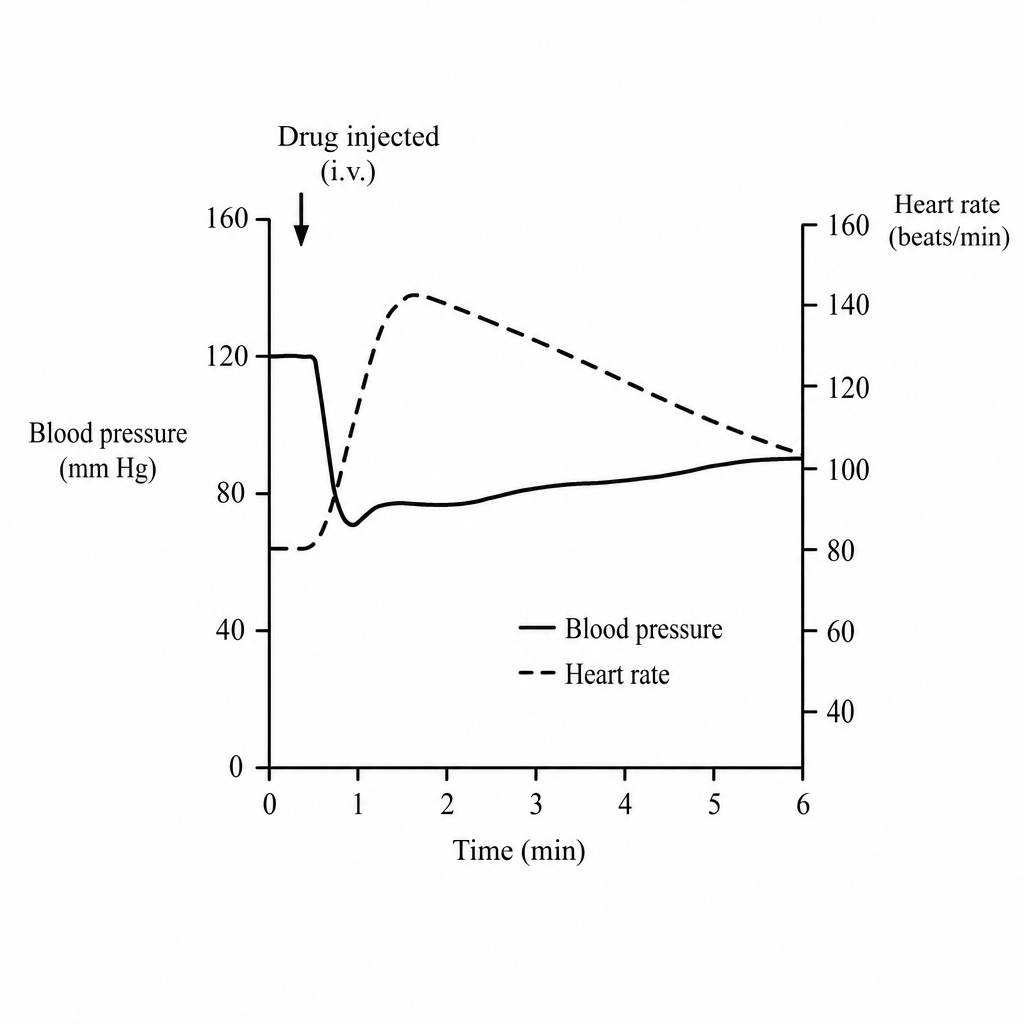
Neostigmine is used in which of the following conditions, except?
An alpha agonist has all of the following actions except?
Which of the following is a selective alpha antagonist?
Why is atropine added to pyridostigmine in the treatment of myasthenia gravis?
What is the first-line drug of choice for primary open-angle glaucoma?
Which neuromuscular blocker is an example of one that causes hypotension?
Tamsulosin, a competitive α adrenoceptor antagonist, has an affinity for which of the following receptors?
Which of the following statements is true regarding Neostigmine?
Anti-cholinesterases are ineffective against which of the following?
Which of the following are adverse effects of tocolytic agonists used in pregnancy?
Explanation: **Explanation:** **Neostigmine** is a synthetic quaternary ammonium compound that acts as a reversible anticholinesterase. It increases the concentration of acetylcholine at both nicotinic and muscarinic receptors. **Why Glaucoma is the correct answer (Except):** While Neostigmine is a potent cholinesterase inhibitor, it is **not used in Glaucoma** because it is a quaternary ammonium compound. This means it is highly polar and has **poor lipid solubility**, resulting in inadequate penetration across the cornea. For Glaucoma, tertiary amines like **Physostigmine** or direct-acting miotics like **Pilocarpine** are preferred as they penetrate ocular tissues more effectively. **Analysis of Incorrect Options:** * **Myasthenia Gravis:** Neostigmine is a drug of choice for symptomatic treatment. It inhibits AChE at the neuromuscular junction, increasing ACh levels to compete with antibodies for nicotinic receptors ($N_m$), thereby improving muscle strength. * **Cobra Bite:** Cobra venom contains post-synaptic neurotoxins that block $N_m$ receptors. Neostigmine (administered with Atropine to block muscarinic side effects) increases ACh levels to displace the toxin and reverse respiratory paralysis. * **Atony of Bladder:** Due to its muscarinic action ($M_3$), Neostigmine stimulates the detrusor muscle and relaxes the trigone/sphincter, making it useful for treating post-operative non-obstructive urinary retention. **Clinical Pearls for NEET-PG:** 1. **Reversal of Muscle Relaxants:** Neostigmine is the standard agent used to reverse the skeletal muscle paralysis induced by non-depolarizing neuromuscular blockers (e.g., d-Tubocurarine). 2. **Physostigmine vs. Neostigmine:** Remember that Physostigmine is a tertiary amine (crosses BBB; used for Atropine poisoning), while Neostigmine is a quaternary amine (does not cross BBB). 3. **Post-op Ileus:** Neostigmine is also used in Ogilvie’s syndrome (acute colonic pseudo-obstruction).
Explanation: Alpha-adrenoceptor agonists are classified into $\alpha_1$ and $\alpha_2$ subtypes, each mediating distinct physiological effects. [1] **Why "General Anesthesia" is the correct answer:** Alpha agonists, specifically $\alpha_2$ agonists like **Dexmedetomidine** and **Clonidine**, are used in anesthesia for their sedative, analgesic, and anesthetic-sparing properties. [3] However, they do not produce "General Anesthesia" (loss of consciousness, amnesia, and immobility) on their own. They are used as **pre-anesthetic medications** or adjuncts to reduce the dose of volatile or intravenous anesthetics. **Analysis of Incorrect Options:** * **Hypertension:** This is a classic effect of $\alpha_1$ agonists (e.g., Phenylephrine, Methoxamine). Activation of $\alpha_1$ receptors on vascular smooth muscle leads to potent vasoconstriction and an increase in peripheral vascular resistance. [1] * **Hypotension:** Centrally acting $\alpha_2$ agonists (e.g., Clonidine, $\alpha$-methyldopa) stimulate presynaptic receptors in the vasomotor center of the medulla. [2] This decreases sympathetic outflow, leading to a fall in blood pressure. [2] * **Nasal Decongestant:** Topical $\alpha_1$ agonists (e.g., Oxymetazoline, Xylometazoline) cause vasoconstriction of the dilated arterioles in the nasal mucosa, reducing swelling and congestion. **High-Yield Clinical Pearls for NEET-PG:** * **Dexmedetomidine:** A highly selective $\alpha_2$ agonist used for "conscious sedation" in ICUs; it causes minimal respiratory depression. [3] * **Phenylephrine:** Used to produce **mydriasis without cycloplegia** (unlike atropine). * **Clonidine Withdrawal:** Abrupt cessation can lead to a "rebound hypertension" crisis due to a sudden surge in catecholamines. * **$\alpha$-methyldopa:** The drug of choice for hypertension in pregnancy.
Explanation: ### Explanation **Correct Answer: B. Prazosin** **Mechanism and Concept:** Prazosin is a highly **selective $\alpha_1$-adrenergic antagonist**. It works by competitively blocking $\alpha_1$ receptors on vascular smooth muscle, leading to vasodilation of both arterioles and veins. This reduces peripheral vascular resistance and blood pressure without significant tachycardia, as it spares the presynaptic $\alpha_2$ receptors (which regulate norepinephrine feedback). **Analysis of Incorrect Options:** * **A. Propranolol:** This is a **non-selective $\beta$-blocker** ($\beta_1$ and $\beta_2$). It has no significant antagonist activity at $\alpha$ receptors. * **C. Phentolamine:** This is a **non-selective $\alpha$-antagonist** (blocks both $\alpha_1$ and $\alpha_2$). Because it blocks presynaptic $\alpha_2$ receptors, it causes a significant increase in norepinephrine release, leading to reflex tachycardia. * **D. Clonidine:** This is a **selective $\alpha_2$-agonist** (centrally acting). It reduces sympathetic outflow from the brainstem and is used as an antihypertensive, not an antagonist. **High-Yield Clinical Pearls for NEET-PG:** * **First-Dose Phenomenon:** Prazosin can cause marked orthostatic hypotension and syncope with the initial dose. Patients should be advised to take the first dose at bedtime. * **BPH Management:** Selective $\alpha_1$ blockers (especially **Tamsulosin**, which is $\alpha_{1A}$ selective) are first-line for Benign Prostatic Hyperplasia as they relax the prostatic urethra. * **Pheochromocytoma:** Non-selective $\alpha$-blockers like **Phenoxybenzamine** (irreversible) or Phentolamine (reversible) are used pre-operatively to manage catecholamine crises. * **Mnemonic:** The "-osin" suffix (Prazosin, Terazosin, Doxazosin) typically denotes selective $\alpha_1$ blockers.
Explanation: ### Explanation **1. Why Option B is Correct:** Pyridostigmine is an acetylcholinesterase inhibitor used to treat Myasthenia Gravis. By inhibiting the breakdown of acetylcholine (ACh), it increases ACh levels at the **nicotinic receptors** of the neuromuscular junction (NMJ) to improve muscle strength. However, this increase in ACh is non-selective and also occurs at **muscarinic receptors** throughout the body. This leads to unwanted parasympathetic overstimulation, causing side effects like abdominal cramps, diarrhea, excessive salivation, and bradycardia. Atropine, a muscarinic antagonist, is added to block these peripheral muscarinic effects without interfering with the desired nicotinic action at the NMJ. **2. Why Other Options are Incorrect:** * **Option A:** Pyridostigmine is a quaternary ammonium compound; it does not cross the blood-brain barrier significantly. Therefore, central excitation is generally not a concern requiring atropine. * **Option C:** Atropine does not alter the metabolism or pharmacokinetics of pyridostigmine; it only manages the side-effect profile. * **Option D:** Myasthenia Gravis is an autoimmune disorder. Pyridostigmine and atropine provide symptomatic relief but do not modify the underlying disease progression (which usually requires steroids or immunosuppressants). **3. Clinical Pearls for NEET-PG:** * **Drug of Choice:** Pyridostigmine is the preferred long-term oral treatment for Myasthenia Gravis due to its longer duration of action compared to Neostigmine. * **Edrophonium (Tensilon Test):** Used for diagnosis and to differentiate between a **Myasthenic crisis** (improvement with edrophonium) and a **Cholinergic crisis** (worsening with edrophonium). * **Antidote:** Atropine is the specific antidote for cholinergic crisis/organophosphate poisoning to reverse life-threatening muscarinic effects (DUMBELS).
Explanation: **Explanation:** **Prostaglandin Analogues (PGAs)**, such as Latanoprost, Bimatoprost, and Travoprost, are currently the **first-line drug of choice** for Primary Open-Angle Glaucoma (POAG). **Why Prostaglandin Analogues?** The primary mechanism of PGAs is increasing the **uveoscleral outflow** of aqueous humor. They are preferred because they provide the most potent reduction in intraocular pressure (IOP), have a long duration of action allowing for **once-daily dosing** (improving patient compliance), and lack systemic side effects compared to other classes. **Analysis of Incorrect Options:** * **Beta-blockers (e.g., Timolol):** Formerly the first-line treatment, they work by decreasing aqueous humor production [3]. They are now considered second-line due to systemic contraindications, such as bradycardia, heart block, and bronchospasm (asthma/COPD). * **Carbonic Anhydrase Inhibitors (e.g., Dorzolamide, Acetazolamide):** These reduce aqueous secretion by inhibiting carbonic anhydrase in the ciliary body epithelium but are generally less efficacious than PGAs [3]. * **Miotics (e.g., Pilocarpine):** These increase trabecular outflow but are rarely used for POAG due to side effects like miosis, brow ache, and risk of retinal detachment [1]. They remain the drug of choice for Acute Angle-Closure Glaucoma. **High-Yield Clinical Pearls for NEET-PG:** * **Side Effects of PGAs:** Increased iris pigmentation (permanent), thickening/darkening of eyelashes, and deepening of the sulcus. * **Latanoprostene bunod:** A newer agent that works via both uveoscleral outflow (prostaglandin) and trabecular meshwork (nitric oxide). * **Apraclonidine:** Used specifically to prevent post-laser (iridotomy/trabeculoplasty) IOP spikes [2].
Explanation: **Explanation:** The correct answer is **Atracurium**. The primary mechanism behind the hypotension caused by certain neuromuscular blockers (NMBs) is **histamine release** and, to a lesser extent, autonomic ganglion blockade. **Why Atracurium is correct:** Atracurium belongs to the benzylisoquinolone class of non-depolarizing NMBs. These drugs are notorious for triggering the mast cell release of histamine. Histamine causes systemic vasodilation and increased capillary permeability, leading to a drop in blood pressure (hypotension) and often a compensatory tachycardia and flushing. **Analysis of Incorrect Options:** * **Pancuronium (Option C):** This drug typically causes **hypertension** and tachycardia rather than hypotension. It possesses "vagolytic" properties (blocks muscarinic receptors in the heart) and stimulates the sympathetic nervous system. * **Vecuronium (Option B) and Rocuronium (Option A):** These are amino-steroid compounds. They are designed to be "cardiovascularly stable" because they do not trigger significant histamine release and lack vagolytic effects at clinical doses. **High-Yield Clinical Pearls for NEET-PG:** * **Hofmann Elimination:** Atracurium and Cisatracurium undergo spontaneous non-enzymatic degradation in the plasma. This makes them the **drugs of choice in patients with liver or kidney failure**. * **Laudanosine Toxicity:** A metabolite of atracurium (laudanosine) can cross the blood-brain barrier and may cause **seizures** at high concentrations. * **Cisatracurium:** It is an isomer of atracurium that is more potent and, importantly, **does not cause histamine release**, making it more hemodynamically stable than atracurium. * **Mivacurium:** Another benzylisoquinolone that causes significant histamine release and hypotension, but it is short-acting.
Explanation: Tamsulosin is a selective $\alpha_1$ adrenoceptor antagonist primarily used in the management of Benign Prostatic Hyperplasia (BPH). While it is often broadly categorized as an $\alpha_{1A}$ blocker, current pharmacological evidence and clinical data emphasize its high affinity for both **$\alpha_{1A}$ and $\alpha_{1D}$** subtypes [1]. **Why Option D is Correct:** The $\alpha_1$ receptors are divided into three subtypes: * **$\alpha_{1A}$:** Predominantly found in the prostate and bladder neck. Blocking this relaxes smooth muscle, improving urine flow. * **$\alpha_{1D}$:** Predominantly found in the bladder detrusor muscle and the sacral spinal cord. Blocking this subtype helps relieve **storage symptoms** (irritative symptoms) like urgency and frequency. Tamsulosin exhibits high affinity for both, making it highly effective for the comprehensive symptom profile of BPH [1]. **Analysis of Incorrect Options:** * **Option A ($\alpha_{1A}$):** While Tamsulosin does bind to $\alpha_{1A}$, selecting this alone is incomplete as it ignores the clinically significant $\alpha_{1D}$ affinity. * **Option B ($\alpha_{1D}$):** Similarly, this is only half of the drug's receptor profile. * **Option C:** Incorrect, as Tamsulosin is a well-established $\alpha_1$ antagonist. **NEET-PG High-Yield Pearls:** * **Uroselectivity:** Tamsulosin has less affinity for $\alpha_{1B}$ receptors (found in blood vessels), leading to a lower incidence of orthostatic hypotension compared to Prazosin or Terazosin [1]. * **Side Effect:** A unique and high-yield complication of Tamsulosin is **Intraoperative Floppy Iris Syndrome (IFIS)** during cataract surgery [1]. * **Clinical Use:** It is the drug of choice for BPH and is also used off-label to facilitate the passage of distal ureteral stones (Medical Expulsive Therapy).
Explanation: **Explanation:** **1. Why Option A is Correct:** Neostigmine is a synthetic anticholinesterase agent characterized chemically as a **quaternary ammonium compound**. Because it carries a positive charge (polar), it is lipid-insoluble. This structural property is fundamental to its pharmacokinetics: it is poorly absorbed orally and does not cross lipid membranes easily. **2. Why the Other Options are Incorrect:** * **Option B:** Neostigmine is primarily hydrolyzed by **plasma cholinesterases** and excreted unchanged in the urine, rather than undergoing extensive hepatic metabolism. * **Option C:** Due to its quaternary (charged) nature, Neostigmine **cannot cross the blood-brain barrier (BBB)**. Therefore, it lacks central nervous system (CNS) effects. In contrast, tertiary amines like Physostigmine are uncharged and can cross the BBB. * **Option D:** While Neostigmine does affect smooth muscle, its **most prominent effect is on the skeletal muscle (Neuromuscular Junction)**. It not only inhibits acetylcholinesterase but also has a direct agonistic action on nicotinic (Nm) receptors. **High-Yield Clinical Pearls for NEET-PG:** * **Drug of Choice:** Neostigmine is the preferred agent for **Myasthenia Gravis** (symptomatic treatment) and for the **reversal of non-depolarizing neuromuscular blockers** (e.g., Vecuronium). * **Post-operative use:** It is used to treat post-operative paralytic ileus and urinary retention. * **Antidote:** Atropine is always administered alongside Neostigmine to block its unwanted muscarinic side effects (bradycardia, salivation) without interfering with its desired nicotinic effects on skeletal muscle. * **Comparison:** Remember: **P**hysostigmine = **P**enetrates CNS; **N**eostigmine = **N**o CNS penetration.
Explanation: **Explanation:** The core concept behind this question is the mechanism of action of **Anti-cholinesterases (AChEs)**. These drugs work by inhibiting the enzyme acetylcholinesterase, thereby increasing the concentration of endogenous acetylcholine (ACh) at the synapse. **Why Carbamate Poisoning is the Correct Answer:** Carbamates (like Carbaryl or Propoxur) are themselves **reversible inhibitors of acetylcholinesterase**. In carbamate poisoning, the enzyme is already occupied and inhibited by the carbamate molecule. Adding another anti-cholinesterase (like Neostigmine or Physostigmine) would be redundant and potentially harmful, as it would further increase acetylcholine levels, worsening the cholinergic crisis. Therefore, AChEs are ineffective and contraindicated; the treatment of choice is **Atropine**. **Analysis of Incorrect Options:** * **Belladonna Poisoning:** This is caused by Atropine-like alkaloids (muscarinic antagonists). Anti-cholinesterases (specifically **Physostigmine**, which crosses the blood-brain barrier) are the treatment of choice because they increase ACh levels to competitively displace the toxin from receptors. * **Postoperative Ileus:** Neostigmine (an AChE) is used to stimulate intestinal motility by increasing ACh at the muscarinic receptors of the GI tract. * **Cobra Bite:** Cobra venom contains **post-synaptic neurotoxins** that block nicotinic receptors (NMJ). Anti-cholinesterases (Neostigmine) increase ACh levels to outcompete the toxin, helping reverse skeletal muscle paralysis. **High-Yield Clinical Pearls for NEET-PG:** 1. **Oximes (Pralidoxime):** These are used in Organophosphate poisoning but are **not** used in Carbamate poisoning because the carbamylated enzyme does not undergo "aging" and oximes may actually worsen carbamate toxicity. 2. **Physostigmine vs. Neostigmine:** Physostigmine is a tertiary amine (crosses BBB; used for central anticholinergic toxicity), while Neostigmine is a quaternary ammonium (does not cross BBB; used for Myasthenia Gravis and Cobra bite). 3. **Drug of Choice:** Atropine is the physiological antagonist for both Organophosphate and Carbamate poisoning.
Explanation: **Explanation:** Tocolytic agonists, specifically **$\beta_2$-selective agonists** like **Ritodrine** and **Terbutaline**, are used to delay preterm labor by relaxing the uterine smooth muscle. Their adverse effect profile is a direct extension of their pharmacological action on $\beta$-receptors. 1. **Why Option A is Correct:** * **Hypotension:** $\beta_2$ stimulation causes peripheral vasodilation (decreased systemic vascular resistance), leading to a drop in blood pressure and compensatory tachycardia. * **Hypokalemia:** $\beta_2$ agonists stimulate the $Na^+/K^+$ ATPase pump, causing an intracellular shift of potassium. This is a transient but significant metabolic effect. * **Pulmonary Edema:** This is the most serious complication. It occurs due to a combination of $i.v.$ fluid overload, increased cardiac output, and increased capillary permeability. 2. **Why Other Options are Incorrect:** * **Hypertension (Options B & D):** $\beta_2$ agonists cause vasodilation and hypotension, not hypertension. While they increase heart rate, the net effect on mean arterial pressure is usually a decrease. * **Hypoglycemia (Option C):** $\beta_2$ agonists actually cause **Hyperglycemia**. They promote glycogenolysis in the liver and skeletal muscle, increasing blood glucose levels. This is particularly important to monitor in diabetic pregnant patients. **NEET-PG High-Yield Pearls:** * **Drug of Choice:** Currently, **Nifedipine** (Calcium Channel Blocker) or **Atosiban** (Oxytocin antagonist) are preferred over $\beta_2$ agonists due to a better safety profile. * **Mnemonic for $\beta_2$ Agonist Side Effects:** "Tachy-Hypo-Hyper-Hypo" (Tachycardia, Hypotension, Hyperglycemia, Hypokalemia). * **Contraindication:** $\beta_2$ agonists should be avoided in women with cardiac disease or poorly controlled diabetes.
Cholinergic Agonists
Practice Questions
Cholinergic Antagonists
Practice Questions
Adrenergic Agonists
Practice Questions
Adrenergic Antagonists
Practice Questions
Ganglionic Agents
Practice Questions
Neuromuscular Blocking Agents
Practice Questions
Autonomic Drugs in Ophthalmology
Practice Questions
Autonomic Drugs in Cardiovascular Disease
Practice Questions
Autonomic Drugs in Respiratory Disease
Practice Questions
Autonomic Drugs in Urological Disorders
Practice Questions
Get full access to all questions, explanations, and performance tracking.
Start For Free