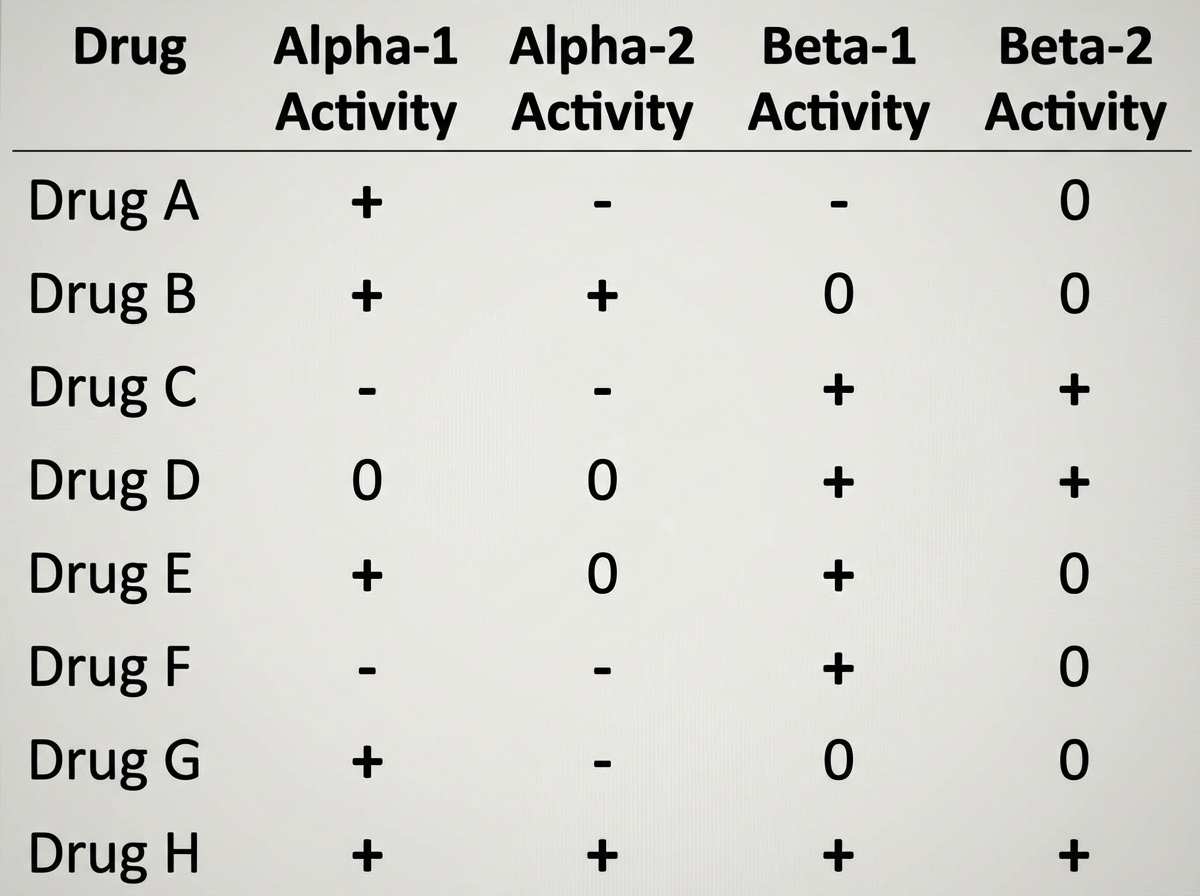
A 32-year-old woman had abdominal surgery, after which she complains about difficulty in urination. Cholinomimetic stimulation with bethanechol or neostigmine is beneficial in relieving post-operative urinary retention. Neostigmine and bethanechol in moderate doses are likely to have different effects on what?
Intravenous administration of norepinephrine in a patient already taking an effective dose of atropine will often:
What is the effect of a Beta 2 agonist?
Carvedilol is an effective antihypertensive agent that, like propranolol, is capable of blocking beta receptors. An important difference between the two drugs is that carvedilol
Which muscles are affected first by tubocurare?
A child has swallowed the contents of two bottles of nasal decongestant, whose primary ingredient is an alpha-adrenergic receptor agonist. What signs of alpha activation may occur in this patient?
Which of the following is a selective alpha-2 blocker?
Which of the following statements regarding the parasympathetic nervous system is true?
Which of the following drugs will decrease heart rate in a patient with a normal heart rate but will have little effect on heart rate in a cardiac transplant recipient?
Which of the following adverse drug reactions is caused by Apraclonidine?
Explanation: ### Explanation The core of this question lies in understanding the difference between **direct-acting** and **indirect-acting** cholinomimetics regarding vascular innervation. **1. Why Vascular Endothelium is the Correct Answer:** * **Bethanechol** is a direct-acting muscarinic agonist. It acts on **M3 receptors** located on the vascular endothelium [1]. These receptors, when stimulated, trigger the release of **Nitric Oxide (EDRF)**, leading to vasodilation and a decrease in blood pressure [4]. * **Neostigmine** is an indirect-acting agent (Acetylcholinesterase inhibitor). It works by increasing the concentration of endogenous Acetylcholine (ACh). However, **blood vessels lack cholinergic innervation** (they have receptors but no nerves) [4]. Since neostigmine only enhances ACh where it is naturally released from nerve endings, it has **no significant effect** on vascular resistance or blood pressure at moderate doses [3]. **2. Why Other Options are Incorrect:** * **B, C, and D (Salivary glands, Ureteral tone, Gastric secretory cells):** These organs are all **directly innervated** by postganglionic parasympathetic fibers. Therefore, both bethanechol (direct action) [2] and neostigmine (by preserving endogenous ACh at the synapse) will produce similar excitatory effects: increased salivation, increased ureteral contraction, and increased gastric acid secretion. **3. NEET-PG High-Yield Pearls:** * **Bethanechol:** The drug of choice for post-operative/post-partum non-obstructive urinary retention [2]. It is "bowel and bladder" selective and has negligible nicotinic activity [1]. * **Vascular M3 Receptors:** These are often called "non-innervated" or "orphan" receptors. They respond to exogenous agonists (like Bethanechol or Pilocarpine) but not to physiological nerve stimulation [4]. * **Neostigmine vs. Physostigmine:** Remember that Neostigmine is a quaternary ammonium (does not cross BBB), while Physostigmine is a tertiary amine (crosses BBB; used for Atropine poisoning).
Explanation: **Explanation:** The correct answer is **A. Increase heart rate.** **Mechanism:** Norepinephrine (NE) is a potent agonist at $\alpha_1$, $\alpha_2$, and $\beta_1$ receptors. When administered alone, NE causes intense vasoconstriction ($\alpha_1$), leading to a significant rise in mean arterial pressure. This triggers a **compensatory baroreceptor reflex**, which increases vagal (parasympathetic) tone to the heart, resulting in **reflex bradycardia**. However, **Atropine** is a muscarinic antagonist that blocks the effects of the vagus nerve on the heart. By "pre-treating" with atropine, the baroreceptor-mediated reflex bradycardia is abolished. Consequently, the direct stimulatory effect of NE on cardiac **$\beta_1$ receptors** is unmasked, leading to an increase in heart rate (tachycardia). **Analysis of Incorrect Options:** * **B. Decrease total peripheral resistance:** Incorrect. NE causes profound vasoconstriction via $\alpha_1$ receptors, which significantly *increases* total peripheral resistance. * **C. Decrease pupil size:** Incorrect. NE acts on $\alpha_1$ receptors in the radial muscle of the iris to cause mydriasis (dilation), not miosis (contraction). * **D. Have no effect:** Incorrect. NE is a potent sympathomimetic with significant hemodynamic effects. **NEET-PG High-Yield Pearls:** * **Vagal Escape:** Atropine "unmasks" the direct $\beta_1$ effect of drugs that otherwise cause reflex bradycardia (like NE or Phenylephrine). * **Norepinephrine vs. Epinephrine:** NE lacks significant $\beta_2$ activity; therefore, it does not cause vasodilation or a drop in diastolic blood pressure, unlike Epinephrine. * **Drug of Choice:** NE is the first-line vasopressor for **septic shock**.
Explanation: **Explanation:** The correct answer is **D. Bronchial muscle relaxation.** **Mechanism of Action:** Beta-2 ($\beta_2$) receptors are G-protein coupled receptors (Gs) primarily located in smooth muscles. When a $\beta_2$ agonist binds to these receptors, it stimulates adenylyl cyclase, increasing intracellular cAMP levels. This leads to the activation of Protein Kinase A, which causes sequestration of calcium and inhibits myosin light chain kinase, resulting in **smooth muscle relaxation**. This effect is most prominent in the bronchioles, making $\beta_2$ agonists (like Salbutamol) the mainstay for treating asthma and COPD. **Analysis of Incorrect Options:** * **A. Mydriasis:** This is caused by the contraction of the radial muscle of the iris, mediated by **Alpha-1 ($\alpha_1$)** receptors. * **B. Contraction of urinary sphincters:** This is an excitatory response mediated by **Alpha-1 ($\alpha_1$)** receptors. $\beta_2$ stimulation actually causes relaxation of the detrusor muscle (though $\beta_3$ is the primary receptor for detrusor relaxation). * **C. Vasoconstriction:** This is mediated by **Alpha-1 ($\alpha_1$)** receptors. In contrast, $\beta_2$ stimulation causes **vasodilation** in skeletal muscle blood vessels, which can lead to a decrease in peripheral resistance. **High-Yield Clinical Pearls for NEET-PG:** * **Tocolysis:** $\beta_2$ agonists (e.g., Ritodrine, Isoxsuprine) are used to relax the uterus and delay premature labor. * **Metabolic effects:** $\beta_2$ stimulation increases glycogenolysis in the liver and promotes the uptake of potassium into skeletal muscles (hence, they are used to treat **Hyperkalemia**). * **Side Effects:** Muscle tremors (most common), tachycardia (due to $\beta_1$ cross-reactivity and reflex response), and hypokalemia.
Explanation: ### Explanation **Core Concept:** Carvedilol belongs to a unique class of **third-generation non-selective beta-blockers**. Unlike Propranolol (a first-generation non-selective beta-blocker), Carvedilol possesses additional **$\alpha_1$-receptor blocking activity**. This dual action results in peripheral vasodilation (via $\alpha_1$ blockade) alongside decreased heart rate and contractility (via $\beta$ blockade), making it highly effective in treating hypertension and chronic heart failure. **Analysis of Options:** * **Option D (Correct):** Carvedilol provides a "balanced" hemodynamic effect. While $\beta$-blockade prevents reflex tachycardia, the $\alpha_1$-blockade reduces peripheral vascular resistance. * **Option A (Incorrect):** Carvedilol is primarily administered **orally**. It is not used as eye drops; Timolol and Betaxolol are the standard beta-blockers used topically for glaucoma. * **Option B (Incorrect):** Carvedilol does **not** have Intrinsic Sympathomimetic Activity (ISA). Drugs with ISA (like Pindolol or Acebutolol) act as partial agonists. * **Option C (Incorrect):** Carvedilol is **non-selective**, blocking $\beta_1$, $\beta_2$, and $\alpha_1$ receptors. Selective $\beta_1$ blockers (cardioselective) include Metoprolol, Atenolol, and Bisoprolol. **High-Yield NEET-PG Pearls:** 1. **Antioxidant Properties:** Carvedilol has unique antioxidant and anti-proliferative properties, which contribute to its mortality benefit in **Congestive Heart Failure (CHF)**. 2. **Labetalol vs. Carvedilol:** Both block $\alpha$ and $\beta$ receptors. However, Labetalol is the drug of choice for **hypertensive emergencies in pregnancy**, while Carvedilol is a cornerstone for **chronic heart failure** management. 3. **Membrane Stabilizing Activity:** Like Propranolol, Carvedilol possesses local anesthetic (membrane stabilizing) activity. 4. **Metabolism:** It is highly lipophilic and undergoes extensive hepatic metabolism.
Explanation: **Explanation:** Tubocurarine is a prototype **non-depolarizing neuromuscular blocker** that acts as a competitive antagonist at the nicotinic acetylcholine receptors ($N_m$) of the neuromuscular junction. **Why Head and Neck Muscles are correct:** Neuromuscular blockers do not affect all muscles simultaneously. There is a characteristic sequence of paralysis based on the muscle's size, vascularity, and metabolic activity. Small, rapidly moving, and highly perfused muscles are affected first. Therefore, the sequence begins with the **extrinsic eye muscles** (causing diplopia), followed by the **small muscles of the face, head, and neck**. **Analysis of Incorrect Options:** * **Limbs (B) and Abdominal muscles (D):** These are larger muscle groups. After the head and neck, paralysis spreads to the muscles of the fingers, then the limbs, and finally the trunk/abdominal muscles. * **Respiratory muscles (C):** These are the **last** to be paralyzed. The diaphragm is the most resistant muscle to non-depolarizing blockers. This is clinically significant as it provides a safety margin during anesthesia; however, it also means the diaphragm is the **first to recover** when the drug wears off. **High-Yield NEET-PG Pearls:** * **Sequence of Paralysis:** Small muscles (Eyes/Face) → Fingers → Limbs → Trunk → Diaphragm. * **Sequence of Recovery:** Exactly the reverse (Diaphragm recovers first). * **Antidote:** Neostigmine (acetylcholinesterase inhibitor) is used to reverse the blockade by increasing ACh levels at the synapse. * **Clinical Sign:** "Train-of-Four" (TOF) monitoring is used in practice to assess the depth of the blockade.
Explanation: **Explanation:** The primary ingredient in most nasal decongestants (e.g., Oxymetazoline, Xylometazoline) is a **direct-acting alpha-adrenergic agonist**. **1. Why Mydriasis is the correct answer:** Alpha-1 ($\alpha_1$) receptors are located on the **radial (dilator) muscle of the iris**. Activation of these receptors causes contraction of the radial muscle, leading to pupil dilation, known as **mydriasis**. Since this is a direct effect of alpha activation on the effector organ, it is a consistent sign of systemic alpha-agonist toxicity. **2. Why other options are incorrect:** * **Vasoconstriction (Option C):** While $\alpha_1$ activation does cause peripheral vasoconstriction, this leads to a significant rise in blood pressure. In response to this acute hypertension, the body triggers a **baroreceptor reflex**, which results in **reflex bradycardia** and a subsequent decrease in sympathetic outflow. Therefore, while vasoconstriction occurs, it is often clinically masked or outweighed by the systemic reflex responses in a toxicity scenario. * **Tachycardia (Option A):** This is incorrect because alpha-agonists typically cause **reflex bradycardia** (due to the baroreceptor reflex responding to increased peripheral resistance). Tachycardia is a feature of beta-agonist or anticholinergic overdose, not pure alpha-agonist overdose. * **All of the above (Option D):** Since tachycardia is not a feature, this option is eliminated. **High-Yield Clinical Pearls for NEET-PG:** * **Imidazoline Derivatives:** Drugs like Oxymetazoline can cross the BBB and stimulate central $\alpha_2$ receptors (like Clonidine), leading to CNS depression, hypotension, and bradycardia in children. * **Mydriasis vs. Miosis:** Remember, $\alpha_1$ agonists cause mydriasis *without* cycloplegia (unlike anticholinergics which cause both). * **Reflex Bradycardia:** Always associate pure $\alpha_1$ agonists (e.g., Phenylephrine) with a decrease in heart rate.
Explanation: **Explanation:** **Correct Answer: C. Yohimbine** **Mechanism and Rationale:** Yohimbine is a classic, selective **alpha-2 adrenergic receptor antagonist (blocker)** [1]. Alpha-2 receptors are primarily located presynaptically; their stimulation normally inhibits the release of norepinephrine (negative feedback) [3]. By blocking these receptors, Yohimbine increases sympathetic outflow and norepinephrine release [1]. Clinically, it was historically used for erectile dysfunction, though it is now largely obsolete due to more effective agents like PDE-5 inhibitors. **Analysis of Incorrect Options:** * **A. Tizanidine:** This is a centrally acting **alpha-2 agonist**. It is used as a skeletal muscle relaxant (spasticity) by inhibiting motor neurons in the spinal cord. * **B. Terazosin:** This is a selective **alpha-1 blocker** [2]. It is primarily used in the management of Benign Prostatic Hyperplasia (BPH) and hypertension by causing vasodilation and relaxing prostatic smooth muscle [2]. * **D. Dexmedetomidine:** This is a highly selective **alpha-2 agonist**. It is used in clinical settings (ICU/Operation Theatre) for sedation and analgesia without causing significant respiratory depression. **High-Yield NEET-PG Pearls:** * **Alpha-2 Blockers:** Other examples include **Idazoxan** and **Rauwolscine**. * **Mirtazapine:** An important antidepressant that acts as an alpha-2 blocker, increasing serotonin and norepinephrine levels. * **Non-selective Alpha Blockers:** Remember **Phenoxybenzamine** (Irreversible) and **Phentolamine** (Reversible) [4]. * **Clinical Caution:** Alpha-2 blockers can cause tachycardia and hypertension due to the unchecked release of norepinephrine.
Explanation: ### Explanation **Correct Option: A. Acetylcholine is the neurotransmitter at both the pre- and post-synaptic junctions.** In the Parasympathetic Nervous System (PSNS), **Acetylcholine (ACh)** is the universal neurotransmitter [2]. It is released by all pre-ganglionic neurons (acting on nicotinic receptors) and all post-ganglionic neurons (acting on muscarinic receptors) [1]. This "cholinergic" nature at both junctions is a defining characteristic of the PSNS. **Analysis of Incorrect Options:** * **B. It causes dilation of skeletal muscles:** The PSNS has no direct innervation to skeletal muscle blood vessels. Vasodilation in skeletal muscles is primarily mediated by the Sympathetic Nervous System (via $\beta_2$ receptors or sympathetic cholinergic fibers). * **C. Post-ganglionic fibers are longer than pre-ganglionic fibers:** In the PSNS, ganglia are located very close to or within the wall of the effector organ (e.g., Auerbach’s plexus) [1]. Therefore, **pre-ganglionic fibers are long**, and **post-ganglionic fibers are short**. (The opposite is true for the Sympathetic Nervous System). * **D. Noradrenaline is the neurotransmitter at the post-ganglionic junction:** This describes the **Sympathetic Nervous System** (except for sweat glands and some blood vessels). **High-Yield Clinical Pearls for NEET-PG:** * **Anatomical Origin:** The PSNS is also known as the **Craniosacral outflow** (Cranial nerves III, VII, IX, X and Sacral nerves S2-S4) [1]. * **Exception to the Rule:** While most sympathetic post-ganglionic neurons release Noradrenaline, the **sweat glands** are an exception—they are innervated by sympathetic fibers that release **Acetylcholine** (Sympathetic Cholinergic). * **Mnemonic:** "P-L-S" — **P**arasympathetic = **L**ong pre-ganglionic, **S**hort post-ganglionic.
Explanation: ### Explanation The correct answer is **Phenylephrine**. This question tests your understanding of **baroreceptor reflexes** and the physiological state of a **denervated heart**. #### 1. Why Phenylephrine is correct: Phenylephrine is a selective **$\alpha_1$-agonist**. It causes potent vasoconstriction, leading to a significant increase in peripheral vascular resistance and blood pressure. * **In a normal individual:** The rise in blood pressure triggers the baroreceptor reflex, resulting in increased vagal (parasympathetic) tone to the heart, which causes **reflex bradycardia**. * **In a cardiac transplant recipient:** The heart is **surgically denervated**. Since the autonomic nerve supply (vagus nerve) is severed, the baroreceptor reflex arc is broken. Therefore, the drug-induced rise in blood pressure cannot trigger a reflex decrease in heart rate. Since Phenylephrine has no significant direct $\beta_1$ activity, the heart rate remains unchanged. #### 2. Why the other options are incorrect: * **Adrenaline:** Acts on $\beta_1$ receptors directly. It would increase heart rate in both normal and transplant patients due to direct stimulation. * **Noradrenaline:** Has both $\alpha_1$ and $\beta_1$ effects. In a normal person, reflex bradycardia often masks its direct $\beta_1$ effect. However, in a transplant patient, the direct $\beta_1$ effect would predominate, likely **increasing** the heart rate. * **Isoproterenol:** A pure $\beta$-agonist ($\beta_1 + \beta_2$). It increases heart rate directly via $\beta_1$ receptors in both scenarios. #### 3. High-Yield Clinical Pearls for NEET-PG: * **Cardiac Transplant Physiology:** The resting heart rate in transplant patients is typically higher (90–100 bpm) because the inhibitory influence of the vagus nerve is lost. * **Atropine Paradox:** Atropine will **not** increase the heart rate in a cardiac transplant patient because its mechanism (blocking vagal tone) requires an intact nerve supply. * **Drug of Choice:** For distributive shock in a transplant patient, Phenylephrine is useful as it increases BP without direct cardiac stimulation.
Explanation: Apraclonidine is a selective alpha-2 (α2) adrenergic agonist primarily used to control or prevent post-surgical elevations in intraocular pressure (IOP) after laser procedures [1]. The question asks for a drug that causes a specific adverse reaction (implied by the context of the options provided). Apraclonidine is notorious for causing local allergic reactions, specifically blepharoconjunctivitis (itching, hyperemia, and lid edema). Because of this high incidence of follicular conjunctivitis and tachyphylaxis (loss of efficacy over time), it is restricted to short-term use rather than chronic glaucoma management. Analysis of Options: * A. Pilocarpine: A miotic (cholinergic agonist). Its classic side effects include miosis, brow ache (ciliary muscle contraction), and retinal detachment [2]. It does not typically cause the allergic blepharoconjunctivitis associated with alpha-agonists. * C. Brimonidine: Also an α2 agonist, but it is more selective and lipid-soluble than Apraclonidine. While it can cause similar reactions, it has a lower incidence of ocular allergy, making it suitable for long-term therapy [1]. * D. Latanoprost: A Prostaglandin analog. Its signature side effects are increased iris pigmentation (permanent), eyelash thickening, and hypertrichosis. NEET-PG High-Yield Pearls: * Mechanism: Apraclonidine reduces IOP by decreasing aqueous humor production [3]. * Clinical Use: Prophylaxis against IOP spikes after Argon Laser Trabeculoplasty (ALT) or Iridotomy [1]. * Lid Retraction: Unlike other glaucoma drugs, Apraclonidine can cause eyelid retraction due to its weak α1 activity on Müller’s muscle. * Horner’s Syndrome: Apraclonidine is used as a diagnostic test; it reverses ptosis in a Horner’s eye due to denervation supersensitivity of α1 receptors [4].
Cholinergic Agonists
Practice Questions
Cholinergic Antagonists
Practice Questions
Adrenergic Agonists
Practice Questions
Adrenergic Antagonists
Practice Questions
Ganglionic Agents
Practice Questions
Neuromuscular Blocking Agents
Practice Questions
Autonomic Drugs in Ophthalmology
Practice Questions
Autonomic Drugs in Cardiovascular Disease
Practice Questions
Autonomic Drugs in Respiratory Disease
Practice Questions
Autonomic Drugs in Urological Disorders
Practice Questions
Get full access to all questions, explanations, and performance tracking.
Start For Free