Which of the following is a short-acting non-depolarizing neuromuscular blocker?
Vasomotor reversal of Dale is due to:
The antianginal effect of beta-blockers may be attributed to which one of the following?
All of the following drugs cause arteriolar dilatation except?
What is the most commonly used drug in the management of open-angle glaucoma?
Among the drugs used in overactive bladder, which of the following has minimum CNS penetration?
All of the following are substitutes for atropine except?
Which of the following drugs exhibits an antispasmodic effect?
Which of the following conditions is a contraindication to vasoconstrictors?
What is the mechanism of action of Oxybutynin?
Explanation: ### Explanation Neuromuscular blockers (NMBs) are classified based on their mechanism of action (Depolarizing vs. Non-depolarizing) and their **duration of action**. **1. Why Mivacurium is correct:** Mivacurium is a benzylisoquinolone derivative and the only **short-acting** non-depolarizing NMB currently in clinical use. Its short duration (approx. 12–20 minutes) is due to its rapid metabolism by **plasma cholinesterase** (pseudocholinesterase), the same enzyme that degrades succinylcholine. **2. Analysis of Incorrect Options:** * **Rocuronium (Option A):** This is an **intermediate-acting** steroid-based non-depolarizing NMB. It is notable for its rapid onset of action, making it an alternative to succinylcholine for rapid sequence intubation. * **Suxamethonium (Option B):** Also known as Succinylcholine, this is a **depolarizing** NMB. While it is short-acting, the question specifically asks for a *non-depolarizing* agent. * **Pancuronium (Option D):** This is a **long-acting** steroid-based non-depolarizing NMB. It is known for causing vagolytic effects (tachycardia). **3. High-Yield NEET-PG Pearls:** * **Metabolism:** Like Succinylcholine, Mivacurium can have a prolonged effect in patients with **genetic atypical plasma cholinesterase** deficiency. * **Histamine Release:** Mivacurium can trigger histamine release, potentially causing hypotension and flushing. * **Hoffman Elimination:** Remember that **Atracurium** and **Cisatracurium** (intermediate-acting) undergo spontaneous degradation (Hoffman elimination), making them safe in liver and kidney failure. * **Longest Acting:** Doxacurium and Pipecuronium are among the longest-acting agents.
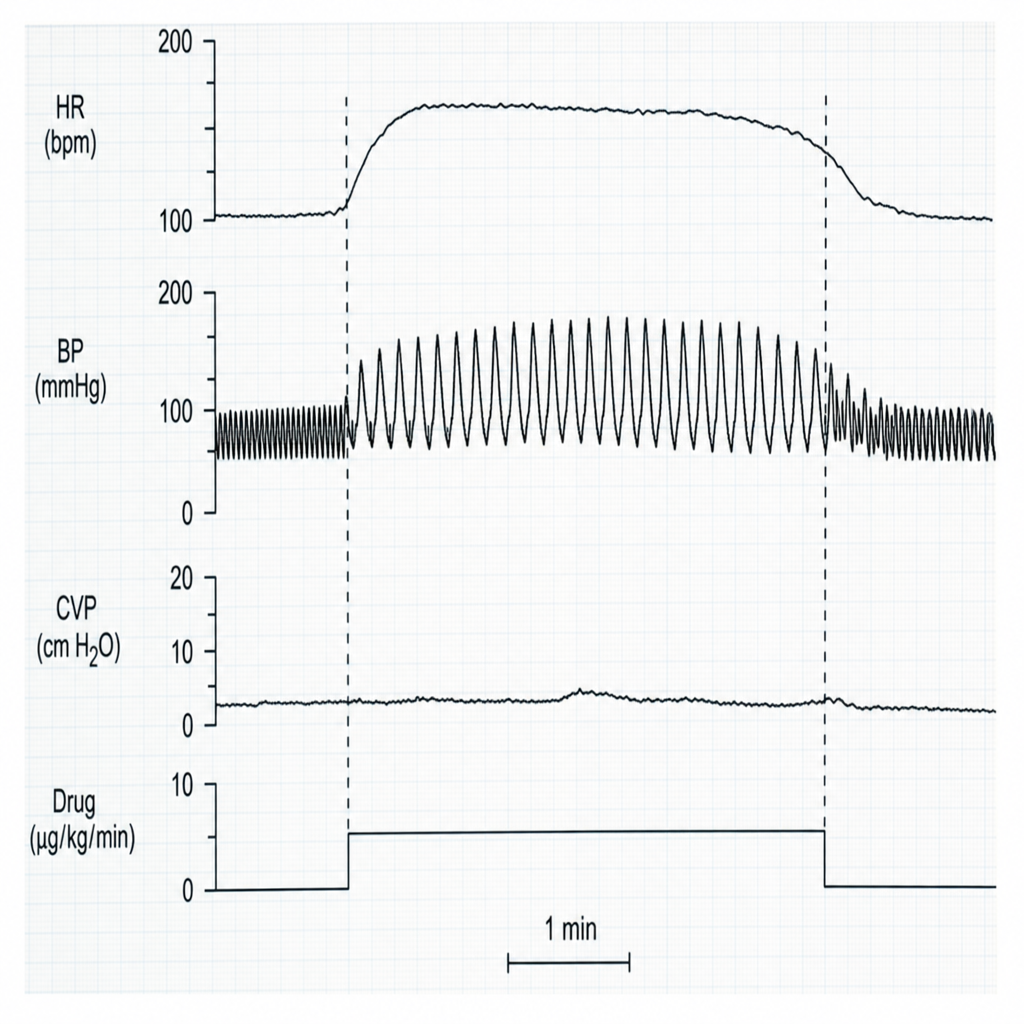
Explanation: ### Explanation: Vasomotor Reversal of Dale **The Concept:** The "Vasomotor Reversal of Dale" is a classic pharmacological phenomenon observed with **Adrenaline (Epinephrine)**. Adrenaline is a non-selective agonist acting on both **α-receptors** (causing vasoconstriction and rise in BP) and **β₂-receptors** (causing vasodilation and fall in BP). In a normal state, the α-response (vasoconstriction) is more potent and masks the β₂-response, leading to a net increase in blood pressure. However, when an **Alpha blocker** (Option A) is administered beforehand, the α-receptors are occupied. If Adrenaline is then injected, it can only act on the available β₂-receptors in the skeletal muscle blood vessels. This results in pure vasodilation and a paradoxical **fall in blood pressure**, effectively "reversing" the usual pressor response. **Why other options are incorrect:** * **Beta blockers (Option B):** If a β-blocker is given, the vasodilatory effect is blocked. Adrenaline would then cause an exaggerated rise in BP (exaggerated pressor response) because the α-mediated vasoconstriction is unopposed. * **Alpha and Beta blockers (Option C):** If both receptors are blocked, Adrenaline will produce little to no significant change in blood pressure as its primary sites of action are inaccessible. **NEET-PG High-Yield Pearls:** * **The Drug:** This phenomenon is specifically associated with **Adrenaline**, not Noradrenaline (as Noradrenaline has negligible action on β₂ receptors). * **The Blocker:** Ergot alkaloids (like Ergotamine) or Phenoxybenzamine are commonly used in experimental setups to demonstrate this. * **Clinical Significance:** This explains why α-blockers must be administered *before* β-blockers in patients with **Pheochromocytoma** to prevent a hypertensive crisis from unopposed α-stimulation.
Explanation: **Explanation:** Beta-blockers (e.g., Metoprolol, Atenolol) are a cornerstone in the management of stable angina. Their primary mechanism involves reducing myocardial oxygen demand by decreasing heart rate, blood pressure, and myocardial contractility. **Why Option B is correct:** The coronary arteries primarily perfuse the myocardium during **diastole**. By blocking $\beta_1$ receptors in the SA node, beta-blockers cause bradycardia (decreased heart rate). A slower heart rate significantly prolongs the duration of diastole. This **increase in diastolic perfusion time** allows more blood to flow through the coronary arteries to the subendocardial layers, thereby improving oxygen supply to the ischemic myocardium. **Why the other options are incorrect:** * **A. Increased heart rate:** This would increase myocardial oxygen demand and shorten diastole, worsening angina. * **C. Decreased end-diastolic ventricular volume:** Beta-blockers actually **increase** end-diastolic volume (EDV) because the prolonged filling time and reduced contractility allow the ventricles to fill more. While this slightly increases oxygen demand (a negative effect), it is far outweighed by the benefits of bradycardia. * **D. Increase in ejection time:** Beta-blockers typically increase systolic ejection time. However, an increase in ejection time (systole) is generally unfavorable as it can increase oxygen consumption; it is not the mechanism behind the antianginal benefit. **High-Yield Clinical Pearls for NEET-PG:** * **DOC:** Beta-blockers are the first-line drugs for chronic stable angina. * **Contraindication:** They are contraindicated in **Prinzmetal (variant) angina** because blocking $\beta_2$ receptors leaves $\alpha_1$-mediated vasoconstriction unopposed, potentially worsening coronary vasospasm. * **Abrupt Withdrawal:** Never stop beta-blockers suddenly; it can precipitate rebound hypertension, tachycardia, or myocardial infarction due to receptor up-regulation.
Explanation: The primary mechanism of action for vasodilators depends on whether they act on the arterial side, the venous side, or both. **Why Glyceryl Trinitrate (GTN) is the correct answer:** Glyceryl trinitrate (Nitroglycerin) is a **predominant venodilator** [1]. At therapeutic doses, it acts mainly on the capacitance vessels (veins), leading to peripheral pooling of blood, decreased venous return, and a reduction in **preload** [2]. While it can cause arteriolar dilatation at very high doses, its primary clinical effect and classification distinguish it from pure arteriolar dilators [2]. **Analysis of Incorrect Options:** * **Hydralazine:** A direct-acting **arteriolar dilator** [3]. It acts by increasing cGMP levels and interfering with calcium release from the sarcoplasmic reticulum in smooth muscle. It has minimal effect on veins [1], [3]. * **Diazoxide:** A potent **arteriolar dilator** that works by opening ATP-sensitive potassium channels ($K_{ATP}$), leading to hyperpolarization of smooth muscle cells [3]. It is used in hypertensive emergencies and insulinomas. * **Nifedipine:** A Calcium Channel Blocker (Dihydropyridine class) that specifically targets L-type calcium channels in the **arteriolar smooth muscle**, causing significant vasodilation and a reduction in afterload [3]. **NEET-PG High-Yield Pearls:** 1. **Pure Arteriolar Dilators:** Hydralazine, Minoxidil, Diazoxide, and Fenoldopam [3]. 2. **Mixed (Arterial + Venous) Dilators:** Sodium Nitroprusside (SNP), Alpha-blockers, and ACE inhibitors. 3. **Drug of Choice (DOC):** Hydralazine is the DOC for hypertension in pregnancy (though Labetalol is often preferred first-line now). 4. **Side Effect:** Pure arteriolar dilators often cause **reflex tachycardia** and fluid retention; therefore, they are frequently co-administered with Beta-blockers and diuretics [1], [3].
Explanation: **Explanation:** The correct answer is **None of the above** because the current first-line treatment for Primary Open-Angle Glaucoma (POAG) consists of **Prostaglandin analogues** (e.g., Latanoprost) or **Beta-blockers** (e.g., Timolol). None of the drugs listed in the options represent the modern "most commonly used" or first-line standard of care. **Analysis of Options:** * **Pilocarpine (Option A):** A direct-acting miotic. While historically significant, it is now rarely used for long-term management of POAG due to side effects like accommodative spasms, brow ache, and the need for frequent dosing (4 times daily). Its primary use today is in acute angle-closure glaucoma. * **Physostigmine (Option B):** An anticholinesterase. It is not used clinically for glaucoma due to significant local irritation and systemic toxicity. * **Epinephrine (Option C):** A sympathomimetic that increases uveoscleral outflow. It is largely obsolete in glaucoma therapy because it can cause pupillary dilation (risky in narrow angles) and local side effects like adrenochrome deposits and cystoid macular edema. **NEET-PG High-Yield Pearls:** * **Drug of Choice (DOC) for POAG:** Prostaglandin analogues (Latanoprost, Bimatoprost) are preferred because they are highly efficacious, require only once-daily dosing, and have fewer systemic side effects. * **Mechanism of Latanoprost:** Increases **uveoscleral outflow**. * **Mechanism of Timolol:** Decreases **aqueous humor production** by blocking $\beta_2$ receptors on the ciliary body. * **Side Effect Note:** Prostaglandin analogues can cause permanent darkening of the iris and thickening/lengthening of eyelashes.
Explanation: **Explanation:** The correct answer is **Trospium**. The key pharmacological concept here is the chemical structure of the drug and its ability to cross the blood-brain barrier (BBB). **1. Why Trospium is correct:** Trospium chloride is a **quaternary ammonium compound**. Unlike other drugs in this class, quaternary amines are permanently charged (ionized) and highly hydrophilic. This physical property prevents them from crossing the lipid-rich blood-brain barrier. Consequently, Trospium has minimal CNS penetration, making it the drug of choice for overactive bladder (OAB) in elderly patients or those at risk of cognitive impairment/dementia. **2. Why the other options are incorrect:** * **Oxybutynin:** This is a tertiary amine with high lipid solubility and a small molecular size. It easily crosses the BBB and is notorious for causing significant CNS side effects like sedation, confusion, and cognitive decline. * **Tolterodine & Solifenacin:** These are also tertiary amines. While Solifenacin is more M3-selective and Tolterodine has slightly less CNS impact than Oxybutynin, they are still lipophilic enough to enter the brain and can cause anticholinergic CNS effects. **High-Yield Clinical Pearls for NEET-PG:** * **Mnemonic:** "Quaternary stays out of the Brain." (Trospium, Ipratropium, Tiotropium). * **Drug of choice for OAB in elderly:** Trospium (due to lack of CNS side effects) or Mirabegron (a $\beta_3$ agonist). * **M3 Selectivity:** Solifenacin and Darifenacin are highly selective for M3 receptors, reducing systemic side effects like xerostomia (dry mouth). * **Metabolism:** Trospium is primarily excreted unchanged in the urine, making it less prone to CYP450 drug interactions compared to Tolterodine or Solifenacin.
Explanation: **Explanation:** The question asks to identify the drug that is **not** a substitute for atropine. Atropine is a non-selective muscarinic antagonist (anticholinergic). Its substitutes are synthetic or semi-synthetic derivatives designed to have more specific actions or fewer side effects. **Why Drotaverine is the Correct Answer:** Drotaverine is a **phosphodiesterase-4 (PDE4) inhibitor**, not an anticholinergic. It acts as a direct-acting smooth muscle relaxant by increasing intracellular cAMP levels. Unlike atropine substitutes, it does not block muscarinic receptors and therefore does not cause typical anticholinergic side effects like dry mouth or blurred vision. It is primarily used as an antispasmodic for biliary, renal, and gastrointestinal colic. **Analysis of Incorrect Options (Atropine Substitutes):** * **Procyclidine:** An **Antimuscarinic** used in Parkinsonism and drug-induced extrapyramidal symptoms. It crosses the blood-brain barrier to reduce cholinergic overactivity in the basal ganglia. * **Propantheline:** A **Quaternary ammonium compound** used as a gastrointestinal antispasmodic. Due to its polar nature, it has poor CNS penetration and acts primarily on peripheral muscarinic receptors. * **Tiotropium:** A **Long-acting muscarinic antagonist (LAMA)** used via inhalation for COPD and asthma. It provides bronchodilation by blocking M3 receptors in the bronchial smooth muscle. **High-Yield Clinical Pearls for NEET-PG:** * **Mydriatic substitutes:** Cyclopentolate, Tropicamide (shorter duration than atropine). * **Antispasmodic substitutes:** Dicyclomine, Oxybutynin (used for overactive bladder). * **Pre-anesthetic substitute:** Glycopyrrolate (Quaternary ammonium; does not cross BBB, less tachycardia than atropine). * **Ipratropium/Tiotropium** are preferred in COPD because they do not inhibit mucociliary clearance, unlike atropine.
Explanation: ### Explanation **Correct Option: B. Propantheline** Propantheline is a **synthetic quaternary ammonium anticholinergic** drug. It acts as a competitive antagonist at muscarinic receptors ($M_3$ subtype) on smooth muscles. By blocking parasympathetic (cholinergic) stimulation, it reduces the tone and motility of the gastrointestinal, biliary, and urinary tracts. This relaxation of smooth muscle is known as an **antispasmodic effect**. Because it is a quaternary ammonium compound, it has poor CNS penetration and is primarily used for peptic ulcers, gastritis, and irritable bowel syndrome (IBS). **Analysis of Incorrect Options:** * **A. Neostigmine:** This is a reversible **acetylcholinesterase inhibitor**. It increases the concentration of acetylcholine at the neuromuscular junction and muscarinic sites. Instead of being an antispasmodic, it *increases* GI motility and is used to treat paralytic ileus and myasthenia gravis. * **C. Nikethamide:** This is a **CNS and respiratory stimulant** (analeptic). It acts on the brainstem to increase the rate and depth of respiration. It has no significant effect on smooth muscle spasms. * **D. Ambenonium:** Similar to Neostigmine, this is a long-acting **cholinesterase inhibitor** used primarily in the management of myasthenia gravis. It enhances cholinergic activity, which would promote rather than inhibit muscle contraction. **NEET-PG High-Yield Pearls:** * **Quaternary Anticholinergics:** Propantheline, Oxyphenonium, and Clidinium are used as "gastric antispasmodics." * **Dicyclomine:** A tertiary amine anticholinergic often preferred for IBS due to its additional direct smooth muscle relaxant action. * **Hyoscine (Scopolamine) butylbromide:** A potent antispasmodic used for acute biliary or renal colic. * **Key Distinction:** Anticholinergics *decrease* secretions and motility (antispasmodic), while Cholinergics *increase* them (prokinetic).
Explanation: **Explanation:** Vasoconstrictors, primarily sympathomimetic amines like **Adrenaline (Epinephrine)** and **Noradrenaline**, act on alpha and beta-adrenergic receptors. Their primary effects include peripheral vasoconstriction (increasing blood pressure) and cardiac stimulation (increasing heart rate and oxygen demand). **Why "All of the above" is correct:** The underlying medical concept is the risk of **exacerbating cardiovascular strain** or triggering life-threatening events in patients with pre-existing sympathetic overactivity or cardiac compromise. * **Thyrotoxicosis:** In hyperthyroidism, there is an upregulation of beta-adrenergic receptors. Administering vasoconstrictors can trigger a "thyroid storm," leading to severe tachycardia, arrhythmias, and heart failure. * **Hypertension:** Vasoconstrictors (via $\alpha_1$ receptors) further increase peripheral vascular resistance, which can lead to a hypertensive crisis or cerebrovascular accidents (stroke). * **Myocardial Infarction (MI):** These drugs increase the heart rate and force of contraction (via $\beta_1$ receptors), significantly raising myocardial oxygen demand. In an infarcted heart, this can extend the area of ischemia or trigger fatal ventricular arrhythmias. **Clinical Pearls for NEET-PG:** * **Local Anesthesia (LA):** Vasoconstrictors are often added to LA to prolong duration and reduce toxicity. However, they are strictly contraindicated in **"end-artery" areas** (fingers, toes, nose, earlobes, and penis) due to the risk of gangrene. * **Drug Interaction:** Use caution in patients on **Non-selective Beta-blockers** (e.g., Propranolol); adding Adrenaline can cause an unopposed alpha-effect, leading to severe hypertension and reflex bradycardia. * **Tricyclic Antidepressants (TCAs):** They potentiate the effects of direct-acting vasoconstrictors by inhibiting reuptake.
Explanation: **Explanation:** **Oxybutynin** is a competitive **muscarinic receptor antagonist** (anticholinergic). Its primary mechanism involves blocking **M3 receptors** on the detrusor muscle of the bladder. By inhibiting the action of acetylcholine, it reduces detrusor contractions, increases bladder capacity, and delays the initial desire to void. * **Why Option B is Correct:** Oxybutynin belongs to the class of tertiary amine anticholinergics. It provides symptomatic relief in overactive bladder (OAB) by exerting both antimuscarinic and direct papaverine-like relaxant effects on smooth muscles. * **Why Option A is Incorrect:** Cholinergic drugs (like Bethanechol) stimulate bladder contraction and are used for urinary retention, the opposite of Oxybutynin’s clinical use. * **Why Option C is Incorrect:** Adrenergic drugs act on alpha or beta receptors. While $\beta_3$ agonists (e.g., Mirabegron) are also used for OAB, Oxybutynin does not act on the adrenergic system. * **Why Option D is Incorrect:** Oxybutynin is a **non-selective** muscarinic antagonist (blocking M1, M2, and M3), though its therapeutic effect in the bladder is mediated via **M3 receptors**. It does not selectively inhibit M2. **High-Yield Clinical Pearls for NEET-PG:** * **Indications:** Drug of choice for **Overactive Bladder (OAB)** and Urge Incontinence. * **Side Effects:** Typical anticholinergic profile—dry mouth (xerostomia), blurred vision, constipation, and confusion (especially in the elderly due to CNS penetration). * **Alternative:** **Darifenacin and Solifenacin** are preferred by some because they are more **M3-selective**, potentially causing fewer systemic side effects.
Cholinergic Agonists
Practice Questions
Cholinergic Antagonists
Practice Questions
Adrenergic Agonists
Practice Questions
Adrenergic Antagonists
Practice Questions
Ganglionic Agents
Practice Questions
Neuromuscular Blocking Agents
Practice Questions
Autonomic Drugs in Ophthalmology
Practice Questions
Autonomic Drugs in Cardiovascular Disease
Practice Questions
Autonomic Drugs in Respiratory Disease
Practice Questions
Autonomic Drugs in Urological Disorders
Practice Questions
Get full access to all questions, explanations, and performance tracking.
Start For Free