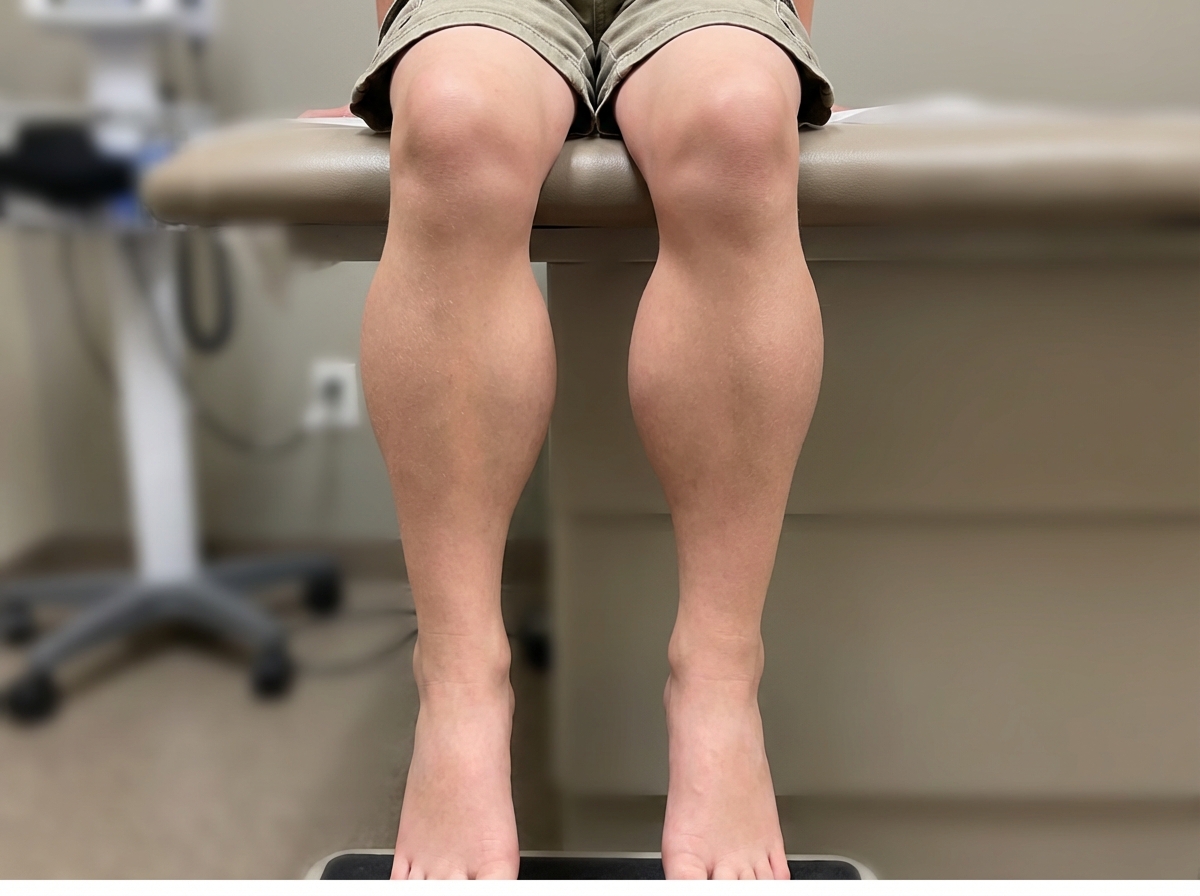
All of the following are true about Rett syndrome EXCEPT:
Which cranial nerves are affected in Moebius syndrome?
Which of the following is NOT associated with an increased risk of future seizures in a child with a history of febrile seizures?
A typical child presents with an epigastric aura, followed by a quiet period of unresponsiveness with staring, lip-smacking, picking at sheets or clothes, contralateral dystonic posturing, and postictal confusion and lethargy. What is the probable diagnosis?
A teenager has a long history of "daydreaming" in school. EEG reveals evidence of a generalized seizure disorder, but there has never been a history of convulsive muscular activity. For the above patient with clinical symptoms and signs, select the most likely seizure type.
Which of the following statements is untrue about acute febrile convulsions?
What is the least common symptom in Friedrich's ataxia?
A 9-year-old girl has had difficulty combing her hair and climbing stairs for 6 months. On examination, Gower sign is positive, and a maculopapular rash is present over the MCP joints. What is the next appropriate investigation to be done?
A 6-year-old child presents with abnormal twitching of the face during sleep, which is noticed by the mother. EEG shows spikes over the centro temporal area. What is the diagnosis?
A child presented with mental retardation and spastic limbs with a history of perinatal distress. What is the most likely diagnosis?
Explanation: **Explanation:** Rett syndrome is a neurodevelopmental disorder primarily affecting females, characterized by a period of normal development followed by a rapid loss of milestones. **1. Why Option D is the Correct Answer (The "Except"):** The regression of skills in Rett syndrome does **not** occur in the third decade. Instead, it typically begins much earlier, usually between **6 to 18 months of age**. This "regression phase" involves the loss of purposeful hand movements and acquired speech. The third decade is usually characterized by a stable but severely disabled state, often involving motor deterioration (Stage IV), but the hallmark regression happens in infancy. **2. Analysis of Other Options:** * **Option A:** It is indeed **X-linked dominant**, caused by mutations in the **MECP2 gene** on the X chromosome. * **Option B:** Loss of purposeful hand skills is a classic feature. It is replaced by stereotypical movements, most notably **"hand-wringing,"** hand-washing, or clapping motions. * **Option C:** Since it is X-linked dominant, the condition is usually **lethal in hemizygous males**. Male fetuses with the mutation typically result in spontaneous abortion or neonatal death due to severe encephalopathy. **Clinical Pearls for NEET-PG:** * **Gender:** Almost exclusively seen in females. * **Key Sign:** Acquired **microcephaly** (deceleration of head growth) is a major diagnostic criterion. * **Breathing:** Patients often exhibit episodic hyperventilation or breath-holding while awake. * **Stages:** 1. Early onset (6–18m) 2. Rapid destruction/regression (1–4y) 3. Plateau (preschool to adulthood) 4. Late motor deterioration.
Explanation: **Explanation:** **Moebius Syndrome** is a rare congenital neurological disorder characterized by the underdevelopment (agenesis or hypoplasia) of specific cranial nerve nuclei. **Why Option C is Correct:** The hallmark of Moebius syndrome is the **congenital paralysis of the facial nerve (CN VII) and the abducens nerve (CN VI)**, usually occurring bilaterally. * **CN VII involvement:** Leads to a "mask-like" facies, inability to smile, and difficulty with eye closure. * **CN VI involvement:** Results in lateral gaze palsy (inability to abduct the eyes), leading to internal strabismus (esotropia). **Why Other Options are Incorrect:** * **Option A & B:** While the Trigeminal nerve (CN V) can be involved in approximately 25% of cases (leading to weak mastication), it is not the defining feature. The diagnostic criteria mandate the involvement of CN VI and VII. * **Option D:** The Glossopharyngeal nerve (CN IX) and Hypoglossal nerve (CN XII) are involved in more severe variants (often associated with feeding difficulties and tongue atrophy), but they are not the primary nerves affected in the classic description of the syndrome. **High-Yield Clinical Pearls for NEET-PG:** * **Clinical Presentation:** Newborns often present with feeding difficulties, drooling, and an expressionless face when crying. * **Associated Features:** Frequently associated with limb abnormalities such as **Talipes equinovarus (Clubfoot)** and **Poland syndrome** (absence of pectoralis major muscle). * **Etiology:** Thought to be due to vascular disruption in the embryonic brainstem (subclavian artery steal sequence). * **Intelligence:** Most children have normal intelligence, though they may have speech delays due to motor deficits.
Explanation: **Explanation:** Febrile seizures are the most common seizure disorder in childhood, occurring in 2–5% of children. While most are benign, certain risk factors increase the likelihood of developing future **unprovoked seizures (epilepsy)**. **Why "Late age of onset" is the correct answer:** A **younger age of onset** (specifically <12–18 months) is a significant risk factor for the *recurrence* of febrile seizures. Conversely, a **late age of onset** does not increase the risk of future epilepsy. In fact, children who experience their first febrile seizure at an older age are statistically less likely to have recurrences or progress to epilepsy compared to infants. **Analysis of Incorrect Options:** * **Developmental delay:** Children with pre-existing neurological abnormalities or developmental delays have a significantly higher risk (up to 33%) of developing subsequent epilepsy. * **Complex febrile seizures:** Defined by duration >15 minutes, focal features, or recurrence within 24 hours. These carry a much higher risk of future epilepsy compared to simple febrile seizures. * **Positive family history:** A family history of **afebrile seizures (epilepsy)** is a well-documented risk factor for the child eventually developing epilepsy. **High-Yield Clinical Pearls for NEET-PG:** * **Risk of Epilepsy:** After a simple febrile seizure, the risk of epilepsy is ~1% (nearly the same as the general population). With risk factors, it rises to 10–15%. * **Most Important Risk Factor for Recurrence:** Age <1 year at the time of the first episode. * **Management:** Reassurance and antipyretics are key. Prophylactic anticonvulsants are generally not recommended due to side effects. * **Lumbar Puncture:** Strongly consider in infants <6–12 months to rule out meningitis, as signs of meningeal irritation may be absent.
Explanation: This clinical scenario describes a classic presentation of **Temporal Lobe Epilepsy (TLE)**, specifically a focal impaired awareness seizure (formerly known as complex partial seizure). ### **Explanation of the Correct Answer** The diagnosis is based on the characteristic sequence of symptoms: 1. **Aura:** The "epigastric aura" (a rising sensation in the stomach) is the most common aura in TLE, originating from the mesial temporal structures (amygdala/hippocampus). 2. **Impaired Awareness:** The "quiet period of unresponsiveness" and staring indicate a transition from a focal aware seizure to one with impaired awareness. 3. **Automatisms:** Lip-smacking (oral) and picking at clothes (manual) are classic orofacial and gestural automatisms. 4. **Lateralizing Signs:** **Contralateral dystonic posturing** is a high-yield sign; it typically indicates that the seizure focus is in the hemisphere opposite to the dystonia. 5. **Postictal State:** Confusion and lethargy are hallmark features of TLE, distinguishing it from absence seizures. ### **Why Other Options are Incorrect** * **Psychogenic Seizures:** These typically present with asynchronous thrashing, side-to-side head movements, and pelvic thrusting, usually without a postictal state or stereotyped auras. * **Panic Disorder:** While it can cause epigastric distress and tachycardia, it does not involve automatisms, dystonic posturing, or postictal confusion. * **Occipital Lobe Epilepsy:** This typically presents with visual hallucinations (flashing lights, colors), blindness, or eye-blinking, rather than epigastric auras and complex manual automatisms. ### **High-Yield Clinical Pearls for NEET-PG** * **Most common cause of TLE:** Mesial Temporal Sclerosis (Hippocampal Sclerosis). * **MRI Finding:** Atrophy and increased T2/FLAIR signal in the hippocampus. * **EEG Finding:** Anterior temporal spikes or sharp waves. * **Differentiating from Absence Seizures:** TLE has a postictal phase and lasts longer (>30-60 seconds), whereas absence seizures are brief (<10 seconds) with an immediate return to baseline.
Explanation: ### Explanation **Correct Answer: D. Absence (petit mal) seizures** The clinical hallmark of **Absence Seizures** is a sudden, brief impairment of consciousness (typically 5–10 seconds) without loss of postural tone. These episodes are often described by teachers or parents as **"daydreaming"** or "staring spells." **Why it is correct:** * **Clinical Presentation:** The patient experiences frequent lapses in awareness but maintains muscle control (no convulsive activity), which fits the description of "daydreaming." * **EEG Findings:** The question mentions a "generalized seizure disorder." Absence seizures are primary generalized seizures. The classic EEG finding (high-yield for NEET-PG) is a **3 Hz spike-and-wave discharge**. **Why other options are incorrect:** * **A. Simple Partial Seizure:** These are focal seizures where consciousness is **preserved**. The patient would be aware of the event. * **B. Complex Partial Seizure:** While these involve impaired consciousness, they are **focal** (not generalized) and are often preceded by an **aura** or accompanied by **automatisms** (e.g., lip-smacking). They typically last longer (>30 seconds) than absence seizures. * **C. Tonic-Clonic Seizures:** These involve dramatic, symmetric convulsive muscular activity (tonic stiffening followed by clonic jerking), which the question explicitly rules out. **High-Yield Clinical Pearls for NEET-PG:** * **Age Group:** Most common in children aged 4–12 years. * **Provocation:** Episodes can be triggered by **hyperventilation** or photic stimulation. * **Drug of Choice:** **Ethosuximide** is the first-line treatment. Valproate is used if there are associated generalized tonic-clonic seizures. * **Prognosis:** Excellent; most children outgrow absence seizures by adolescence.
Explanation: ### Explanation **1. Why "Focal in nature" is the correct (untrue) statement:** Acute febrile convulsions are typically **generalized** (usually tonic-clonic) in nature. By definition, a **Simple Febrile Seizure**—which accounts for the majority of cases—must be generalized, last less than 15 minutes, and not recur within 24 hours. If a febrile seizure is **focal**, lasts longer than 15 minutes, or occurs in a cluster, it is classified as a **Complex Febrile Seizure**. Therefore, stating that febrile convulsions are inherently focal is incorrect. **2. Analysis of other options:** * **EEG is normal after 2 weeks:** This is a **true** statement. EEG is not recommended in a child with a simple febrile seizure as it does not predict recurrence or epilepsy. If an EEG is performed during or immediately after the acute episode, it may show transient slowing, but it typically returns to normal within 1–2 weeks. * **Usually occur below 6 years of age:** This is a **true** statement. Febrile seizures are age-dependent, typically occurring between **6 months and 5 years** (60 months) of age, with a peak incidence in the second year of life. **3. High-Yield Clinical Pearls for NEET-PG:** * **Most common cause:** Viral infections (e.g., HHV-6, Influenza). * **Risk of Epilepsy:** After a simple febrile seizure, the risk of developing epilepsy is ~1% (nearly the same as the general population). * **Management:** The priority is to control the fever and identify the source of infection. For an active seizure lasting >5 mins, **Intravenous Lorazepam** or **Rectal Diazepam** is the drug of choice. * **Prophylaxis:** Continuous anticonvulsant prophylaxis is generally **not** recommended. Intermittent prophylaxis (e.g., oral diazepam during fever) may be considered in specific high-risk cases.
Explanation: **Explanation:** Friedreich’s Ataxia (FRDA) is an autosomal recessive trinucleotide repeat (GAA) disorder characterized by the degeneration of the spinocerebellar tracts, posterior columns, and pyramidal tracts. **Why "Moderate Mental Retardation" is the correct answer:** Cognitive function is typically **preserved** in Friedreich’s Ataxia. While some patients may exhibit mild executive dysfunction or slowed processing speed late in the disease course due to cerebellar-cerebral pathways, significant or moderate mental retardation is **not** a feature of the disease. This distinguishes it from many other neurodegenerative storage disorders. **Analysis of Incorrect Options:** * **Scoliosis:** This is a very common skeletal manifestation, occurring in approximately 75–80% of patients. it often precedes the onset of significant ataxia. * **Cardiac Abnormality:** Hypertrophic cardiomyopathy (specifically symmetric or asymmetric septal hypertrophy) is present in about 90% of patients and is the **most common cause of death**. * **Diabetes Mellitus:** Impaired glucose tolerance or frank Diabetes Mellitus occurs in about 10–20% of cases due to insulin resistance and pancreatic beta-cell dysfunction. **High-Yield Clinical Pearls for NEET-PG:** * **Genetics:** GAA repeat on Chromosome 9 (Frataxin gene), leading to mitochondrial iron overload. * **Clinical Triad:** Progressive limb and gait ataxia, absent lower limb reflexes (areflexia), and extensor plantar responses (Babinski sign). * **Other Features:** Pes cavus (high-arched feet), optic atrophy, and sensorineural hearing loss. * **Differential:** Unlike Vitamin E deficiency (which mimics FRDA), FRDA involves cardiomyopathy and skeletal deformities.
Explanation: ### Explanation The clinical presentation of proximal muscle weakness (difficulty climbing stairs and combing hair, positive Gower sign) combined with a characteristic skin rash (maculopapular rash over the MCP joints, known as **Gottron papules**) is diagnostic of **Juvenile Dermatomyositis (JDM)**. **1. Why Serum Creatine Kinase (CK) is the correct next step:** In a patient suspected of inflammatory myopathy like JDM, the immediate next step is to document muscle inflammation and damage. **Serum CK** is the most sensitive and commonly used screening laboratory test. It is elevated in the majority of patients during the active phase of the disease. While an MRI or EMG can also show muscle involvement, serum enzymes (CK, LDH, Aldolase, AST/ALT) are the standard initial biochemical investigations to support the diagnosis. **2. Why the other options are incorrect:** * **RA Factor:** This is a marker for Rheumatoid Arthritis. While JDM is an autoimmune condition, RA factor is not specific or diagnostic for inflammatory myositis. * **Electromyography (EMG):** While EMG shows a characteristic triad (myopathic potentials, irritability, and denervation), it is invasive and painful. It has largely been replaced by MRI in pediatric practice and is not the first-line investigation. * **Muscle Biopsy:** This is the **gold standard** (definitive) investigation for JDM, showing perifascicular atrophy. However, it is invasive and usually performed after initial screening with blood tests and imaging. **Clinical Pearls for NEET-PG:** * **Gottron Papules:** Pathognomonic erythematous, scaly plaques over the dorsal surface of MCP and IP joints. * **Heliotrope Rash:** Violaceous discoloration of the upper eyelids with periorbital edema. * **Diagnosis:** Requires 4/5 criteria (Bohan and Peter): Proximal weakness, elevated muscle enzymes, EMG changes, biopsy findings, and characteristic rash. * **Treatment:** High-dose corticosteroids are the first-line treatment.
Explanation: ### Explanation **Correct Answer: B. Rolandic epilepsy** **Why it is correct:** The clinical presentation and EEG findings are classic for **Benign Childhood Epilepsy with Centrotemporal Spikes (BECTS)**, also known as **Rolandic Epilepsy**. This is the most common focal epilepsy syndrome in children (typically aged 3–13 years). * **Clinical Features:** Seizures typically occur during **sleep** or upon awakening. They involve the face (twitching), oropharynx (salivation, gurgling sounds), and speech arrest (anarthria), though they can secondarily generalize. * **EEG Hallmark:** The pathognomonic finding is **high-voltage spikes over the centrotemporal (Rolandic) area**, often increased during sleep. **Why the other options are incorrect:** * **A. Generalized tonic-clonic seizure (GTCS):** These involve the whole body with loss of consciousness and tonic-clonic movements from the onset. EEG would show generalized spike-and-wave discharges, not focal centrotemporal spikes. * **C. Absence seizure:** Characterized by brief "staring spells" and loss of awareness without focal twitching. The classic EEG finding is **3 Hz spike-and-wave discharges**. * **D. Subtle seizure:** These are primarily seen in **neonates** (e.g., bicycling movements, eye deviation, or lip-smacking) and do not fit the age group or the specific EEG pattern described. **High-Yield Clinical Pearls for NEET-PG:** * **Prognosis:** Excellent. Most children outgrow this condition by age 15–16 (puberty), hence the term "benign." * **Treatment:** Often not required if seizures are infrequent and nocturnal. If needed, **Carbamazepine** or Levetiracetam are first-line choices. * **Key EEG Buzzword:** "Centrotemporal spikes" or "Sylvian spikes." * **Age of Onset:** Peak incidence is between **7 and 10 years**.
Explanation: ### Explanation **Correct Option: A. Cerebral Palsy (CP)** Cerebral Palsy is a **non-progressive** motor impairment syndrome resulting from an insult to the developing brain (fetal or infant). The clinical hallmark is a combination of motor deficits (spasticity, dystonia, or ataxia) and often associated intellectual disability (mental retardation). A history of **perinatal distress** (asphyxia) is a classic risk factor leading to permanent brain injury. The presence of "spastic limbs" specifically points toward Spastic CP, the most common subtype, often involving the pyramidal tracts. **Why other options are incorrect:** * **B. Hypoxic Ischemic Encephalopathy (HIE):** While HIE is the *acute* event occurring at birth due to perinatal distress, it is a clinical stage (Sarnat staging). Cerebral Palsy is the *chronic, permanent sequela* or end-result of that initial HIE. * **C & D. Down’s (Trisomy 21) and Edward (Trisomy 18) Syndromes:** These are chromosomal anomalies. While they cause mental retardation, they typically present with distinct dysmorphic features (e.g., epicanthal folds in Down’s, clenched fists/rocker-bottom feet in Edward) and are usually associated with **hypotonia** rather than spasticity in the neonatal period. **High-Yield Clinical Pearls for NEET-PG:** * **Most common type of CP:** Spastic CP (specifically Spastic Diplegia is most associated with prematurity/PVL). * **Most common cause:** Prematurity (not birth asphyxia, though asphyxia is a significant contributor). * **Neuroimaging:** MRI is the investigation of choice; it may show Periventricular Leukomalacia (PVL). * **Early Sign:** Hand preference before the age of 1 year is a red flag for hemiplegic CP. * **Management:** Multidisciplinary; Baclofen or Botulinum toxin is used for spasticity management.
Seizure Disorders and Epilepsy
Practice Questions
Febrile Seizures
Practice Questions
Headache Disorders
Practice Questions
Cerebral Palsy
Practice Questions
Neural Tube Defects
Practice Questions
Neuromuscular Disorders
Practice Questions
Neurodegenerative Disorders
Practice Questions
CNS Infections
Practice Questions
Hydrocephalus
Practice Questions
Movement Disorders
Practice Questions
Traumatic Brain Injury
Practice Questions
Neuroimaging in Pediatrics
Practice Questions
Get full access to all questions, explanations, and performance tracking.
Start For Free