Which of the following is NOT a feature of Rett's syndrome?
What is the recurrence rate of febrile seizures?
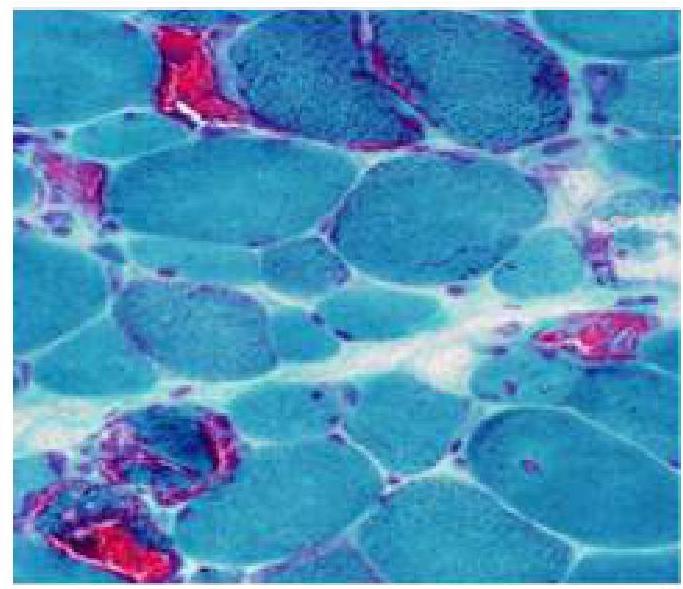
An 8-year old child has difficulty walking and getting up from a squatting position. A muscle biopsy was done and is as shown in the image. Which of the following is true about this condition?
A 10-month-old infant was brought with complaints of jerking movements of limbs towards the body. On examination, there is regression of developmental milestones. Electroencephalogram shows hypsarrhythmia. What is the most appropriate first-line treatment?
Which of the following is not a known cause of neuroregression in children?
Which of the following statements about encephalocoele is false?
A young child presents with episodes of inappropriate laughter. What is the most likely diagnosis?
What is the significance of the persistence of the asymmetric tonic neck reflex in a 9-month-old infant?
Treatment of simple febrile convulsion is based on
What is correct about febrile seizures
Explanation: ***Focal Convulsions*** - While **seizures occur in 60-80% of individuals with Rett syndrome**, focal convulsions are **not part of the diagnostic criteria** for the condition. - When seizures occur in Rett syndrome, they are typically **mixed types** (generalized tonic-clonic, myoclonic, or absence), though focal seizures can occur, they are less characteristic. - The **core diagnostic features** of Rett syndrome focus on developmental regression, hand stereotypies, and acquired microcephaly rather than seizure patterns. *Microcephaly* - **Acquired progressive microcephaly** (deceleration of head growth) is a **major diagnostic criterion** for Rett syndrome, typically appearing between 5 months and 4 years of age. - This reflects underlying **neurological regression** and is one of the cardinal features distinguishing Rett syndrome from other developmental disorders. *Regression of milestones* - **Loss of acquired purposeful hand skills and spoken language** is the hallmark and **essential diagnostic criterion** of Rett syndrome. - After **6-18 months of normal development**, affected children undergo a distinctive regression phase, losing previously acquired skills—this defines the condition. *Cardiac arrhythmias* - **Prolonged QT interval and cardiac arrhythmias** are well-documented features of Rett syndrome, occurring in a significant proportion of patients. - These contribute to increased risk of **sudden unexpected death in Rett syndrome (SUDRS)** and require cardiac monitoring.
Explanation: ***30-50%*** - The recurrence rate of febrile seizures is approximately **30-50%**, with an average of about **33% (one-third)** of children experiencing another febrile seizure. - The rate varies with age: children **<12 months** at first seizure have up to **50% recurrence risk**, while those **>12 months** have approximately **20-30% risk**. - Other risk factors for recurrence include a **lower temperature threshold** for seizures, a **family history** of febrile seizures, and a **short duration** between fever onset and seizure occurrence. *10-20%* - This range is **too low** for the overall recurrence rate of febrile seizures. - While this might represent recurrence in older children with no risk factors, it does not reflect the average population risk. *20-30%* - This percentage represents a **lower estimate** than the generally accepted overall recurrence rate. - This range may apply to children **>12 months** at first seizure, but the overall average is higher at approximately **33%**. *50-70%* - This range is **too high** for the overall recurrence rate of febrile seizures. - While children with **multiple risk factors** (very young age, family history, low fever threshold) may approach **50%** recurrence, rates of 70% are not supported by evidence.
Explanation: ***Death occurs in the 3rd decade for certain types of muscular dystrophy.*** - The image shows muscle fibers with varying sizes and **necrosis**, along with areas of **regeneration** and **fibrosis**, which are characteristic findings in **muscular dystrophies**, particularly Duchenne muscular dystrophy. - In **Duchenne muscular dystrophy**, patients often succumb to **respiratory or cardiac complications** by their **late teens or early twenties (3rd decade)**, making this statement true for this condition. *Previous history of viral prodrome* - A **viral prodrome** is typically associated with **acute viral myositis** or **polymyositis**, which are inflammatory conditions, not primarily genetic muscular dystrophies. - While viral infections can sometimes trigger symptoms or exacerbate underlying conditions, a direct causal link as a defining feature of muscular dystrophy is incorrect. *It is a mitochondrial storage disorder* - **Mitochondrial storage disorders** involve dysfunction of the mitochondria and can manifest as myopathies, but the histological features (ragged red fibers) and clinical presentation often differ from the classic presentation of muscular dystrophy. - The image and clinical context point towards a **dystrophinopathy**, not a primary mitochondrial disorder. *Early treatment has excellent prognosis* - Despite advances in care, **muscular dystrophies**, especially Duchenne, remain **progressive and incurable**, with treatments aimed at slowing progression and managing symptoms rather than achieving a cure or excellent prognosis. - **Early diagnosis and intervention** can improve quality of life and prolong survival but do not lead to an "excellent prognosis" in terms of disease reversal or complete functional recovery.
Explanation: ***Adrenocorticotropic hormone (ACTH)*** - **ACTH** is considered the **first-line treatment** for infantile spasms due to its high efficacy in controlling spasms and improving developmental outcomes. - Its mechanism involves directly modulating **cortical excitability** and neurotransmitter function. *Phenytoin* - **Phenytoin** is primarily used for **focal and tonic-clonic seizures** but is generally ineffective for infantile spasms. - Its mechanism of action involves **blocking voltage-gated sodium channels**, which is not the primary pathophysiology target for infantile spasms. *Levetiracetam* - **Levetiracetam** is an **adjunctive therapy** for various seizure types and can be used in some cases of infantile spasms, but it is not typically the first-line treatment. - It acts by binding to the **synaptic vesicle protein 2A (SV2A)**, modulating neurotransmitter release. *Phenobarbitone* - **Phenobarbitone** is an older anticonvulsant that can be used for various seizure types, including some forms of infantile epilepsy, but it is **not the preferred first-line agent** for infantile spasms due to potential side effects and lower efficacy compared to ACTH. - It works by **enhancing GABAergic inhibition** in the brain.
Explanation: ***ADHD*** - **Attention-deficit/hyperactivity disorder (ADHD)** is a neurodevelopmental disorder characterized by persistent patterns of inattention, hyperactivity, and impulsivity. It is **not** a cause of neuroregression. - While ADHD can impact cognitive and behavioral functioning, it does not involve a loss of previously acquired developmental milestones or skills. *Wilson's disease* - **Wilson's disease** is an inherited disorder that causes **copper accumulation** in organs, particularly the liver and brain. - Neurological symptoms, including **neuroregression**, can occur due to copper toxicity in the central nervous system. *Vitamin B12 deficiency* - **Vitamin B12 deficiency** can lead to neurological complications such as **subacute combined degeneration** of the spinal cord and peripheral neuropathy. - In children, severe or prolonged deficiency can impair brain development and lead to **developmental regression**. *Ataxia telangiectasia* - **Ataxia telangiectasia** is a rare, neurodegenerative, inherited disease that affects multiple body systems. - It is characterized by progressive **cerebellar ataxia**, leading to **neuroregression** and intellectual disability over time.
Explanation: ***Common in the parietal region*** - This statement is **false** because encephaloceles are **rarely found in the parietal region** (only 10-15% of cases). - **Occipital encephaloceles** are most common in Western populations (75-80%), while **frontal/sincipital encephaloceles** are most common in Southeast Asia including India (40-60%). - **Parietal encephaloceles** represent only a small minority of cases globally, making this statement incorrect. *It is a neural tube defect* - **Encephalocele** is indeed a type of **neural tube defect (NTD)**, resulting from incomplete closure of the neural tube during embryonic development. - Specifically, it involves a defect in the skull that allows for protrusion of brain tissue and/or meninges. *Can be associated with hydrocephalus* - **Hydrocephalus**, or the accumulation of cerebrospinal fluid in the brain, is a known complication and associated condition with encephaloceles. - The abnormal brain development and structural defects can disrupt normal CSF flow and absorption, particularly with posterior encephaloceles. *It is protrusion of neural tissue through a defect* - This is the defining characteristic of an **encephalocele**: the **herniation of intracranial contents**, such as brain tissue, meninges, or both, through a congenital **bony defect** in the skull. - The contents of the sac can vary (meninges only = meningocele; brain tissue included = meningoencephalocele), influencing clinical presentation and prognosis.
Explanation: ***Hypothalamic hamartoma*** - **Gelastic seizures**, characterized by episodes of inappropriate laughter, are the hallmark symptom of a **hypothalamic hamartoma**. - These benign brain malformations are located near the **mammillary bodies** and can disrupt normal brain function, leading to these characteristic seizures. *Tetralogy of Fallot* - This is a **congenital heart defect** involving four specific abnormalities, leading to cyanosis. - Its symptoms include **"tet spells"** (bluish skin during crying or feeding), shortness of breath, and clubbing of fingers, not inappropriate laughter. *Nitrous oxide poisoning* - Inhalation of nitrous oxide can lead to euphoria, dizziness, and motor incoordination, but it does not typically cause recurrent episodes of involuntary, inappropriate laughter as a primary neurological symptom. - Chronic exposure can cause **vitamin B12 deficiency** and neurological dysfunction like neuropathy. *Seizure disorder* - While inappropriate laughter can be a symptom of a seizure (gelastic seizure), a general diagnosis of "seizure disorder" is too broad and does not pinpoint the specific, highly localized cause implied by this particular presentation. - The type of seizure (gelastic) specifically points to a lesion in the **hypothalamus**.
Explanation: ***Increased muscle tone*** - The **asymmetric tonic neck reflex (ATNR)** should integrate by **6 months of age**, and its persistence beyond this period is a sign of **neurological dysfunction**. - Persistent primitive reflexes, including ATNR, are often associated with **upper motor neuron lesions** and can manifest as increased muscle tone or **spasticity**. *Decreased muscle tone* - **Decreased muscle tone**, or **hypotonia**, is typically associated with **lower motor neuron lesions** or certain genetic conditions, not the persistence of primitive reflexes. - While some neurological conditions can cause hypotonia, persistent ATNR is a hallmark of problems leading to **hypertonia**. *Normal phenomenon* - The persistence of the ATNR beyond **6 months of age** is considered abnormal and indicates a potential developmental delay or neurological issue. - In a **9-month-old**, the reflex should have fully integrated, and its presence warrants further investigation. *None of the options* - As the persistence of the ATNR is indeed a significant finding, associated with increased muscle tone, this option is incorrect.
Explanation: ***Control of fever*** - Among the given options, **control of fever** is the most appropriate answer as it represents the **immediate supportive care** for a child with a simple febrile seizure. - Management includes using antipyretics like **paracetamol** or **ibuprofen** to reduce fever and improve comfort. - **Important note:** While fever control is good supportive care, evidence shows that antipyretics do **NOT prevent recurrence** of febrile seizures. The actual cornerstone of management is **reassurance and parental education**. - According to AAP guidelines, simple febrile seizures are benign, self-limited events that require no specific anticonvulsant treatment. *Rectal diazepam* - **Rectal diazepam** is used for **acute termination** of prolonged seizures (>5 minutes) or as rescue therapy for recurrent episodes. - It is NOT indicated for routine management of simple febrile seizures, which typically last <15 minutes and resolve spontaneously. - May be prescribed for home use in select cases with recurrent seizures. *CSF finding* - **CSF analysis** is a **diagnostic procedure**, not a treatment basis. - It is indicated only when there is clinical suspicion of meningitis or meningoencephalitis (e.g., altered sensorium, meningeal signs, complex seizure features). - NOT routinely required for simple febrile seizures in well-appearing children. *Blood reports* - **Blood investigations** are diagnostic, not treatment-guiding for simple febrile seizures. - They may be considered to identify the source of fever or rule out electrolyte abnormalities, but are not the basis of seizure management itself. - Simple febrile seizures do not require routine laboratory workup.
Explanation: ***Normal EEG*** - An **electroencephalogram (EEG)** is generally **not recommended** after a simple febrile seizure because these seizures are due to the brain's response to fever, not an underlying epileptic disorder. - The **EEG typically appears normal** following a simple febrile seizure, as there is no intrinsic cerebral pathology to detect. - Simple febrile seizures are benign events that do not require routine EEG investigation. *Focal deficits* - **Focal neurological deficits** (e.g., weakness on one side of the body) are **not characteristic** of **simple febrile seizures** and would suggest a more complex neurological issue or an underlying etiology. - The presence of focal deficits would prompt further investigation for complex febrile seizures or other neurological conditions. *Repeated seizure* - While **recurrence of febrile seizures** is common (about 30-35% of children experience a second seizure), this refers to a **risk factor** for recurrence rather than a defining characteristic of febrile seizures. - Risk factors for recurrence include young age at first seizure, family history of febrile seizures, low fever at onset, and brief duration between fever onset and seizure. *Abnormal EEG* - An **abnormal EEG** in the context of a febrile seizure would raise concerns for an **underlying epileptic syndrome** or other neurological pathology, which is not typical for **simple febrile seizures**. - Routine EEG is not indicated for simple febrile seizures as it is unlikely to show abnormalities and is not predictive of future epilepsy.
Seizure Disorders and Epilepsy
Practice Questions
Febrile Seizures
Practice Questions
Headache Disorders
Practice Questions
Cerebral Palsy
Practice Questions
Neural Tube Defects
Practice Questions
Neuromuscular Disorders
Practice Questions
Neurodegenerative Disorders
Practice Questions
CNS Infections
Practice Questions
Hydrocephalus
Practice Questions
Movement Disorders
Practice Questions
Traumatic Brain Injury
Practice Questions
Neuroimaging in Pediatrics
Practice Questions
Get full access to all questions, explanations, and performance tracking.
Start For Free