All are characteristic features of cerebral palsy except
Initial drug of choice in a child with status epilepticus:
An 8 month old female has history of kernicterus. On sudden movement of the baby’s neck, the following features were seen abduction and extension of the arms, opening of hands and adduction of arms in front of the body. Which reflex is elicited in this infant?
What is the typical age of occurrence of febrile seizures in children?
Most common acute complication of meningitis in children is –
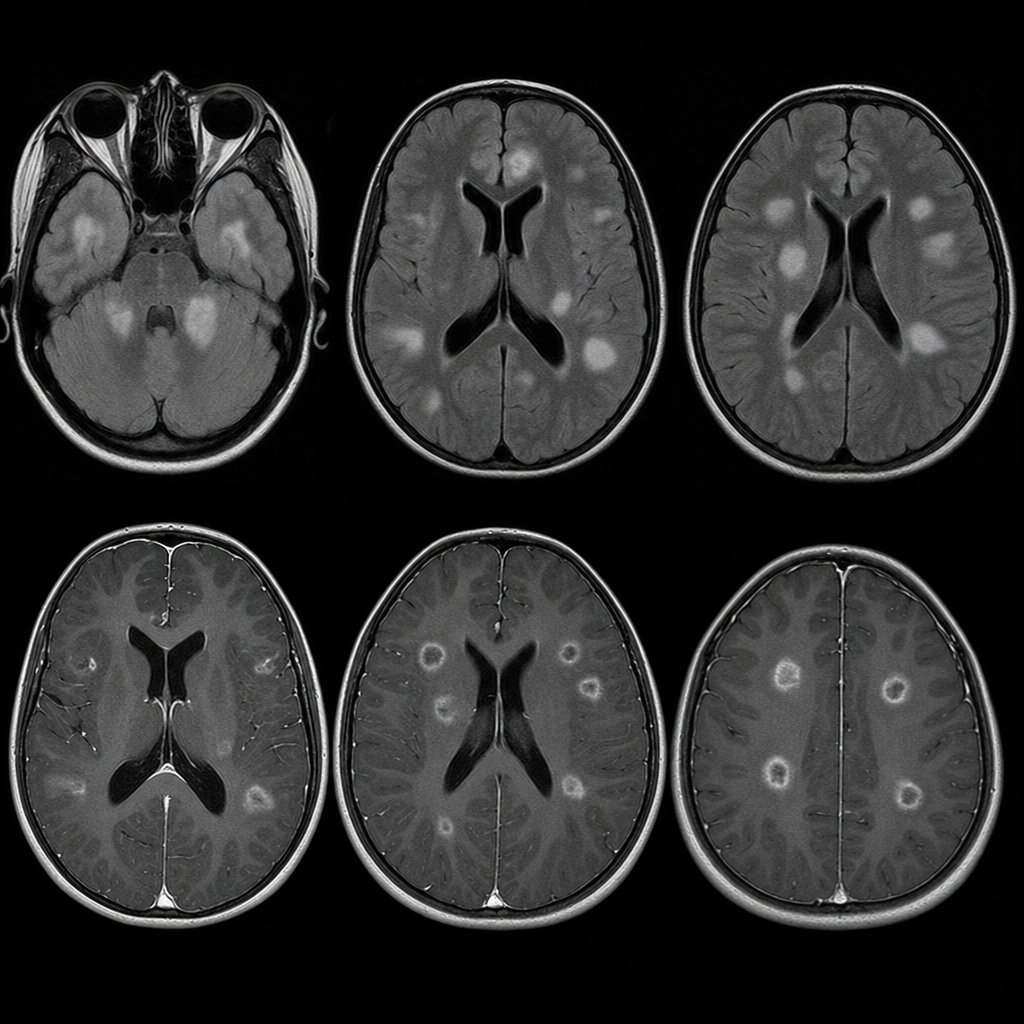
A 2-year-old boy has been doing well despite his diagnosis of tetralogy of Fallot. He presented to an outside ER a few days ago with a complaint of an acute febrile illness for which he was started on a "pink, bubble-gum tasting antibiotic." His mother reports that for the past 12 hours or so he has been holding his head saying it hurts and he is less active than normal. On your examination, he seems to have a severe headache, nystagmus, and ataxia. Which of the following would be the most appropriate first test to order?
Management of typical febrile seizures includes all except:
The type of cerebral palsy characterized by constant and uncontrolled motion of involved muscles is called:
Commonest cause of convulsions in a child with fever is-
Which of the following is LEAST preferred as first-line treatment for pediatric status epilepticus?
Explanation: ***Erb's palsy*** - **Erb's palsy** is a form of brachial plexus palsy, characterized by injury to the **upper brachial plexus** (C5-C6 nerve roots), typically occurring during birth. - It results in a characteristic **"waiter's tip" position** of the arm and is a distinct peripheral nerve injury, not a characteristic feature of **cerebral palsy**, which is a central neurological disorder. *Hypotonia* - While many forms of cerebral palsy present with **spasticity**, some individuals, particularly those with **ataxic cerebral palsy** or specific types of dyskinetic cerebral palsy, can exhibit **hypotonia** (low muscle tone). - Hypotonia can also be an early manifestation before the development of more prominent hypertonia or spasticity, making it an associated feature. *Epilepsy* - **Epilepsy** and seizure disorders are common co-morbidities seen in children with **cerebral palsy**, particularly in those with severe brain damage or certain types of CP. - The underlying brain injury that causes cerebral palsy can also disrupt normal electrical activity in the brain, leading to seizures. *Spasticity* - **Spasticity** is the most common motor type of **cerebral palsy**, affecting approximately 80% of individuals. - It is characterized by **increased muscle tone** and **hyperreflexia**, resulting in stiff, tight muscles and exaggerated reflexes, due to damage to the motor cortex or pyramidal tracts.
Explanation: ***Lorazepam*** - **Lorazepam** is a benzodiazepine that rapidly crosses the blood-brain barrier and has a longer duration of action compared to other benzodiazepines, making it highly effective for acute seizure termination in children with **status epilepticus**. - Its rapid onset and sustained anticonvulsant effect reduce the risk of ongoing neuronal damage and provide a window for administering longer-acting antiepileptic drugs. *Phenobarbitone* - **Phenobarbitone** is a potent anticonvulsant but has a slower onset of action and a higher risk of **respiratory depression** and sedation compared to lorazepam. - It is typically considered a second-line or third-line agent in status epilepticus, after benzodiazepines have failed. *Phenytoin* - **Phenytoin** is a classic antiepileptic drug, but it has a slower onset of action when administered intravenously and carries risks of **cardiac arrhythmias** and **hypotension** with rapid infusion. - It's generally used as a second-line agent to maintain seizure control after the initial termination of status epilepticus with a benzodiazepine. *Valproate* - **Valproate** can be effective in status epilepticus, especially for generalized seizures, but its intravenous formulation also has a slower onset of action than lorazepam. - While it's a good broad-spectrum antiepileptic, it is not the **first-line choice** for immediate seizure termination due to its slower pharmacokinetics in acute settings.
Explanation: ***Moro’s reflex*** - The description of **abduction and extension of the arms**, opening of hands, and then adduction fits the classic presentation of the **Moro reflex**, which is a normal primitive reflex in infants. - A prominent Moro reflex at 8 months, especially in a child with a history of **kernicterus**, suggests **neurological dysfunction** as it should have integrated by 6 months of age. *Asymmetric tonic reflex* - Also known as the **"fencing reflex,"** this reflex involves the baby extending the arm and leg on the side to which the head is turned, while flexing the opposite limbs. - The description provided does not match this unilateral posture. *Startle reflex* - The startle reflex is a general response to a sudden loud noise or bright light, characterized by a **rapid, whole-body jerk** or flinch. - While similar to the Moro reflex in being a protective response, the specific arm movements of abduction, extension, and then adduction are characteristic of Moro. *Parachute reflex* - The parachute reflex is a **protective postural reflex** that develops around 6-9 months, where an infant extends their arms forward as if to "break a fall" when their body is quickly tilted downward. - This reflex is an indication of normal neurological development and is not consistent with the described movements.
Explanation: ***6 months - 60 months*** - Febrile seizures typically occur in children between **6 months and 5 years** of age (60 months). - This age range reflects the period of brain development where children are most susceptible to seizures triggered by **fever**. *5 months - 60 months* - While it's close, the lower limit of **5 months** is generally considered outside the typical range for **simple febrile seizures**. - Seizures occurring at this younger age might warrant further investigation to rule out other causes. *1 year - 50 months* - This option narrows the typical range too much, excluding the important period between **6 months and 1 year** and also not fully encompassing up to **5 years** (60 months). - The peak incidence of febrile seizures is often observed between **12 and 18 months**, but the overall range is broader. *1 year - 5 years* - This option is equivalent to 1 year - 60 months, but it misses the critical age range between **6 months and 1 year**, where a significant number of **febrile seizures** occur. - The definition explicitly includes children starting from **6 months of age**.
Explanation: ***Seizures*** - **Seizures** are a common acute complication of meningitis in children, often occurring due to brain irritation and inflammation. - They can be the presenting symptom or develop during the course of the illness, and are particularly prevalent in **bacterial meningitis**. *Hydrocephalus* - **Hydrocephalus** can be a complication of meningitis due to obstruction of cerebrospinal fluid (CSF) flow or impaired absorption, but it is less frequent than seizures. - It usually represents a more chronic or late complication rather than an immediate and common one. *Hearing loss* - **Hearing loss**, especially sensorineural, is a well-recognized and serious complication of bacterial meningitis in children, but it is generally less common than seizures. - It can be permanent and often results from damage to the cochlea or auditory nerve. *Mitral regurgitation* - **Mitral regurgitation** is a heart valve disorder and is **not a typical complication of meningitis**. - Meningitis primarily affects the central nervous system and does not directly lead to valvular heart disease.
Explanation: ***CT or MRI of the brain*** - The patient's history of **tetralogy of Fallot** puts him at increased risk for a **brain abscess** due to right-to-left shunting, bypassing pulmonary filtration of bacteria. - New onset of severe headache, nystagmus, and ataxia in this context strongly suggests an **intracranial mass lesion**, making immediate imaging crucial. *Lumbar puncture* - Performing a **lumbar puncture** in the presence of signs of elevated intracranial pressure (severe headache, nystagmus, ataxia) or suspicion of a mass lesion (brain abscess) is **contraindicated** due to the risk of herniation. - While it can diagnose meningitis, the clinical picture with focal neurological signs makes a mass lesion a higher concern that needs to be ruled out first. *Urine drug screen* - The patient's symptoms (severe headache, nystagmus, ataxia) are not typical for drug intoxication in a 2-year-old, especially given the history of a recent febrile illness and a congenital heart defect. - There is no clinical indication for drug use in this young child, and this test would not address the serious neurological symptoms. *Blood culture* - While a blood culture might be useful to identify a systemic infection, it will not directly explain or diagnose the acute focal neurological deficits such as nystagmus and ataxia, and the severe headache. - Given the high suspicion of an intracranial lesion with risk of herniation, obtaining imaging is a higher priority than waiting for blood culture results, which would take time.
Explanation: ***Prophylactic phenobarbitone*** - **Continuous prophylactic anticonvulsant therapy** with phenobarbitone is **definitively NOT recommended** for typical (simple) febrile seizures - The risks of chronic anticonvulsant use—including **sedation, cognitive impairment, and behavioral problems**—significantly outweigh any potential benefits - Evidence shows prophylactic phenobarbital does **not prevent future epilepsy** and has insufficient benefit in preventing recurrent febrile seizures - This is the **correct answer** as it is explicitly excluded from management guidelines *Intermittent diazepam* - While **not routinely recommended** for typical febrile seizures, intermittent rectal or buccal diazepam may be discussed as a *potential option* for specific situations (frequent recurrences, parental anxiety, prolonged seizures) - It serves as **rescue medication** to abort an ongoing seizure rather than daily prophylaxis - Its role in typical febrile seizure management is controversial and limited, but it may be mentioned in comprehensive management discussions *Sponging* - **Tepid sponging** is a supportive physical cooling measure used in fever management - While it does not prevent febrile seizures, it is part of general **symptomatic care** for fever reduction - Typically used alongside antipyretics to help lower body temperature and improve comfort *Paracetamol or ibuprofen* - **Antipyretics** are standard management for fever control and improving the child's comfort - While they do **not reliably prevent** febrile seizures from occurring, they are essential for **symptomatic fever management** - Recommended as first-line treatment for fever in children with febrile seizures
Explanation: ***Athetosis*** - **Athetoid cerebral palsy** is characterized by **involuntary, slow, writhing movements** affecting the limbs and often the face and trunk. - These uncontrolled movements are due to damage to the **basal ganglia**, responsible for motor control and coordination. *Rigidity* - **Rigidity** is a form of hypertonia characterized by a constant, uniform resistance to passive movement throughout the range of motion. - It does not specifically describe constant and uncontrolled motion, but rather **increased muscle tone** that hampers movement. *Spasticity* - **Spasticity** is a type of hypertonia characterized by a velocity-dependent increase in muscle tone, often with a "clasp-knife" phenomenon. - It involves **exaggerated reflexes** and muscle stiffness, which is different from continuous, uncontrolled movements. *Ataxia* - **Ataxia** refers to impaired coordination and balance, leading to unsteady gait and difficulty with fine motor skills. - It is caused by damage to the **cerebellum** and typically involves a lack of smooth, coordinated movement rather than uncontrolled motion of involved muscles. *Hypotonia* - **Hypotonia** refers to decreased muscle tone, resulting in floppiness and reduced resistance to passive movement. - It is the opposite of the uncontrolled, involuntary movements seen in athetosis and is sometimes seen in early infancy before other CP types become apparent.
Explanation: ***Febrile convulsions*** - **Febrile convulsions** are the most common cause of seizures in children aged 6 months to 5 years that are associated with a fever but without any evidence of intracranial infection or other defined cause. - They occur in response to a rapid rise in body temperature, typically presenting as generalized tonic-clonic seizures that are usually brief and self-limiting. *Hypothyroidism* - While congenital hypothyroidism can rarely cause developmental delays and neurological issues, seizures are not a common or typical presentation, especially as the primary symptom in children with fever. - Furthermore, seizures related to hypothyroidism would not usually be linked to a fever as the direct precipitating factor. *Epilepsy* - **Epilepsy** involves recurrent, unprovoked seizures, meaning they are not generally triggered by a fever in the absence of other underlying causes. - Although some febrile seizures can evolve into epilepsy, a single seizure in the presence of fever is more likely to be a febrile convulsion than an indication of epilepsy. *Meningitis* - **Meningitis** is a serious infection of the membranes surrounding the brain and spinal cord that can cause seizures in children with fever. - However, it is far less common than febrile convulsions and would present with additional symptoms such as **nuchal rigidity**, **altered mental status**, and other signs of severe illness, which are not implied by the question's simple presentation.
Explanation: ***Clonazepam*** - While a benzodiazepine, **clonazepam** is generally not considered a first-line agent for acute status epilepticus due to its **slower onset of action** compared to other benzodiazepines like midazolam or diazepam. - Its longer half-life also makes it less ideal for rapid termination of seizures when immediate action is needed to prevent neuronal injury. *Fosphenytoin* - **Fosphenytoin** is a **prodrug of phenytoin** that is often used as a second-line agent for status epilepticus after benzodiazepines have failed. - It can be administered more rapidly and has a lower risk of local injection site reactions compared to phenytoin, making it a viable option when first-line agents are insufficient. *Diazepam* - **Diazepam** is a **short-acting benzodiazepine** that is a preferred first-line treatment for status epilepticus, especially in the pre-hospital setting or as an initial hospital intervention. - It has a **rapid onset of action** when administered intravenously or rectally, effectively terminating seizures quickly. *Phenobarbital* - **Phenobarbital** is a **barbiturate** that acts as a potent anticonvulsant and is considered a second-line or third-line treatment option for status epilepticus, particularly in pediatric patients. - While effective, its use is often reserved for cases unresponsive to benzodiazepines due to its potential for **respiratory depression** and sedative effects.
Seizure Disorders and Epilepsy
Practice Questions
Febrile Seizures
Practice Questions
Headache Disorders
Practice Questions
Cerebral Palsy
Practice Questions
Neural Tube Defects
Practice Questions
Neuromuscular Disorders
Practice Questions
Neurodegenerative Disorders
Practice Questions
CNS Infections
Practice Questions
Hydrocephalus
Practice Questions
Movement Disorders
Practice Questions
Traumatic Brain Injury
Practice Questions
Neuroimaging in Pediatrics
Practice Questions
Get full access to all questions, explanations, and performance tracking.
Start For Free