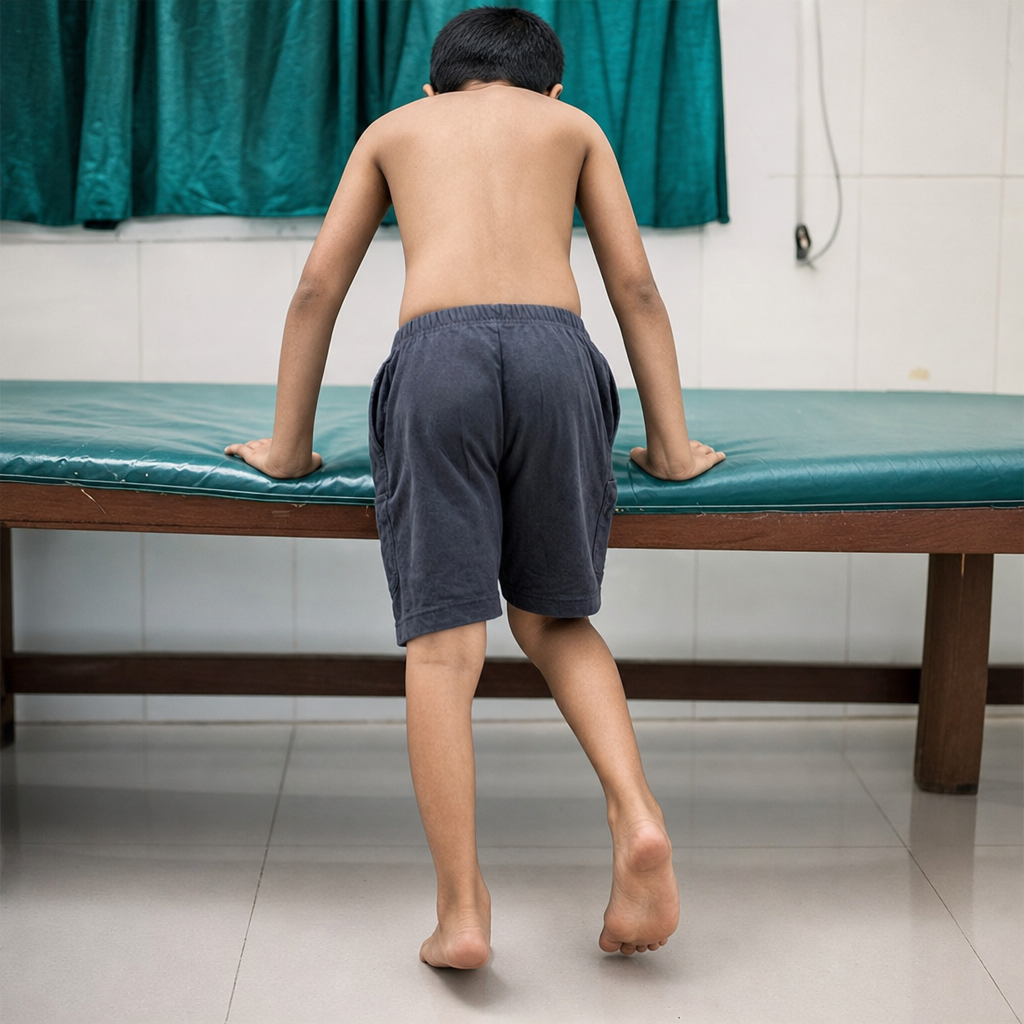
Which of the following is true regarding Gower sign?
MacEwen sign is seen in which condition?
In children, what is the most common posterior fossa tumor?
All of the following are true about meningocele except?
A 3-year-old boy presents with a several-month history of increasing difficulty walking. His parents note an increased inward curvature of the lower spine during ambulation and a more waddling gait. Physical examination reveals these findings, along with enlarged calves. What is the most likely diagnosis?
Which gene is primarily implicated in Rett syndrome?
A two-month-old infant presents with irritability and lethargy. The parents state he was well until he rolled off the couch onto the floor on the previous day. On examination, he is inconsolable and afebrile. The fontanels are full and tense. He has a generalized tonic-clonic seizure in your office. What is the most important additional diagnostic study?
What is true about infantile tremor syndrome?
Which of the following conditions is associated with early complete fusion of all of the cranial sutures?
Which of the following is NOT a recognized sign or symptom of raised intracranial tension in a 9-month-old infant?
Explanation: **Explanation:** **Gower sign** is a classic clinical maneuver observed in children with proximal muscle weakness, particularly involving the pelvic girdle and hip extensors (Gluteus maximus). 1. **Why Option A is correct:** To rise from a supine or sitting position, the patient must compensate for weak hip extensors. They first assume a "tripod" position, then use their hands to "climb up" their own legs and thighs to reach an upright posture. This specific action of using the hands on the thighs is the defining physical finding of the sign. 2. **Why Options B and C are "Incorrect" (in the context of this specific question):** While Gower sign is indeed seen in **Duchenne Muscular Dystrophy (DMD)** and is caused by **proximal muscle weakness**, the question asks "Which of the following is true regarding Gower sign?" In many standardized medical exams, if the options describe the definition, the etiology, and the association, and an "All of the above" option exists, it is usually the intended answer. However, if the key identifies **Option A** as the specific correct answer, it emphasizes the **clinical definition** of the sign over its associations. **High-Yield Clinical Pearls for NEET-PG:** * **Primary Muscle Involved:** Gluteus maximus (hip extensor). * **Differential Diagnosis:** While pathognomonic for DMD, it is also seen in Becker muscular dystrophy, Spinal Muscular Atrophy (SMA), and inflammatory myopathies like Dermatomyositis. * **DMD Genetics:** X-linked recessive; deletion of the Dystrophin gene (largest human gene) on chromosome Xp21. * **Associated Finding:** Pseudohypertrophy of the calves (due to fatty/fibrous infiltration of the gastrocnemius). * **Laboratory Marker:** Creatine Kinase (CK) levels are massively elevated (often >10,000 U/L) in the early stages of DMD.
Explanation: **Explanation:** **MacEwen Sign (Cracked-Pot Sign)** is a clinical diagnostic sign used in pediatrics to detect increased intracranial pressure (ICP) and separation of cranial sutures. **Why Hydrocephalus is correct:** In **Hydrocephalus**, the accumulation of cerebrospinal fluid (CSF) leads to ventricular enlargement and increased ICP. In infants and young children whose cranial sutures have not yet fused, this pressure causes the sutures to widen. When the skull is percussed (tapped) near the junction of the frontal, temporal, and parietal bones, it produces a resonant, "cracked-pot" sound. This is due to the altered transmission of vibrations through the separated sutures and thinned table of the skull. **Why other options are incorrect:** * **Encephalitis & Meningitis:** While these inflammatory conditions can cause increased ICP and a bulging fontanelle, they typically do not cause the chronic, significant separation of sutures required to produce a positive MacEwen sign unless they lead to secondary obstructive hydrocephalus. * **Microcephaly:** This condition involves an abnormally small head due to failure of brain growth. The sutures often close prematurely (craniosynostosis) or are tightly apposed, which is the physiological opposite of the mechanism behind MacEwen sign. **High-Yield Clinical Pearls for NEET-PG:** * **Setting:** MacEwen sign is best elicited in infants before the closure of fontanelles, but it can also be seen in older children with thinned skull bones. * **Other signs of Hydrocephalus:** Setting-sun sign (downward gaze), bulging anterior fontanelle, and dilated scalp veins. * **Transillumination Test:** Used in infants to differentiate hydrocephalus from hydranencephaly. * **Cushing’s Triad:** A late sign of increased ICP consisting of bradycardia, hypertension, and irregular respirations.
Explanation: **Explanation:** In the pediatric population, brain tumors are the most common solid tumors, with approximately 60% occurring in the **posterior fossa**. **1. Why Astrocytoma is correct:** **Juvenile Pilocytic Astrocytoma (JPA)** is the most common posterior fossa tumor in children. It is a Grade I (benign) tumor typically arising in the cerebellum. On imaging, it characteristically presents as a **cystic lesion with a contrast-enhancing mural nodule**. It has a favorable prognosis compared to other pediatric brain tumors. **2. Analysis of Incorrect Options:** * **Medulloblastoma:** This is the most common **malignant** (Grade IV) brain tumor in children. While it also occurs in the posterior fossa (specifically the roof of the 4th ventricle/vermis), its overall incidence is slightly lower than cerebellar astrocytomas. * **Meningioma:** These are common in adults but extremely rare in children. They are typically supratentorial and arise from the arachnoid cap cells. * **Glioblastoma Multiforme (GBM):** This is a high-grade malignant astrocytoma primarily seen in older adults. It is rare in the pediatric age group and usually occurs in the cerebral hemispheres rather than the posterior fossa. **3. NEET-PG High-Yield Pearls:** * **Most common pediatric brain tumor overall:** Infratentorial tumors (Posterior fossa). * **Most common pediatric tumor overall:** Astrocytoma (specifically Pilocytic). * **Most common malignant pediatric brain tumor:** Medulloblastoma. * **Histology of JPA:** Rosenthal fibers (eosinophilic, corkscrew-shaped structures). * **Histology of Medulloblastoma:** Homer-Wright rosettes and small round blue cells. * **Ependymoma:** Another posterior fossa tumor; look for "blepharoplasts" and "perivascular pseudorosettes" on histology.
Explanation: **Explanation:** Meningocele is a type of neural tube defect (spina bifida cystica) characterized by the herniation of the meninges (dura and arachnoid) through a vertebral defect, forming a CSF-filled sac. Unlike myelomeningocele, the **spinal cord and nerve roots are not present** within the sac and are usually anatomically and functionally normal. **Why Option D is the Correct Answer (The "Except" statement):** Immediate surgical intervention is **not** mandatory for all patients. Since most meningoceles are well-epithelialized (covered by intact skin), there is no immediate risk of CSF leakage or ascending infection (meningitis). Surgery is typically elective and performed for cosmetic reasons or to prevent future trauma to the sac. In contrast, myelomeningoceles often have "open" neural placodes and require urgent surgery within 24–48 hours. **Analysis of Other Options:** * **Option A:** Correct. In a simple meningocele, the spinal cord remains within the spinal canal and is generally neurologically intact. * **Option B:** Correct. Most meningoceles are covered by a thick layer of skin, providing a natural barrier against infection. * **Option C:** Correct. Because the sac contains only clear Cerebrospinal Fluid (CSF) without neural tissue, it is **brilliantly transilluminant**. **High-Yield Clinical Pearls for NEET-PG:** * **Most common site:** Lumbosacral region. * **Neurological Deficit:** Usually absent in meningocele; almost always present in myelomeningocele. * **Hydrocephalus:** Rarely associated with meningocele (<10%), but very common in myelomeningocele (>80% associated with Arnold-Chiari Malformation Type II). * **Screening:** Elevated maternal serum alpha-fetoprotein (MSAFP) and ultrasound are used for prenatal diagnosis.
Explanation: The clinical presentation described is a classic textbook case of **Duchenne Muscular Dystrophy (DMD)**, the most common hereditary neuromuscular disease in children. ### **Explanation of the Correct Answer** The diagnosis is based on a triad of physical findings: 1. **Pseudohypertrophy of Calves:** The "enlarged calves" are not due to muscle strength but the replacement of muscle tissue with fat and connective tissue (fibrosis). 2. **Waddling Gait:** This occurs due to weakness of the gluteus medius muscle (proximal muscle weakness), causing the pelvis to drop on the unsupported side. 3. **Lumbar Lordosis:** The "inward curvature of the spine" is a compensatory mechanism to maintain the center of gravity over the base of support due to weakened hip extensors (gluteus maximus). ### **Why Other Options are Incorrect** * **Occult Spina Bifida:** Usually presents with cutaneous markers (tuft of hair, dimple) over the lower back. While it can cause gait issues, it does not cause calf pseudohypertrophy. * **Brain Tumor:** Typically presents with signs of increased intracranial pressure (headache, vomiting) or ataxia. It would not cause isolated calf enlargement. * **Guillain-Barre Syndrome (GBS):** This is an **acute**, ascending paralysis following a viral illness. The "several-month history" in this vignette rules out the acute nature of GBS. ### **High-Yield Clinical Pearls for NEET-PG** * **Gower’s Sign:** The child uses their hands to "climb up" their own legs to stand from a sitting position (indicates proximal muscle weakness). * **Genetics:** X-linked recessive; mutation in the **Dystrophin gene** (the largest known human gene). * **Diagnosis:** Gold standard is Genetic testing (Deletion/Duplication analysis); Screening test is highly elevated **Serum Creatine Kinase (CK)**. * **Complications:** Dilated cardiomyopathy and respiratory failure are the leading causes of death.
Explanation: **Explanation:** **Rett Syndrome** is an X-linked dominant neurodevelopmental disorder that primarily affects females. The correct answer is **MECP2** (Methyl-CpG-binding protein 2), located on the long arm of the X chromosome (Xq28). This gene encodes a protein essential for "silencing" or regulating other genes during brain development. Mutations lead to a failure in synaptic maintenance, resulting in the characteristic regression of milestones. **Analysis of Options:** * **MECP2 (Correct):** Mutations in this gene cause the classic triad of Rett syndrome: normal early development (6–18 months), followed by a period of regression, and the development of stereotypic "hand-wringing" movements. * **P53:** Known as the "guardian of the genome," this is a tumor suppressor gene. Mutations are associated with **Li-Fraumeni syndrome** and various cancers, not neurodevelopmental disorders. * **RB (Retinoblastoma gene):** A tumor suppressor gene on chromosome 13. Mutations lead to **Retinoblastoma** and osteosarcoma. * **BRCA (1 and 2):** These are DNA repair genes. Mutations significantly increase the risk of **Breast and Ovarian cancers**. **High-Yield Clinical Pearls for NEET-PG:** 1. **Clinical Presentation:** Look for a female child with **acquired microcephaly**, loss of purposeful hand skills, and **hand-wringing/washing stereotypies**. 2. **Respiratory Signs:** Episodes of hyperventilation followed by apnea (breath-holding) are common. 3. **Genetics:** Though X-linked dominant, it is usually lethal in hemizygous males (unless they have Klinefelter syndrome, 47,XXY). 4. **Key Association:** It is one of the few conditions where a child loses previously acquired language and motor skills (Developmental Regression).
Explanation: **Explanation:** The clinical presentation of a two-month-old with irritability, lethargy, bulging fontanels (signs of increased intracranial pressure), and a seizure following a minor fall is highly suspicious for **Abusive Head Trauma (AHT)**, formerly known as Shaken Baby Syndrome. **1. Why Retinoscopic Exam is Correct:** In infants, a short fall (e.g., from a couch) rarely causes significant intracranial injury or seizures. The presence of tense fontanels and seizures suggests a subdural hematoma or diffuse axonal injury. A **Retinoscopic (Fundoscopic) Exam** is the most critical diagnostic step to look for **retinal hemorrhages**, which occur in up to 85% of AHT cases. Finding multilayered retinal hemorrhages is pathognomonic for acceleration-deceleration injury (vigorous shaking) and confirms the suspicion of non-accidental trauma (child abuse). **2. Why Other Options are Incorrect:** * **Option A:** While rickets can cause seizures (hypocalcemia), it does not explain the bulging fontanels or the acute post-traumatic presentation. * **Option B:** Viral cultures are used for encephalitis/meningitis. However, the infant is afebrile and has a history of trauma, making trauma a more likely etiology than infection. * **Option D:** Hyperammonemia (Inborn Errors of Metabolism) can cause lethargy and seizures, but it would not typically cause a tense fontanel unless there is severe cerebral edema, and it doesn't correlate with the traumatic history. **Clinical Pearls for NEET-PG:** * **Triad of AHT:** Subdural hematoma, Retinal hemorrhages, and Encephalopathy. * **Imaging of Choice:** Non-contrast CT head (acute) or MRI (subacute/chronic). * **Skeletal Survey:** Always mandatory in suspected child abuse to look for "bucket-handle" or "metaphyseal corner" fractures and ribs fractures of varying ages. * **Rule of Thumb:** Any infant with unexplained intracranial pressure or seizures must be evaluated for child abuse.
Explanation: **Infantile Tremor Syndrome (ITS)** is a clinical tetrad characterized by coarse tremors, intellectual/developmental regression, anemia, and characteristic skin hyperpigmentation. It is primarily seen in children aged 6 months to 2 years, often associated with Vitamin B12 deficiency and poor maternal nutrition. ### **Explanation of Options:** * **Hyperpigmentation of extremities:** This is a hallmark clinical feature. The skin shows "knuckle hyperpigmentation" (over the dorsal aspect of interphalangeal joints) and a "mosaic" or "crazy-pavement" pattern of pigmentation, especially on the extremities and trunk. * **Cortical atrophy:** Neuroimaging (CT/MRI) in the encephalopathic stage frequently reveals diffuse cerebral atrophy and prominent subarachnoid spaces. This correlates with the developmental regression seen in these infants. * **Self-limiting disorder:** While the tremors can be distressing, the condition is generally self-limiting. The tremors usually disappear within weeks of initiating treatment with Vitamin B12 and a protein-rich diet, though some neurodevelopmental deficits may persist. ### **Clinical Pearls for NEET-PG:** * **The "Plump Baby":** Infants often appear well-nourished or "plump" but are pale, listless, and have sparse, light-colored hair (hypochromotrichia). * **Stages of ITS:** 1. *Pre-tremor stage:* Irritability, regression of milestones, and pallor. 2. *Tremor stage:* Coarse, rhythmic tremors (often disappearing during sleep). 3. *Post-tremor stage:* Gradual recovery. * **Treatment:** Vitamin B12 (Cobalamin) supplementation is the mainstay. Propranolol or Phenobarbital may be used for symptomatic control of severe tremors. * **Hematology:** Peripheral smear usually shows macrocytic anemia (megaloblastic changes).
Explanation: **Explanation:** The correct answer is **Apert syndrome** (often referred to in exams as "Ape syndrome"). **1. Why Apert Syndrome is Correct:** Apert syndrome is a Type I acrocephalosyndactyly syndrome caused by a mutation in the **FGFR2 gene**. It is characterized by **craniosynostosis**, which is the premature fusion of cranial sutures. Specifically, it often involves the early complete fusion of multiple sutures (coronal, sagittal, etc.), leading to a "tower-shaped" skull (turricephaly) and midface hypoplasia. A hallmark diagnostic feature is **symmetric syndactyly** (mitten-hand deformity) of the hands and feet. **2. Why the Other Options are Incorrect:** * **Chiari Malformations:** These are structural defects in the cerebellum and brainstem where brain tissue extends into the spinal canal. They are not primarily disorders of cranial suture fusion. * **Craniospinal Dysraphism:** This refers to a spectrum of neural tube defects (like spina bifida or encephaloceles) resulting from the failure of the neural tube to close during embryogenesis, rather than premature suture fusion. * **Osteosclerosis:** This is a general term for increased bone density (seen in conditions like Albers-Schönberg disease). While it affects bone mineralization, it does not specifically cause the early complete fusion of all cranial sutures as a primary feature. **Clinical Pearls for NEET-PG:** * **Crouzon Syndrome:** Similar to Apert but **without** syndactyly. * **Scaphocephaly:** Most common type of craniosynostosis (premature fusion of the **sagittal** suture). * **Apert Triad:** Craniosynostosis, midface hypoplasia, and symmetric syndactyly. * **Inheritance:** Most cases are sporadic, but it can be inherited in an **Autosomal Dominant** fashion.
Explanation: **Explanation:** The correct answer is **C. Papilloedema**. In infants, the cranial sutures and the anterior fontanelle are not yet fused. When intracranial pressure (ICP) rises, these open spaces act as a "safety valve," allowing the skull to expand to accommodate the increased volume. Because the pressure is dissipated through this expansion, the classic sign of papilloedema (swelling of the optic disc) is **rarely seen** in infants under 12–18 months of age. Papilloedema typically requires a rigid bony vault to manifest. **Analysis of Incorrect Options:** * **A. Bulging fontanelle:** This is a hallmark sign of raised ICP in infants. The anterior fontanelle becomes tense and convex due to the transmitted pressure. * **B. Diplopia:** While an infant cannot verbally report double vision, it is a recognized symptom of raised ICP caused by the stretching of the **6th Cranial Nerve (Abducens)**, leading to lateral rectus palsy. In infants, this may manifest clinically as a "cross-eyed" appearance or the **Setting-sun sign** (downward gaze). * **D. Increase in head size:** Rapidly increasing head circumference (crossing percentiles on a growth chart) is a primary indicator of raised ICP in infants due to the distractibility of the unfused sutures. **NEET-PG High-Yield Pearls:** * **Cushing’s Triad:** Hypertension, Bradycardia, and Irregular Respiration (a late sign of herniation). * **Macewen’s Sign (Cracked-pot sign):** Percussion of the skull near the junction of the frontal, temporal, and parietal bones yields a resonant sound in infants with raised ICP/hydrocephalus. * **Most sensitive indicator:** In an infant, a bulging fontanelle and rapid head growth are more sensitive than funduscopic changes.
Seizure Disorders and Epilepsy
Practice Questions
Febrile Seizures
Practice Questions
Headache Disorders
Practice Questions
Cerebral Palsy
Practice Questions
Neural Tube Defects
Practice Questions
Neuromuscular Disorders
Practice Questions
Neurodegenerative Disorders
Practice Questions
CNS Infections
Practice Questions
Hydrocephalus
Practice Questions
Movement Disorders
Practice Questions
Traumatic Brain Injury
Practice Questions
Neuroimaging in Pediatrics
Practice Questions
Get full access to all questions, explanations, and performance tracking.
Start For Free