
Demyelinating Diseases — MCQs

Which test is most useful in diagnosing a clinically occult lesion in multiple sclerosis?
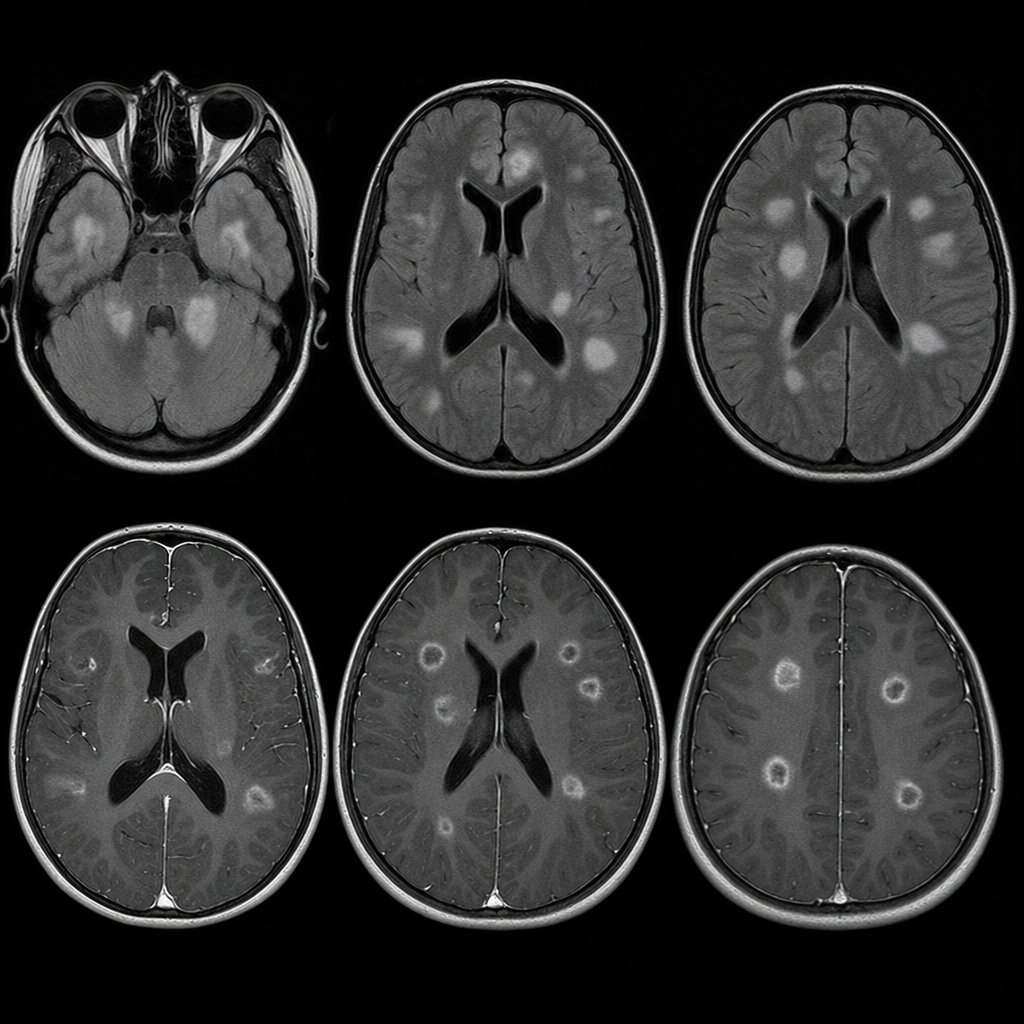
The 7-year-old boy, who is now in your office, was last seen 2 weeks ago with a mild viral upper respiratory tract infection. However, he presents today with fever, ataxia, weakness, headache, and vomiting. In the office, he experiences a 3-minute left-sided tonic-clonic seizure. After sending him to the hospital and ordering a magnetic resonance imaging (MRI) with contrast of the brain, the results of which are shown, his likely diagnosis is which of the following?
All of the following are morphological neurological complications of measles except
Investigation of choice for multiple sclerosis
Which of the following drugs is preferred in the management of primary progressive multiple sclerosis?
False regarding Alzheimer's disease (AD) is:
A muscle biopsy shows type 1 fiber atrophy and increased internal nuclei on histology. Which additional finding on light microscopy would be most specific for myotonic dystrophy?
Loss of striatal fibres in caudate nucleus is associated with?
What is the histological appearance of the brain in Creutzfeldt-Jakob disease?
An elderly man has become progressively unable to live independently over the past several years, requiring assistance with daily activities. He has no motor or sensory deficits on physical examination, but is unable to give the current date or state his location. At autopsy, a large superficial left parietal lobe hemorrhage is found, along with numerous neocortical neuritic plaques and neurofibrillary tangles in the brain. Which mechanism is most likely responsible for his disease?
Want unlimited practice?
Get full access to all questions, explanations, and performance tracking.
Scan to download app