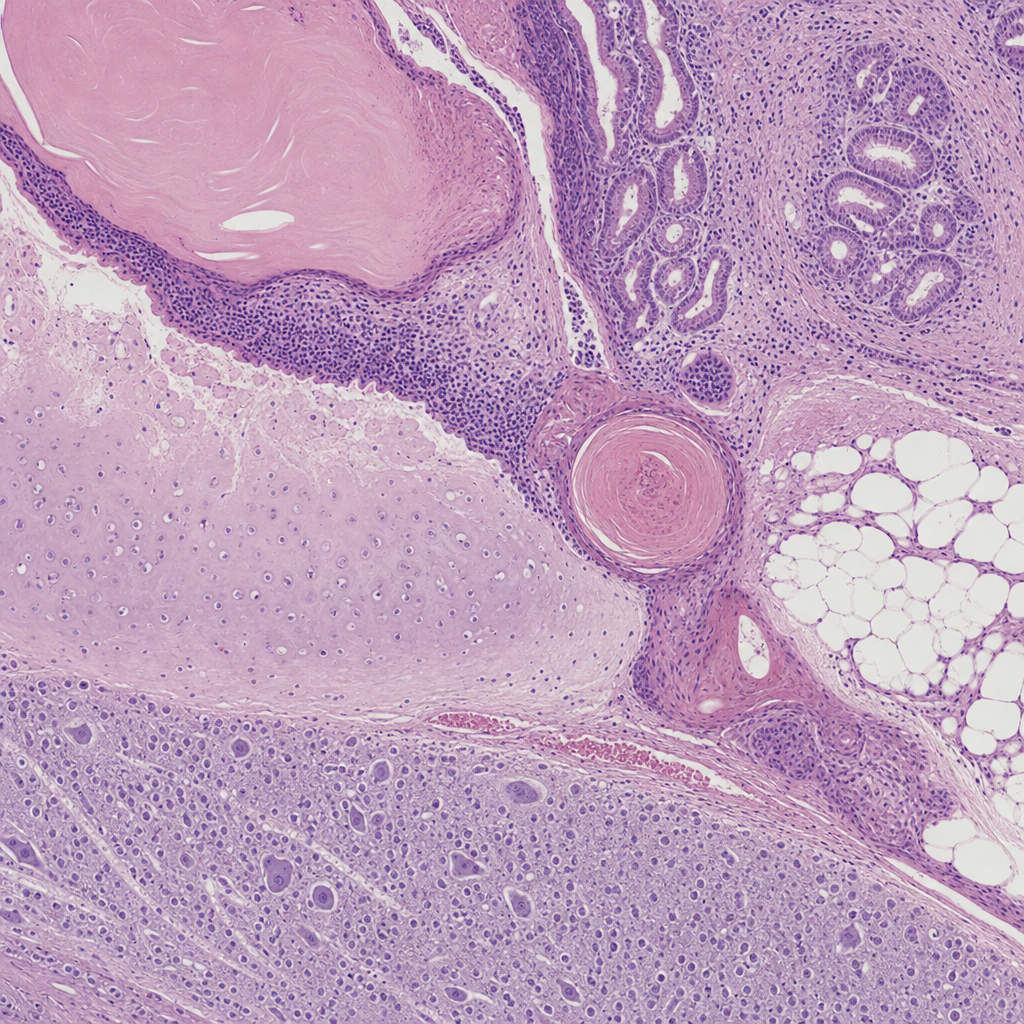
Teratoma arises from which type of cells?
Which of the following conditions has an increased risk of malignancy?
The Epstein Barr virus is implicated in all of the following conditions, EXCEPT?
Which of the following is involved in the tumor metastasis cascade?
Choristoma is defined as:
What is the diagnostic electron microscopy feature of Paragangliomas?
Which of the following terms best describes a round cell malignancy?
In retinoblastoma, after enucleation, which tissue is sectioned to find out systemic metastasis?
All of the following tumours are associated with organisms except?
Which of the following is associated with von Hippel-Lindau disease?
Explanation: **Explanation:** **1. Why Totipotent cells are correct:** A teratoma is a germ cell tumor composed of tissues derived from more than one germ layer (ectoderm, mesoderm, and endoderm) [1]. These tumors arise from **totipotent germ cells**, typically found in the gonads (ovaries or testes) or embryonic rests along the midline [3]. Because these cells are totipotent, they possess the unique capacity to differentiate into any cell type found in the adult body [3], ranging from hair and teeth to intestinal epithelium and neurological tissue [1], [4]. **2. Why other options are incorrect:** * **Options B, C, and D (Mesodermal, Ectodermal, and Endodermal cells):** These represent the three primary germ layers. While a teratoma *contains* tissues derived from these layers [1], it does not *originate* from any single one of them. A tumor arising solely from mesodermal cells would be a mesenchymal tumor (e.g., fibroma), not a teratoma. The hallmark of a teratoma is its **multilineage** composition [2]. **3. High-Yield Clinical Pearls for NEET-PG:** * **Common Sites:** The most common site is the **ovary** (usually benign "Dermoid cysts") [1], followed by the **testis** (often malignant in adults) [2]. In infants, the most common site is the **sacrococcygeal** region. * **Classification:** * **Mature Teratoma:** Well-differentiated tissues (usually benign in females) [4]. * **Immature Teratoma:** Contains fetal/embryonic tissue (usually neuroepithelium); carries higher malignant potential. * **Monodermal Teratoma:** Highly specialized (e.g., **Struma ovarii** – contains thyroid tissue; **Carcinoid**) [4]. * **Marker:** Mature teratomas usually do not have specific markers, but malignant transformations may show elevated AFP or hCG [1]. **References:** [1] Cross SS. Underwood's Pathology: A Clinical Approach. 6th ed. Common Clinical Problems From Female Genital Tract Disease, pp. 480-481. [2] Kumar V, Abbas AK, et al.. Robbins and Cotran Pathologic Basis of Disease. 9th ed. The Lower Urinary Tract and Male Genital System, pp. 979-980. [3] Cross SS. Underwood's Pathology: A Clinical Approach. 6th ed. (Basic Pathology) introduces the student to key general principles of pathology, both as a medical science and as a clinical activity with a vital role in patient care. Part 2 (Disease Mechanisms) provides fundamental knowledge about the cellular and molecular processes involved in diseases, providing the rationale for their treatment. Part 3 (Systematic Pathology) deals in detail with specific diseases, with emphasis on the clinically important aspects., pp. 84-85. [4] Kumar V, Abbas AK, et al.. Robbins and Cotran Pathologic Basis of Disease. 9th ed. The Female Genital Tract, p. 1034.
Explanation: **Explanation:** The correct answer is **D. All of the above**. This question tests the understanding of cellular adaptations and their potential to progress to neoplasia [2]. While these processes are initially reversible, they represent a continuum of cellular stress that can lead to malignant transformation [2]. 1. **Metaplasia (Option A):** This is a reversible change where one adult cell type is replaced by another (e.g., Barrett’s esophagus: squamous to columnar) [4], [5]. While the new cells are better suited to the stress, they are genetically unstable. Persistent irritation can lead to the accumulation of mutations, progressing to dysplasia and eventually **Adenocarcinoma** [4]. 2. **Dysplasia (Option B):** Characterized by disordered growth and maturation (loss of uniformity and architectural orientation), dysplasia is considered a **pre-cancerous** state [1], [3]. If the entire thickness of the epithelium is involved without breaching the basement membrane, it is termed "Carcinoma in situ" [3]. 3. **Hyperplasia (Option C):** An increase in the number of cells [3]. While physiological hyperplasia is safe, **pathological hyperplasia** (e.g., Endometrial hyperplasia due to unopposed estrogen) provides a fertile soil for cancerous proliferation [2]. **High-Yield Clinical Pearls for NEET-PG:** * **Most common metaplasia:** Squamous metaplasia (e.g., respiratory tract of smokers) [5]. * **Exception:** Nerve and cardiac muscle cells do not undergo hyperplasia/metaplasia as they are permanent cells. * **Reversibility:** Metaplasia and Dysplasia (low-grade) are reversible if the stimulus is removed; however, once it crosses the threshold to malignancy, it becomes irreversible [3]. * **Key Association:** Barrett’s Esophagus $\rightarrow$ Dysplasia $\rightarrow$ Adenocarcinoma [4]. **References:** [1] Cross SS. Underwood's Pathology: A Clinical Approach. 6th ed. (Basic Pathology) introduces the student to key general principles of pathology, both as a medical science and as a clinical activity with a vital role in patient care. Part 2 (Disease Mechanisms) provides fundamental knowledge about the cellular and molecular processes involved in diseases, providing the rationale for their treatment. Part 3 (Systematic Pathology) deals in detail with specific diseases, with emphasis on the clinically important aspects., pp. 222-223. [2] Kumar V, Abbas AK, et al.. Robbins and Cotran Pathologic Basis of Disease. 9th ed. Neoplasia, pp. 286-287. [3] Cross SS. Underwood's Pathology: A Clinical Approach. 6th ed. Common Clinical Problems From Female Genital Tract Disease, pp. 467-468. [4] Cross SS. Underwood's Pathology: A Clinical Approach. 6th ed. Common Clinical Problems From Alimentary System Disease, pp. 348-349. [5] Cross SS. Underwood's Pathology: A Clinical Approach. 6th ed. (Basic Pathology) introduces the student to key general principles of pathology, both as a medical science and as a clinical activity with a vital role in patient care. Part 2 (Disease Mechanisms) provides fundamental knowledge about the cellular and molecular processes involved in diseases, providing the rationale for their treatment. Part 3 (Systematic Pathology) deals in detail with specific diseases, with emphasis on the clinically important aspects., pp. 91-92.
Explanation: **Explanation:** The **Epstein-Barr Virus (EBV)**, also known as Human Herpesvirus 4 (HHV-4), is a potent oncogenic DNA virus that primarily infects B-lymphocytes and epithelial cells. **Why Leukemia is the correct answer:** EBV is strongly associated with various lymphomas and carcinomas, but it is **not** a recognized causative agent for **Leukemia** (such as AML, ALL, or CLL) [1]. While EBV can cause a lymphoproliferative disorder, the malignant transformation into classic leukemia involves different genetic mutations or other viral triggers (e.g., HTLV-1 for Adult T-cell Leukemia) [1]. **Analysis of other options:** * **Nasopharyngeal Carcinoma:** EBV has a 100% association with the undifferentiated type (Type III) [3]. It infects the nasopharyngeal epithelium, where the viral protein **LMP-1** promotes cell survival and proliferation. * **Burkitt’s Lymphoma:** This is the classic EBV-associated B-cell lymphoma, particularly the **Endemic (African) variant** [1][2]. It is characterized by the **t(8;14)** translocation involving the *c-MYC* gene. * **Infectious Mononucleosis (IM):** This is the acute, self-limiting clinical manifestation of primary EBV infection, characterized by fever, sore throat, and "atypical lymphocytes" (Downey cells/activated CD8+ T-cells) on a peripheral smear. **High-Yield Clinical Pearls for NEET-PG:** * **Receptor:** EBV enters B-cells via the **CD21** receptor (CR2). * **Other EBV Associations:** Hodgkin Lymphoma (Mixed cellularity subtype), Oral Hairy Leukoplakia (in HIV patients), and Gastric Adenocarcinoma (subset). * **Diagnosis:** Monospot test (detects heterophile antibodies) is the screening test for IM. * **LMP-1 (Latent Membrane Protein 1):** The most important viral oncogene that mimics CD40 signaling to drive B-cell activation [2]. **References:** [1] Cross SS. Underwood's Pathology: A Clinical Approach. 6th ed. (Basic Pathology) introduces the student to key general principles of pathology, both as a medical science and as a clinical activity with a vital role in patient care. Part 2 (Disease Mechanisms) provides fundamental knowledge about the cellular and molecular processes involved in diseases, providing the rationale for their treatment. Part 3 (Systematic Pathology) deals in detail with specific diseases, with emphasis on the clinically important aspects., pp. 219-220. [2] Kumar V, Abbas AK, et al.. Robbins and Cotran Pathologic Basis of Disease. 9th ed. Neoplasia, pp. 335-336. [3] Kumar V, Abbas AK, et al.. Robbins and Cotran Pathologic Basis of Disease. 9th ed. Head and Neck, pp. 744-745.
Explanation: ### Explanation **Correct Option: B (E-Cadherin)** The metastatic cascade is a multi-step process. The **first and most crucial step** in the invasion of the extracellular matrix is the **dissociation of cancer cells from one another** [1]. In normal epithelial tissues, cells are held together by intercellular adhesion molecules, primarily **E-cadherin** [1]. * **Mechanism:** E-cadherin acts as a "cellular glue." In most epithelial cancers (carcinomas), there is a **downregulation or loss of E-cadherin function** (often via mutations or EMT—Epithelial-Mesenchymal Transition) [1]. This loss of "homotypic adhesion" allows tumor cells to detach from the primary mass and initiate the metastatic journey. **Why other options are incorrect:** * **A. Fibronectin:** While tumor cells bind to fibronectin and laminin to migrate through the interstitial matrix, it is a component of the ECM rather than the primary molecule whose *alteration* initiates the cascade in this context. * **C. Type IV Collagenase (MMP-2/MMP-9):** These enzymes are involved in the *second* step of invasion (degradation of the basement membrane) [3]. While essential, the question asks for the molecule "involved" in the cascade; E-cadherin is the classic "gatekeeper" molecule whose inactivation is the hallmark of metastasis. * **D. Tyrosine Kinase:** These are enzymes involved in signal transduction and cell growth (e.g., HER2/neu). While they contribute to oncogenesis, they are not specific structural components of the metastatic cascade steps. --- ### High-Yield Clinical Pearls for NEET-PG * **Cadherin-Catenin Complex:** E-cadherin is linked to the cytoskeleton via **β-catenin**. Loss of E-cadherin not only reduces adhesion but also releases β-catenin, which translocates to the nucleus to promote proliferation. * **Lobular Carcinoma of Breast:** Characteristically shows a complete **loss of E-cadherin** (due to CDH1 gene mutation), explaining its "single-file" (Indian file) growth pattern. * **Steps of Metastasis:** 1. Dissociation (Loss of E-cadherin) → 2. Degradation of ECM (MMPs) → 3. Attachment to new ECM components → 4. Locomotion [2]. **References:** [1] Kumar V, Abbas AK, et al.. Robbins and Cotran Pathologic Basis of Disease. 9th ed. Neoplasia, pp. 314-318. [2] Cross SS. Underwood's Pathology: A Clinical Approach. 6th ed. (Basic Pathology) introduces the student to key general principles of pathology, both as a medical science and as a clinical activity with a vital role in patient care. Part 2 (Disease Mechanisms) provides fundamental knowledge about the cellular and molecular processes involved in diseases, providing the rationale for their treatment. Part 3 (Systematic Pathology) deals in detail with specific diseases, with emphasis on the clinically important aspects., pp. 233-234. [3] Cross SS. Underwood's Pathology: A Clinical Approach. 6th ed. (Basic Pathology) introduces the student to key general principles of pathology, both as a medical science and as a clinical activity with a vital role in patient care. Part 2 (Disease Mechanisms) provides fundamental knowledge about the cellular and molecular processes involved in diseases, providing the rationale for their treatment. Part 3 (Systematic Pathology) deals in detail with specific diseases, with emphasis on the clinically important aspects., pp. 232-233.
Explanation: **Explanation:** **Choristoma** is a developmental anomaly characterized by the presence of **microscopically normal cells or tissues in an abnormal anatomical location** [1]. It is a form of heterotopia or ectopia [1]. Although it presents as a mass and can mimic a neoplasm, it is not a true tumor but rather a congenital malformation. **Analysis of Options:** * **Option A (Correct):** This is the definition of Choristoma. A classic example is a nodule of well-organized pancreatic tissue found in the submucosa of the stomach or small intestine [1]. * **Option B (Incorrect):** This describes a **Hamartoma**. A hamartoma consists of an excessive, disorganized growth of mature cells and tissues indigenous to that particular site (e.g., a pulmonary hamartoma containing cartilage, bronchial epithelium, and connective tissue in the lung). * **Option C (Incorrect):** This is a vague description that could apply to various conditions, including dysplasia or neoplasia, but it does not define the specific developmental entity of choristoma. **High-Yield Clinical Pearls for NEET-PG:** * **Choristoma vs. Hamartoma:** Remember the mnemonic: **C**horistoma is **C**onfused (wrong place), **H**amartoma is **H**ome (right place, wrong organization). * **Common Examples of Choristoma:** 1. Pancreatic tissue in the stomach or Meckel’s diverticulum [1]. 2. Adrenal rest tissue in the kidney, ovary, or testis. 3. Gastric mucosa in the distal esophagus (Inlet patch) [1]. * **Key Feature:** Both choristomas and hamartomas are **benign** and grow at a rate similar to the surrounding tissues, unlike true neoplasms which exhibit autonomous growth. **References:** [1] Kumar V, Abbas AK, et al.. Robbins and Cotran Pathologic Basis of Disease. 9th ed. The Gastrointestinal Tract, pp. 757-759.
Explanation: **Explanation:** **1. Why the Correct Answer is Right:** Paragangliomas (and their adrenal counterpart, Pheochromocytoma) are neuroendocrine tumors derived from the extra-adrenal chromaffin cells of the autonomic nervous system [2]. Under **Electron Microscopy (EM)**, these cells characteristically contain numerous membrane-bound, **dense-core neurosecretory granules** [1]. These granules store catecholamines (epinephrine and norepinephrine) and are the ultrastructural hallmark of neuroendocrine differentiation [1]. **2. Analysis of Incorrect Options:** * **Option A:** Describes the light microscopy appearance of "Zellballen" (nests of cells), but it is a histological feature, not an EM feature. Furthermore, the cytoplasm in paragangliomas is typically abundant and granular, not scarce [3]. * **Option B:** This describes a non-specific inflammatory or neoplastic infiltrate. Bizarre nuclei in perineural tissue are more suggestive of malignant peripheral nerve sheath tumors (MPNST) or perineural invasion in carcinomas. * **Option C:** Lipofuscin is a "wear-and-tear" pigment found in aging cells (especially heart and liver). While it can be seen in some endocrine tissues, it is not a diagnostic feature of paragangliomas. **3. High-Yield Clinical Pearls for NEET-PG:** * **Histology:** Look for the **"Zellballen" pattern** (nests of cells surrounded by vascular stroma and sustentacular cells) [3]. * **Immunohistochemistry (IHC):** Chief cells are positive for **Chromogranin** and **Synaptophysin**; Sustentacular cells are positive for **S-100**. * **Rule of 10s:** Traditionally associated with Pheochromocytoma (10% bilateral, 10% malignant, 10% extra-adrenal). * **Genetic Association:** Frequently associated with mutations in the **Succinate Dehydrogenase (SDH)** gene complex (SDHB, SDHD) [2]. **References:** [1] Kumar V, Abbas AK, et al.. Robbins and Cotran Pathologic Basis of Disease. 9th ed. Diseases of Infancy and Childhood, pp. 484-485. [2] Kumar V, Abbas AK, et al.. Robbins and Cotran Pathologic Basis of Disease. 9th ed. Head and Neck, pp. 748-749. [3] Cross SS. Underwood's Pathology: A Clinical Approach. 6th ed. Common Clinical Problems From Liver And Biliary System Disease, pp. 419-420.
Explanation: **Explanation:** **1. Why "Poorly Differentiated" is Correct:** In pathology, **differentiation** refers to the extent to which neoplastic cells resemble their normal cells of origin, both morphologically and functionally [2]. * **Small Round Blue Cell Tumors (SRBCTs)** are a group of highly malignant neoplasms characterized by cells with scant cytoplasm, large hyperchromatic nuclei, and a lack of distinct architectural features [1]. * Because these cells have lost the specialized morphological characteristics of their parent tissue, they are classified as **poorly differentiated** or **undifferentiated (anaplastic)** [2], [3]. The "round cell" morphology is a hallmark of primitive cells that are rapidly dividing and have not matured into a recognizable tissue type [3]. **2. Why Other Options are Incorrect:** * **A. Well Differentiated:** These tumors closely resemble the tissue of origin (e.g., a well-differentiated adenocarcinoma forms clear glandular structures) [2]. Round cell malignancies lack these mature features. * **B. Moderately Differentiated:** These show intermediate features where the tissue of origin is still recognizable but the cells exhibit significant atypia. Round cell tumors are more primitive than this stage. **3. NEET-PG High-Yield Clinical Pearls:** * **Differential Diagnosis of SRBCTs:** Use the mnemonic **"LENP"** or **"RENS"**: * **R**habdomyosarcoma (Alveolar) [1] * **E**wing’s Sarcoma / PNET (CD99 positive) * **N**euroblastoma (Homer-Wright rosettes) * **S**mall cell carcinoma of the lung * **L**ymphoma (Non-Hodgkin’s) * **W**ilms Tumor * **Key Concept:** The higher the grade (poorly differentiated), the more aggressive the clinical behavior and the higher the mitotic rate. * **IHC:** Since round cell tumors look similar under H&E stain, **Immunohistochemistry (IHC)** is mandatory for definitive diagnosis (e.g., Desmin for Rhabdomyosarcoma, CD99 for Ewing’s) [1]. **References:** [1] Kumar V, Abbas AK, et al.. Robbins and Cotran Pathologic Basis of Disease. 9th ed. Bones, Joints, and Soft Tissue Tumors, pp. 1224-1225. [2] Kumar V, Abbas AK, et al.. Robbins and Cotran Pathologic Basis of Disease. 9th ed. Neoplasia, pp. 276-278. [3] Kumar V, Abbas AK, et al.. Robbins and Cotran Pathologic Basis of Disease. 9th ed. Neoplasia, p. 278.
Explanation: ### Explanation **Correct Answer: C. Optic Nerve** **The Concept:** Retinoblastoma is the most common intraocular malignancy in children. The most critical route for **extraocular extension and systemic metastasis** (specifically to the Central Nervous System) is via the **optic nerve** [1]. The tumor cells invade the lamina cribrosa, travel along the optic nerve, and reach the subarachnoid space, leading to leptomeningeal spread. During histopathological examination of an enucleated eye, the surgical margin of the optic nerve is the most vital section to evaluate [1]. If tumor cells are present at the cut end of the nerve, the risk of intracranial spread and systemic metastasis increases significantly. **Analysis of Incorrect Options:** * **A. Central retinal artery:** While the tumor can involve retinal vessels, it does not typically use the arterial lumen as a primary route for systemic dissemination compared to the neural pathway. * **B. Sclera and episclera:** While "transscleral" spread can occur (leading to orbital involvement), it is less common than optic nerve invasion and is usually a late feature rather than the primary prognostic indicator for systemic metastasis. * **D. Vortex vein:** Hematogenous spread can occur via the choroid and vortex veins (leading to bone marrow or lung metastasis), but the optic nerve remains the most clinically significant section for staging and determining the need for adjuvant chemotherapy. **High-Yield Clinical Pearls for NEET-PG:** * **Genetics:** Mutation in the **RB1 gene** on chromosome **13q14**. It follows Knudson’s "Two-hit hypothesis." * **Histopathology:** Characterized by **Flexner-Wintersteiner rosettes** (highly specific, representing photoreceptor differentiation) and Homer-Wright rosettes. * **Clinical Sign:** The most common presenting sign is **Leukocoria** (white pupillary reflex). * **Prognostic Marker:** The depth of optic nerve invasion (post-lamina cribrosa) is the single most important histopathological predictor of mortality. **References:** [1] Kumar V, Abbas AK, et al.. Robbins and Cotran Pathologic Basis of Disease. 9th ed. The Eye, pp. 1341-1342.
Explanation: **Explanation:** The correct answer is **Non-small cell lung carcinoma (NSCLC)**. The underlying medical concept here is **Microbial Oncogenesis**, where specific viruses, bacteria, or parasites act as biological carcinogens. While NSCLC is strongly associated with chemical carcinogens (tobacco smoke) and genetic mutations (EGFR, ALK), it has no established causative link with infectious organisms [3]. **Analysis of Options:** * **Gastric Carcinoma:** Strongly associated with the bacterium ***Helicobacter pylori***. Chronic infection leads to chronic gastritis, intestinal metaplasia, and eventually adenocarcinoma. It is also linked to the **Epstein-Barr Virus (EBV)** in about 10% of cases. * **Hepatocellular Carcinoma (HCC):** Primarily associated with chronic viral hepatitis, specifically **Hepatitis B Virus (HBV)** and **Hepatitis C Virus (HCV)** [2]. These viruses cause chronic inflammation and hepatocyte regeneration, increasing the risk of malignant transformation [1]. * **Nasopharyngeal Carcinoma:** This tumor has a classic, strong association with the **Epstein-Barr Virus (EBV)**, particularly the undifferentiated type (Type 3) [2]. **High-Yield Clinical Pearls for NEET-PG:** * **EBV Associations:** Nasopharyngeal Ca, Burkitt Lymphoma, Hodgkin Lymphoma (Mixed cellularity), and Primary CNS Lymphoma in AIDS [2]. * **HHV-8:** Associated with Kaposi Sarcoma [2]. * **HPV (16, 18):** Associated with Cervical, Anogenital, and Oropharyngeal carcinomas [2]. * **HTLV-1:** The only RNA virus directly linked to human cancer (Adult T-cell Leukemia/Lymphoma) [2]. * **Parasites:** *Schistosoma haematobium* is linked to Squamous Cell Carcinoma of the urinary bladder; *Clonorchis sinensis* is linked to Cholangiocarcinoma. **References:** [1] Kumar V, Abbas AK, et al.. Robbins and Cotran Pathologic Basis of Disease. 9th ed. Neoplasia, pp. 336-337. [2] Cross SS. Underwood's Pathology: A Clinical Approach. 6th ed. (Basic Pathology) introduces the student to key general principles of pathology, both as a medical science and as a clinical activity with a vital role in patient care. Part 2 (Disease Mechanisms) provides fundamental knowledge about the cellular and molecular processes involved in diseases, providing the rationale for their treatment. Part 3 (Systematic Pathology) deals in detail with specific diseases, with emphasis on the clinically important aspects., pp. 219-220. [3] Cross SS. Underwood's Pathology: A Clinical Approach. 6th ed. (Basic Pathology) introduces the student to key general principles of pathology, both as a medical science and as a clinical activity with a vital role in patient care. Part 2 (Disease Mechanisms) provides fundamental knowledge about the cellular and molecular processes involved in diseases, providing the rationale for their treatment. Part 3 (Systematic Pathology) deals in detail with specific diseases, with emphasis on the clinically important aspects., pp. 217-218.
Explanation: **Explanation:** **Von Hippel-Lindau (VHL) disease** is an autosomal dominant multisystem disorder caused by a mutation in the *VHL* tumor suppressor gene on chromosome 3p25 [1]. This mutation leads to the stabilization of Hypoxia-Inducible Factor (HIF), resulting in the overexpression of angiogenic growth factors like VEGF. **Why Option D is Correct:** VHL disease is characteristically associated with **cavernous hemangiomas** (vascular malformations) occurring in the cerebellum, retina, and brainstem. These are often referred to as **hemangioblastomas** [2]. Additionally, VHL is associated with cavernous hemangiomas of the liver and pancreas. While the term "hemangioblastoma" is more specific for the CNS lesions, in the context of systemic involvement and standard pathology classifications, cavernous hemangiomas are the recognized vascular association. **Why Other Options are Incorrect:** * **A. Pyogenic granuloma:** This is a reactive inflammatory hyperplasia (lobular capillary hemangioma) typically occurring on the skin or oral mucosa, often following minor trauma or during pregnancy. It is not associated with genetic syndromes like VHL. * **B. Juvenile hemangioma:** Also known as "strawberry hemangioma," these are common benign tumors of infancy that appear shortly after birth and usually undergo spontaneous regression. * **C. Capillary hemangioma:** These are composed of small, thin-walled capillaries. While they are the most common type of hemangioma, they are typically sporadic and not the defining vascular lesion of VHL. **High-Yield Clinical Pearls for NEET-PG:** * **VHL Gene:** Located on **Chromosome 3p**. * **VHL Syndrome Triad:** 1. Hemangioblastomas (Retina/Cerebellum) [2]. 2. Renal Cell Carcinoma (Clear cell type, often bilateral) [2]. 3. Pheochromocytoma [2]. * **Other associations:** Pancreatic cysts and Epididymal cystadenomas. * **Diagnostic Tip:** If a question mentions "bilateral renal cell carcinoma" or "cerebellar signs with polycythemia" (due to ectopic EPO from hemangioblastoma), always think of VHL. **References:** [1] Cross SS. Underwood's Pathology: A Clinical Approach. 6th ed. Common Clinical Manifestations Of Central And Peripheral Nervous System Disease, pp. 724-725. [2] Kumar V, Abbas AK, et al.. Robbins and Cotran Pathologic Basis of Disease. 9th ed. The Endocrine System, p. 1137.
Nomenclature and Classification of Tumors
Practice Questions
Characteristics of Benign and Malignant Neoplasms
Practice Questions
Molecular Basis of Cancer
Practice Questions
Carcinogenesis and Carcinogens
Practice Questions
Tumor Progression and Metastasis
Practice Questions
Tumor Markers
Practice Questions
Paraneoplastic Syndromes
Practice Questions
Genetic Basis of Cancer
Practice Questions
Tumor Immunity
Practice Questions
Cancer Epidemiology and Prevention
Practice Questions
Get full access to all questions, explanations, and performance tracking.
Start For Free