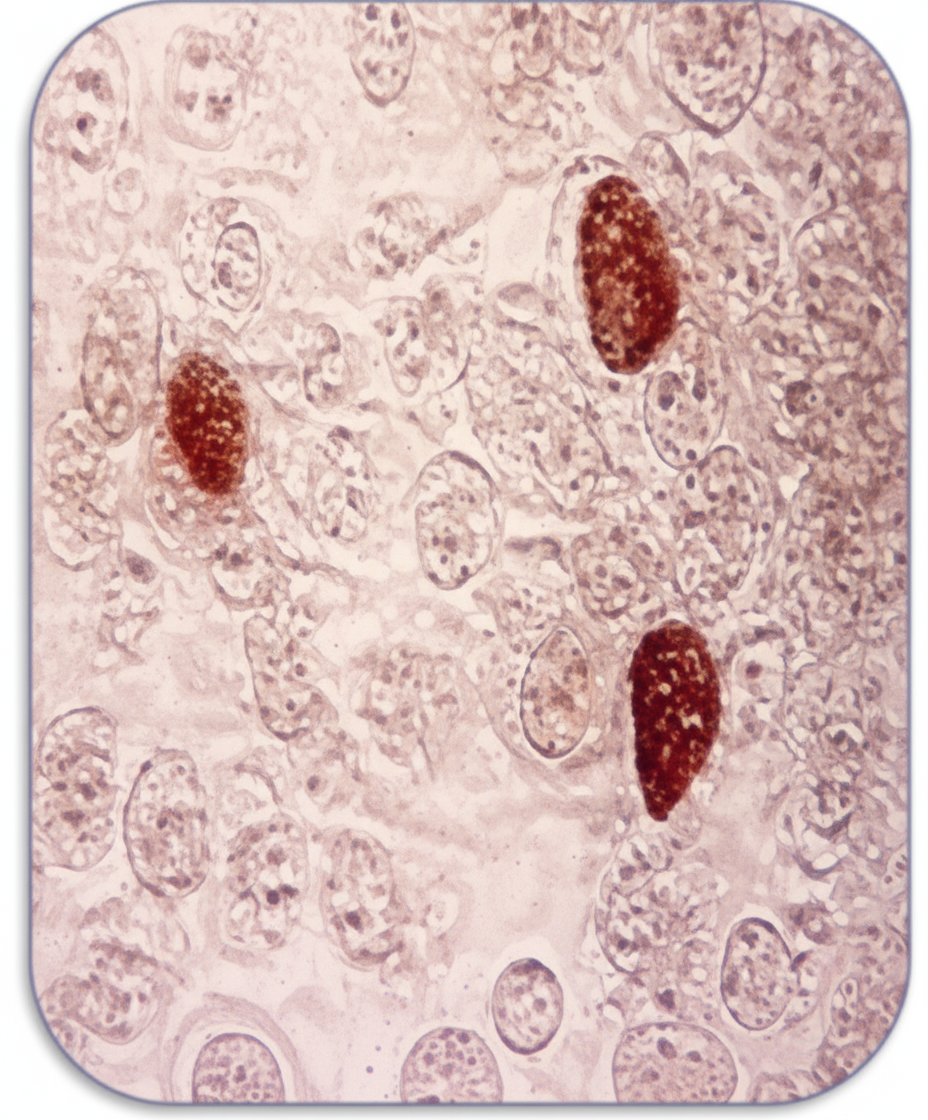
An elderly man presents with an ulcerative lesion at the inner canthus of his eye with pearly margins. On microscopic examination, it shows a palisading arrangement of cells. Identify the lesion:
What is the characteristic microscopic finding in a Tzanck smear from a herpes lesion?
Which of the following structures is pathognomonic for chromoblastomycosis?
A 55-year-old man with a history of sun exposure presents with a slowly growing, pearly nodule with telangiectasias on his nose. The lesion occasionally bleeds when traumatized. Biopsy shows basaloid cells arranged in palisading patterns. Which of the following mutations is most likely involved in the pathogenesis?
A skin biopsy shows 'snowstorm' appearance on polarized microscopy. Which histological finding would best confirm gouty tophi?
A skin biopsy shows 'tadpole' appearance of melanocytes. Which histological pattern would confirm Spitz nevus?
A skin biopsy shows 'crown of thorns' pattern on immunofluorescence. Which additional finding would confirm IgA vasculitis?
Munro's microabscesses are seen in all of the following except:
Parakeratosis is defined as:
Which of the following is the location beyond which fungus does not penetrate in tinea capitis ?
Explanation: ***Basal cell carcinoma*** - The clinical presentation of an ulcerative lesion with **pearly margins**, especially in a sun-exposed area like the inner canthus, is a classic sign of nodular **basal cell carcinoma (BCC)** [1]. - Histologically, the pathognomonic feature is nests of **basaloid cells** with a **peripheral palisading** arrangement, as described and shown in the image [1], [2]. *Squamous cell carcinoma* - **Squamous cell carcinoma (SCC)** typically presents as a scaly, crusted, or erythematous lesion and usually lacks the characteristic **pearly** borders seen in BCC [2]. - Microscopically, SCC is characterized by invasive nests of atypical keratinocytes, often with the formation of **keratin pearls** and intercellular bridges, not palisading [2]. *Keratoacanthoma* - A **keratoacanthoma** is a rapidly growing, dome-shaped tumor with a central, **keratin-filled crater**, which is a distinct clinical feature not described here [2]. - Histologically, it resembles a well-differentiated SCC and does not show the basaloid cells with peripheral palisading characteristic of BCC [2]. *Melanocytic melanoma* - **Melanoma** is a malignancy of melanocytes, typically presenting as a pigmented lesion following the **ABCDE** criteria (Asymmetry, Border irregularity, Color variation, Diameter >6mm, Evolving). - Histology shows atypical melanocytes, not basaloid cells. The cells may contain melanin pigment and have prominent nucleoli, which differs from the microscopic findings in this case. **References:** [1] Kumar V, Abbas AK, et al.. Robbins and Cotran Pathologic Basis of Disease. 9th ed. The Skin, pp. 1158-1160. [2] Cross SS. Underwood's Pathology: A Clinical Approach. 6th ed. Disorders Involving Inflammatory And Haemopoietic Cells, pp. 643-645.
Explanation: ***Multinucleated giant cells*** - The presence of **multinucleated giant cells** (also called Tzanck cells or multinucleated keratinocytes) is the **most characteristic** cytological finding in a Tzanck smear from herpes simplex virus (HSV) or varicella-zoster virus (VZV) lesions. - These giant cells with **2-15 nuclei** form due to **viral-induced cell fusion (syncytia formation)** and are readily identified on routine staining. - This is the hallmark finding that makes Tzanck smear a useful rapid diagnostic test. *Intracellular inclusion bodies* - While **intranuclear inclusion bodies** (Cowdry type A inclusions) are indeed present in herpes infections, they are **less prominent** and require careful examination [1]. - These inclusions are **strictly intranuclear** (within the nucleus), appearing as eosinophilic inclusions surrounded by a clear halo [1]. - Although diagnostic when present, multinucleated giant cells are more readily identified and thus considered the characteristic finding on Tzanck smear. *Budding yeast cells* - **Budding yeast cells** are characteristic of fungal infections, most commonly *Candida* species. - They are typically seen in conditions like candidiasis, not viral infections such as herpes. *Clue cells* - **Clue cells** are epithelial cells covered with bacteria, specifically *Gardnerella vaginalis*, and are a hallmark of **bacterial vaginosis**. - They are not associated with viral vesicular lesions or herpes infections. **References:** [1] Kumar V, Abbas AK, et al.. Robbins and Cotran Pathologic Basis of Disease. 9th ed. Infectious Diseases, pp. 366-367.
Explanation: ***Sclerotic body*** - **Sclerotic bodies**, also known as **Medlar bodies** or **fumagoid cells**, are characteristic coin-shaped, thick-walled, septate, dematiaceous structures observed histologically in affected tissues. - Their presence is **pathognomonic** for chromoblastomycosis, a chronic fungal infection of the skin and subcutaneous tissue. *Asteroid body* - **Asteroid bodies** are typically found in **sporotrichosis**, representing an antigen-antibody complex surrounding fungal elements. - They are not characteristic of chromoblastomycosis. *Budding yeast* - **Budding yeast** forms are commonly seen in various fungal infections, such as **candidiasis** or **cryptococcosis**, but are not specific to chromoblastomycosis. [1] - This morphology indicates yeast proliferation but lacks the distinctive sclerotic appearance. *Negri body* - **Negri bodies** are eosinophilic, sharply demarcated neuronal cytoplasmic inclusions found in the diagnostic examination of **rabies** infection. - They are entirely unrelated to fungal infections like chromoblastomycosis. **References:** [1] Kumar V, Abbas AK, et al.. Robbins and Cotran Pathologic Basis of Disease. 9th ed. The Lung, p. 717.
Explanation: **PTCH1 gene mutation** - The clinical presentation of a **pearly nodule with telangiectasias** on the **nose**, history of **sun exposure**, and **basaloid cells arranged in palisading patterns** on biopsy are classic for **basal cell carcinoma (BCC)** [1]. - Mutations in the **PTCH1 gene**, a tumor suppressor gene involved in the **Hedgehog signaling pathway**, are found in the majority of sporadic BCCs and are central to its pathogenesis [2,3]. *P53 mutation* - While **P53 mutations** are common in many cancers, including **squamous cell carcinoma** [3], they are not the primary driver mutation for basal cell carcinoma in the way PTCH1 mutations are. - Loss of P53 function typically leads to uncontrolled cell growth and reduced apoptosis, but it's a general cancer mechanism rather than a specific one for BCC. *EGFR mutation* - **EGFR mutations** are primarily associated with certain types of **lung adenocarcinoma** and **glioblastoma**, not basal cell carcinoma. - These mutations lead to constitutive activation of the **epidermal growth factor receptor** signaling pathway, promoting cell proliferation and survival in those specific cancers. *KIT mutation* - **KIT mutations** are most commonly found in **gastrointestinal stromal tumors (GIST)** and certain types of **melanoma**. - The KIT receptor tyrosine kinase plays a role in cell growth and differentiation in specific cell lineages, distinct from the epidermal cells involved in BCC. **References:** [1] Kumar V, Abbas AK, et al.. Robbins and Cotran Pathologic Basis of Disease. 9th ed. The Skin, pp. 1158-1162. [2] Kumar V, Abbas AK, et al.. Robbins and Cotran Pathologic Basis of Disease. 9th ed. Neoplasia, pp. 306-307. [3] Cross SS. Underwood's Pathology: A Clinical Approach. 6th ed. Disorders Involving Inflammatory And Haemopoietic Cells, pp. 643-644.
Explanation: ***Needle-shaped crystals*** - The "snowstorm" appearance on polarized microscopy, combined with the presence of **needle-shaped crystals**, is highly characteristic of **monosodium urate (MSU) crystals** seen in gouty tophi [1]. - These crystals typically show **strong negative birefringence** under polarized light [1]. *Rhomboid crystals* - **Rhomboid crystals** are characteristic of **calcium pyrophosphate dihydrate (CPPD) crystal deposition disease**, also known as pseudogout. - These crystals exhibit **positive birefringence**, differentiating them from MSU crystals. *Malta crosses* - **"Malta crosses"** are spherical aggregates of crystals, most commonly seen in **lipid-rich conditions**, such as cholesterol crystals in synovial fluid or fat emboli. - While they show birefringence, their morphology and association are distinct from gout. *Apple-green birefringence* - **Apple-green birefringence** is a characteristic finding in tissues stained with **Congo red** when viewed under polarized light, indicating the presence of **amyloid deposits**. - Amyloidosis is a protein misfolding disorder, unrelated to the crystal deposition seen in gout. **References:** [1] Kumar V, Abbas AK, et al.. Robbins and Cotran Pathologic Basis of Disease. 9th ed. Bones, Joints, and Soft Tissue Tumors, pp. 1218-1220.
Explanation: ***Kamino bodies*** - Kamino bodies are **eosinophilic globules** found within the epidermis of a Spitz nevus, particularly at the **dermo-epidermal junction**. - Their presence, along with the characteristic **'tadpole' appearance of melanocytes** (spindled and epithelioid cells in nests), strongly supports the diagnosis of Spitz nevus. *Civatte bodies* - **Civatte bodies** (also known as apoptotic keratinocytes) are typically seen in conditions involving **lichenoid inflammation**, such as **lichen planus** or **lupus erythematosus**. - They represent **apoptotic keratinocytes** that have undergone necrosis, not a specific feature of Spitz nevus. *Asteroid bodies* - **Asteroid bodies** are star-shaped inclusions found within **giant cells** in granulomatous conditions, most notably **sarcoidosis**. - They are composed of lipids and proteins and are not associated with melanocytic lesions like Spitz nevus. *Russell bodies* - **Russell bodies** are **eosinophilic, hyaline inclusions** found within plasma cells, representing accumulations of **immunoglobulins** in conditions like **plasmacytomas**. - They are not a feature of Spitz nevus or other melanocytic proliferations.
Explanation: ***Leukocytoclastic vasculitis*** - **IgA vasculitis**, also known as Henoch-Schönlein purpura, is characterized by **leukocytoclastic vasculitis** on skin biopsy, which involves fragmentation of neutrophils and fibrinoid necrosis of vessel walls [1]. - The "crown of thorns" pattern on immunofluorescence refers to the **perivascular IgA deposition** seen in IgA vasculitis, which is pathognomonic when coupled with the histological finding of leukocytoclastic vasculitis. *Granulomatous inflammation* - This type of inflammation is characterized by aggregates of **macrophages** (histiocytes) and is typical of conditions like **tuberculosis**, sarcoidosis, or certain fungal infections, not IgA vasculitis. - **Granulomas** form as a defense mechanism to wall off foreign substances or pathogens that cannot be eliminated by other inflammatory responses. *Eosinophilic spongiosis* - **Eosinophilic spongiosis** is characterized by intercellular edema within the epidermis accompanied by **eosinophil infiltration**, typically seen in **allergic contact dermatitis**, drug reactions, or pemphigus. - This pattern reflects an allergic or hypersensitivity response rather than a vasculitic process, and is not a feature of IgA vasculitis. *Interface dermatitis* - **Interface dermatitis** is a pattern of inflammation at the dermo-epidermal junction, typically seen in conditions like **lichen planus**, lupus erythematosus, or erythema multiforme. - It is characterized by vacuolar degeneration of basal keratinocytes and a prominent lymphocytic infiltrate at the junction, which is fundamentally different from a vasculitic process. **References:** [1] Cross SS. Underwood's Pathology: A Clinical Approach. 6th ed. Common Clinical Problems From Cardiovascular Disease, pp. 278-280.
Explanation: ***Pemphigus*** - **Pemphigus** is characterized by **acantholysis**, the dissolution of intercellular bridges between keratinocytes, leading to intraepidermal blister formation [1]. - While it involves inflammatory changes, the characteristic neutrophilic collections known as **Munro's microabscesses** (which are collections of neutrophils in the stratum corneum) are not a feature [4]. *Benign migratory glossitis* - Also known as **geographic tongue**, this condition can show histological features similar to psoriasis, including **Munro's microabscesses**. - It involves areas of **atrophic filiform papillae** surrounded by elevated white or yellowish borders, which histologically show features of chronic inflammation and neutrophil accumulation. *Psoriasis* - **Munro's microabscesses** are a classic histological hallmark of **psoriasis**, particularly in the pustular forms [3]. - They represent accumulations of **neutrophils in the stratum corneum** and indicate the inflammatory nature of the disease [2]. *Reiter syndrome* - **Reiter syndrome**, now often referred to as **reactive arthritis**, can present with dermatological manifestations such as **keratoderma blennorrhagicum**, which is histologically indistinguishable from **pustular psoriasis**. - Therefore, **Munro's microabscesses** can be found in the epidermal lesions associated with Reiter syndrome. **References:** [1] Cross SS. Underwood's Pathology: A Clinical Approach. 6th ed. Disorders Involving Inflammatory And Haemopoietic Cells, pp. 645-646. [2] Cross SS. Underwood's Pathology: A Clinical Approach. 6th ed. Disorders Involving Inflammatory And Haemopoietic Cells, pp. 640-641. [3] Cross SS. Underwood's Pathology: A Clinical Approach. 6th ed. Disorders Involving Inflammatory And Haemopoietic Cells, pp. 636-637. [4] Kumar V, Abbas AK, et al.. Robbins and Cotran Pathologic Basis of Disease. 9th ed. The Skin, p. 1172.
Explanation: ***Retention of nuclei in stratum corneum*** - **Parakeratosis** is a histological term defining the abnormal retention of **nuclei** within the cells of the **stratum corneum** [1]. - This indicates incomplete or abnormal keratinization, where keratinocytes fail to fully mature and lose their nuclei as they reach the uppermost layer of the epidermis [1]. *Decreased thickness of stratum corneum* - A decreased thickness of the **stratum corneum** is referred to as **atrophy** or thinning, which is not the definition of parakeratosis. - This typically indicates a reduction in the number of cell layers, not the presence of nuclei within those layers. *Retention of cytoplasmic contents in stratum corneum* - While cells normally lose most of their cytoplasmic organelles during the keratinization process, the defining feature of parakeratosis specifically refers to the retention of the **nucleus**. - The presence of cytoplasmic contents without nuclei would not be termed parakeratosis. *Increased thickness in stratum corneum* - An increased thickness of the **stratum corneum** is known as **hyperkeratosis**. - Hyperkeratosis can occur with or without parakeratosis, but the presence of nuclei is the key characteristic of parakeratosis, not merely the thickness. **References:** [1] Cross SS. Underwood's Pathology: A Clinical Approach. 6th ed. Disorders Involving Inflammatory And Haemopoietic Cells, pp. 640-641.
Explanation: ***Adamson's fringe*** - Adamson's fringe is the **critical anatomical boundary** located at the opening of the sebaceous gland duct into the hair follicle. - It represents the zone where **hair keratinization is complete** and marks the transition between the keratinized (dead) upper portion and the living, pre-keratinized hair matrix below. - In tinea capitis, dermatophyte fungi **cannot penetrate beyond Adamson's fringe** because they are keratinophilic organisms that can only invade fully keratinized tissue [1]—they cannot survive in the living hair bulb below this level. - This is the **deepest point of fungal penetration** in the hair follicle. *Isthmus* - The isthmus is the mid-portion of the hair follicle located **between the insertion of the arrector pili muscle and the opening of the sebaceous gland**. - It is **above/superficial to Adamson's fringe**, meaning fungi can and do penetrate through this region as they invade downward toward Adamson's fringe. - Therefore, the isthmus is **not the limiting boundary** of fungal penetration. *Infundibulum* - The infundibulum is the **uppermost segment** of the hair follicle, extending from the skin surface down to the sebaceous gland opening. - This is the **most superficial region** where fungal infection typically begins in tinea capitis. - Fungi are readily present in the infundibulum but penetrate **deeper than this level**, making it not the limiting boundary. *Stem* - "Stem" refers to the **hair shaft itself** (the visible, keratinized hair fiber) rather than a specific anatomical boundary within the follicle. - While fungi do invade the hair stem/shaft, this term does not define the **anatomical limit of penetration within the follicle architecture**—that limit is specifically Adamson's fringe. **References:** [1] Cross SS. Underwood's Pathology: A Clinical Approach. 6th ed. Disorders Involving Inflammatory And Haemopoietic Cells, pp. 638-639.
Structure and Function of Skin
Practice Questions
Inflammatory Dermatoses
Practice Questions
Blistering Diseases
Practice Questions
Infectious Diseases of the Skin
Practice Questions
Disorders of Pigmentation
Practice Questions
Benign Skin Tumors
Practice Questions
Malignant Skin Tumors
Practice Questions
Connective Tissue Disorders of the Skin
Practice Questions
Cutaneous Manifestations of Systemic Disease
Practice Questions
Hair and Nail Disorders
Practice Questions
Get full access to all questions, explanations, and performance tracking.
Start For Free