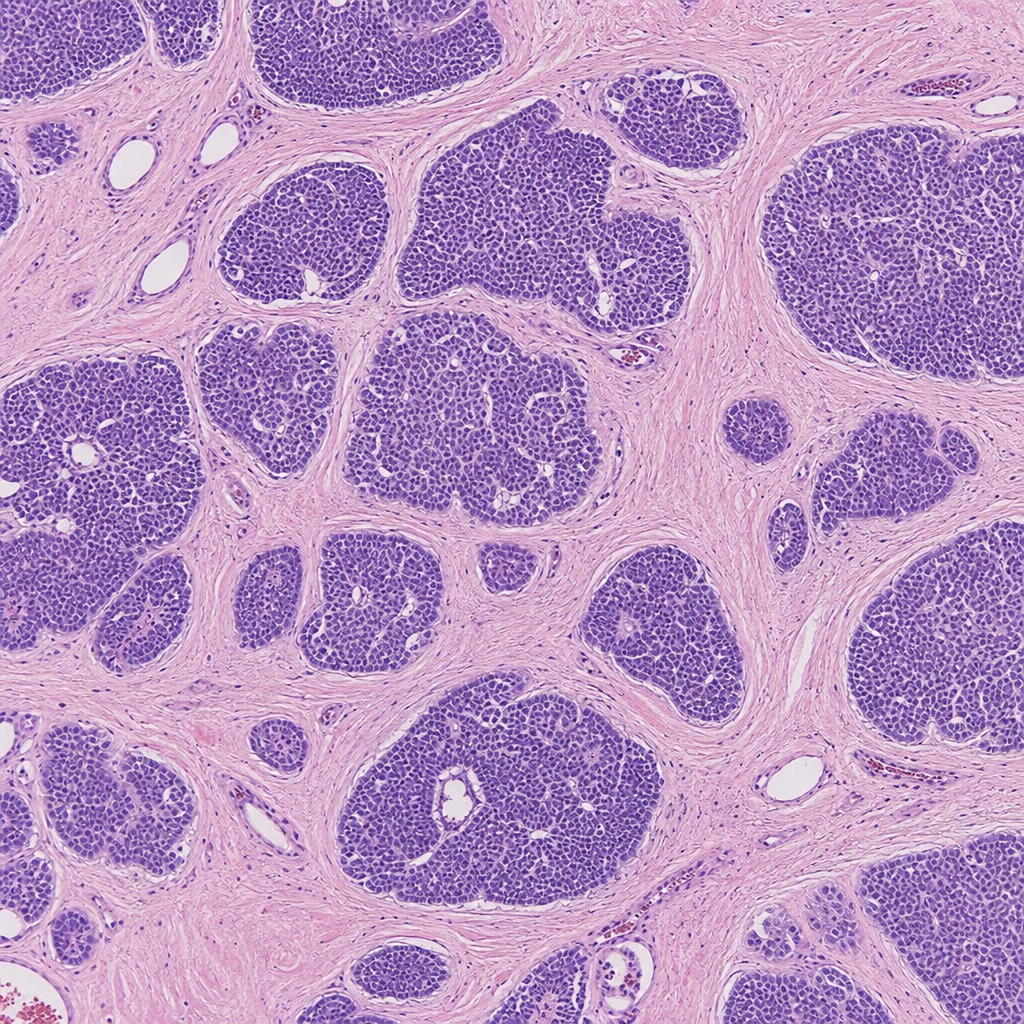
"Church spire effect" is shown by which of the following conditions?
What is the characteristic feature of Paget's cells?
Examination of a skin lesion demonstrates very abnormal squamous cells with a high nuclear/cytoplasmic ratio and clumped chromatin. These cells form nests within the epidermis that extend to the superficial surface of the epithelium. In some places, nests of these cells have central areas of abnormal keratin formation. The basement membrane is intact and no nests of cells are seen in the dermis. Which of the following terms best describes this lesion?
Abrus precatorius (abrin) poisoning is characterized by which of the following findings?
What is Mycosis fungoides?
Which marker is used for malignant melanoma?
Which of the following is a feature of acanthosis nigricans?
Which of the following conditions is associated with Psoriasis?
Melanin pigmentation in pregnancy is known as?
What is the characteristic pathological feature of pyogenic granuloma?
Explanation: The **"Church spire effect"** is a classic histopathological descriptor for **Verruca vulgaris** (the common wart), caused by Human Papillomavirus (HPV) [1]. **1. Why Verruca vulgaris is correct:** In Verruca vulgaris, the epidermis undergoes significant reactive changes. The "church spire" appearance refers to **pointed projections of hyperkeratosis** (thickening of the stratum corneum) and **parakeratosis** (retention of nuclei in the stratum corneum) that sit atop a papillomatous (undulating) epidermis [1]. These sharp, peaked elevations resemble the spires of a church. **2. Why the other options are incorrect:** * **Pemphigus vulgaris:** Characterized by **suprabasal acantholysis** (loss of cell-to-cell adhesion) leading to a "tombstone appearance" of the basal layer and intraepidermal blisters. * **Pemphigus vegetans:** A variant of pemphigus characterized by exuberant granulation tissue and **pseudoepitheliomatous hyperplasia**, but it lacks the peaked, spire-like keratinization. * **Verrucous papillary outgrowth:** This is a general morphological description rather than a specific pathological sign like the "church spire" effect. **3. High-Yield Clinical Pearls for NEET-PG:** * **Koilocytes:** The hallmark of HPV infection; these are squamous cells with shrunken, "raisin-like" nuclei surrounded by a clear halo [1]. * **Other features of Verruca:** Hypergranulosis (thickened granular layer) and inward-bending rete ridges (often called "kissing" rete ridges) [1]. * **Acanthosis:** Diffuse epidermal hyperplasia is always present in verrucous lesions [1]. * **Differential Diagnosis:** Seborrheic keratosis also shows papillomatosis but is distinguished by "horn cysts" and a "stuck-on" clinical appearance. **References:** [1] Kumar V, Abbas AK, et al.. Robbins and Cotran Pathologic Basis of Disease. 9th ed. The Skin, pp. 1177-1178.
Explanation: **Explanation:** Paget’s cells are the hallmark of **Paget’s disease** (both Mammary and Extramammary). These are malignant epithelial cells that originate from underlying glandular structures (like lactiferous ducts) and migrate into the epidermis [2], [3]. **Why Option B is correct:** Under light microscopy, Paget’s cells are characterized by their large size and **abundant, pale, or clear cytoplasm** [1], [2]. This "clear" appearance is due to the presence of intracellular **mucin** (sialomucin), which does not stain well with standard H&E but can be highlighted using special stains like PAS (Periodic Acid-Schiff) or Mucicarmine. **Analysis of Incorrect Options:** * **A. Eosinophilic cytoplasm:** While some malignant cells are eosinophilic, Paget’s cells are specifically noted for their "washed-out" or clear appearance due to mucin content [2]. * **C. Glycogen mass:** While some clear cell tumors (like Clear Cell RCC) contain glycogen, the primary substance in Paget’s cells is mucin. * **D. Multinucleated giant cell:** These are characteristic of granulomatous inflammation or specific tumors like Giant Cell Tumor of bone, not Paget’s disease. **NEET-PG High-Yield Pearls:** 1. **Staining Profile:** Paget’s cells are **PAS positive** (diastase resistant) and **Mucicarmine positive**. 2. **Immunohistochemistry (IHC):** They are typically **CK7 positive** and **S100 negative** (this helps differentiate them from Melanoma, which is S100 positive) [1]. 3. **Clinical Presentation:** Often presents as a chronic, eczematous, or crusting lesion of the nipple-areola complex [3]. 4. **Association:** Mammary Paget’s disease is almost always associated with an underlying **Ductal Carcinoma in Situ (DCIS)** or invasive ductal carcinoma [2], [3]. **References:** [1] Kumar V, Abbas AK, et al.. Robbins and Cotran Pathologic Basis of Disease. 9th ed. The Female Genital Tract, p. 1004. [2] Cross SS. Underwood's Pathology: A Clinical Approach. 6th ed. Common Clinical Problems From Liver And Biliary System Disease, pp. 456-457. [3] Kumar V, Abbas AK, et al.. Robbins and Cotran Pathologic Basis of Disease. 9th ed. The Breast, pp. 1061-1062.
Explanation: **Explanation:** The clinical description points toward a high-grade malignant transformation of squamous cells that is still confined by anatomical boundaries. **1. Why Carcinoma in situ (CIS) is correct:** The presence of "very abnormal squamous cells" with high N/C ratios and clumped chromatin indicates **anaplasia** (malignancy). The formation of nests with "central areas of abnormal keratin formation" (keratin pearls) is a hallmark of squamous cell carcinoma [2]. Crucially, the description states the **basement membrane is intact** and no cells are seen in the dermis. This defines CIS: full-thickness cytologic atypia of the epithelium without invasion through the basement membrane [1], [4]. In the skin, this is often referred to as **Bowen’s Disease**. **2. Why the other options are incorrect:** * **Dysplasia:** While dysplasia involves disordered growth and loss of maturation, the term "Carcinoma in situ" is more specific for full-thickness atypia that exhibits all the cytologic features of malignancy without invasion [1]. * **Invasive Carcinoma:** This would require the breach of the basement membrane and the presence of malignant cell nests within the **dermis**. The question explicitly states the basement membrane is intact. * **Metaplasia:** This is a reversible change where one adult cell type is replaced by another (e.g., columnar to squamous) [3]. It does not inherently imply the malignant features (high N/C ratio, clumped chromatin) described here. **NEET-PG High-Yield Pearls:** * **Bowen’s Disease:** The clinical name for Squamous Cell Carcinoma in situ of the skin. It presents as a persistent, scaly red plaque. * **Erythroplasia of Queyrat:** CIS involving the glans penis or prepuce. * **Key Histological Marker:** The integrity of the **Basement Membrane** is the "gold standard" for differentiating CIS from invasive carcinoma [1], [4]. Once the membrane is breached, the risk of metastasis increases significantly. **References:** [1] Cross SS. Underwood's Pathology: A Clinical Approach. 6th ed. (Basic Pathology) introduces the student to key general principles of pathology, both as a medical science and as a clinical activity with a vital role in patient care. Part 2 (Disease Mechanisms) provides fundamental knowledge about the cellular and molecular processes involved in diseases, providing the rationale for their treatment. Part 3 (Systematic Pathology) deals in detail with specific diseases, with emphasis on the clinically important aspects., pp. 209-210. [2] Kumar V, Abbas AK, et al.. Robbins and Cotran Pathologic Basis of Disease. 9th ed. The Female Genital Tract, pp. 1002-1004. [3] Cross SS. Underwood's Pathology: A Clinical Approach. 6th ed. Common Clinical Problems From Female Genital Tract Disease, pp. 467-468. [4] Cross SS. Underwood's Pathology: A Clinical Approach. 6th ed. Common Clinical Manifestations Of Central And Peripheral Nervous System Disease, pp. 741-742.
Explanation: **Explanation:** **Abrus precatorius (Abrin) poisoning** is a high-yield topic in forensic pathology and toxicology. The seeds of *Abrus precatorius* (Rosary pea/Ratti) contain **abrin**, a potent Type II Ribosome-Inactivating Protein (RIP). Its mechanism of action is identical to ricin: it inhibits protein synthesis by removing an adenine residue from the 28S ribosomal RNA, leading to cell death. 1. **Why Option A is correct:** The question asks to identify the condition characterized by its own name (a common pattern in recall-based questions). Clinically, abrin poisoning via "suicidal needles" (sui) causes intense local inflammation, **hemorrhagic edema**, and necrosis at the injection site. Systemically, it leads to multi-organ failure and fatal gastroenteritis if ingested. 2. **Why other options are incorrect:** * **Pemphigus:** An autoimmune blistering disease characterized by acantholysis (loss of intercellular connections) due to antibodies against desmogleins [1]. * **Aphthous ulcer:** Common, painful oral ulcers (canker sores) associated with T-cell mediated immune responses, not toxins. * **Erythema multiforme:** A hypersensitivity reaction (often triggered by HSV or drugs) characterized by "target" or "iris" lesions and subepidermal bullae. **High-Yield Clinical Pearls for NEET-PG:** * **The "Sui" (Needles):** Traditionally used for cattle poisoning; seeds are decorticated, made into a paste, and shaped into needles. * **Fatal Dose:** 1–2 seeds (ingested) or 0.1–1.0 mg of abrin (injected). * **Post-mortem finding:** Presence of a "sui" or fragments of the seed at the site of injection/inflammation. * **Treatment:** Primarily supportive; there is no specific antidote for abrin. **References:** [1] Cross SS. Underwood's Pathology: A Clinical Approach. 6th ed. Disorders Involving Inflammatory And Haemopoietic Cells, pp. 645-646.
Explanation: **Explanation:** **Mycosis Fungoides (MF)** is the most common form of **Cutaneous T-cell Lymphoma (CTCL)** [1]. Despite its name, it is a primary neoplastic proliferation of skin-homing **CD4+ T-helper cells**, not a fungal infection [1], [2]. 1. **Why Option A is Correct:** MF is a malignancy of mature T-lymphocytes that initially involves the skin [2]. It typically follows a chronic clinical course, progressing through three classic stages: **Patch, Plaque, and Tumor** [1], [3]. Histologically, it is characterized by **Pautrier’s microabscesses** (aggregates of neoplastic T-cells within the epidermis) and **epidermotropism** (migration of T-cells into the epidermis without significant spongiosis) [3]. 2. **Why Incorrect Options are Wrong:** * **Option B & C:** The term "Mycosis" was historically coined because the skin tumors resembled mushrooms; however, it is neither fungal nor bacterial. It is a hematologic malignancy. * **Option D:** While cutaneous B-cell lymphomas exist, MF specifically involves T-cells. **High-Yield Clinical Pearls for NEET-PG:** * **Sezary Syndrome:** This is the leukemic phase of CTCL characterized by a triad of **erythroderma, lymphadenopathy, and circulating Sezary cells** (T-cells with characteristic **cerebriform nuclei**) [2], [3]. * **Immunophenotype:** Neoplastic cells are typically **CD3+ and CD4+**. A loss of CD7 expression is a common diagnostic marker. * **Histology Hallmark:** Look for "lining up" of atypical lymphocytes along the dermo-epidermal junction (tagging). * **Treatment:** Early stages are managed with skin-directed therapies (PUVA, topical steroids), while advanced stages may require systemic chemotherapy. **References:** [1] Kumar V, Abbas AK, et al.. Robbins and Cotran Pathologic Basis of Disease. 9th ed. The Skin, p. 1162. [2] Kumar V, Abbas AK, et al.. Robbins and Cotran Pathologic Basis of Disease. 9th ed. Diseases of White Blood Cells, Lymph Nodes, Spleen, and Thymus, pp. 613-614. [3] Cross SS. Underwood's Pathology: A Clinical Approach. 6th ed. Common Clinical Problems From Diseases Of The Urinary And Male Genital Tracts, pp. 564-565.
Explanation: **Explanation:** **Malignant Melanoma** is a neoplasm arising from melanocytes, which are cells derived from the **neural crest**. **Why S-100 is the correct answer:** S-100 is a calcium-binding protein found in cells derived from the neural crest (melanocytes, Schwann cells, glial cells). It is considered the **most sensitive marker** for malignant melanoma. While it lacks high specificity (as it also stains nerve sheath tumors and some carcinomas), its high sensitivity makes it the primary screening tool in immunohistochemistry (IHC) for suspected melanoma. **Analysis of Incorrect Options:** * **A. Cytokeratin:** This is a marker for epithelial cells [4]. It is used to identify **carcinomas** [4]. Melanomas are typically cytokeratin-negative. * **B. MBN-45:** This appears to be a distractor/typo for **HMB-45** (Human Melanoma Black-45). HMB-45 is a highly specific marker for melanoma (reacts with gp100), but it is less sensitive than S-100, especially in desmoplastic variants. * **C. Alpha FP (Alpha-fetoprotein):** This is a tumor marker used for **Hepatocellular Carcinoma (HCC)** and certain germ cell tumors like Yolk Sac tumors. **High-Yield NEET-PG Pearls:** * **Most Sensitive Marker:** S-100. * **Most Specific Markers:** HMB-45 and Melan-A (MART-1). * **SOX10:** A newer, highly sensitive and specific nuclear marker for melanocytic differentiation. * **Breslow’s Depth:** The most important prognostic factor for cutaneous melanoma (measures thickness from the granular layer to the deepest tumor cell) [1]. * **Common Mutation:** BRAF V600E is frequently seen in non-acral cutaneous melanomas [2], [3]. **References:** [1] Cross SS. Underwood's Pathology: A Clinical Approach. 6th ed. Disorders Involving Inflammatory And Haemopoietic Cells, pp. 649-650. [2] Cross SS. Underwood's Pathology: A Clinical Approach. 6th ed. Disorders Involving Inflammatory And Haemopoietic Cells, pp. 650-651. [3] Kumar V, Abbas AK, et al.. Robbins and Cotran Pathologic Basis of Disease. 9th ed. The Skin, pp. 1152-1153. [4] Cross SS. Underwood's Pathology: A Clinical Approach. 6th ed. (Basic Pathology) introduces the student to key general principles of pathology, both as a medical science and as a clinical activity with a vital role in patient care. Part 2 (Disease Mechanisms) provides fundamental knowledge about the cellular and molecular processes involved in diseases, providing the rationale for their treatment. Part 3 (Systematic Pathology) deals in detail with specific diseases, with emphasis on the clinically important aspects., pp. 208-209.
Explanation: **Explanation:** **Acanthosis Nigricans (AN)** is a common dermatosis characterized clinically by symmetrical, velvety, **hyperpigmented** plaques, typically involving intertriginous areas like the axilla and neck. **1. Why Option B is Correct:** The pathogenesis of AN is driven by the stimulation of **Insulin-like Growth Factor (IGF) receptors** on keratinocytes and fibroblasts. In states of **Insulin Resistance** and **Obesity**, high levels of circulating insulin cross-react with IGF-1 receptors, leading to epidermal proliferation [1]. This manifests as hyperpigmented, thickened skin. **2. Analysis of Incorrect Options:** * **Option A:** Incorrect because AN presents with **hyperpigmentation**, not hypopigmentation. Furthermore, it is associated with insulin resistance (Type 2 Diabetes), whereas an **insulinoma** (insulin-secreting tumor) causes hypoglycemia. * **Option C & D:** These are technically incorrect due to the histological description. Despite the name "acanthosis," the hallmark of AN is actually **hyperkeratosis and papillomatosis** (undulating epidermal folds) [1]. The "thickening of the spinous layer" (true acanthosis) is surprisingly minimal in AN. Additionally, Option D mentions "lean" patients; while AN can occur in lean individuals (malignancy-associated), the classic triad includes obesity. **High-Yield Facts for NEET-PG:** * **Histology:** Hyperkeratosis, Papillomatosis, and minimal acanthosis [1]. * **Clinical Associations:** * **Type I (Benign):** Associated with obesity and endocrine disorders (PCOS, Diabetes). * **Type II (Malignant):** Sudden onset in an older, non-obese patient. Most commonly associated with **Gastric Adenocarcinoma**. * **Tripe Palms:** A variant of AN involving the palms, highly suggestive of internal malignancy (Lung or Gastric cancer). **References:** [1] Kumar V, Abbas AK, et al.. Robbins and Cotran Pathologic Basis of Disease. 9th ed. The Skin, pp. 1153-1154.
Explanation: **Explanation:** **Psoriasis** is a chronic inflammatory skin condition characterized by hyperproliferation of keratinocytes [1]. The correct answer is **Geographic tongue** (also known as Benign Migratory Glossitis). 1. **Why Geographic Tongue is correct:** Geographic tongue is often considered an **oral manifestation of psoriasis**. Histologically, it is nearly identical to cutaneous psoriasis, showing parakeratosis, acanthosis, and **Munro’s microabscesses** (neutrophil collections in the stratum corneum) [2]. Patients with psoriasis have a significantly higher prevalence of geographic tongue compared to the general population, and both conditions share a common genetic link with **HLA-Cw6**. 2. **Why other options are incorrect:** * **Benign Median Rhomboid Glossitis:** This is typically associated with chronic **Candidiasis** (fungal infection) and presents as a smooth, red, asymptomatic plaque in the midline of the dorsal tongue. * **Lupus Erythematosus:** This is an autoimmune connective tissue disease. While it can have oral ulcers, it is not etiologically linked to the psoriasiform changes seen in geographic tongue. * **Lupus Vulgaris:** This is a chronic progressive form of **cutaneous tuberculosis**, characterized by "apple-jelly" nodules on diascopy. **High-Yield Clinical Pearls for NEET-PG:** * **Histology of Psoriasis:** Look for "Regular" elongation of rete ridges (camel-foot appearance), Auspitz sign (pinpoint bleeding), and Kogoj pustules [1], [2]. * **HLA Association:** Strongly linked with **HLA-Cw6**. * **Other Associations:** Psoriatic arthritis (seronegative), metabolic syndrome, and nail changes (pitting, oil spots). * **Koebner Phenomenon:** Development of lesions at sites of trauma (also seen in Vitiligo and Lichen Planus) [3]. **References:** [1] Cross SS. Underwood's Pathology: A Clinical Approach. 6th ed. Disorders Involving Inflammatory And Haemopoietic Cells, pp. 636-641. [2] Kumar V, Abbas AK, et al.. Robbins and Cotran Pathologic Basis of Disease. 9th ed. The Skin, p. 1168. [3] Kumar V, Abbas AK, et al.. Robbins and Cotran Pathologic Basis of Disease. 9th ed. The Skin, pp. 1168-1170.
Explanation: **Explanation:** **Melasma** (also known as chloasma or the "mask of pregnancy") is a common acquired hypermelanosis characterized by symmetric, brown-to-grayish patches on sun-exposed areas, most frequently the face. In the context of pregnancy, it is driven by elevated levels of estrogen, progesterone, and melanocyte-stimulating hormone (MSH), which stimulate melanocytes to increase melanin production. **Analysis of Options:** * **Melasma (Correct):** This is the classic dermatological manifestation of hormonal changes during pregnancy. It typically affects the cheeks, forehead, and upper lip. * **Melanoma:** This is a malignant neoplasm of melanocytes. While pregnancy can sometimes affect the prognosis or detection of melanoma, it is not a term for physiological pigmentation [1]. * **Epulis:** Specifically "Epulis Gravidarum" (Pyogenic Granuloma), this refers to a vascular, tumor-like gingival growth occurring in pregnant women, not a pigmentary disorder. * **Melanosis:** This is a general term for abnormal melanin deposition (e.g., Smoker’s melanosis or Melanosis coli) but is not the specific clinical term used for pregnancy-induced facial hyperpigmentation. **High-Yield NEET-PG Pearls:** * **Histopathology:** Melasma shows increased melanin in the basal and suprabasal layers of the epidermis and/or dermal melanophages. * **Wood’s Lamp Examination:** Used to classify melasma into Epidermal (enhances under light), Dermal (does not enhance), or Mixed types. * **Treatment:** Often resolves postpartum. First-line medical therapy is **Kligman’s Formula** (Hydroquinone + Tretinoin + Fluocinolone acetonide). * **Other Pregnancy Pigmentary Changes:** Darkening of the linea alba (becoming **linea nigra**), secondary areola, and darkening of pre-existing nevi [1]. **References:** [1] Kumar V, Abbas AK, et al.. Robbins and Cotran Pathologic Basis of Disease. 9th ed. The Skin, pp. 1146-1148.
Explanation: **Explanation:** **Pyogenic granuloma (Lobular Capillary Hemangioma)** is a common, benign vascular lesion of the skin and mucous membranes. Despite its name, it is neither "pyogenic" (pus-forming) nor a true "granuloma." **Why Granulation Tissue is Correct:** The hallmark histological feature of pyogenic granuloma is a circumscribed proliferation of capillaries arranged in a **lobular pattern** within an edematous stroma. This morphology closely resembles **granulation tissue** (the tissue formed during wound healing, consisting of new capillaries, fibroblasts, and inflammatory cells) [1], [2]. Over time, the lesion may become pedunculated and develop an epidermal "collarette" at the base. **Analysis of Incorrect Options:** * **A. Epithelioid cells:** These are activated macrophages characteristic of true granulomatous inflammation (e.g., Tuberculosis, Sarcoidosis), which is absent in pyogenic granuloma [1]. * **B. Cavernous hemangioma:** These consist of large, dilated, blood-filled vascular spaces. Pyogenic granuloma is a subtype of capillary hemangioma, characterized by small, narrow-lumen vessels. * **D. Giant cells:** Multinucleated giant cells are features of granulomatous diseases or specific lesions like Giant Cell Reparative Granuloma, but they are not a defining feature of pyogenic granuloma. **High-Yield Clinical Pearls for NEET-PG:** * **Clinical Presentation:** Rapidly growing, friable (bleeds easily), red nodule often following minor trauma. * **Common Sites:** Gingiva (common in pregnant women, known as **Granuloma Gravidarum** or "pregnancy tumor"), fingers, and lips. * **Key Histology:** Lobular arrangement of capillaries (Lobular Capillary Hemangioma) with an overlying thinned or ulcerated epidermis. **References:** [1] Cross SS. Underwood's Pathology: A Clinical Approach. 6th ed. (Basic Pathology) introduces the student to key general principles of pathology, both as a medical science and as a clinical activity with a vital role in patient care. Part 2 (Disease Mechanisms) provides fundamental knowledge about the cellular and molecular processes involved in diseases, providing the rationale for their treatment. Part 3 (Systematic Pathology) deals in detail with specific diseases, with emphasis on the clinically important aspects., pp. 105-106. [2] Kumar V, Abbas AK, et al.. Robbins and Cotran Pathologic Basis of Disease. 9th ed. Inflammation and Repair, p. 119.
Structure and Function of Skin
Practice Questions
Inflammatory Dermatoses
Practice Questions
Blistering Diseases
Practice Questions
Infectious Diseases of the Skin
Practice Questions
Disorders of Pigmentation
Practice Questions
Benign Skin Tumors
Practice Questions
Malignant Skin Tumors
Practice Questions
Connective Tissue Disorders of the Skin
Practice Questions
Cutaneous Manifestations of Systemic Disease
Practice Questions
Hair and Nail Disorders
Practice Questions
Get full access to all questions, explanations, and performance tracking.
Start For Free