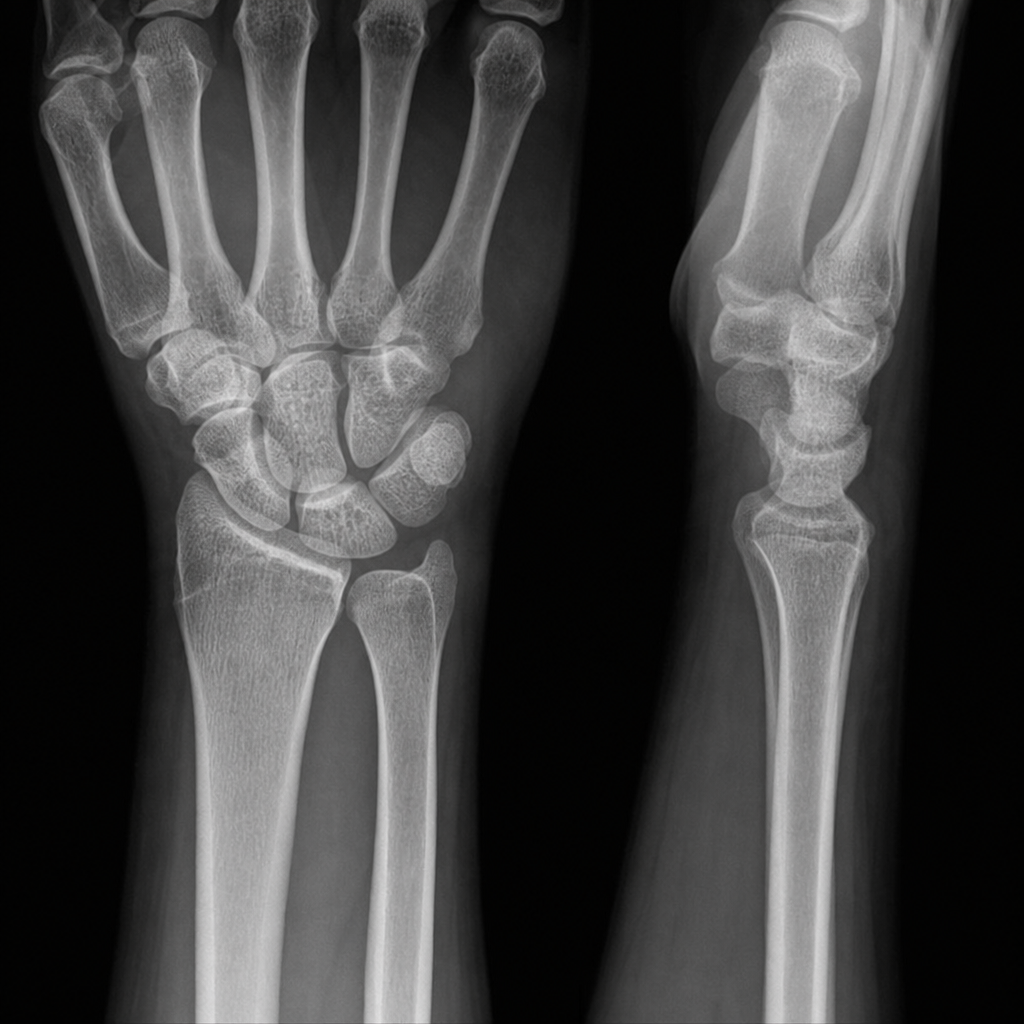
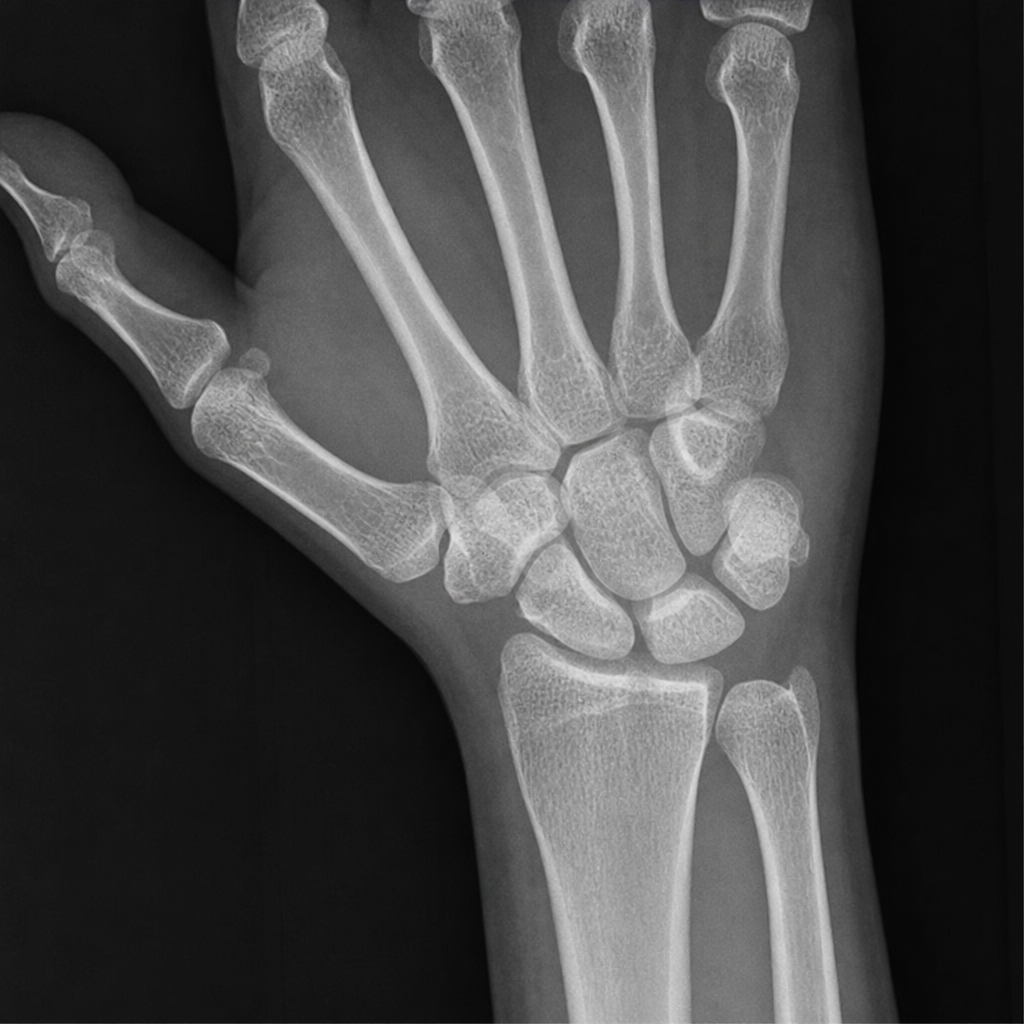
What is the deforming force on the proximal fragment in a Bennett's fracture?
Which of the following is not a classification of humerus fractures?
What is the mechanism of anterior dislocation of the shoulder?
Which test is used to evaluate posteroinferior instability of the glenohumeral joint?
Which of the following femoral shaft fractures are most suitable for internal fixation with a Kuntscher nail?
A fall on the heel is commonly associated with which of the following fractures or dislocations?
Neuropraxia is defined as:
Which of the following is NOT a delayed complication of a fracture?
Which of the following is NOT a symptom of Sudeck's dystrophy?
Gamma nail is used in the treatment of which of the following?
Explanation: **Explanation:** A **Bennett’s fracture** is an intra-articular fracture-dislocation at the base of the first metacarpal. The fracture pattern involves a small volar-ulnar fragment that remains attached to the **Anterior Oblique Ligament (AOL)**, while the rest of the metacarpal (the distal/proximal fragment) is displaced. **Why APL is the correct answer:** The **Abductor Pollicis Longus (APL)** inserts onto the radial side of the base of the first metacarpal. When the fracture occurs, the APL exerts an unopposed pulling force, displacing the metacarpal shaft **proximally, radially, and dorsally**. Additionally, the Adductor Pollicis pulls the distal end of the fragment toward the palm, resulting in the characteristic deformity. **Analysis of Incorrect Options:** * **B. Abductor pollicis brevis (APB):** This is an intrinsic muscle originating from the flexor retinaculum/trapezium and inserting into the proximal phalanx. It does not exert the primary deforming force on the metacarpal base. * **C & D. EPL and EPB:** While the Extensor Pollicis Longus (EPL) can contribute to the adduction deformity of the distal fragment, neither the EPL nor the EPB is the primary driver of the proximal/radial migration of the metacarpal shaft in a Bennett's fracture. **High-Yield Clinical Pearls for NEET-PG:** * **Stability:** Bennett's fracture is inherently **unstable** due to the pull of the APL; thus, it usually requires operative intervention (Closed reduction and K-wire fixation/CRIF). * **Rolando Fracture:** A comminuted T- or Y-shaped intra-articular fracture at the base of the first metacarpal (worse prognosis than Bennett's). * **The "Fragment":** Remember that the small volar fragment stays in place because of the **Anterior Oblique Ligament** (the "beak" ligament).
Explanation: **Explanation:** The correct answer is **Garden’s Classification**, as it is used for **Fractures of the Neck of Femur**, not the humerus. It classifies subcapital femoral neck fractures into four stages based on the degree of displacement and the alignment of medial trabeculae, which helps determine the risk of avascular necrosis (AVN). **Analysis of other options:** * **Neer’s Classification:** This is the standard classification for **Proximal Humerus fractures**. It is based on the displacement of four anatomical segments: the greater tuberosity, lesser tuberosity, articular surface (head), and the humeral shaft. * **Gartland’s Classification:** (Note: Often misspelled as Galand's in exams). This is the most widely used system for **Supracondylar fractures of the humerus** in children. It categorizes fractures into Type I (undisplaced), Type II (displaced with intact posterior cortex), and Type III (completely displaced). * **Milch Classification:** This is used for **Condylar fractures of the humerus** (specifically the lateral or medial condyle). It distinguishes fractures based on whether the fracture line passes through the trochlear groove (Milch Type II) or lateral to it (Milch Type I), determining elbow stability. **High-Yield Clinical Pearls for NEET-PG:** * **Holstein-Lewis Fracture:** A spiral fracture of the distal 1/3rd of the humeral shaft, frequently associated with **Radial Nerve palsy**. * **Laugier’s Sign:** Ecchymosis over the inner aspect of the arm, seen in displaced fractures of the humeral neck. * **Garden’s Index:** Used post-reduction of femoral neck fractures; an acceptable reduction shows an angle of 155°–160° on AP view and 180° on lateral view.
Explanation: **Mechanism of Anterior Shoulder Dislocation** **Explanation of the Correct Answer:** The shoulder is the most commonly dislocated joint in the body, with **anterior dislocation** accounting for over 95% of cases. The primary mechanism of injury is a combination of **abduction, external rotation, and extension**. When the arm is abducted and externally rotated (e.g., a basketball player blocking a shot), the humeral head is forced anteriorly against the relatively weak anterior capsule and glenohumeral ligaments. This leverage forces the head of the humerus out of the glenoid fossa, typically tearing the anterior labrum (Bankart lesion). **Analysis of Incorrect Options:** * **A & B (Flexion):** Flexion is rarely a mechanism for dislocation. While posterior dislocations can occur with flexion and internal rotation (e.g., pushing a heavy door), anterior displacement requires the humerus to be levered forward, which flexion does not facilitate. * **C (Abduction and Internal Rotation):** Internal rotation actually tightens the posterior capsule and moves the humeral head away from the anterior "weak spot." **Internal rotation** is a classic component of the mechanism for **posterior shoulder dislocation** (often associated with seizures or electric shocks). **Clinical Pearls for NEET-PG:** * **Most Common Nerve Injury:** Axillary nerve (tested by checking sensation over the "regimental badge" area). * **Bankart Lesion:** Avulsion of the anterior-inferior labrum; the most common cause of recurrent instability. * **Hill-Sachs Lesion:** A compression fracture of the posterolateral humeral head caused by impact against the anterior glenoid rim. * **Classic Sign:** "Flattening of the shoulder" or loss of the normal rounded contour of the deltoid. * **X-ray View:** The **Axillary view** or **Scapular Y view** is best to confirm the direction of dislocation.
Explanation: **Explanation:** The **Jerk Test** is the specific clinical maneuver used to evaluate **posteroinferior instability** of the glenohumeral joint. To perform this test, the patient's arm is placed in 90° of abduction and internal rotation. As the examiner applies a longitudinal axial load to the humerus while moving the arm into horizontal adduction, a sudden "jerk" or "clunk" is felt as the humeral head subluxates posteriorly over the glenoid rim. A second jerk may be felt when the arm is returned to the starting position (reduction). **Analysis of Incorrect Options:** * **Crank Test:** Used to evaluate **SLAP lesions** (Superior Labrum Anterior to Posterior). It involves axial loading and rotation of the humerus in an elevated position to "crank" the labrum. * **Fulcrum Test:** Used to assess **Anterior instability**. While the patient is supine, the examiner’s hand acts as a fulcrum under the shoulder while the arm is abducted and externally rotated. (Note: Also used in femoral stress fracture assessment). * **Sulcus Test:** Used to evaluate **Inferior/Multidirectional instability**. A downward traction is applied to the humerus; a visible "sulcus" or dip appearing below the acromion indicates laxity of the superior glenohumeral ligament. **Clinical Pearls for NEET-PG:** * **Kim Test:** Often paired with the Jerk test; it is highly sensitive for **posteroinferior labral tears**. * **Apprehension & Relocation Tests:** Gold standard for **Anterior instability**. * **Bankart Lesion:** Most common cause of recurrent anterior dislocation (avulsion of the anteroinferior labrum).
Explanation: ### Explanation The **Kuntscher nail (K-nail)** is a cloverleaf-shaped intramedullary nail that works on the principle of **three-point fixation**. It is a non-locking nail, meaning it relies entirely on the friction between the nail and the endosteal surface of the bone for stability. **Why Option A is Correct:** The ideal site for a K-nail is the **mid-shaft** because the medullary canal is narrowest at the isthmus, providing the tightest "snug fit." A **transverse fracture** is the most stable configuration for this device because the bone ends can buttress against each other, preventing shortening. Since the K-nail cannot be "locked" with screws, it can only resist angulation; it relies on the transverse fracture geometry to resist axial loading (shortening). **Why Other Options are Incorrect:** * **B. Spiral & C. Oblique Fractures:** These are inherently unstable. Without locking bolts, a K-nail cannot prevent the bone fragments from sliding past each other, leading to **telescoping (shortening)** and rotational deformity. * **C. Distal Third:** The medullary canal widens significantly in the distal femur (metaphysis). A K-nail would "wobble" in this wide space, failing to achieve the necessary three-point fixation. * **D. Subtrochanteric Fracture:** These fractures are subject to high biomechanical stresses and are proximal to the isthmus. A non-locking nail cannot provide adequate proximal stability here. **High-Yield Clinical Pearls for NEET-PG:** * **Gold Standard:** For most adult femoral shaft fractures today, the **Interlocking Intramedullary Nail** is the treatment of choice (allows for early weight-bearing in comminuted/unstable fractures). * **K-nail Principle:** It is a **load-sharing** device. * **Indication:** Only stable, transverse, mid-shaft fractures (Zone 2). * **Cross-section:** The K-nail has a **cloverleaf** cross-section to provide elasticity and a better grip on the endosteum.
Explanation: **Explanation:** The correct answer is **Fracture of the vertebra**. This association is a classic example of **indirect trauma** and the transmission of axial loading forces. **1. Why Fracture of the Vertebra is Correct:** When a person falls from a height and lands on their heels, the kinetic energy travels proximally through the skeletal system. This axial loading force is transmitted from the calcaneum, through the talus, tibia, and femur, into the pelvis, and finally to the **axial skeleton (spine)**. The most common site of injury is the **thoracolumbar junction (T12-L1)**, as this is the transition zone between the rigid thoracic spine and the mobile lumbar spine. This specific mechanism is often referred to as the **"Don Juan Syndrome"** (or Lover’s Leap injury), characterized by concurrent fractures of the calcaneum and the spine. **2. Why Other Options are Incorrect:** * **Fracture of the clavicle:** Typically occurs due to a fall on an outstretched hand (FOOSH) or a direct blow to the shoulder. * **Fracture of the femur:** Usually requires high-energy trauma like motor vehicle accidents or direct falls in elderly osteoporotic patients. * **Posterior dislocation of the hip:** Most commonly occurs in "dashboard injuries" where the knee strikes a dashboard, forcing the femoral head out of the acetabulum while the hip is flexed. **3. NEET-PG High-Yield Pearls:** * **Rule of Two:** In any patient presenting with a bilateral calcaneal fracture, you **must** screen the spine (specifically T12-L1) with radiographs, even if the patient is asymptomatic. * **Most common site:** The calcaneum is the most frequently fractured tarsal bone. * **Mondor’s Sign:** Ecchymosis extending to the sole of the foot is a clinical sign of calcaneal fracture. * **Bohler’s Angle:** A decrease in this angle (normal: 25°–40°) on a lateral X-ray indicates a depressed calcaneal fracture.
Explanation: **Explanation:** The classification of nerve injuries is based on the **Seddon** and **Sunderland** systems. **Neuropraxia** is the mildest form of nerve injury. **1. Why Option A is Correct:** In Neuropraxia, there is a **physiological interruption** of nerve conduction (usually due to focal demyelination or ischemia) without any physical disruption of the axon or the connective tissue sheath (epineurium/perineurium). The nerve remains **anatomically intact**. Clinically, this results in temporary motor or sensory loss, but because the axon is preserved, **Wallerian degeneration does not occur**, and recovery is complete within days to weeks. **2. Why Other Options are Incorrect:** * **Option B (Axonotmesis):** This describes a "nerve intact with broken axons." The axon is disrupted, leading to Wallerian degeneration, but the supporting connective tissue framework (endoneurium) remains intact. Recovery is slow (1mm/day). * **Option C (Neurotmesis):** This describes "axons as well as nerve broken." Both the axon and the entire nerve sheath are completely severed. Spontaneous recovery is impossible; surgical repair is required. **High-Yield Clinical Pearls for NEET-PG:** * **Recovery Pattern:** Neuropraxia follows a "proximal to distal" recovery pattern and is the most common injury seen in "Saturday Night Palsy" (Radial nerve compression). * **Electrodiagnostic (EMG/NCV) Finding:** In Neuropraxia, there is a **conduction block** at the site of injury, but stimulation distal to the lesion produces a normal response (since the distal axon is intact). * **Tinel’s Sign:** It is **absent** in Neuropraxia (as there is no axonal regeneration) but **present** in Axonotmesis.
Explanation: **Explanation:** Complications of fractures are clinically categorized based on the timing of their onset: **Immediate** (at the time of injury), **Early** (within days), and **Late/Delayed** (weeks to years later). **Why Hypovolemic Shock is the Correct Answer:** Hypovolemic shock is an **immediate/early complication**. It occurs due to significant internal or external hemorrhage following a fracture (e.g., a pelvic fracture can lead to 2–3 liters of blood loss, and a femoral shaft fracture can lead to 1–1.5 liters). Because it occurs acutely and requires emergent resuscitation, it cannot be classified as a delayed complication. **Analysis of Incorrect Options (Delayed Complications):** * **Osteoarthritis:** This is a late sequela, often occurring years after an intra-articular fracture due to joint surface irregularity (Post-traumatic Arthritis). * **Joint Stiffness:** This develops over weeks to months due to prolonged immobilization, intra-articular adhesions, or soft tissue fibrosis. * **Avascular Necrosis (AVN):** This is a delayed complication resulting from the interruption of blood supply to the bone (common in the femoral head, scaphoid, and talus). It typically manifests months after the initial trauma. **High-Yield Clinical Pearls for NEET-PG:** * **Immediate Complications:** Hypovolemic shock, injury to major vessels (e.g., Popliteal artery in knee dislocation), and nerve injuries. * **Early Complications:** Fat embolism, Compartment syndrome, and Thromboembolism (DVT/PE). * **Delayed Complications:** Delayed union, Non-union, Malunion, AVN, Sudeck's atrophy (CRPS), and Myositis ossificans. * **Memory Tip:** Think of "Shock" as a "Right Now" problem, while the other options are "Down the Road" problems.
Explanation: **Explanation:** Sudeck’s atrophy (also known as **Complex Regional Pain Syndrome Type 1**) is a chronic pain condition that typically follows a minor injury or fracture, most commonly involving the distal radius (Colles' fracture). **Why "Increased bone density" is the correct answer:** The hallmark radiographic feature of Sudeck’s dystrophy is **patchy osteoporosis** (decreased bone density) or "ground-glass" appearance of the bones due to rapid bone resorption. This occurs because of localized sympathetic overactivity leading to increased vascularity and subsequent demineralization. Therefore, increased bone density is the opposite of what is observed in this condition. **Analysis of other options:** * **Pain (A):** This is the most prominent symptom. It is typically "burning" in nature and out of proportion to the severity of the initial injury. * **Sweating (C):** Autonomic dysfunction is a core feature. Patients often experience sudomotor changes, leading to excessive sweating (hyperhidrosis) or dryness in the affected limb. * **Stiffness (D):** Due to pain and trophic changes in the soft tissues, joints in the affected area become stiff, often leading to a "frozen" hand or foot. **High-Yield Clinical Pearls for NEET-PG:** * **Common Site:** Hand (following Colles' fracture) or Foot. * **Clinical Stages:** 1. Acute (Hyperemic), 2. Dystrophic (Ischemic), 3. Atrophic. * **X-ray finding:** Patchy/Sudden decalcification of the carpal/tarsal bones. * **Triple Phase Bone Scan:** The most sensitive investigation (shows increased uptake). * **Treatment:** Early mobilization (best prevention), sympathetic blocks, and Vitamin C (prophylactic).
Explanation: **Explanation:** The **Gamma nail** is a second-generation **intramedullary (IM) interlocking nail** specifically designed for the management of **Intertrochanteric (IT) femur fractures**. It consists of a short intramedullary nail inserted through the greater trochanter, a large-diameter lag screw that passes through the nail into the femoral head, and a distal locking bolt. **Why it is the correct choice:** The Gamma nail functions as a **load-sharing device**. Unlike the Dynamic Hip Screw (DHS), which is an extramedullary device, the Gamma nail is positioned closer to the mechanical axis of the femur. This reduces the lever arm and the bending moment on the implant, making it biomechanically superior for **unstable IT fractures** (e.g., fractures with loss of posteromedial support or reverse oblique patterns). **Analysis of Incorrect Options:** * **Fracture neck of femur:** These are typically treated with Multiple Cannulated Cancellous Screws (for young patients) or Hemi/Total Hip Arthroplasty (for elderly patients). * **Ankle arthrodesis:** This procedure involves fusing the talocrural joint using compression screws or specialized retrograde hindfoot nails (e.g., TTC nails), not Gamma nails. * **Hip arthrodesis:** This is a salvage procedure for a painful, destroyed hip joint, usually performed using specialized plates (e.g., Cobra plate) or long reconstruction nails, but not a standard Gamma nail. **High-Yield Clinical Pearls for NEET-PG:** * **Gold Standard:** While DHS remains the gold standard for *stable* IT fractures, the Gamma nail/Cephalomedullary nail is preferred for *unstable* and *reverse oblique* fractures. * **Entry Point:** The entry point for a Gamma nail is the tip of the **Greater Trochanter**. * **Complication:** A classic complication associated with early Gamma nails was a fracture at the tip of the nail (distal femur fracture), though newer designs have reduced this risk.
Principles of Fracture Management
Practice Questions
Upper Limb Fractures
Practice Questions
Lower Limb Fractures
Practice Questions
Spinal Trauma
Practice Questions
Pelvic and Acetabular Fractures
Practice Questions
Open Fractures
Practice Questions
Fractures in Children
Practice Questions
Fracture Complications
Practice Questions
Nonunion and Malunion
Practice Questions
Polytrauma Management
Practice Questions
Joint Dislocations
Practice Questions
Soft Tissue Injuries
Practice Questions
Get full access to all questions, explanations, and performance tracking.
Start For Free