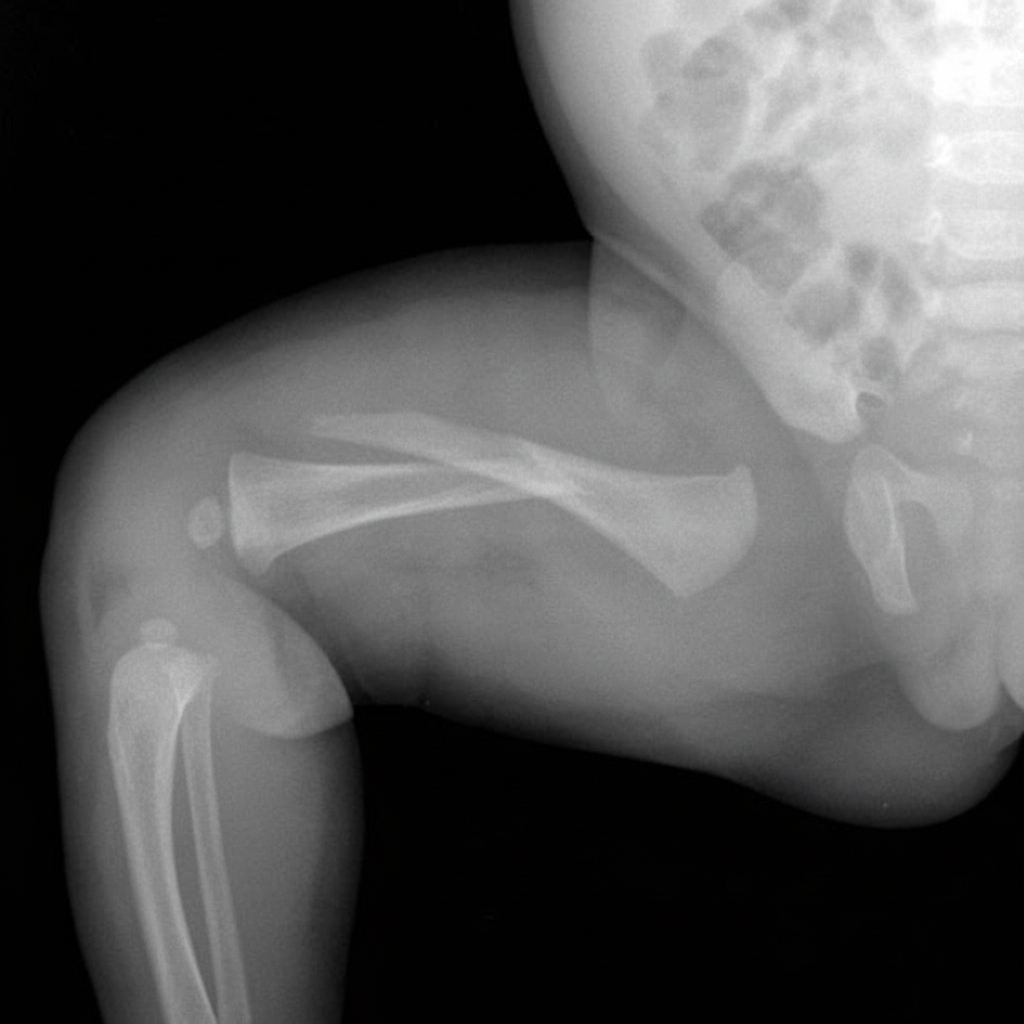
Patella commonly dislocates:
Which nerve is most commonly injured in an anterior shoulder dislocation?
What is the most common complication of a transcervical fracture of the femur?
All of the following can occur as complications of fracture of the neck of femur except?
All are features of a haemophilic knee joint, EXCEPT?
Which of the following fractures requires a direct force for its occurrence?
Which of the following are key components of fracture treatment?
Trimalleolar fracture is:
All of the following conditions can lead to genu recurvatum, except?
Bennet's fracture involves which metacarpal bone?
Explanation: **Explanation:** The patella most commonly dislocates **laterally**. This is primarily due to the **Q-angle** (Quadriceps angle), which creates a natural lateral vector of force when the quadriceps muscle contracts. Because the femur is angled medially toward the knee while the tibia remains vertical, the pull of the quadriceps tends to shift the patella outward. **Why Lateral is Correct:** Several anatomical factors predispose the patella to lateral displacement: 1. **Q-Angle:** The physiological valgus alignment of the knee. 2. **Vastus Lateralis:** This muscle is often stronger than the Vastus Medialis Obliquus (VMO), pulling the patella laterally. 3. **Laxity:** Weakness of the Medial Patellofemoral Ligament (MPFL), which is the primary stabilizer against lateral displacement. **Why other options are incorrect:** * **Medially:** Medial dislocation is extremely rare and usually iatrogenic (following over-zealous lateral release surgery) or due to direct high-energy trauma. The prominent lateral condyle of the femur acts as a physical buttress preventing medial movement. * **Superiorly/Inferiorly:** These are not "dislocations" in the clinical sense. Superior displacement (Patella Alta) or inferior displacement (Patella Baja) are positional abnormalities usually resulting from a rupture of the patellar tendon or quadriceps tendon, respectively. **High-Yield Clinical Pearls for NEET-PG:** * **Primary Stabilizer:** The **Medial Patellofemoral Ligament (MPFL)** is the most important structure torn in a lateral dislocation. * **Bony Stabilizer:** The **lateral femoral condyle** is higher/more prominent anteriorly to prevent lateral slippage. A shallow trochlear groove (trochlear dysplasia) is a major risk factor for recurrence. * **Apprehension Test (Fairbank’s Sign):** The classic clinical test where the patient becomes anxious when the examiner attempts to push the patella laterally. * **Reduction:** Usually occurs spontaneously when the knee is extended.
Explanation: **Explanation:** **1. Why Axillary Nerve is Correct:** The axillary nerve (C5-C6) is the most commonly injured nerve in anterior shoulder dislocations due to its unique anatomical course. It winds around the **surgical neck of the humerus** within the quadrangular space. When the humeral head displaces anteroinferiorly, it directly stretches or compresses the nerve against the neck of the humerus. Injury typically manifests as: * **Motor loss:** Weakness in shoulder abduction (Deltoid) and external rotation (Teres minor). * **Sensory loss:** Numbness over the lateral aspect of the upper arm, known as the **"Regimental Badge area."** **2. Why Other Options are Incorrect:** * **Radial Nerve:** Most commonly injured in **mid-shaft humerus fractures** (as it travels in the spiral groove) or Holstein-Lewis fractures. * **Ulnar Nerve:** Typically injured in fractures of the **medial epicondyle** of the humerus or elbow dislocations. * **Median Nerve:** Most frequently associated with **supracondylar fractures** of the humerus (specifically the anterior interosseous nerve branch). **3. Clinical Pearls for NEET-PG:** * **Most common type of shoulder dislocation:** Anterior (95%), specifically the subcoracoid variant. * **Associated Vascular Injury:** The **Axillary artery** is the most common vascular structure injured (especially in elderly patients with atherosclerotic vessels). * **Hill-Sachs Lesion:** A compression fracture of the posterolateral humeral head. * **Bankart Lesion:** Avulsion of the anteroinferior glenoid labrum. * **Management:** Immediate closed reduction (e.g., Kocher’s or Hippocratic method) followed by neurovascular assessment. Always check for the "Regimental Badge" sign before and after reduction.
Explanation: **Explanation:** The correct answer is **Avascular Necrosis (AVN)**. **1. Why Avascular Necrosis is the correct answer:** The femoral head's blood supply is precarious and retrograde. It primarily depends on the **medial circumflex femoral artery**, which gives off retinacular vessels that travel along the femoral neck. A transcervical (intracapsular) fracture frequently disrupts these vessels. Furthermore, the intracapsular location means the fracture is bathed in synovial fluid, which lacks pro-coagulant factors, and the resulting intracapsular pressure (tamponade) further compromises blood flow. This leads to ischemia and subsequent necrosis of the femoral head. **2. Why other options are incorrect:** * **Non-union:** While non-union is a very common complication of neck of femur fractures (due to lack of cambium layer in the periosteum and the presence of synovial fluid), **AVN occurs more frequently** and is considered the most characteristic "dreaded" complication. * **Malunion:** This is **rare** in femoral neck fractures. Because the fracture is intracapsular and the bone is cortical, it either heals in the correct position (if stabilized) or fails to heal at all (non-union). Malunion is more common in extracapsular fractures like intertrochanteric fractures. **3. NEET-PG High-Yield Pearls:** * **Garden’s Classification:** Used to assess the risk of AVN (Stage III and IV have the highest risk). * **Pauwels’ Classification:** Based on the angle of the fracture line; higher angles indicate greater shear forces and higher risk of non-union. * **Best Investigation for Early AVN:** MRI (shows changes much earlier than X-rays). * **Management Rule:** In young patients, attempt **internal fixation** (Screws/DHS) to save the head; in elderly patients, perform **replacement** (Hemiarthroplasty/THR) due to the high risk of AVN and non-union.
Explanation: **Explanation:** The correct answer is **Mal-union**. Fracture of the neck of the femur (intracapsular fracture) is notorious for its high rate of complications due to the unique anatomy of the hip joint. **Why Mal-union is the correct answer:** Mal-union (healing in a faulty position) is rare in femoral neck fractures because these fractures **seldom heal** if they are not perfectly reduced and stabilized. The fracture is bathed in synovial fluid, which contains fibrinolysins that inhibit callus formation. If the fracture does not unite perfectly, it typically progresses to **non-union** rather than healing in a deformed position. In contrast, extracapsular fractures (like intertrochanteric fractures) have a rich blood supply and heal readily, making mal-union a common complication there. **Analysis of Incorrect Options:** * **Shortening:** This is a common clinical feature and complication. It occurs due to the proximal migration of the distal fragment caused by the pull of the gluteal and iliopsoas muscles. * **Non-union:** This occurs in about 15-30% of cases. The lack of a periosteal layer (no external callus) and the presence of synovial fluid hinder the healing process. * **Avascular Necrosis (AVN):** The femoral head receives its primary blood supply from the **retinacular vessels** (branches of the medial circumflex femoral artery). A neck fracture often tears these vessels, leading to ischemia and necrosis of the head. **High-Yield Clinical Pearls for NEET-PG:** * **Pauwel’s Classification:** Based on the angle of the fracture line; higher angles (Type III) have higher risks of non-union due to shear forces. * **Garden’s Classification:** Based on the degree of displacement; used to decide between internal fixation and arthroplasty. * **Ward’s Triangle:** An area of low bone density in the neck of the femur, susceptible to fracture in osteoporotic elderly patients. * **Management Rule:** In young patients, always attempt **Internal Fixation** (Head preservation); in elderly patients, **Arthroplasty** is preferred to avoid the complications of AVN and non-union.
Explanation: In Haemophilic Arthropathy, the primary pathology is recurrent intra-articular bleeding (haemarthrosis). This leads to chronic synovitis, synovial hypertrophy, and the deposition of **haemosiderin**, which is toxic to the articular cartilage. **Why Option A is the Correct Answer:** The hallmark of haemophilic arthropathy is **Juxta-articular Osteopenia** (decreased bone density), not osteosclerosis. The chronic hyperaemia (increased blood flow) caused by persistent synovial inflammation leads to local bone resorption and thinning of the trabeculae. Osteosclerosis (thickening of bone) is typically seen in primary osteoarthritis, but in haemophilia, the bone remains osteoporotic. **Explanation of Other Options (Radiological Features):** * **Subchondral Cyst Formation (B):** Haemosiderin-induced cartilage destruction allows synovial fluid or blood to be forced into the subchondral bone under pressure, creating "geodes" or cysts. * **Widening of the Intercondylar Notch (C):** This is a classic sign. Chronic hyperaemia at the attachment sites of the cruciate ligaments leads to erosions and widening of the femoral intercondylar notch. * **Squaring of the Patella (D):** Also known as the **Jordan’s Sign**, this occurs due to premature closure of the epiphyseal plates or overgrowth of the inferior pole of the patella caused by increased blood supply to the joint. **NEET-PG High-Yield Pearls:** * **Earliest Sign:** Soft tissue swelling due to synovial thickening. * **Arnold-Hilgartner Classification:** Used to stage haemophilic arthropathy (Stage I to V). * **Target Joint:** Defined as a joint in which 3 or more spontaneous bleeds occur within a 6-month period (Knee is the most common). * **Differential Diagnosis:** Juvenile Idiopathic Arthritis (JIA) also presents with similar features like epiphyseal overgrowth and squaring of the patella, but lacks the specific history of bleeding diathesis.
Explanation: **Explanation:** The mechanism of injury in fractures is broadly classified into **direct force** (blow at the site of impact) and **indirect force** (force transmitted from a distance, such as a fall on an outstretched hand). **Why Clavicle Fracture is the Correct Answer:** The clavicle is the most commonly fractured bone in the body. While it can occur via indirect force (fall on the shoulder), it frequently results from a **direct blow** to the shoulder or the bone itself (e.g., sports injuries or road traffic accidents). In the context of this specific question, the clavicle is the most superficial bone among the options, making it highly susceptible to direct impact. **Analysis of Incorrect Options:** * **Fracture Neck of Femur (A) & Intertrochanteric Fracture (B):** These are typically injuries of the elderly resulting from **indirect force**, such as a trivial fall or a rotational trip. The force is transmitted through the long axis of the femur or via torsional stress. * **Colles Fracture (D):** This is the classic example of an **indirect force** injury. It occurs due to a **Fall On an Outstretched Hand (FOOSH)**, where the force travels from the palm through the carpal bones to the distal radius. **NEET-PG High-Yield Pearls:** * **Clavicle:** Most common site of fracture is the junction of the medial 2/3 and lateral 1/3 (the weakest point where the curvature changes). * **Colles Fracture:** Characterized by "Dinner Fork Deformity" with dorsal displacement and tilt. * **Mechanism Rule:** Most long bone fractures in the elderly (Hip, Wrist) are due to indirect force (FOOSH/Falls), whereas fractures in subcutaneous bones (Clavicle, Tibia shaft) are often due to direct impact.
Explanation: The management of fractures follows a fundamental triad often referred to as the **"Three R’s" of Fracture Treatment**. This systematic approach ensures the restoration of anatomy and function. ### 1. Why Option A is Correct: The correct sequence is **Reduction, Retention, and Rehabilitation**: * **Reduction:** This is the first step, involving the restoration of the displaced bone fragments to their normal anatomical alignment. It can be **Closed** (manual manipulation) or **Open** (surgical). * **Retention (Immobilization):** Once reduced, the fragments must be held in place to prevent displacement while healing occurs. This is achieved through external means (plaster casts, splints) or internal/external fixation. * **Rehabilitation:** This is the final, crucial phase. It involves physiotherapy and joint mobilization to prevent stiffness, muscle atrophy, and to restore the patient to their pre-injury functional state. ### 2. Why Other Options are Incorrect: * **Reunion (Options B, C, and D):** While "union" (healing of the bone) is the desired *outcome* of fracture treatment, it is a biological process, not a treatment component performed by the surgeon. The surgeon provides the environment (Reduction and Retention) for union to occur naturally. ### 3. Clinical Pearls for NEET-PG: * **Primary Goal:** The ultimate goal of fracture management is to return the injured part to maximal functional capacity. * **Emergency Rule:** Always check the **Distal Neurovascular Status** before and after any reduction maneuver. * **The 4th 'R':** In some modern texts, **Recognition** (Diagnosis via clinical exam and X-rays) is considered the "Zero-th" step before Reduction. * **High-Yield Fact:** For intra-articular fractures, **Anatomical Reduction** is mandatory to prevent early-onset secondary osteoarthritis.
Explanation: **Explanation:** A **Trimalleolar fracture** involves fractures of the medial malleolus, lateral malleolus, and the posterior lip of the tibia (often referred to as the "posterior malleolus"). * **Cotton’s Fracture (Correct Answer):** This is the eponymous name for a trimalleolar fracture. It was described by Frederic Jay Cotton in 1915. The inclusion of the posterior malleolus makes the ankle joint significantly more unstable compared to bimalleolar injuries, often requiring surgical fixation of all three components to restore the articular surface of the tibial plafond. **Analysis of Incorrect Options:** * **Pott’s Fracture:** A general term for fractures around the ankle involving at least two malleoli (bimalleolar). While often used interchangeably with ankle fractures, it specifically refers to a fracture-dislocation caused by eversion forces. * **Tillaux Fracture:** An avulsion fracture of the **anterolateral** aspect of the distal tibial epiphysis. It is caused by the pull of the anterior inferior tibiofibular ligament (AITFL) and is typically seen in adolescents during the period of growth plate closure. * **Jones Fracture:** A transverse fracture through the **base of the fifth metatarsal** (specifically at the junction of the diaphysis and metaphysis, Zone 2). It is notorious for high rates of non-union due to a watershed blood supply. **High-Yield Clinical Pearls for NEET-PG:** 1. **Lauge-Hansen Classification:** The most common system used to describe ankle fractures based on the foot position and the direction of the deforming force. 2. **Maisonneuve Fracture:** A high fibular fracture associated with a medial malleolus fracture or deltoid ligament tear; always palpate the proximal fibula in ankle injuries. 3. **Pilon Fracture:** A comminuted intra-articular fracture of the distal tibia caused by high-energy axial loading (e.g., fall from height).
Explanation: **Explanation:** **Genu recurvatum** is a deformity of the knee joint characterized by excessive hyperextension (beyond 10–15 degrees). It typically results from ligamentous laxity, muscular imbalance, or malunion of fractures around the knee. **Why Perthes Disease is the Correct Answer:** Perthes disease (Legg-Calvé-Perthes) is an idiopathic avascular necrosis of the **femoral head** in children. It primarily affects the **hip joint**, leading to a limp, pain, and restricted abduction and internal rotation. It does not involve the knee joint or the mechanical axis of the tibia/femur in a way that causes hyperextension; therefore, it is not a cause of genu recurvatum. **Analysis of Other Options:** * **Poliomyelitis:** This is a classic cause. Weakness of the quadriceps leads the patient to lock their knee in hyperextension to maintain stability during the stance phase of gait. Over time, this stretches the posterior capsule, resulting in recurvatum. * **Rheumatoid Arthritis:** Chronic inflammation leads to ligamentous laxity and joint destruction. If the posterior cruciate ligament (PCL) or posterior capsule becomes incompetent, the knee can drift into hyperextension. * **Rickets:** Nutritional deficiencies lead to softened bones. Weight-bearing on weak physes can cause anterior bowing of the femur or tibia, or a "tilting" of the tibial plateau, resulting in a recurvatum deformity. **Clinical Pearls for NEET-PG:** * **Most common cause worldwide:** Historically, Poliomyelitis (due to muscle imbalance). * **Congenital Genu Recurvatum:** Often associated with developmental dysplasia of the hip (DDH). * **Hand-to-knee gait:** Seen in Polio patients with quadriceps weakness to prevent the knee from buckling by forcing it into recurvatum. * **Osseous vs. Postural:** Rickets causes *osseous* recurvatum, while Polio causes *postural/ligamentous* recurvatum.
Explanation: **Explanation:** **Bennett’s fracture** is a specific injury defined as an **intra-articular fracture-dislocation** at the base of the **1st metacarpal** (the thumb). The fracture line separates a small, triangular volar-ulnar fragment, which remains attached to the strong anterior oblique ligament. Meanwhile, the rest of the metacarpal shaft is displaced proximally and radially by the pull of the **Abductor Pollicis Longus (APL)** muscle. This instability makes it a classic "fracture-dislocation." **Why other options are incorrect:** * **2nd and 3rd Metacarpals:** These bones are relatively fixed at the carpo-metacarpal joints and are not associated with Bennett’s or Rolando’s fractures. Fractures here are usually shaft or neck fractures. * **4th and 5th Metacarpals:** Fractures of the neck of the 5th (and sometimes 4th) metacarpal are known as **Boxer’s fractures**, typically caused by a direct blow with a clenched fist. **High-Yield Clinical Pearls for NEET-PG:** 1. **Rolando Fracture:** A comminuted (T or Y-shaped) intra-articular fracture at the base of the 1st metacarpal. It carries a worse prognosis than Bennett's. 2. **Mechanism:** Usually caused by axial loading along the longitudinal axis of the thumb (e.g., a punch or a fall). 3. **Treatment:** Because it is inherently unstable due to the pull of the APL, it often requires **Closed Reduction and Internal Fixation (CRIF)** with K-wires or Open Reduction (ORIF). 4. **Gamekeeper’s/Skier’s Thumb:** An injury to the **Ulnar Collateral Ligament (UCL)** of the 1st metacarpophalangeal (MCP) joint, not the metacarpal base.
Principles of Fracture Management
Practice Questions
Upper Limb Fractures
Practice Questions
Lower Limb Fractures
Practice Questions
Spinal Trauma
Practice Questions
Pelvic and Acetabular Fractures
Practice Questions
Open Fractures
Practice Questions
Fractures in Children
Practice Questions
Fracture Complications
Practice Questions
Nonunion and Malunion
Practice Questions
Polytrauma Management
Practice Questions
Joint Dislocations
Practice Questions
Soft Tissue Injuries
Practice Questions
Get full access to all questions, explanations, and performance tracking.
Start For Free