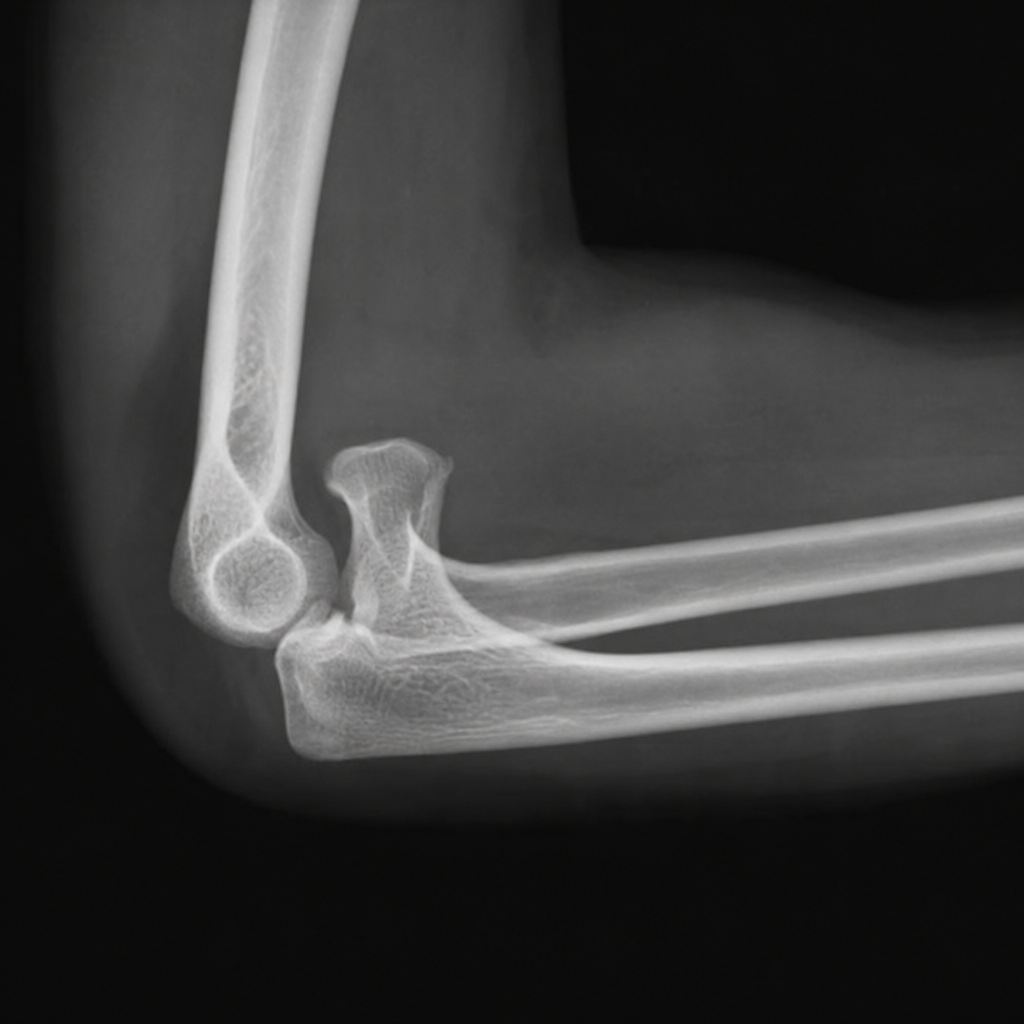
"Dinner-fork" deformity is seen in which fracture?
AP and lateral views of the wrist are provided. What is the diagnosis?

Volkmann's Ischaemic Contracture is due to which of the following?
All of the following are true about the clavicle, except:
Stress fracture is treated by:
The Lachman test is positive in which of the following conditions?
In some old fractures, cartilaginous tissue forms over the fractured bone end with a cavity in between containing clear fluid. What is this condition called?
Which of the following nerves is most commonly damaged during a wrist slash injury?
What is the most reliable test for an acutely injured knee in a 27-year-old athlete?
A 20-year-old male presents with anterior shoulder dislocation. This injury is usually caused as a combination of which of the following?
Explanation: **Explanation:** The **"Dinner-fork" deformity** is the classic clinical presentation of a **Colles’ fracture**, which is a fracture of the **distal end of the radius**. 1. **Why Radius is Correct:** A Colles’ fracture occurs approximately 2.5 cm proximal to the wrist joint, typically due to a fall on an outstretched hand (FOOSH). The characteristic deformity is caused by the **dorsal (posterior) displacement** and dorsal tilt of the distal radial fragment. This creates a silhouette resembling an upside-down dinner fork when viewed from the side. 2. **Why other options are incorrect:** * **Ulna:** While the ulnar styloid is often fractured concurrently in a Colles' injury, the primary deformity is defined by the radial displacement. Isolated ulnar fractures (like a Nightstick fracture) do not produce this shape. * **Humerus:** Supracondylar fractures of the humerus may cause an S-shaped deformity or "gunstock" deformity (cubitus varus), but not a dinner-fork appearance. * **Clavicle:** Clavicular fractures typically present with a drooping shoulder and visible bony prominence, but no specific named "fork" deformity. **NEET-PG High-Yield Pearls:** * **Colles’ Fracture:** Distal fragment is displaced **Dorsally**. (Mnemonic: **D**inner fork = **D**orsal). * **Smith’s Fracture:** Also known as a "Reverse Colles," where the distal fragment is displaced **Ventrally/Volarly**, leading to a **"Garden-spade" deformity**. * **6 Classic Displacements in Colles’:** Dorsal displacement, Dorsal tilt, Lateral displacement, Lateral tilt, Impaction, and Supination. * **Treatment:** Most are managed by closed reduction and a "Colles' cast" (below-elbow cast with the wrist in slight flexion and ulnar deviation).
Explanation: ***Galeazzi fracture*** - Characterized by a **fracture of the distal third of the radius** with **dislocation of the distal radioulnar joint (DRUJ)**. - **Mnemonic**: "**GRU**" - **G**aleazzi involves **R**adial fracture with **U**lnar dislocation at the wrist. *Monteggia fracture* - Involves **fracture of the ulnar shaft** with **dislocation of the radial head** at the elbow. - **Mnemonic**: "**MURL**" - **M**onteggia involves **U**lnar fracture with **R**adial dislocation at the e**L**bow. *Smith fracture* - **Volarly angulated distal radius fracture** (reverse of Colles), often called "**reverse Colles fracture**". - Results from **flexion mechanism** and shows **volar displacement** of the distal fragment on lateral view. *Colles fracture* - **Dorsally angulated distal radius fracture** with **dorsal displacement** of the distal fragment. - Shows classic **dinner fork deformity** clinically and **dorsal angulation** on lateral X-ray view.
Explanation: **Explanation:** **Volkmann’s Ischaemic Contracture (VIC)** is the permanent end-stage sequela of an untreated or inadequately treated **Acute Compartment Syndrome**, most commonly following a Supracondylar fracture of the humerus in children. 1. **Why Option D is Correct:** The primary pathology is **ischaemic necrosis of the forearm muscles** (specifically the deep flexor compartment). When tissue pressure within the osteofascial compartment exceeds capillary perfusion pressure, it leads to muscle infarction. The infarcted muscle is eventually replaced by **fibrous tissue**, which undergoes contraction, leading to the characteristic deformities. The **Flexor Digitorum Profundus (FDP)** and **Flexor Pollicis Longus (FPL)** are the most commonly affected muscles. 2. **Why Other Options are Incorrect:** * **Options A & B:** While nerve palsies (Median and Ulnar) can occur as a secondary result of ischaemia or compression within the compartment, they are not the *cause* of the contracture. The contracture itself is a myogenic process (muscle fibrosis). * **Option C:** Contracture of the palmar fascia refers to **Dupuytren’s Contracture**, a completely different fibroproliferative condition unrelated to ischaemia. **Clinical Pearls for NEET-PG:** * **Characteristic Deformity:** Wrist flexion, MCP joint hyperextension, and IP joint flexion (Claw-like hand). * **Volkmann’s Sign:** Passive extension of the fingers is restricted and painful when the wrist is kept extended; however, fingers can be extended if the wrist is flexed (as this relaxes the fibrotic flexor tendons). * **Earliest Sign:** Pain on passive stretching of the affected muscles (out of proportion to the injury). * **Infant/Neonatal VIC:** Usually presents as a sentinel skin lesion (bullae/eschar) at birth.
Explanation: The clavicle is a unique bone with several high-yield anatomical and clinical characteristics. This question tests the distinction between anatomical facts and clinical management. ### **Explanation of the Correct Answer (A)** Option **A** is the "except" (incorrect statement) because clavicle fractures **do require treatment**, even if it is non-surgical. While most fractures are managed conservatively, they require more than just "rest." Standard treatment involves immobilization using a **Figure-of-8 bandage** or a **triangular broad arm sling** for 3–6 weeks to provide stability, reduce pain, and facilitate union. Complete lack of treatment can lead to symptomatic malunion or non-union. ### **Analysis of Incorrect Options (True Statements)** * **B. Breaks at the midpoint:** This is true. The junction of the medial two-thirds and lateral one-third is the weakest point of the bone because it is where the curvature changes. Approximately 80% of clavicle fractures occur here. * **C. First bone to ossify:** This is a classic embryological fact. The clavicle is the first bone in the human body to begin ossification (around the 5th–6th week of intrauterine life). * **D. Ossifies in membrane:** Unlike most long bones that undergo endochondral ossification, the clavicle undergoes **intramembranous ossification** (except for its ends). ### **NEET-PG High-Yield Pearls** * **Unique Features:** It is the only long bone that lies horizontally, has no medullary cavity, and is the only long bone to ossify in membrane. * **Nerve Injury:** The most common nerve structure at risk in displaced fractures is the **Brachial Plexus** (specifically the divisions). * **Surgical Indications:** Surgery (ORIF with plate) is indicated for open fractures, neurovascular injury, skin tenting, or significant shortening (>2 cm). * **Most Common Site of Non-union:** The lateral third (Type II Neer fractures).
Explanation: **Explanation:** **Stress fractures** (also known as fatigue fractures) occur due to repetitive submaximal loading on a bone, where the rate of bone resorption by osteoclasts exceeds the rate of bone formation by osteoblasts. 1. **Why Cast Immobilization is Correct:** While minor stress fractures in non-weight-bearing bones may sometimes be managed with rest alone, the standard orthopedic management for a confirmed stress fracture—especially in weight-bearing bones (like the tibia or metatarsals)—is **Cast Immobilization**. This provides rigid stabilization, eliminates the repetitive mechanical strain, and prevents the progression of a "stress reaction" into a complete cortical break or displaced fracture. 2. **Why Other Options are Incorrect:** * **Rest:** While "activity modification" is part of the treatment, simple rest without immobilization is often insufficient for high-risk stress fractures and may lead to non-union or recurrence. * **Closed Reduction:** This is used for displaced fractures to restore anatomical alignment. Stress fractures are, by definition, non-displaced micro-cracks; therefore, there is no displacement to "reduce." * **Internal Fixation:** This is a second-line treatment reserved only for "high-risk" stress fractures (e.g., tension side of the femoral neck, Jones fracture, or navicular bone) that have failed conservative management. **NEET-PG High-Yield Pearls:** * **Most common site:** Tibia (overall), followed by the 2nd and 3rd metatarsals (**March Fracture**). * **Imaging:** X-rays are often negative in the first 2–3 weeks. **MRI** is the gold standard and the most sensitive investigation for early detection (shows marrow edema). * **Triple Phase Bone Scan:** Shows "hot spots" but is less specific than MRI. * **Female Athlete Triad:** Disordered eating, amenorrhea, and osteoporosis are major risk factors for stress fractures.
Explanation: **Explanation:** The **Lachman test** is the most sensitive and reliable clinical test for diagnosing an **Anterior Cruciate Ligament (ACL) injury**. It is performed with the knee in 20–30 degrees of flexion. The examiner stabilizes the femur with one hand and applies an anterior force to the proximal tibia with the other. A positive result is indicated by increased anterior translation of the tibia compared to the healthy side and the absence of a firm "end-point." **Why the other options are incorrect:** * **Posterior Cruciate Ligament (PCL) injury:** This is assessed using the **Posterior Drawer Test** or the **Sag Sign** (Godfrey’s test), where the tibia moves posteriorly relative to the femur. * **Medial and Lateral Meniscus injuries:** These are evaluated using provocative rotation maneuvers such as **McMurray’s test**, **Apley’s Grinding test**, or the **Thessaly test**. These tests aim to elicit joint line pain or a "click" rather than ligamentous laxity. **High-Yield Clinical Pearls for NEET-PG:** * **Gold Standard Clinical Test:** While the Anterior Drawer test also checks for ACL integrity, the **Lachman test** is superior because, at 20–30° flexion, the hamstrings are relaxed and the secondary stabilizers (menisci) do not interfere with the movement. * **Pivot Shift Test:** This is the most **specific** clinical test for ACL deficiency (indicates anterolateral rotatory instability). * **Imaging:** **MRI** is the investigation of choice for ACL and meniscal tears. * **Unhappy Triad (O'Donoghue):** Includes injury to the ACL, Medial Collateral Ligament (MCL), and Medial Meniscus (though recent studies suggest the Lateral Meniscus is more commonly involved in acute ACL tears).
Explanation: **Explanation:** The correct answer is **Pseudoarthrosis** (Option D). **1. Why Pseudoarthrosis is correct:** Pseudoarthrosis, or "false joint," is a specific type of nonunion where the body fails to bridge the fracture gap with bone. Instead, persistent motion at the fracture site leads to the formation of a **fibrocartilaginous cap** over the bone ends. Over time, a **synovial-like cavity** develops between these ends, filled with clear fluid (synovial fluid). This mimics the structure of a true joint, hence the name. It is most commonly seen in fractures of the humeral shaft or the scaphoid where there is excessive mobility. **2. Why other options are incorrect:** * **Delayed Union (A) & Slow Union (B):** These terms refer to a fracture that is taking longer than the expected time to heal but still shows signs of progressing toward union. The biological process of repair is active, and no "false joint" has formed. * **Nonunion (C):** This is a broad category where the fracture fails to heal. While pseudoarthrosis is a *type* of nonunion, "Nonunion" itself is a general term that includes both atrophic (no callus) and hypertrophic (elephant foot) varieties. The specific description of a **fluid-filled cavity and cartilaginous ends** is the hallmark definition of Pseudoarthrosis. **Clinical Pearls for NEET-PG:** * **Radiological Sign:** In pseudoarthrosis, the medullary canal is often **obliterated (sealed)** by sclerotic bone at the fracture ends. * **Common Sites:** Scaphoid, Femoral neck, and Humeral shaft. * **Congenital Pseudoarthrosis:** Most commonly affects the **Tibia** and is strongly associated with **Neurofibromatosis Type 1**. * **Treatment:** Usually requires surgical intervention, including freshening of bone ends, internal fixation, and bone grafting.
Explanation: **Explanation:** In a wrist slash injury (often seen in suicidal attempts or accidental trauma), the **Median nerve** is the most commonly injured nerve. This is due to its relatively superficial anatomical position at the level of the wrist, where it lies just deep to the palmaris longus tendon and between the flexor carpi radialis and flexor digitorum superficialis. **Why the other options are incorrect:** * **Ulnar nerve:** While frequently injured in deep lacerations, it is situated more medially and is partially protected by the flexor carpi ulnaris tendon and the pisiform bone. * **Radial nerve:** The main trunk of the radial nerve does not cross the volar (palmar) aspect of the wrist. Only its superficial sensory branch is present laterally, but it is less frequently the primary nerve involved in transverse slash injuries compared to the median nerve. * **Palmar cutaneous branch of the median nerve:** This branch arises proximal to the wrist and stays superficial to the flexor retinaculum. While it can be damaged, the question asks for the nerve most commonly damaged; the main trunk of the median nerve is the standard clinical answer for these injuries. **NEET-PG High-Yield Pearls:** * **Clinical Presentation:** Injury at the wrist (low median nerve palsy) leads to **"Ape Thumb Deformity"** due to paralysis of the thenar muscles (Opponens pollicis, Abductor pollicis brevis, and Flexor pollicis brevis). * **Sensory Loss:** Occurs over the lateral 3.5 fingers. * **The "Million Dollar Nerve":** The recurrent motor branch of the median nerve is often called this because its injury results in the loss of thumb opposition, a major disability. * **Test of Choice:** The **Pen Test** (testing Abductor Pollicis Brevis) is used to assess motor function of the median nerve at the thumb.
Explanation: **Explanation:** The **Lachman test** is the most sensitive and reliable clinical test for diagnosing an acute **Anterior Cruciate Ligament (ACL)** injury. In an acutely injured knee, pain and protective muscle guarding (hamstring spasm) often prevent the knee from being flexed to 90°, making other tests difficult to perform. The Lachman test is performed at **20–30° of flexion**, which minimizes the stabilizing effect of the secondary restraints (like the posterior horn of the medial meniscus) and reduces muscle guarding, allowing for a more accurate assessment of anterior tibial translation. **Analysis of Incorrect Options:** * **Anterior Drawer Test:** Performed at 90° of flexion. In acute injuries, hemarthrosis and hamstring spasms often lead to false-negative results. It is more useful in chronic cases. * **Posterior Drawer Test:** This is the most sensitive test for **Posterior Cruciate Ligament (PCL)** injuries, not ACL injuries. * **Steinmann Test:** This is used to clinical diagnose **Meniscal injuries** (specifically the Steinmann I and II tests for displaced tenderness), not ligamentous laxity. **High-Yield Clinical Pearls for NEET-PG:** * **Gold Standard Investigation:** MRI is the investigation of choice for ACL tears, but the Lachman test remains the most reliable clinical bedside test. * **Pivot Shift Test:** This is the most **specific** test for ACL deficiency and indicates rotatory instability, but it is often difficult to perform in an acute setting without anesthesia due to patient guarding. * **Segond Fracture:** A cortical avulsion fracture of the lateral tibial condyle; it is pathognomonic for an ACL tear. * **Unhappy Triad (O'Donoghue):** Includes injury to the ACL, Medial Collateral Ligament (MCL), and Medial Meniscus (though recent studies suggest the Lateral Meniscus is more commonly involved in acute settings).
Explanation: ### **Explanation** The shoulder joint is the most commonly dislocated joint in the body, with **anterior dislocation** accounting for over 95% of cases. **1. Why Abduction and External Rotation is Correct:** The mechanism of injury typically involves a fall on an outstretched hand or a direct blow to the arm when it is in a position of **abduction, external rotation, and extension**. In this position, the humeral head is levered out of the glenoid cavity, pushing against the relatively weak anterior capsule and glenohumeral ligaments. This "throwing motion" position puts maximum stress on the anterior stabilizers, leading to the displacement of the humeral head anteriorly and inferiorly. **2. Why the Other Options are Incorrect:** * **Adduction and Internal Rotation (Option D):** This is the classic mechanism for **Posterior Shoulder Dislocation**. It often occurs during seizures or electric shocks, where the powerful internal rotators (Latissimus dorsi, Pectoralis major) overpower the external rotators. * **Abduction and Internal Rotation (Option C):** This position is biomechanically stable for the anterior capsule and is not a recognized mechanism for primary dislocation. * **Adduction and External Rotation (Option B):** This position does not provide the necessary leverage to force the humeral head out of the glenoid labrum. **3. High-Yield Clinical Pearls for NEET-PG:** * **Most common type:** Subcoracoid (a subtype of anterior dislocation). * **Associated Nerve Injury:** **Axillary nerve** (tested by checking sensation over the "Regimental Badge" area). * **Radiological Signs:** **Hill-Sachs lesion** (compression fracture of the posterolateral humeral head) and **Bankart lesion** (avulsion of the anteroinferior glenoid labrum). * **Classic Sign:** Flattening of the shoulder contour (loss of rounded appearance) and positive **Dugas Test**.
Principles of Fracture Management
Practice Questions
Upper Limb Fractures
Practice Questions
Lower Limb Fractures
Practice Questions
Spinal Trauma
Practice Questions
Pelvic and Acetabular Fractures
Practice Questions
Open Fractures
Practice Questions
Fractures in Children
Practice Questions
Fracture Complications
Practice Questions
Nonunion and Malunion
Practice Questions
Polytrauma Management
Practice Questions
Joint Dislocations
Practice Questions
Soft Tissue Injuries
Practice Questions
Get full access to all questions, explanations, and performance tracking.
Start For Free