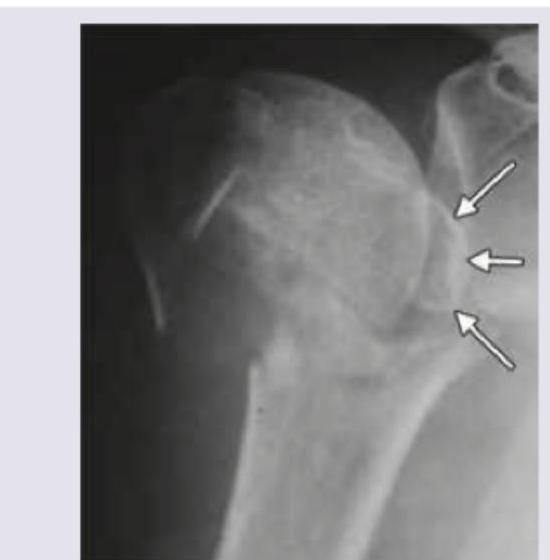
Increased intercondylar distance is seen in fracture of all except:
Tinel's sign is used to assess what?
Deformity with decreased carrying angle is:
Which type represents a true supracondylar fracture of the femur?
What is the most common elbow injury in adolescents?
Which of the following is NOT a feature of fat embolism?
Gallows traction is used in the management of fracture of which bone shaft?
The Gustilo-Anderson classification is used for which type of fracture?
A 6-year-old female child presented with a valgus deformity of the right elbow that has been gradually progressive over 2 years. She also experiences tingling in her ulnar one and a half fingers. Two years prior, she had a cast applied for 6 weeks following a fall on an outstretched hand. What is the probable fracture?
What is Jones fracture?
Explanation: **Explanation:** The **intercondylar distance** refers to the width between the medial and lateral humeral condyles. An increase in this distance occurs when a fracture line separates the condyles from each other or from the humeral shaft, causing them to splay apart. **1. Why Olecranon is the correct answer:** The **Olecranon** is part of the proximal **ulna**, not the humerus. A fracture of the olecranon involves the joint surface of the elbow but does not disrupt the anatomical relationship or the distance between the medial and lateral condyles of the humerus. Therefore, the intercondylar distance remains unchanged. **2. Analysis of incorrect options:** * **Medial/Lateral Epicondyle & Condyle Fractures:** These are components of the distal humerus. In fractures involving these structures (especially T-shaped or Y-shaped intercondylar fractures), the bony fragments are displaced by the pull of the forearm muscles (flexors from the medial side, extensors from the lateral side). This muscle pull causes the fragments to diverge, leading to a measurable **increase in intercondylar width**. **High-Yield Clinical Pearls for NEET-PG:** * **Three-Point Bony Relationship:** In an extended elbow, the medial epicondyle, lateral epicondyle, and the tip of the olecranon form a straight line. In a flexed elbow (90°), they form an **isosceles triangle**. * **Supracondylar Fracture:** This is an extra-articular fracture; therefore, the three-point relationship remains **maintained**, and the intercondylar distance is **normal**. * **Elbow Dislocation:** The three-point relationship is **disturbed**, which helps clinically differentiate it from a supracondylar fracture. * **Milch Classification:** Used specifically for fractures of the lateral condyle of the humerus.
Explanation: **Explanation:** **Tinel’s sign** (or the Hoffmann-Tinel sign) is a clinical test used to identify regenerating axonal sprouts. It is elicited by percussing along the course of a damaged nerve. A positive sign is characterized by a "pins and needles" or tingling sensation in the cutaneous distribution of the nerve. 1. **Why Nerve Regeneration is Correct:** Following a nerve injury, axons undergo Wallerian degeneration. As the nerve heals, new axons sprout from the proximal stump and grow distally (typically at a rate of **1 mm/day**). These immature, regenerating axons are hypersensitive to mechanical stimulation. If percussion over the nerve trunk distal to the site of injury produces tingling, it indicates that regenerating fibers have reached that specific point. A "distally progressing" Tinel’s sign is a strong clinical indicator of active nerve recovery. 2. **Why Other Options are Incorrect:** * **Spinal shock:** This is a physiological state of loss of all reflex activity below the level of a spinal cord injury; it is assessed via the Bulbocavernosus reflex. * **Severity/Type of nerve damage:** Tinel’s sign does not distinguish between Seddon’s classifications (Neuropraxia, Axonotmesis, or Neurotmesis) at the time of injury. In fact, a positive Tinel’s sign can occur in both Axonotmesis (good prognosis) and Neurotmesis (requires surgery), though it will not "advance" in the latter. **High-Yield Clinical Pearls for NEET-PG:** * **Rate of Nerve Growth:** 1 mm per day (or 1 inch per month). * **Tinel’s vs. Phalen’s:** While Tinel’s is used for regeneration, it is also used to diagnose **Carpal Tunnel Syndrome** (compression of the Median nerve), though Phalen’s test is more sensitive. * **Wartenberg’s Sign:** Specific for Ulnar nerve palsy (abduction of the little finger). * **Froment’s Sign:** Specific for Adductor Pollicis paralysis (Ulnar nerve).
Explanation: **Explanation:** The **carrying angle** is the lateral deviation of the forearm in relation to the long axis of the humerus when the arm is in the anatomical position (extended and supinated). The normal carrying angle is approximately **10–15°** (slightly more in females). 1. **Cubitus Varus (Correct Answer):** When the carrying angle **decreases** or becomes negative, the forearm deviates toward the midline of the body. This is known as Cubitus varus. Because of its characteristic appearance, it is clinically referred to as the **"Gunstock deformity."** It is the most common late complication of a malunited **Supracondylar fracture of the humerus**. 2. **Cubitus Valgus:** This occurs when the carrying angle **increases** (forearm deviates further away from the body). It is commonly seen following a malunited fracture of the **Lateral Condyle of the humerus**. A high-yield complication of this deformity is **Tardy Ulnar Nerve Palsy**. 3. **Mannus Varus/Valgus:** These terms refer to deformities of the **hand/wrist** (*Manus* = Hand), not the elbow. Mannus varus involves a medial deviation of the hand, while Mannus valgus involves a lateral deviation. **High-Yield Clinical Pearls for NEET-PG:** * **Supracondylar Fracture:** Most common cause of Cubitus varus. * **Lateral Condyle Fracture:** Most common cause of Cubitus valgus. * **Gunstock Deformity:** Another name for Cubitus varus. * **Tardy Ulnar Nerve Palsy:** Associated with Cubitus valgus due to the chronic stretching of the ulnar nerve around the medial epicondyle.
Explanation: This question refers to the **AO/OTA Classification** of fractures, which is the gold standard for categorizing long bone injuries in orthopaedics. ### **Explanation of the Correct Answer** **Type A** fractures are defined as **extra-articular** fractures. In the context of the distal femur, a "true" supracondylar fracture is one where the fracture line occurs above the femoral condyles without extending into the knee joint surface. Because Type A fractures involve the metaphysis but spare the joint entirely, they represent the classic definition of a supracondylar fracture. ### **Analysis of Incorrect Options** * **Type B (Partial Articular):** These involve only a part of the articular surface (e.g., a unicondylar fracture like a Hoffa fracture). One condyle remains attached to the shaft, so it is not a true supracondylar (above-condyle) pattern. * **Type C (Complete Articular):** These are **intercondylar** fractures (often T or Y-shaped). The fracture line extends between the condyles and separates them from the diaphysis. While they involve the supracondylar area, they are classified as intra-articular injuries. * **Type D:** This is not a standard category in the AO classification for distal femoral fractures (which uses A, B, and C). ### **NEET-PG High-Yield Pearls** * **Deforming Forces:** In supracondylar fractures, the distal fragment is typically **tilted posteriorly** due to the pull of the **Gastrocnemius** muscle. This poses a high risk of injury to the **Popliteal artery**. * **Classification System:** Remember the AO mnemonic: **A** = Extra-articular, **B** = Partial articular, **C** = Complete articular. * **Hoffa Fracture:** A specific Type B fracture involving a coronal plane fracture of the femoral condyle (usually lateral). * **Management:** Most adult supracondylar fractures require ORIF (Open Reduction Internal Fixation) using a Distal Femoral Nail (DFN) or a Locking Compression Plate (LCP).
Explanation: **Explanation:** In adolescents, the **physeal (growth) plate** is the weakest link in the musculoskeletal system. While ligaments and tendons are relatively strong, the hypertrophic zone of the physis is structurally vulnerable to shear and tension forces. During the adolescent growth spurt, the physis is particularly susceptible to injury before it undergoes complete ossification. Therefore, trauma that would cause a ligamentous sprain in an adult or a greenstick fracture in a younger child typically results in a **physeal injury** (often classified by the Salter-Harris system) in adolescents. **Analysis of Incorrect Options:** * **A. Dislocation:** While elbow dislocations do occur, they are more common in young adults after the growth plates have fused. In adolescents, the bone usually fails at the physis before the joint capsule or ligaments give way. * **C. Supracondylar fracture:** This is the most common elbow fracture in **children** (peak age 5–8 years). By adolescence, the distal humerus has remodeled and strengthened, making this injury less frequent than physeal disruptions. * **D. Olecranon fracture:** These are relatively rare in the pediatric and adolescent population, usually associated with direct trauma or underlying conditions like osteogenesis imperfecta. **Clinical Pearls for NEET-PG:** * **CRITOE:** Remember the order of ossification center appearance: **C**apitellum (1y), **R**adial head (3y), **I**nternal/Medial epicondyle (5y), **T**rochlea (7y), **O**lecranon (9y), **E**xternal/Lateral epicondyle (11y). * **Little League Elbow:** A common adolescent overuse injury involving the medial epicondyle physis. * **Salter-Harris Type II** is the most common type of physeal injury overall.
Explanation: **Explanation:** Fat Embolism Syndrome (FES) typically follows fractures of long bones (like the femur) or pelvic fractures. The pathophysiology involves the release of fat globules from the bone marrow into the systemic circulation, leading to mechanical obstruction and a secondary inflammatory response. **Why Hypotension is the correct answer:** Fat Embolism is characterized by a classic triad of **Respiratory distress, Neurological symptoms, and Petechial rashes.** While FES affects the pulmonary vasculature, it typically presents with **normotension or hypertension** (due to sympathetic overactivity). Hypotension is not a standard feature of FES; its presence should instead raise suspicion for **hypovolemic shock** (due to blood loss from the fracture itself) or a massive pulmonary embolism. **Analysis of Incorrect Options:** * **Tachycardia & Tachypnoea:** These are the earliest and most common signs. They occur as a compensatory response to pulmonary micro-vascular obstruction and the resulting hypoxia (V/Q mismatch). * **Petechial Rashes:** This is a pathognomonic sign, usually appearing 24–72 hours after injury. They are typically found in a "vest-like" distribution (chest, axilla, neck, and conjunctiva) due to fat globules obstructing dermal capillaries. **High-Yield Pearls for NEET-PG:** * **Gurd’s Criteria:** Used for diagnosis. Major criteria include axillary/subconjunctival petechiae, hypoxemia ($PaO_2 < 60$ mmHg), and CNS depression. * **Snowstorm Appearance:** The characteristic finding on a Chest X-ray (diffuse bilateral pulmonary infiltrates). * **Treatment:** Primarily supportive (Oxygenation/Ventilation). Early stabilization and internal fixation of fractures are the best preventive measures. * **Free Fatty Acids:** The biochemical theory suggests that lipase breaks down neutral fat into toxic free fatty acids, causing endothelial damage (ARDS).
Explanation: **Explanation:** **Gallows traction** (also known as Bryant’s traction) is a specific type of skin traction used primarily for the management of **femur shaft fractures** in young children. **Why Femur is Correct:** The underlying principle involves suspending the child’s lower limbs vertically using skin traction applied to both legs. The legs are hoisted such that the **buttocks are just lifted off the bed**. This uses the child’s own body weight as counter-traction to align the femoral fragments. It is specifically indicated for children **under 2 years of age** (or weighing less than 12–15 kg) because their light body weight allows for effective traction without compromising peripheral circulation. **Why Other Options are Incorrect:** * **Tibia:** Fractures here in children are usually managed with closed reduction and casting (above-knee or below-knee casts). * **Humerus:** Pediatric humeral shaft fractures are typically treated with U-slabs, hanging casts, or simple immobilization. * **Ulna:** Forearm fractures are managed via closed reduction and "well-molded" POP casts. Traction is not a standard modality for upper limb shaft fractures in this age group. **High-Yield Clinical Pearls for NEET-PG:** 1. **Age/Weight Limit:** Crucial for the exam—used for children <2 years or <15 kg. 2. **Position:** Both legs are suspended, even if only one is fractured, to maintain stability and prevent rotation. 3. **Complication:** The most serious risk is **vascular compromise** (ischemia). Frequent checks of the dorsalis pedis pulse and capillary refill are mandatory. 4. **Alternative:** For children older than 2 years with femur fractures, **Thomas Splint** or immediate spica casting is preferred.
Explanation: **Explanation:** The **Gustilo-Anderson classification** is the most widely used system for grading **open (compound) fractures**. It is designed to assess the severity of soft tissue injury, the degree of contamination, and the energy of the mechanism, which helps in predicting the risk of infection and guiding surgical management. * **Type I:** Clean wound <1 cm; minimal soft tissue damage. * **Type II:** Wound 1–10 cm; moderate soft tissue damage. * **Type III:** Wound >10 cm or high-energy trauma (includes segmental fractures, farm injuries, or vascular injuries). * **IIIA:** Adequate soft tissue coverage of the bone. * **IIIB:** Extensive soft tissue loss; requires a flap for coverage. * **IIIC:** Associated with arterial injury requiring repair. **Analysis of Incorrect Options:** * **B. Closed fractures:** These are classified using systems like the **Tscherne classification**, which focuses on internal soft tissue edema and compartment pressure. * **C. Distal end radius fractures:** These are specifically classified using the **Frykman** or **Fernandez** systems. * **D. Femur head fractures:** These are classified using the **Pipkin classification**. **Clinical Pearls for NEET-PG:** * **Antibiotic Choice:** Type I/II usually require 1st generation cephalosporins; Type III requires the addition of an aminoglycoside. * **Golden Period:** Debridement should ideally occur within 6–8 hours to minimize infection risk. * **High-Yield Fact:** Any open fracture sustained in a **farm/soil environment** is automatically classified as **Type IIIA** regardless of wound size due to high contamination.
Explanation: ### Explanation The clinical presentation of a progressive **cubitus valgus** deformity following a remote history of trauma in a child is a classic hallmark of a **Lateral Condyle Humerus Fracture**. **1. Why Lateral Condyle Humerus Fracture is correct:** Lateral condyle fractures are intra-articular and often involve the growth plate (physeal injury). If the fracture is missed or fails to unite (non-union), the lateral side of the distal humerus stops growing while the medial side continues. This asymmetric growth leads to a progressive **cubitus valgus** deformity. Over time, this deformity stretches the ulnar nerve as it passes behind the medial epicondyle, leading to **Tardy Ulnar Nerve Palsy** (tingling in the ulnar 1.5 fingers), exactly as described in the case. **2. Why the other options are incorrect:** * **Supracondylar humerus fracture:** This is the most common pediatric elbow fracture. Malunion typically results in **cubitus varus** (Gunstock deformity), not valgus. It rarely causes tardy ulnar nerve palsy. * **Posterior dislocation of the elbow:** While it can cause acute neurovascular injury, it does not typically lead to progressive growth-related valgus deformity. * **Medial condyle humerus fracture:** These are rare. If they result in growth arrest, they would lead to **cubitus varus**, not valgus. **3. Clinical Pearls for NEET-PG:** * **Lateral Condyle Fracture:** Known as the "Fracture of Necessity" because it often requires ORIF due to the pull of extensor muscles causing displacement. * **Milch Classification:** Used to classify these fractures based on the fracture line relative to the trochlear groove. * **Tardy Ulnar Nerve Palsy:** The most common late complication of lateral condyle non-union. Treatment involves ulnar nerve transposition. * **Non-union:** This is the most common complication of lateral condyle fractures due to the bathing of the fracture line in synovial fluid and the poor blood supply.
Explanation: **Explanation:** A **Jones fracture** is a specific transverse fracture occurring at the **base of the 5th metatarsal**, specifically at the metaphyseal-diaphyseal junction (Zone 2). This area is clinically significant because it is a "watershed area" with a precarious blood supply, making these fractures prone to delayed union or non-union. It typically occurs due to a forceful adduction of the forefoot while the ankle is plantar-flexed. **Analysis of Options:** * **Option A (Correct):** Jones fracture occurs at the base of the 5th metatarsal. It must be distinguished from a Pseudo-Jones (avulsion) fracture, which occurs more proximally at the tuberosity (Zone 1). * **Option B:** Fractures of the base of the 2nd metatarsal are often associated with **Lisfranc injuries** (tarsometatarsal joint dislocation), as the 2nd metatarsal base acts as the "keystone" of the foot arch. * **Option C:** A fracture of the base of the 1st metacarpal (thumb) is known as a **Bennett’s fracture** (if intra-articular) or a **Rolando fracture** (if comminuted). * **Option D:** A fracture of the head/neck of the 5th metacarpal is known as a **Boxer’s fracture**, commonly caused by striking an object with a closed fist. **High-Yield Clinical Pearls for NEET-PG:** 1. **Classification:** 5th metatarsal base fractures are divided into three zones: * **Zone 1:** Avulsion fracture (Pseudo-Jones) – most common. * **Zone 2:** Jones fracture – high risk of non-union. * **Zone 3:** Stress fracture – common in athletes. 2. **Management:** Jones fractures often require non-weight-bearing casts for 6–8 weeks or internal fixation (intramedullary screw) in athletes to prevent non-union. 3. **Mechanism:** Inversion injury of the foot.
Principles of Fracture Management
Practice Questions
Upper Limb Fractures
Practice Questions
Lower Limb Fractures
Practice Questions
Spinal Trauma
Practice Questions
Pelvic and Acetabular Fractures
Practice Questions
Open Fractures
Practice Questions
Fractures in Children
Practice Questions
Fracture Complications
Practice Questions
Nonunion and Malunion
Practice Questions
Polytrauma Management
Practice Questions
Joint Dislocations
Practice Questions
Soft Tissue Injuries
Practice Questions
Get full access to all questions, explanations, and performance tracking.
Start For Free