A patient develops compartment syndrome (swelling, pain, and numbness) following manipulation and plaster for a fracture of both bones of the leg. What is the best treatment?
Which anatomical compartment is involved in De Quervain's tenosynovitis?
A fracture of the neck of the fibula is most likely to result in injury to which nerve?
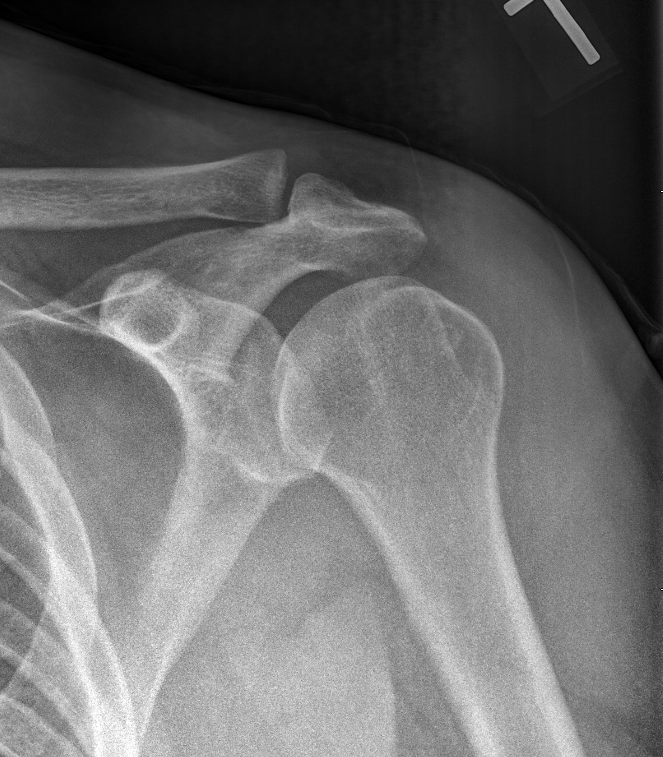
Which of the following complications occurs commonly in the fracture shown in the X-ray, EXCEPT?

Which statement is NOT true about thoracic outlet syndrome?
What is a comminuted depressed fracture of the lateral tibial condyle classified as?
Which X-ray view is best for evaluating a patellar fracture?
Garden I fractures are also known as?
In myositis ossificans, where is mature bone typically seen?
A 67-year-old woman presents with a 3-month history of increasing right shoulder pain, resulting in an inability to lift her arm to brush her hair or retrieve items from shelves. She denies numbness, tingling, or pain radiation down her arm. Physical examination reveals weakness in abduction and external rotation of her right arm, with a normal passive range of motion. She is unable to hold her arms abducted to 90 degrees on the right side. There is no motor weakness, normal pulse, and normal sensation in her right upper extremity. Which of the following is the most likely diagnosis?
Explanation: **Explanation:** **1. Why Option D is Correct:** The clinical presentation of swelling, severe pain (especially on passive stretch), and numbness following a fracture and casting is diagnostic of **Acute Compartment Syndrome (ACS)**. This is a surgical emergency where increased pressure within a closed osteofascial space compromises local circulation. Once the diagnosis is clinically established, the definitive and gold-standard treatment is **urgent operative decompression via fasciotomy**. This involves long incisions to open the fascia of all involved compartments to restore tissue perfusion and prevent irreversible muscle and nerve necrosis. **2. Why Other Options are Incorrect:** * **Option A & C:** Splitting the plaster or elevating the limb are initial "first-aid" measures. While splitting the cast can reduce pressure by approximately 30-65%, it is **not a definitive treatment** for established ACS. Furthermore, **elevation is contraindicated** in compartment syndrome because it reduces the arteriovenous pressure gradient, further compromising capillary perfusion. * **Option B:** Low molecular weight dextran is used to improve microcirculation in certain vascular conditions but has no role in relieving the mechanical pressure of compartment syndrome. **3. Clinical Pearls for NEET-PG:** * **Earliest Clinical Sign:** Pain out of proportion to the injury and pain on **passive stretching** of muscles. * **Late Sign:** Pulselessness (The presence of a distal pulse does *not* rule out compartment syndrome). * **Pressure Threshold:** Fasciotomy is generally indicated if the absolute compartment pressure is **>30 mmHg** or if the "Delta pressure" (Diastolic BP minus Compartment Pressure) is **<30 mmHg**. * **Most Common Site:** The **Deep Posterior Compartment** of the leg is most frequently involved in leg fractures.
Explanation: **Explanation:** **De Quervain’s Tenosynovitis** is a stenosing tenosynovitis involving the tendons of the **First Dorsal Compartment** of the wrist. This condition is caused by repetitive friction or overuse, leading to thickening of the extensor retinaculum and narrowing of the fibro-osseous tunnel. 1. **Why the First Dorsal Compartment is correct:** This compartment contains two specific tendons: the **Abductor Pollicis Longus (APL)** and the **Extensor Pollicis Brevis (EPB)**. Inflammation here results in pain over the radial styloid process. 2. **Why the other options are incorrect:** * **Second Compartment:** Contains the Extensor Carpi Radialis Longus (ECRL) and Brevis (ECRB). Inflammation here is known as *Intersection Syndrome*. * **Fifth Compartment:** Contains the Extensor Digiti Minimi (EDM). * **Sixth Compartment:** Contains the Extensor Carpi Ulnaris (ECU). Inflammation here causes ulnar-sided wrist pain. **High-Yield Clinical Pearls for NEET-PG:** * **Finkelstein’s Test:** The pathognomonic clinical test where the patient makes a fist with the thumb tucked inside the fingers, followed by ulnar deviation of the wrist. A positive test elicits sharp pain over the first compartment. * **Demographics:** Most common in females aged 30–50 and often seen in **new mothers** (due to repetitive lifting of the infant). * **Anatomical Variation:** A common cause of treatment failure (steroid injection) is the presence of a **septum** separating the APL and EPB within the first compartment. * **Treatment:** Conservative management includes thumb spica splinting, NSAIDs, and corticosteroid injections. Surgical release is reserved for refractory cases.
Explanation: **Explanation:** **1. Why Common Peroneal Nerve (CPN) is correct:** The common peroneal nerve (also known as the common fibular nerve) is the most frequently injured nerve in the lower limb due to its superficial and vulnerable anatomical course. After branching from the sciatic nerve, it winds laterally around the **neck of the fibula**. At this specific site, the nerve lies directly against the bone, covered only by skin and fascia, making it highly susceptible to injury from fibular neck fractures, tight casts, or direct lateral trauma. **2. Why other options are incorrect:** * **Obturator nerve:** This nerve arises from the lumbar plexus (L2-L4) and supplies the medial compartment (adductors) of the thigh. It does not descend below the knee. * **Genitofemoral nerve:** This is a branch of the lumbar plexus (L1-L2) providing sensory innervation to the upper anterior thigh and motor supply to the cremaster muscle; it is anatomically distant from the fibula. * **Posterior tibial nerve:** This nerve passes through the popliteal fossa and travels deep in the **posterior compartment** of the leg, well-protected by the gastrocnemius and soleus muscles. It is more commonly injured in distal tibial fractures or tarsal tunnel syndrome. **3. Clinical Pearls for NEET-PG:** * **Clinical Presentation:** Injury to the CPN leads to **Foot Drop** (loss of dorsiflexion) and loss of sensation over the first dorsal web space and lateral aspect of the leg. * **Gait:** Patients exhibit a **High Steppage Gait** to prevent toes from dragging. * **Branches:** The CPN divides into the **Deep Peroneal Nerve** (muscles of the anterior compartment) and the **Superficial Peroneal Nerve** (muscles of the lateral compartment). * **Deformity:** The characteristic deformity is **Equinovarus** (due to unopposed action of the tibialis posterior and calf muscles).
Explanation: ***Delayed union*** - **Colles' fracture** involves the **metaphyseal region** of the distal radius, which has excellent **blood supply** and typically heals readily without delayed union. - The **cancellous bone** in this region promotes rapid healing, making delayed union an uncommon complication. *Malunion* - **Loss of reduction** is common due to **dorsal angulation** and **radial shortening** if immobilization is inadequate. - Results in **dinner fork deformity** and can cause functional impairment and cosmetic issues. *Shoulder stiffness* - Prolonged **immobilization** in a cast or sling commonly leads to **frozen shoulder** (adhesive capsulitis). - **Disuse** of the shoulder joint during healing period causes **capsular contracture** and reduced range of motion. *Carpal tunnel syndrome* - **Hematoma** and **swelling** at the fracture site can compress the **median nerve** in the carpal tunnel. - **Mal-reduction** with **volar angulation** can also narrow the carpal tunnel space, leading to nerve compression symptoms.
Explanation: ### Explanation Thoracic Outlet Syndrome (TOS) is a clinical condition resulting from the compression of the neurovascular bundle (brachial plexus and/or subclavian vessels) as it passes through the thoracic outlet. **Why Option A is the Correct Answer (The "NOT True" statement):** While the lower trunk of the brachial plexus (C8-T1) is the most commonly compressed neural structure, it is technically incorrect to say the **ulnar nerve** is affected. The compression occurs at the **roots or trunks** of the plexus, not the peripheral nerve itself. While symptoms often manifest in the ulnar distribution (medial forearm and hand), the pathology is proximal to the formation of the ulnar nerve. **Analysis of Other Options:** * **Option B:** Neurological features (Neurogenic TOS) account for approximately **95% of cases**, making it the most common presentation. Patients typically present with pain, paresthesia, and weakness. * **Option C:** Surgical management, such as **resection of the first rib** or a cervical rib, is a definitive treatment to decompress the space and relieve symptoms when conservative management fails. * **Option D:** **Adson’s test** (loss of radial pulse on rotating the head to the affected side during deep inspiration) is a classic clinical sign of TOS, though it has high false-positive rates in the general population. **NEET-PG High-Yield Pearls:** * **Most common site of compression:** Scalene triangle (between anterior and middle scalenes). * **Commonest cause:** Presence of a **Cervical Rib** (elongated C7 transverse process). * **Gilliatt-Sumner Hand:** Severe wasting of the thenar and hypothenar muscles seen in chronic neurogenic TOS. * **Paget-Schroetter Syndrome:** Venous TOS leading to effort-induced thrombosis of the subclavian vein.
Explanation: ### Explanation **Correct Answer: C. Bumper fracture** A **Bumper fracture** (also known as a Fender fracture) refers to a fracture of the **lateral tibial plateau/condyle**. * **Mechanism:** It typically occurs when a pedestrian is struck by the bumper of a moving vehicle. The impact hits the lateral side of the knee, creating a forceful **valgus (abduction) stress**. This causes the hard lateral femoral condyle to be driven into the softer articular surface of the lateral tibial plateau, resulting in a depressed and/or comminuted fracture. * **Classification:** These fractures are categorized using the **Schatzker Classification** (Types I–VI). --- ### Why the other options are incorrect: * **A & B. Pilon / Plafond fracture:** These terms are often used interchangeably. They refer to a comminuted intra-articular fracture of the **distal tibia** (the "ceiling" of the ankle joint), usually caused by high-energy axial loading (e.g., a fall from height). * **D. Malgaigne's fracture:** This is a vertical shear injury of the **pelvis**. It involves a double vertical fracture through the anterior pelvic ring (pubic rami) and the posterior pelvic ring (sacrum, SI joint, or ilium) on the same side. --- ### High-Yield Clinical Pearls for NEET-PG: 1. **Nerve Injury:** The most commonly injured nerve in a Bumper fracture is the **Common Peroneal Nerve** (due to its proximity to the fibular neck). 2. **Ligamentous Injury:** Because of the valgus stress mechanism, the **Medial Collateral Ligament (MCL)** is frequently torn. 3. **Schatzker Type II** is the most common pattern (cleavage with depression of the lateral plateau). 4. **Management Goal:** The priority is restoring the articular congruity of the knee joint to prevent early-onset osteoarthritis.
Explanation: **Explanation:** The **Skyline view** (also known as the Sunrise or Merchant view) is the gold standard for evaluating the patella and the patellofemoral joint. In this tangential projection, the knee is flexed, and the X-ray beam passes superior-to-inferior (or vice versa) through the space between the patella and the femoral condyles. This view is superior for detecting **vertical (longitudinal) fractures**, marginal osteochondral fractures, and assessing patellar subluxation or tilt, which may be missed on standard AP or Lateral views. **Analysis of Incorrect Options:** * **Judet view:** These are specialized 45-degree oblique views of the pelvis used specifically to evaluate **acetabular fractures** (iliopubic and iliotschial columns). * **Water’s view:** This is a radiographic projection used to visualize the **paranasal sinuses** and midface fractures (e.g., Le Fort or tripod fractures). * **Oblique view:** While sometimes used in knee trauma to see the tibial plateaus, it is less specific and less effective than the Skyline view for visualizing the articular surface of the patella. **High-Yield Clinical Pearls for NEET-PG:** * **Standard Knee Series:** Includes AP and Lateral views. The **Lateral view** is best for identifying transverse patellar fractures and assessing patellar height (Patella Alta/Baja). * **Bipartite Patella:** A common mimic of a fracture, usually located in the **superolateral** quadrant with smooth, sclerotic margins (unlike the sharp, irregular edges of an acute fracture). * **Mechanism of Injury:** Patellar fractures usually occur via direct trauma (dashboard injury) or indirect force (sudden forceful contraction of the quadriceps). * **Surgical Indication:** Surgery (usually Tension Band Wiring) is indicated if there is >2mm of articular displacement or >3mm of fragment separation.
Explanation: The **Garden Classification** is the most widely used system for femoral neck fractures, based on the degree of displacement and the alignment of medial trabeculae on an AP radiograph. ### **Explanation of the Correct Answer** **Option D (Valgus impaction fractures)** is correct. Garden Stage I is defined as an **incomplete or abducted (valgus) impacted fracture**. In this type, the femoral head tilts into a valgus position, causing the medial trabeculae of the neck to be "jammed" or impacted. Because the fragments are wedged together, these are considered inherently stable fractures with a lower risk of avascular necrosis (AVN) compared to higher stages. ### **Analysis of Incorrect Options** * **Option A:** This describes **Garden Stage II**. In Stage II, the fracture is complete (extending across the entire neck), but there is no displacement. The alignment remains normal. * **Option B:** This describes **Garden Stage III**. There is complete disruption with partial displacement. The femoral head usually tilts into a varus position, but some contact between the fragments remains. * **Option C:** This describes **Garden Stage IV**. There is complete displacement with no contact between the fracture fragments. The femoral head often realigns with the acetabulum, appearing "normal" while the shaft is displaced. ### **NEET-PG High-Yield Pearls** * **Stability:** Garden I and II are "Undisplaced/Stable"; Garden III and IV are "Displaced/Unstable." * **Management:** In elderly patients, Stage I and II are often treated with **Internal Fixation (Cannulated Cancellous Screws)**, whereas Stage III and IV usually require **Arthroplasty** (Hemi or Total) due to the high risk of non-union and AVN. * **Pauwels Classification:** Another high-yield system based on the **angle of the fracture line** (verticality); higher angles (Type III) indicate greater shear force and instability.
Explanation: **Explanation:** **Myositis Ossificans (MO)** is a benign, heterotopic ossification where bone forms within soft tissues, usually following trauma (e.g., a muscle hematoma). 1. **Why Option A is Correct:** The hallmark of Myositis Ossificans is the **"Zonal Phenomenon."** As the lesion matures, it organizes from the outside in. The most mature, lamellar bone forms at the **periphery** (forming a shell), while the center remains composed of immature fibroblastic tissue and osteoid. This centrifugal maturation is a crucial diagnostic feature on imaging and histology. 2. **Why Other Options are Incorrect:** * **Option B:** The center contains the most immature, cellular components. If a biopsy is taken only from the center, it may be misdiagnosed as osteosarcoma due to high mitotic activity. * **Option C:** Bone is not distributed uniformly; the distinct "zonal" maturation pattern differentiates it from malignant tumors. * **Option D:** MO occurs within the muscle belly (extra-articular), not the joint capsule. **High-Yield Clinical Pearls for NEET-PG:** * **Radiology:** Shows a characteristic "eggshell calcification" or "circumferential calcification" on X-ray. There is often a **radiolucent zone** (string sign) between the lesion and the underlying bone, distinguishing it from a parosteal osteosarcoma. * **Common Site:** Brachialis (following elbow dislocation) and Quadriceps femoris. * **Management:** Conservative initially (Rest, NSAIDs). Surgery is only indicated for mature lesions (usually after 6–12 months) if they cause significant pain or limit joint motion. Excision of an immature lesion leads to high recurrence rates.
Explanation: ### Explanation **Correct Answer: D. Rotator cuff tear** The clinical presentation is classic for a **Rotator Cuff Tear (RCT)**, likely involving the **Supraspinatus** (abduction) and **Infraspinatus** (external rotation). The hallmark of a rotator cuff tear is the **dissociation between active and passive range of motion (ROM)**. The patient has a normal passive ROM (the joint itself is not stiff), but significant weakness in active movements (the "motor" or tendon is damaged). The inability to hold the arm abducted at 90 degrees is a positive **Drop Arm Test**, a high-yield clinical sign for a full-thickness supraspinatus tear. #### Why other options are incorrect: * **A. Brachial plexus injury:** While this causes weakness, it typically presents with sensory deficits (numbness/tingling) and follows a specific dermatomal or peripheral nerve distribution, which is absent here. * **B. Glenohumeral osteoarthritis:** This would present with a **decreased passive range of motion** and "grinding" (crepitus). In OA, the joint is mechanically blocked, unlike this patient’s normal passive ROM. * **C. Proximal humerus fracture:** This is an acute traumatic event presenting with sudden severe pain, swelling, ecchymosis, and a history of a fall. A 3-month progressive history makes this unlikely. #### NEET-PG High-Yield Pearls: * **Most common muscle involved:** Supraspinatus (the "workhorse" of the rotator cuff). * **Gold Standard Investigation:** MRI Shoulder. * **Initial Investigation:** Ultrasound (highly sensitive for full-thickness tears). * **Clinical Tests:** * **Jobe’s Test (Empty Can):** Supraspinatus. * **Hornblower’s Sign:** Teres minor. * **Gerber’s Lift-off Test:** Subscapularis. * **Management:** Conservative (PT/NSAIDs) for partial tears; Surgical repair for full-thickness tears in active patients.
Principles of Fracture Management
Practice Questions
Upper Limb Fractures
Practice Questions
Lower Limb Fractures
Practice Questions
Spinal Trauma
Practice Questions
Pelvic and Acetabular Fractures
Practice Questions
Open Fractures
Practice Questions
Fractures in Children
Practice Questions
Fracture Complications
Practice Questions
Nonunion and Malunion
Practice Questions
Polytrauma Management
Practice Questions
Joint Dislocations
Practice Questions
Soft Tissue Injuries
Practice Questions
Get full access to all questions, explanations, and performance tracking.
Start For Free