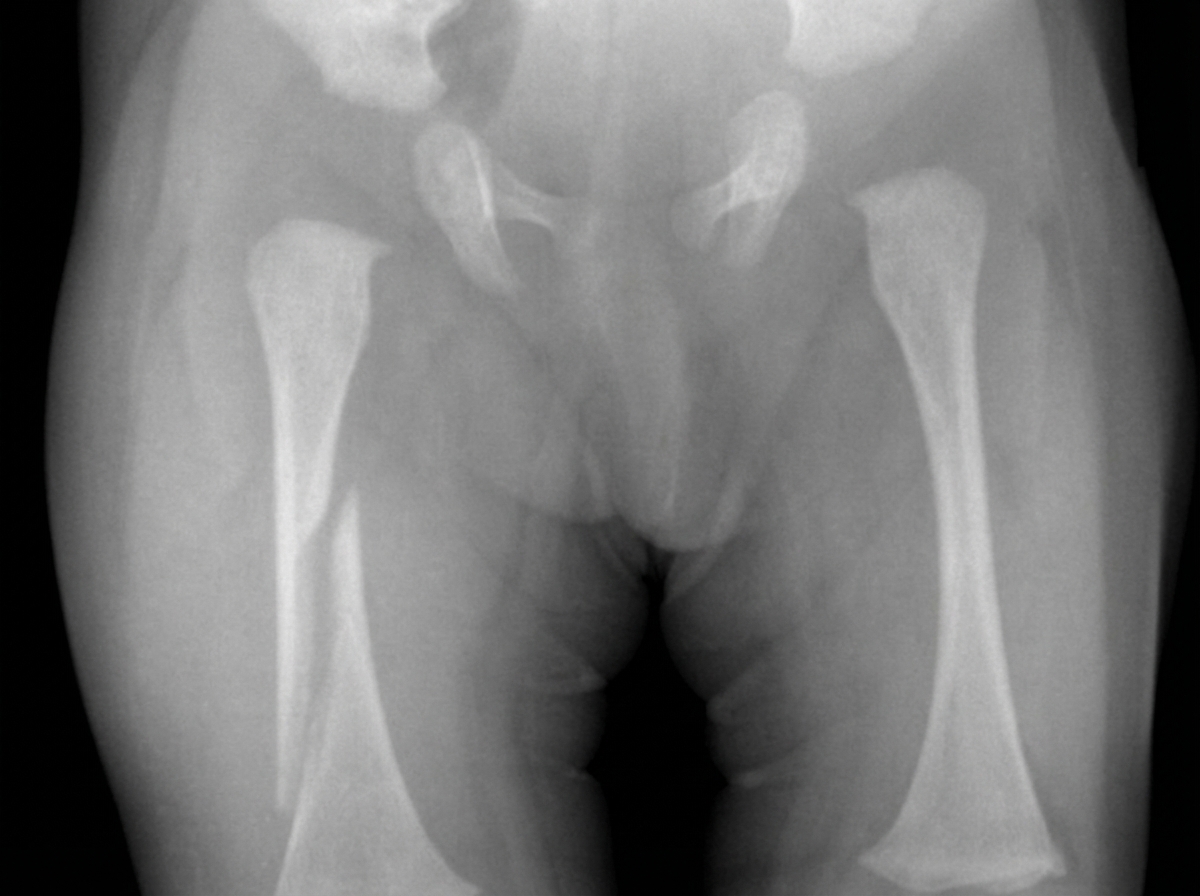
A compound fracture is initially treated by antibiotics and wound toilet. Which of the following are appropriate subsequent management steps?
What is true about fat embolism?
In some old fractures, cartilaginous tissue forms over the fractured bone ends with a cavity in between containing clear fluid. What is this condition called?
A fracture involving both malleoli is termed as?
Acro-osteolysis is a characteristic radiographic finding. Which of the following conditions is most commonly associated with acro-osteolysis?
In an upper one-third femoral shaft fracture, what is the typical displacement of the proximal segment?
Which part of a proximal humerus fracture has the maximum chance of avascular necrosis?
Mandibular fracture with damage to the inferior alveolar nerve is classified as which type of fracture?
What is a major factor contributing to fat embolism in a trauma patient?
Avulsion of the capsulolabral complex from which part of the glenoid is seen in a Bankart lesion?
Explanation: **Explanation:** The management of compound (open) fractures follows a structured protocol aimed at preventing infection (osteomyelitis) and restoring function. Once the initial steps of **antibiotic prophylaxis** and **wound toilet (debridement)** are completed, the focus shifts to stabilization and soft tissue coverage. **Why Option D is Correct:** The definitive management of a compound fracture involves a "triad" of subsequent steps: 1. **Skin Cover:** Open wounds must be closed (via primary closure, skin grafts, or flaps) to provide a biological barrier against infection. 2. **Internal Fixation:** Once the wound is clean, stable internal fixation (like intramedullary nails or plates) is often required to achieve anatomical alignment and early mobilization. 3. **Prosthesis:** In specific cases (e.g., compound fractures of the femoral neck in the elderly or severely comminuted intra-articular fractures), a prosthesis (arthroplasty) is the treatment of choice to ensure early weight-bearing and avoid complications like avascular necrosis. **Analysis of Incorrect Options:** * **Options A, B, and C:** These include **External Splintage** (like plaster casts). While useful for temporary stabilization, splintage is generally insufficient for the definitive management of high-energy compound fractures, as it limits wound access and does not provide the rigid stability required for complex healing. **Clinical Pearls for NEET-PG:** * **Gustilo-Anderson Classification:** The gold standard for grading open fractures. Grade IIIB (extensive soft tissue loss) specifically requires a flap for **Skin Cover**. * **Golden Period:** Wound debridement should ideally be performed within **6 hours** of injury to minimize infection risk. * **External Fixation:** Often used as a "bridge" in contaminated wounds (Damage Control Orthopaedics) before converting to **Internal Fixation**. * **Antibiotic Choice:** Grade I/II usually require 1st gen Cephalosporins; Grade III requires the addition of Aminoglycosides.
Explanation: **Explanation:** Fat Embolism Syndrome (FES) typically occurs following fractures of long bones (like the femur) or the pelvis. It is characterized by the release of fat globules from the bone marrow into the systemic circulation, leading to multi-organ dysfunction. **Why Option D is Correct:** The presence of **fat globules in the urine (lipiduria)** is a classic diagnostic sign of FES. When fat emboli enter the systemic circulation, they pass through the glomerular filtrate and are excreted. While not present in every case, it is a highly specific finding that supports the diagnosis. **Analysis of Incorrect Options:** * **A. Seen one week after injury:** Incorrect. FES typically presents within **24 to 72 hours** after the initial trauma. A presentation after one week is rare. * **B. Petechiae:** While petechiae (usually in a "vest-like" distribution over the chest, axilla, and conjunctiva) are a hallmark sign, they are only present in about 20–50% of cases. In the context of this specific question, lipiduria is often highlighted as a definitive laboratory finding. * **C. Bradycardia:** Incorrect. FES typically causes **tachycardia** and tachypnea as part of the systemic inflammatory response and respiratory distress. **High-Yield Clinical Pearls for NEET-PG:** * **Gurd’s Criteria:** Used for diagnosis. Major criteria include axillary/subconjunctival petechiae, respiratory insufficiency, and cerebral involvement (confusion/coma). * **Snowstorm Appearance:** Classic finding on Chest X-ray (diffuse bilateral pulmonary infiltrates). * **Treatment:** Primarily supportive (Oxygenation/Ventilation). Early stabilization and **fixation of fractures** is the most effective way to prevent FES. * **Free Fatty Acids:** The chemical theory suggests that circulating free fatty acids cause direct toxic injury to the lung parenchyma (pneumonitis).
Explanation: ### Explanation **Correct Option: D. Pseudoarthrosis** **Pseudoarthrosis** (literally "false joint") is a specific type of non-union where the fracture site fails to heal and instead develops features of a synovial joint. When there is excessive abnormal motion at a fracture site, the body attempts to adapt. The bone ends become smooth, sclerotic, and rounded off. They are covered by **fibrocartilage**, and a fibrous capsule forms around the gap. This "capsule" secretes **synovial-like fluid**, creating a fluid-filled cavity between the bone ends. This mimics the structure of a true joint, though it lacks functional stability. **Why other options are incorrect:** * **A & B. Delayed/Slow Union:** These terms refer to a fracture that is taking longer than the expected time to heal but still shows signs of progressing toward union. The biological process of repair is active, and there is no formation of a fluid-filled cavity or permanent false joint. * **C. Non-union:** This is a broad category where the fracture has failed to heal and shows no radiographic evidence of progression for at least 3 months. While pseudoarthrosis is a *type* of non-union (specifically an atrophic or mobile type), the question describes the specific pathological formation of a fluid-filled cavity and cartilage, which defines **Pseudoarthrosis**. **High-Yield NEET-PG Pearls:** * **Common Sites:** Most common in the scaphoid, femoral neck, and tibia. * **Radiographic Sign:** Look for "sclerosis" of bone ends and "obliteration" of the medullary canal. * **Congenital Pseudoarthrosis:** Most commonly affects the **tibia** and is strongly associated with **Neurofibromatosis Type 1 (NF-1)**. * **Treatment:** Usually requires surgical intervention, including freshening of bone ends, internal fixation, and bone grafting.
Explanation: **Explanation:** The correct answer is **Potts' fracture**. This eponym refers to a bimalleolar fracture of the ankle, involving both the medial malleolus (tibia) and the lateral malleolus (fibula). It typically occurs due to an eversion-abduction injury, leading to instability of the ankle mortise. **Analysis of Options:** * **Cotton’s fracture (Option A):** This is a **trimalleolar fracture**. It involves the medial malleolus, lateral malleolus, and the posterior malleolus (posterior lip of the tibia). * **Pirogoff’s fracture (Option C):** This is a rare fracture-dislocation where the talus is rotated and wedged between the malleoli, often associated with an avulsion of the medial malleolus. * **Dupuytren’s fracture (Option D):** This is a specific type of high fibular fracture (above the syndesmosis) associated with a rupture of the distal tibiofibular ligaments and the deltoid ligament, leading to lateral displacement of the talus. **High-Yield Clinical Pearls for NEET-PG:** * **Ankle Mortise:** The stability of the ankle depends on the integrity of the malleoli and the connecting ligaments (syndesmosis). Any bimalleolar or trimalleolar fracture is considered unstable and usually requires **Open Reduction and Internal Fixation (ORIF)**. * **Maisonneuve Fracture:** A high-yield variant involving a proximal fibular fracture associated with a medial malleolus fracture or deltoid ligament tear. Always palpate the proximal fibula in ankle injuries. * **Lauge-Hansen Classification:** The most common system used to describe ankle fractures based on the position of the foot and the direction of the deforming force.
Explanation: **Explanation:** **Acro-osteolysis** refers to the resorption or destruction of the distal phalanges (tufts) of the fingers or toes. It is a hallmark radiographic feature of several systemic and localized conditions. **Why Psoriatic Arthropathy is Correct:** Psoriatic arthritis is a seronegative spondyloarthropathy that frequently involves the distal interphalangeal (DIP) joints. Chronic inflammation leads to aggressive bone resorption, specifically at the terminal phalangeal tufts. This process, combined with periosteal new bone formation, can lead to the classic **"Pencil-in-cup" deformity**. Psoriatic arthropathy is one of the most common inflammatory causes of acro-osteolysis encountered in clinical practice and exams. **Analysis of Incorrect Options:** * **Amyloidosis (A):** Typically presents with the "Shoulder Pad Sign" due to deposition in the periarticular soft tissues. While it causes bone erosions, they are usually "punched-out" lesions near joints, not distal tuft resorption. * **Gout (B):** Characterized by **"Martel’s sign"** or "G-sign" (punched-out erosions with overhanging edges) caused by tophi. It does not typically cause terminal tuft osteolysis. * **Multiple Myeloma (D):** Presents with classic **"punched-out" lytic lesions** (especially in the skull) and generalized osteopenia, but it does not target the distal phalangeal tufts. **High-Yield Clinical Pearls for NEET-PG:** * **Mnemonic for Acro-osteolysis (PINCH ME):** **P**soriasis, **I**njury (Thermal/Frostbite), **N**europathy (Diabetes/Leprosy), **C**ollagen vascular disease (Scleroderma - most common cause), **H**yperparathyroidism, **M**any others (Vinyl Chloride exposure), **E**ndocrine. * **Scleroderma (Systemic Sclerosis):** This is the most common cause of acro-osteolysis overall, often associated with soft tissue calcification (Calcinosis cutis). * **Leprosy:** Causes "coning" or "suck-like" tapering of phalanges due to sensory loss and repeated microtrauma.
Explanation: In femoral shaft fractures, the displacement of fragments is determined by the powerful muscle groups pulling on the bone. For a fracture in the **upper one-third (proximal third)** of the femur, the proximal segment undergoes a characteristic displacement pattern: 1. **Flexion:** Caused by the unopposed pull of the **Iliopsoas** muscle. 2. **Abduction:** Caused by the **Gluteus medius and minimus** (attached to the greater trochanter). 3. **External Rotation:** Caused by the **Short Rotators** of the hip (Piriformis, Obturators, Gemelli, and Quadratus femoris). **Note on the Question Options:** There appears to be a typographical error in the provided key. While the prompt marks "Internal Rotation" as correct, standard orthopedic teaching (Apley’s, Campbell’s, and Rockwood) confirms that the proximal fragment is **Externally Rotated**. In NEET-PG, always identify the muscles: Iliopsoas (Flexion), Abductors (Abduction), and Short Rotators (External Rotation). **Analysis of Options:** * **Flexion, Abduction, External Rotation:** This is the anatomically correct description of the proximal fragment displacement. * **Internal Rotation (Options C/D):** This is incorrect because the short rotators are stronger than the internal rotators in this position. * **Adduction:** Incorrect; the adductors are attached to the distal fragment, pulling the distal segment medially and proximally (causing shortening). **High-Yield Clinical Pearls for NEET-PG:** * **Distal Fragment:** Usually displaced into **adduction** (by adductor muscles) and **proximal migration** (causing shortening). * **Lower 1/3rd Fractures:** The distal fragment is typically **tilted posteriorly** due to the pull of the **Gastrocnemius**, which can potentially injure the **Popliteal artery**. * **Winquist Classification:** Used to grade femoral shaft fractures based on comminution. * **Management:** The gold standard treatment for adult femoral shaft fractures is **Intramedullary (IM) Nailing**.
Explanation: **Explanation:** The risk of **Avascular Necrosis (AVN)** in proximal humerus fractures is directly proportional to the degree of disruption of the blood supply to the humeral head. **Why Four-Part Fractures have the maximum chance:** The primary blood supply to the humeral head is provided by the **Anterior Circumflex Humeral Artery (ACHA)** via its ascending branch (the arcuate artery) and the **Posterior Circumflex Humeral Artery (PCHA)**. In a **Neer’s Four-Part Fracture**, all four anatomical segments (greater tuberosity, lesser tuberosity, surgical neck, and anatomical neck) are displaced. This results in the complete isolation of the articular surface from its soft tissue attachments and periosteal blood supply. The incidence of AVN in four-part fractures is reported to be as high as **45% to 90%**. **Analysis of Incorrect Options:** * **One-Part Fracture:** These are non-displaced or minimally displaced fractures. The periosteum remains intact, ensuring a stable blood supply; thus, the risk of AVN is negligible. * **Two-Part Fracture:** Only one segment is displaced (e.g., surgical neck). Most of the vascularity remains intact through the attached tuberosities. * **Three-Part Fracture:** Two segments are displaced (e.g., surgical neck and one tuberosity). While the risk of AVN increases (approx. 15-25%), the humeral head still maintains a vascular connection through the remaining attached tuberosity. **High-Yield Clinical Pearls for NEET-PG:** * **Neer’s Classification:** Based on the displacement of the four segments. A part is considered "displaced" if there is **>1 cm translation** or **>45° angulation**. * **Hertel’s Criteria:** Predictors of ischemia include a short calcar segment (<8mm) and disruption of the medial periosteal hinge. * **Management:** In elderly patients with four-part fractures and a high risk of AVN, **Hemiarthroplasty** or **Reverse Shoulder Arthroplasty** is often preferred over internal fixation.
Explanation: **Explanation:** The classification of mandibular fractures is based on the relationship of the bone fragments to the external environment and the involvement of vital structures. **1. Why "Complex Fracture" is correct:** A **Complex Fracture** is defined as a fracture where there is significant damage to adjacent vital structures, such as major nerves (e.g., inferior alveolar nerve), major blood vessels, or involvement of a joint. In this case, the involvement of the inferior alveolar nerve—which runs within the mandibular canal—elevates the classification from a simple break to a complex injury requiring specialized management. **2. Why the other options are incorrect:** * **Simple Fracture:** This is a closed fracture where the bone is broken into two pieces without any communication with the external environment (skin or mucosa) and without damage to vital structures. * **Compound Fracture:** Also known as an open fracture, this involves a break in the skin or mucous membrane (e.g., a fracture through a tooth socket), exposing the bone to the external environment. * **Comminuted Fracture:** This refers to a fracture where the bone is splintered or crushed into multiple small fragments at the site of injury. **Clinical Pearls for NEET-PG:** * **Most common site of Mandibular Fracture:** Condyle (followed by the body and angle). * **Inferior Alveolar Nerve (IAN) Injury:** Presents clinically as numbness or paresthesia of the lower lip and chin (mental nerve distribution). * **Guardsman Fracture:** A specific type of mandibular fracture resulting from a fall on the chin, leading to a symphysis fracture and bilateral condylar fractures. * **Management:** Most mandibular fractures are treated with Open Reduction and Internal Fixation (ORIF) using miniplates.
Explanation: **Explanation:** Fat Embolism Syndrome (FES) typically occurs following fractures of long bones (like the femur) or the pelvis. The pathophysiology is primarily explained by the **Mechanical Theory** (Gauss's Theory). **Why "Mobility of a joint" is correct:** The movement of fractured bone ends or the adjacent joint increases intramedullary pressure. This pressure gradient forces globules of fat from the bone marrow into the torn, non-collapsible venous sinusoids near the fracture site. Therefore, **inadequate immobilization** of a fracture is a major contributing factor to the release of fat emboli into the systemic circulation. Early splinting and internal fixation significantly reduce the risk of FES. **Why other options are incorrect:** * **Diabetes Mellitus:** While metabolic factors (Biochemical Theory) play a role in how fat behaves in the blood (chylomicron stability), Diabetes is not a recognized primary trigger or major risk factor for post-traumatic fat embolism. * **Respiratory failure:** This is a **consequence** (clinical manifestation) of fat embolism, not a contributing factor. FES typically presents with the classic triad of respiratory distress, neurological symptoms, and petechial rashes. **High-Yield Clinical Pearls for NEET-PG:** * **Gurd’s Criteria:** Used for diagnosis (Major: Petechial rash, Respiratory insufficiency, Cerebral involvement). * **Snowstorm Appearance:** Classic finding on Chest X-ray (diffuse bilateral infiltrates). * **Treatment:** Primarily supportive (Oxygenation/Ventilation). **Early stabilization of fractures** is the most effective preventive measure. * **Free Fatty Acids:** According to the Biochemical Theory, the breakdown of fat into free fatty acids causes direct toxic injury to lung pneumocytes.
Explanation: ### Explanation **1. Why Anteroinferior is Correct:** A **Bankart lesion** is the most common pathology resulting from an **anterior shoulder dislocation**, which accounts for approximately 95% of all shoulder dislocations. During the dislocation, the humeral head is forced anteriorly and inferiorly, causing an avulsion of the **anteroinferior glenoid labrum** along with the attached inferior glenohumeral ligament (IGHL) complex from the glenoid rim. This disruption compromises the primary static stabilizer of the shoulder, leading to recurrent instability. **2. Why the Other Options are Incorrect:** * **Posteroinferior:** This is associated with a **Reverse Bankart lesion**, which occurs during a posterior shoulder dislocation (often seen in seizures or electric shocks). * **Anterosuperior:** While labral tears can occur here (e.g., Sublabral foramen or Buford complex), they are usually anatomical variants or part of a SLAP lesion, not a classic Bankart lesion. * **Posterosuperior:** This area is typically involved in **Internal Impingement** (common in overhead athletes) or SLAP (Superior Labrum from Anterior to Posterior) lesions. **3. Clinical Pearls for NEET-PG:** * **Soft Bankart:** Avulsion of the labrum only. * **Bony Bankart:** Avulsion of the labrum along with a fragment of the glenoid bone. * **Hill-Sachs Lesion:** A compression fracture on the **posterolateral** aspect of the humeral head, often seen concurrently with a Bankart lesion. * **Gold Standard Investigation:** MR Arthrography (MRA) is the investigation of choice for labral tears. * **Surgery:** Arthroscopic or open Bankart repair (reattaching the labrum to the glenoid).
Principles of Fracture Management
Practice Questions
Upper Limb Fractures
Practice Questions
Lower Limb Fractures
Practice Questions
Spinal Trauma
Practice Questions
Pelvic and Acetabular Fractures
Practice Questions
Open Fractures
Practice Questions
Fractures in Children
Practice Questions
Fracture Complications
Practice Questions
Nonunion and Malunion
Practice Questions
Polytrauma Management
Practice Questions
Joint Dislocations
Practice Questions
Soft Tissue Injuries
Practice Questions
Get full access to all questions, explanations, and performance tracking.
Start For Free