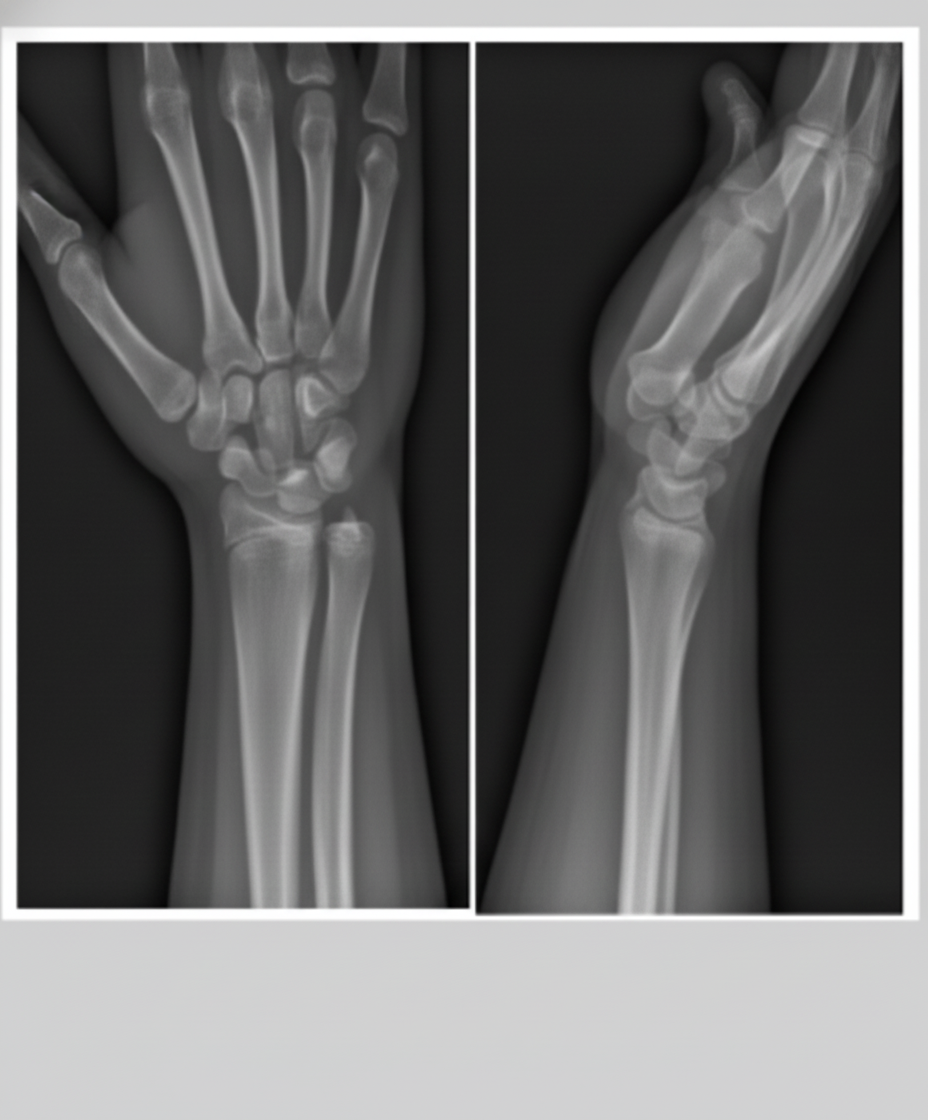
Sudeck's atrophy is associated with which of the following conditions?
A patient involved in a road traffic accident is found lying in the right lateral position with bruises on the face, elbow, and lateral side of the knee. Which nerve injury has the maximum chance of occurring in this position of the victim?
A bodybuilder taking steroids and creatinine presented with hip pain and inability to squat. MRI shows disruption of the femoral articular surface and a crescent sign is seen on radiograph. What is the diagnosis?
All of the following are types of avascular non-union except:
Supracondylar fracture of the femur commonly injures which structure?
Dashboard injury typically results in which of the following?
What is the best treatment for a fracture of the neck of the femur in a 65-year-old female patient?
A patient presents with the hip in adduction and medial rotation and is unable to move. What is the probable diagnosis?
Which of the following is/are benefits of immobilization of a fracture?
Which of the following is typically NOT seen in a Colles fracture?
Explanation: **Explanation:** **Sudeck’s atrophy**, also known as **Complex Regional Pain Syndrome (CRPS) Type 1**, is a post-traumatic condition characterized by autonomic dysfunction leading to severe pain, swelling, and vasomotor instability. **Why Osteopenia is correct:** The hallmark radiographic feature of Sudeck’s atrophy is **patchy, periarticular osteopenia** (rarefaction of bone). This occurs due to increased bone resorption triggered by localized hyperemic changes and disuse of the affected limb. While it is a form of bone loss, the term "osteopenia" specifically describes the decreased bone density seen on X-rays in this clinical context. **Why the other options are incorrect:** * **A. Osteoporosis:** While Sudeck's involves bone loss, "Osteoporosis" usually refers to a systemic metabolic bone disease. In the context of Sudeck's, "patchy osteopenia" is the more precise descriptive term used in standard orthopedic literature. * **B. Osteophyte formation:** Osteophytes are bony outgrowths characteristic of degenerative conditions like Osteoarthritis, not acute sympathetic dystrophy. * **C. Osteochondritis:** This refers to inflammation of bone and cartilage (e.g., Perthes disease), which involves necrosis rather than the sympathetic-mediated bone resorption seen in Sudeck's. **High-Yield Clinical Pearls for NEET-PG:** * **Common Site:** Most frequently follows a **Colles’ fracture**. * **Clinical Features:** "Burning" pain out of proportion to the injury, hyperesthesia, and trophic skin changes (shiny, tight skin). * **Radiology:** Patchy "ground-glass" appearance of bones. * **Gold Standard Diagnosis:** Triple-phase bone scan (shows increased uptake). * **Treatment:** Early mobilization (best prevention), sympathetic blocks, and Vitamin C (prophylactic).
Explanation: **Explanation:** The correct answer is **Common Peroneal Nerve (CPN)**. The common peroneal nerve is the most frequently injured nerve in the lower limb due to its superficial and vulnerable anatomical course. It winds around the **neck of the fibula**, where it is covered only by skin and fascia, making it highly susceptible to compression against the underlying bone. In this scenario, the patient is lying in a **right lateral position**. This position causes the lateral aspect of the right knee (specifically the fibular neck) to be compressed against the hard ground. The presence of bruises on the lateral side of the knee further confirms a direct impact or prolonged pressure in this specific anatomical region, leading to a "compression neuropathy" of the CPN. **Analysis of Incorrect Options:** * **Trigeminal Nerve (A):** While facial bruises are present, the trigeminal nerve is deep-seated and protected by the skull and facial bones; it is rarely injured by simple lateral positioning. * **Ulnar Nerve (B):** Although there are bruises on the elbow, the ulnar nerve is most vulnerable at the medial epicondyle (cubital tunnel). In a lateral position, the lateral elbow is usually the point of contact, not the medial side. * **Tibial Nerve (D):** This nerve is deeply embedded in the popliteal fossa and posterior compartment of the leg, protected by thick muscle and fat, making it much less likely to be injured by external compression compared to the CPN. **Clinical Pearls for NEET-PG:** * **Clinical Presentation:** CPN injury leads to **Foot Drop** (loss of dorsiflexion) and loss of sensation over the first dorsal web space (deep peroneal) and lateral leg/dorsum of the foot (superficial peroneal). * **Common Causes:** Tight plaster casts, cross-legged sitting, or lateral decubitus positioning during surgery/unconsciousness. * **Mnemonic:** **PED** (Peroneal Everts and Dorsiflexes; if injured, you get **D**rop foot).
Explanation: ### **Explanation** **Correct Option: A. Avascular Necrosis (AVN)** The clinical presentation and imaging findings are classic for **Avascular Necrosis of the femoral head**. * **Risk Factors:** The patient is a bodybuilder using **steroids**, which is a leading non-traumatic cause of AVN due to fat emboli and increased intraosseous pressure. * **Radiological Signs:** The **"Crescent Sign"** is a pathognomonic radiographic finding representing a subchondral fracture (Ficat Stage III). MRI is the gold standard for early diagnosis, showing disruption of the articular surface and marrow edema. * **Clinical Features:** Hip pain and restricted terminal movements (like squatting or sitting cross-legged) are typical early signs. **Why other options are incorrect:** * **B. Osteochondroma:** This is a benign bone tumor (exostosis) usually occurring at the metaphysis of long bones. It does not cause subchondral collapse or a crescent sign. * **C. Tuberculous arthritis:** While common in India, it typically presents with constitutional symptoms (fever, weight loss), "Phemister triad" (juxta-articular osteopenia, peripheral erosions, joint space narrowing), and cold abscesses, rather than a crescent sign. * **D. Fracture neck of femur:** While it can *lead* to AVN, an acute fracture would present with a history of trauma, sudden onset of total inability to bear weight, and a shortened, externally rotated limb. ### **NEET-PG High-Yield Pearls** * **Gold Standard Investigation:** MRI (shows "Double Line Sign" on T2 images). * **Earliest Sign on X-ray:** Increased density (sclerosis) of the femoral head. * **Ficat-Arlet Classification:** Used for staging AVN (Stage I: Normal X-ray, abnormal MRI; Stage II: Sclerosis/Cysts; Stage III: Crescent sign/Flattening; Stage IV: Secondary Osteoarthritis). * **Most common site:** Head of the femur (due to retrograde blood supply via the medial circumflex femoral artery).
Explanation: ### Explanation The classification of non-union is primarily based on the **Weber and Cech classification**, which divides non-unions into two main categories: **Hypervascular (Hypertrophic)** and **Avascular (Atrophic)**. **1. Why "Elephant Foot" is the Correct Answer:** An **Elephant foot** non-union is a classic example of a **Hypervascular (Hypertrophic)** non-union. It occurs when there is adequate blood supply but **inadequate stability** at the fracture site. The body attempts to heal by forming exuberant callus (resembling an elephant's foot on X-ray) to bridge the gap, but fails due to excessive motion. Since it is hypervascular, it is *not* an avascular non-union. **2. Analysis of Incorrect Options (Avascular Types):** Avascular non-unions occur due to poor blood supply and lack of biological activity. * **Comminuted (Necrotic):** Occurs when intermediate fragments lose their blood supply (sequestrum), preventing bridge formation. * **Torsion Wedge:** Results from a butterfly fragment that has a deficient blood supply, leading to healing on only one side. * **Atrophic:** The end-stage of avascular non-union where there is no callus formation; bone ends appear rounded or osteoporotic due to complete biological inactivity. **Clinical Pearls for NEET-PG:** * **Hypertrophic Non-union:** Rich blood supply. Treatment focuses on **Stability** (e.g., rigid internal fixation/nailing). * **Atrophic Non-union:** Poor blood supply. Treatment requires **Biology** (e.g., decortication and bone grafting) plus stability. * **Horse's Foot:** Another type of hypertrophic non-union, but with less callus than the elephant foot type. * **Most common site for non-union:** Scaphoid, Talus, and Neck of Femur (due to retrograde/precarious blood supply).
Explanation: **Explanation:** The **supracondylar fracture of the femur** is a high-yield topic in trauma orthopaedics. The correct answer is the **popliteal vessel** due to the specific displacement pattern of the fracture. **1. Why Popliteal Vessel is Correct:** In a supracondylar fracture, the distal fragment is typically displaced **posteriorly**. This occurs because of the powerful pull of the **gastrocnemius muscle**, which originates from the femoral condyles. Since the popliteal artery and vein are tethered closely to the posterior aspect of the femur in the popliteal fossa, this sharp bony fragment can easily kink, compress, or lacerate these vessels. **2. Why Other Options are Incorrect:** * **Sciatic Nerve:** The sciatic nerve usually bifurcates into the tibial and common peroneal nerves well above the supracondylar region. While it can be injured in hip dislocations or shaft fractures, it is not the primary structure at risk here. * **Popliteal Nerve:** This is a non-specific term; the nerves in this region are the Tibial and Common Peroneal nerves. While they are posterior, they are more superficial (posterior) to the vessels and thus less likely to be impinged by the bone fragment than the artery. * **Femoral Vessel:** The femoral vessels transition into the popliteal vessels as they pass through the **adductor hiatus**. The injury site in a supracondylar fracture is distal to this hiatus, making the "popliteal" designation anatomically accurate. **Clinical Pearls for NEET-PG:** * **Rule of Thumb:** Always check the **distal pulses** (Dorsalis Pedis and Posterior Tibial) in any distal femur injury. * **Management:** If vascular compromise is suspected, an urgent angiogram or surgical exploration is required. * **Associated Deformity:** The proximal fragment is usually displaced anteriorly due to the pull of the quadriceps and iliopsoas.
Explanation: **Explanation:** **Mechanism of Injury (The "Dashboard Injury"):** The correct answer is **Posterior dislocation of the hip**. This injury occurs when a person is seated in a vehicle (e.g., during a head-on collision) with the hip and knee flexed. Upon impact, the knee strikes the dashboard, transmitting a powerful longitudinal force along the shaft of the femur. Because the hip is flexed and slightly adducted in this position, the femoral head is driven backward, rupturing the posterior capsule and dislocating out of the acetabulum. **Analysis of Incorrect Options:** * **Anterior dislocation of the hip:** This occurs due to forced **abduction and external rotation** (e.g., a fall from a height or a motor vehicle accident where the knees are spread wide). * **Central dislocation of the hip:** This is technically a fracture-dislocation where the femoral head is driven through the **medial wall of the acetabulum** into the pelvis, usually due to a direct lateral blow to the greater trochanter. * **Fracture of the neck of the femur:** While common in elderly patients due to low-energy falls (osteoporosis), in young adults, it requires high-energy trauma but is not the classic "dashboard" presentation. **High-Yield Clinical Pearls for NEET-PG:** * **Clinical Presentation:** The limb is typically held in **Flexion, Adduction, and Internal Rotation** (mnemonic: **FADIR**). * **Associated Nerve Injury:** The **Sciatic nerve** (specifically the peroneal division) is the most commonly injured nerve in posterior dislocations. * **Radiology:** On an AP X-ray, the femoral head appears smaller than the contralateral side (due to being closer to the film). * **Complications:** Avascular Necrosis (AVN) of the femoral head and secondary osteoarthritis are significant long-term risks. * **Management:** It is an **orthopaedic emergency** requiring immediate closed reduction (e.g., Allis method or Stimson’s maneuver) to minimize AVN risk.
Explanation: **Explanation:** Fractures of the neck of the femur are **intracapsular**, which disrupts the retrograde blood supply (primarily from the medial circumflex femoral artery). This leads to a high risk of **Avascular Necrosis (AVN)** and non-union. **Why Hemireplacement Arthroplasty (HRA) is correct:** In elderly patients (typically >60-65 years), the primary goal is early mobilization to prevent complications like pneumonia, bedsores, and DVT. Since the regenerative capacity of the bone is low and the risk of AVN is high, internal fixation often fails. HRA (using a Thompson or Austin Moore prosthesis) or Total Hip Arthroplasty (THA) allows the patient to weight-bear immediately after surgery. **Analysis of Incorrect Options:** * **A. Pop cast:** Femur neck fractures are unstable and cannot be managed by immobilization. Prolonged bed rest in the elderly is associated with high mortality. * **B. Gleotomy:** This is likely a distractor or a misspelling of "Osteotomy" (e.g., McMurray’s). Osteotomies are used to realign the fracture to promote healing in younger patients, not as a primary treatment in the elderly. * **C. Bone grafting and compression:** While used for non-union or in younger patients (e.g., using a DHS or Cannulated Cancellous screws), it requires a long period of non-weight bearing, which is poorly tolerated by 65-year-olds. **High-Yield Clinical Pearls for NEET-PG:** 1. **Garden’s Classification:** Used to grade the severity of displacement; Stages III and IV usually require replacement in the elderly. 2. **Young vs. Old:** In patients **<60 years**, the priority is "Life for the Head" (Internal fixation/Screws). In patients **>60 years**, the priority is "Life for the Patient" (Arthroplasty). 3. **Pauwels’ Classification:** Based on the angle of the fracture line; higher angles (Type III) are more unstable due to shear forces.
Explanation: **Explanation:** The clinical presentation of a hip held in **adduction, internal (medial) rotation, and flexion** is the classic "textbook" deformity of a **Posterior Dislocation of the Hip**. This occurs because the femoral head is forced posteriorly out of the acetabulum, and the tension from the surrounding ligaments (specifically the iliofemoral ligament) pulls the limb into this characteristic position. It is most commonly caused by high-energy trauma, such as a "dashboard injury" in motor vehicle accidents. **Analysis of Options:** * **Fracture of the neck of the femur:** Typically presents with **external rotation** and shortening of the limb, as the distal fragment is rotated outwards by the powerful lateral rotator muscles. * **Fracture of the shaft of the femur:** Presents with gross swelling, deformity, and abnormal mobility, but does not have a fixed, specific rotational deformity like a dislocation. * **Sciatica:** This is a clinical symptom of nerve root compression characterized by radiating pain; it does not cause a fixed mechanical deformity of the hip joint. **High-Yield Clinical Pearls for NEET-PG:** * **Posterior Dislocation (90%):** Adduction, Internal Rotation, Flexion. (Mnemonic: **P**osterior = **P**igeon-toed/Internal). * **Anterior Dislocation (10%):** Abduction, External Rotation, Flexion. * **Complications:** The most common nerve injured is the **Sciatic nerve** (specifically the peroneal component). The most dreaded late complication is **Avascular Necrosis (AVN)** of the femoral head. * **Management:** This is an orthopedic emergency requiring immediate closed reduction (e.g., Allis or Bigelow maneuver) within 6 hours to reduce the risk of AVN.
Explanation: **Explanation:** Immobilization is the cornerstone of initial fracture management. The correct answer is **D (All of the above)** because stabilizing the bone fragments addresses multiple physiological and mechanical complications associated with trauma. 1. **Reduction in Pain (Option A):** Pain in fractures is primarily caused by the grating of jagged bone ends against each other and the irritation of the sensitive periosteum. Immobilization prevents this abnormal movement, significantly reducing pain and muscle spasms. 2. **Reduced chances of Fat Embolism (Option B):** Movement at the fracture site increases intra-medullary pressure and causes mechanical agitation of the bone marrow. This can force fat globules into the ruptured venous sinusoids, leading to Fat Embolism Syndrome (FES). Splinting "quiets" the marrow, reducing this risk. 3. **Reduced chances of Neurovascular Injury (Option C):** Sharp, displaced bone fragments act like internal knives. Immobilization prevents these fragments from shifting and causing secondary injuries to adjacent nerves (e.g., radial nerve in humeral shafts) or vessels (e.g., popliteal artery in supracondylar femur fractures). **Clinical Pearls for NEET-PG:** * **The "Golden Rule":** Always splint a fracture "where they lie" before transporting the patient to prevent further soft tissue damage. * **Fat Embolism:** Most common in long bone fractures (Femur > Tibia). Classic triad: Dyspnea, Confusion, and Petechial rashes (vest distribution). * **Splinting Principle:** A splint must immobilize the joint above and the joint below the fracture site to be effective. * **Emergency Management:** For open fractures, immobilization also helps in tamponading local hemorrhage and preventing the spread of contamination deeper into the tissues.
Explanation: A **Colles fracture** is a distal radius fracture occurring within 2.5 cm of the wrist joint, typically resulting from a fall on an outstretched hand (FOOSH). The hallmark of this fracture is the characteristic **"Dinner Fork Deformity,"** which is produced by six distinct displacements of the distal fragment. ### **Explanation of the Correct Answer** **D. Medial rotation** is the correct answer because the distal fragment in a Colles fracture undergoes **Lateral (External) rotation**, not medial rotation. As the radius fractures, the distal fragment shifts and rotates away from the midline (towards the radial/lateral side) due to the force of the impact and the pull of the brachioradialis muscle. ### **Analysis of Incorrect Options** * **A. Proximal impaction:** This occurs as the force of the fall drives the distal fragment into the proximal shaft (cancellous bone), leading to shortening of the radius. * **B. Lateral rotation:** This is a classic displacement where the distal fragment rotates externally around the long axis. * **C. Dorsal angulation:** This refers to the tilting of the distal articular surface posteriorly, contributing to the "dinner fork" appearance. ### **High-Yield Clinical Pearls for NEET-PG** * **The 6 Displacements:** (1) Dorsal displacement, (2) Dorsal angulation, (3) Lateral displacement, (4) **Lateral rotation**, (5) Proximal impaction, and (6) Supination. * **Reverse Colles:** Known as **Smith’s fracture**, where the displacement is volar (ventral) instead of dorsal (Garden Spade deformity). * **Common Complication:** The most common late complication is **Malunion**; the most common nerve involved is the **Median nerve** (Carpal Tunnel Syndrome); and the most common tendon rupture is the **Extensor Pollicis Longus (EPL)**. * **Treatment:** Undisplaced fractures use a Colles cast; displaced fractures require "closed reduction" and a below-elbow cast in **Charnley’s position** (flexion and ulnar deviation).
Principles of Fracture Management
Practice Questions
Upper Limb Fractures
Practice Questions
Lower Limb Fractures
Practice Questions
Spinal Trauma
Practice Questions
Pelvic and Acetabular Fractures
Practice Questions
Open Fractures
Practice Questions
Fractures in Children
Practice Questions
Fracture Complications
Practice Questions
Nonunion and Malunion
Practice Questions
Polytrauma Management
Practice Questions
Joint Dislocations
Practice Questions
Soft Tissue Injuries
Practice Questions
Get full access to all questions, explanations, and performance tracking.
Start For Free