Which of the following is NOT a common site for fracture non-union?
A Hill-Sachs lesion is associated with which condition?
Avascular necrosis is commoner in which of the following bones?
What is the probable diagnosis in a patient presenting with bilious vomiting, who is currently in a spinal POP cast?
A fracture of the proximal third of the ulna is associated with dislocation of the radial head. Which of the following injury types is this most likely to be?
Ruedi and Allgower classification is used for which of the following fractures?
Avascular necrosis is not uncommon. Select the type of fracture or dislocation with which it is most likely to be associated.
What is the commonest fracture in childhood?
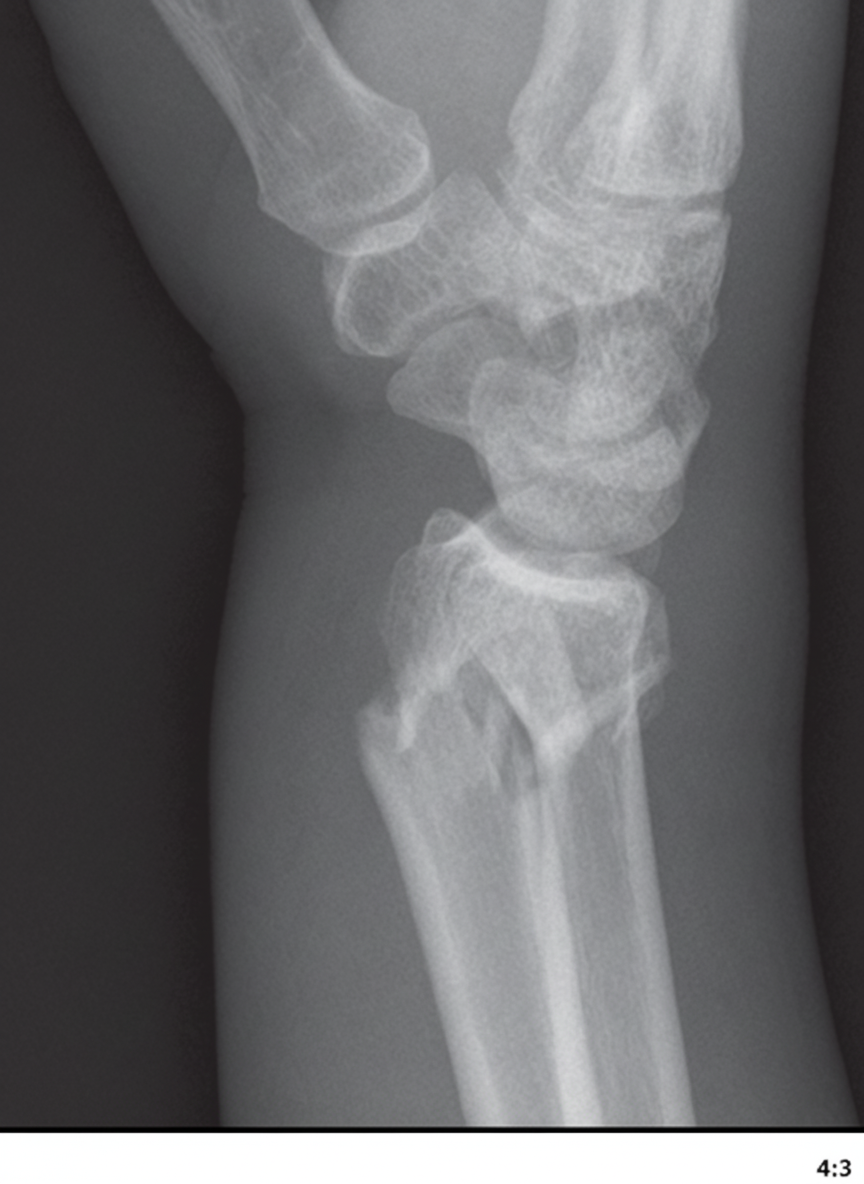
A 26-year-old engineering student presents with wrist pain after a fall on an outstretched hand. Examination reveals swelling, diffuse tenderness, deformity, and limited wrist movement. A PA view X-ray of the wrist shows a 'spilled teacup' sign. What is the likely diagnosis?
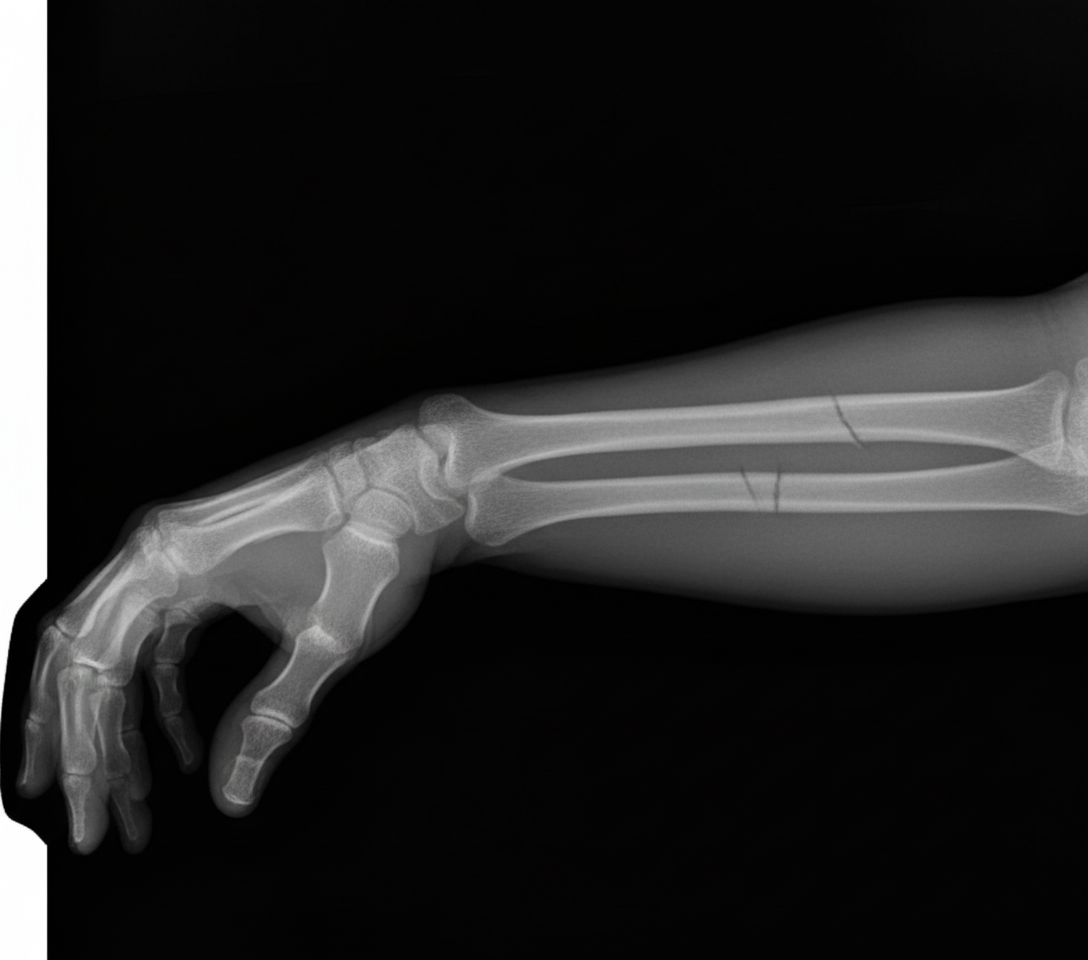
Which tendon is involved in Colles' fracture?
Explanation: **Explanation:** The correct answer is **Distal end of the radius**. Non-union is defined as a permanent failure of bone healing. The distal end of the radius is characterized by **cancellous (spongy) bone** and a rich vascular supply. Cancellous bone has a large surface area and high osteogenic potential, which facilitates rapid and reliable healing. Consequently, fractures like Colles' fracture almost always unite, though they may result in *malunion* (healing in a bad position) rather than non-union. **Why the other options are common sites for non-union:** * **Waist of the scaphoid:** This site is notorious for non-union due to its **retrograde blood supply**. The vessels enter the distal pole; a fracture at the waist cuts off the blood supply to the proximal pole, leading to avascular necrosis (AVN) and non-union. * **Neck of the femur:** This is an **intracapsular** fracture. The synovial fluid contains collagenases that inhibit callus formation, and the blood supply (mainly via the medial circumflex femoral artery) is frequently disrupted, leading to high rates of non-union and AVN. * **Distal third of tibia:** This area has a **tenuous blood supply** and minimal soft tissue/muscle cover. The nutrient artery enters the bone in the upper third, leaving the distal third prone to ischemia and subsequent non-union. **High-Yield Clinical Pearls for NEET-PG:** * **Most common site of non-union in the body:** Scaphoid (specifically the waist). * **Most common long bone for non-union:** Tibia (distal third). * **Atrophic Non-union:** Characterized by "pencil-like" bone ends on X-ray due to poor vascularity. * **Hypertrophic Non-union:** Characterized by "elephant foot" appearance, indicating adequate blood supply but inadequate immobilization.
Explanation: **Explanation:** **Hill-Sachs lesion** is a classic radiological finding associated with **recurrent anterior dislocation of the shoulder**. It is a compression fracture (indentation) of the **posterosuperolateral aspect of the humeral head**. **Mechanism:** When the shoulder dislocates anteriorly, the soft humeral head is driven against the hard, sharp anterior edge of the glenoid labrum. This mechanical impact creates a "divot" or "dent" in the humeral head. In recurrent cases, this lesion becomes more pronounced, making the joint inherently unstable and prone to further dislocations. **Analysis of Options:** * **Option A (Correct):** Recurrent anterior shoulder dislocation is the primary cause. It is often seen alongside a **Bankart lesion** (avulsion of the anterior-inferior glenoid labrum). * **Option B:** Recurrent hip dislocations are rare and usually associated with high-energy trauma or dysplasia; they do not involve Hill-Sachs lesions. * **Option C:** **Panner’s disease** is osteochondrosis of the capitellum of the humerus, typically seen in young children (throwers). * **Option D:** Fracture of the neck of femur is a common geriatric injury unrelated to glenohumeral instability. **NEET-PG High-Yield Pearls:** * **Reverse Hill-Sachs Lesion:** An impaction fracture of the *anteromedial* humeral head, associated with **posterior shoulder dislocation**. * **Bankart Lesion:** Injury to the anterior-inferior labrum; if it involves a bone fragment, it is called a "Bony Bankart." * **Imaging:** The Hill-Sachs lesion is best visualized on an **AP view with internal rotation** or a **Stryker Notch view**. * **Management:** Large lesions may require surgical intervention like the **Remplissage procedure**.
Explanation: **Explanation:** The **Talus** is highly susceptible to Avascular Necrosis (AVN) due to its unique anatomical and vascular characteristics. Approximately **60% of the talus is covered by articular cartilage**, leaving a limited surface area for nutrient arteries to enter. Furthermore, it lacks any muscular or tendinous attachments. Its blood supply is **retrograde** (flowing from the neck to the body), primarily derived from the artery of the tarsal canal (branch of the posterior tibial artery). Fractures of the talar neck frequently disrupt this precarious blood supply, leading to a high incidence of AVN (Hawkins’ Classification). **Analysis of Options:** * **Cuboid & Calcaneum:** These bones have a robust, multi-directional blood supply and are surrounded by significant soft tissue and muscular attachments. AVN in these bones is extremely rare. * **Navicular:** While the navicular can undergo AVN (known as **Kohler’s disease** in children or **Mueller-Weiss syndrome** in adults), it is statistically less common than post-traumatic AVN of the talus. **Clinical Pearls for NEET-PG:** * **Hawkins’ Sign:** A subchondral radiolucent line seen on an X-ray of the talus 6–8 weeks post-fracture. It indicates intact vascularity (active resorption of bone) and is a **good prognostic sign** (rules out AVN). * **Other bones prone to AVN:** Scaphoid (proximal pole), Femoral head, and Capitate. These all share the common feature of **retrograde blood flow**. * **Most common site of AVN in the body:** Head of the Femur.
Explanation: **Explanation:** The patient is presenting with **Cast Syndrome** (also known as Superior Mesenteric Artery Syndrome). This occurs when a tight spinal POP (Plaster of Paris) cast, often used for scoliosis or spinal fractures, causes hyperextension of the spine. This position narrows the angle between the **Superior Mesenteric Artery (SMA)** and the **Aorta**, leading to compression of the **third part of the duodenum** which lies between them. The resulting mechanical obstruction leads to bilious vomiting, abdominal distension, and pain. **Analysis of Options:** * **B. Duodenal Obstruction (Correct):** This is the hallmark of Cast Syndrome. The compression of the duodenum by the SMA is the direct cause of the symptoms. * **A. Acute dilation of the stomach:** While this can occur secondary to duodenal obstruction (as the stomach cannot empty), it is a consequence rather than the primary diagnosis. * **C. Peritonitis:** This presents with guarding, rigidity, and fever. While a late complication of untreated obstruction could be perforation, it is not the primary diagnosis in a stable patient in a cast. * **D. Acute pancreatitis:** While it causes vomiting and pain, it is not specifically associated with spinal casting or mechanical compression by the SMA. **NEET-PG High-Yield Pearls:** * **Anatomical Site:** The 3rd part of the duodenum is compressed. * **Predisposing Factors:** Rapid weight loss (loss of mesenteric fat pad), spinal surgery, or application of a body cast (hip spica or body jacket). * **Management:** Immediate removal/splitting of the cast, nasogastric decompression, and placing the patient in the **left lateral decubitus or prone position** to open the SMA angle.
Explanation: **Explanation:** The correct answer is **Monteggia’s deformity**. This injury is defined as a **fracture of the proximal third of the ulna** associated with **dislocation of the proximal radio-ulnar joint (radial head dislocation)**. The underlying medical concept involves the anatomical relationship between the radius and ulna; they act as a "closed ring" system. When one bone suffers a displaced fracture, the force is often transmitted to the other, leading to either a second fracture or a dislocation of the adjacent joint. In Monteggia's injury, the ulnar shaft breaks, and the force displaces the radial head, most commonly in an anterior direction. **Analysis of Incorrect Options:** * **A. Navicular (scaphoid) fracture:** This is a fracture of a carpal bone in the wrist, usually caused by a fall on an outstretched hand (FOOSH). It does not involve the ulna or radial head. * **C. Greenstick fracture:** This is an incomplete fracture typically seen in children where the bone bends and cracks but does not break completely. It describes a fracture morphology, not a specific injury pattern involving dislocation. * **D. Spiral fracture:** This describes a fracture line caused by a twisting (rotational) force. Like the greenstick fracture, it is a descriptive term for the break itself rather than a named fracture-dislocation complex. **Clinical Pearls for NEET-PG:** * **Mnemonic (MU-GR):** **M**onteggia = **U**lna fracture (proximal); **G**aleazzi = **R**adius fracture (distal). * **Galeazzi Fracture:** Fracture of the distal third of the radius with dislocation of the distal radio-ulnar joint (DRUJ). * **Bado Classification:** Used to classify Monteggia fractures based on the direction of radial head dislocation (Type I/Anterior is the most common). * **Nerve Injury:** The **Posterior Interosseous Nerve (PIN)**, a branch of the radial nerve, is the most commonly injured nerve in Monteggia fractures.
Explanation: The **Ruedi-Allgower classification** is the standard system used to categorize **Pilon fractures**, which are intra-articular fractures of the **distal tibia** caused by high-energy axial loading (vertical compression). ### Why the Correct Answer is Right: The classification focuses on the degree of comminution and displacement of the distal tibial articular surface. It is divided into three types: * **Type I:** Non-displaced articular fracture. * **Type II:** Displaced articular fracture but without significant comminution. * **Type III:** Highly comminuted and displaced articular fracture (the most severe). ### Why Other Options are Wrong: * **Radius fracture:** Distal radius fractures are commonly classified using the **Frykman** or **Fernandez** classifications. * **Fibular fracture:** While often associated with Pilon fractures, isolated fibular fractures are typically classified using the **Danis-Weber** system (based on the level of the fracture relative to the syndesmosis). * **Proximal tibial fracture:** These are known as Tibial Plateau fractures and are classified using the **Schatzker** classification. ### High-Yield Clinical Pearls for NEET-PG: * **Mechanism of Injury:** Pilon fractures usually result from a fall from height or motor vehicle accidents where the talus is driven into the tibial plafond like a "pestle" into a "mortar." * **Associated Injuries:** Always look for "Don Juan Syndrome" (calcaneal fractures and lumbar spine compression fractures) in axial loading injuries. * **Management Tip:** Soft tissue management is critical; these are often managed with initial external fixation followed by delayed internal fixation (ORIF) once the "wrinkle sign" appears.
Explanation: **Explanation:** The correct answer is **A. Navicular (scaphoid) fracture**. **Why Scaphoid Fracture?** Avascular Necrosis (AVN) occurs when the blood supply to a bone is disrupted, leading to bone death. The scaphoid bone (historically called the navicular bone of the hand) has a unique **retrograde blood supply**. The nutrient arteries enter the bone through the distal pole and flow proximally. Therefore, a fracture across the waist or proximal pole of the scaphoid often severs this blood supply, leaving the proximal fragment ischemic and prone to AVN (Preiser’s disease). **Analysis of Incorrect Options:** * **B. Monteggia’s deformity:** This involves a fracture of the proximal third of the ulna with dislocation of the radial head. While it can lead to nerve injuries (PIN) or malunion, it is not typically associated with AVN. * **C. Greenstick fracture:** This is an incomplete fracture seen in children where the bone bends and breaks only on one side. Because the periosteum remains largely intact and pediatric bone is highly vascular, AVN is not a risk. * **D. Spiral fracture:** This is a descriptive term for a fracture pattern caused by a twisting force. It does not inherently imply a risk of AVN unless it occurs in a specific "at-risk" anatomical site. **High-Yield Clinical Pearls for NEET-PG:** * **Common sites for AVN post-trauma:** Head of femur (most common), Scaphoid (proximal pole), Talus (neck), and Humeral head. * **Scaphoid Fracture:** Tenderness in the **Anatomical Snuffbox** is the classic clinical sign. * **Radiology:** AVN appears as **increased radiodensity** (sclerosis) on X-ray because the dead bone does not undergo the resorption seen in surrounding vascularized bone. * **Management:** Undisplaced scaphoid fractures are treated with a Scaphoid cast; displaced fractures require ORIF with a Herbert screw.
Explanation: **Explanation:** **1. Why Radius is Correct:** The **distal radius** is the most common site of fracture in the pediatric population, accounting for approximately 20–25% of all childhood fractures. This is primarily due to the mechanism of injury: a **Fall On an Outstretched Hand (FOOSH)**. In children, the distal radial metaphysis is a biomechanically weak area because of rapid bone turnover and remodeling during growth, making it susceptible to "buckle" (torus) or "greenstick" fractures. **2. Analysis of Incorrect Options:** * **Clavicle (B):** While the clavicle is the most common fracture during **birth/delivery** and a very frequent injury in early childhood, it ranks second to the distal radius in overall pediatric incidence. * **Distal Humerus (C):** Supracondylar fractures of the humerus are the most common fractures **around the elbow** in children and carry a high risk of neurovascular complications, but they are less frequent than distal radius fractures. * **Femur (A):** Femoral fractures are significant injuries but are much less common than upper limb fractures due to the high energy required to break the strongest bone in the body. **3. Clinical Pearls for NEET-PG:** * **Most common site of fracture in children:** Distal Radius. * **Most common fracture during birth:** Clavicle. * **Most common elbow fracture in children:** Supracondylar fracture of the humerus. * **Unique Pediatric Fracture Types:** * *Torus (Buckle) Fracture:* Compression injury causing a bulge in the cortex. * *Greenstick Fracture:* Incomplete fracture where one cortex is broken and the other is bent. * **Physeal Injuries:** Classified using the **Salter-Harris Classification**; Type II is the most common.
Explanation: **Explanation:** The clinical presentation and the classic radiographic sign described are pathognomonic for **Lunate/Perilunate dislocations**. 1. **Why Perilunate Dislocation is correct:** The **'spilled teacup' sign** is seen on the **lateral view** (though often identified when evaluating wrist trauma series) when the lunate loses its normal concave relationship with the capitate and the radius. In a **lunate dislocation**, the lunate is displaced volarly (tilted), resembling a cup spilling its contents. In a **perilunate dislocation**, the lunate remains aligned with the radius, but the capitate and the rest of the carpus are displaced posteriorly. These injuries result from high-energy trauma on an outstretched hand (FOOSH). 2. **Why other options are incorrect:** * **Scaphoid fracture:** While common after FOOSH, it presents with localized tenderness in the **anatomical snuffbox**. Radiographs would show a fracture line through the scaphoid waist, not the 'spilled teacup' sign. * **Post-traumatic arthritis:** This is a chronic, late complication of joint trauma characterized by joint space narrowing and osteophytes, not an acute presentation with deformity. * **Fracture of the radial styloid (Chauffeur's fracture):** This involves an intra-articular fracture of the distal radius. While it causes radial-sided pain, it does not produce the specific carpal malalignment seen in the 'spilled teacup' sign. **NEET-PG High-Yield Pearls:** * **Terry Thomas Sign:** Increased scapholunate gap (>3mm), indicating scapholunate dissociation. * **Piece of Pie Sign:** On the **AP view**, the lunate appears triangular instead of quadrilateral due to rotation in a lunate dislocation. * **Median Nerve Compression:** The most common acute complication of lunate dislocation due to its volar displacement into the carpal tunnel. * **Order of Injury:** These injuries follow the **Mayfield classification** (Stage IV is lunate dislocation).
Explanation: **Explanation:** The correct answer is **Extensor Pollicis Longus (EPL)**. **Why it is correct:** In a Colles' fracture (distal radius fracture with dorsal displacement), the **Extensor Pollicis Longus (EPL)** tendon is at significant risk of delayed rupture. This occurs because the EPL tendon hooks around **Lister’s tubercle** on the dorsal aspect of the distal radius. The fracture often creates a sharp bony irregularity or causes localized ischemia to the tendon due to its precarious blood supply within the fibro-osseous tunnel (3rd dorsal compartment). This leads to attrition and eventual rupture, typically occurring **4 to 8 weeks** post-injury. **Why other options are incorrect:** * **Abductor Pollicis Longus (APL) & Extensor Pollicis Brevis (EPB):** These tendons reside in the **1st dorsal compartment**. While they are located near the radial styloid, they do not wrap around a bony prominence like Lister’s tubercle and are not subject to the same mechanical friction or ischemic vulnerability following a Colles' fracture. They are more commonly associated with **De Quervain’s Tenosynovitis**. **High-Yield Clinical Pearls for NEET-PG:** * **Clinical Presentation:** A patient post-Colles' fracture suddenly loses the ability to extend the distal phalanx of the thumb (IP joint). * **Management:** Since the ruptured ends of the EPL are often frayed and ischemic, a primary repair is usually not possible. The treatment of choice is an **Indicis Proprius (EIP) tendon transfer**. * **Lister’s Tubercle:** It acts as a pulley for the EPL; its involvement is the anatomical reason why the EPL is the most commonly ruptured tendon in distal radius fractures. * **Colles' Fracture Deformity:** Classically described as a **"Dinner Fork Deformity."**
Principles of Fracture Management
Practice Questions
Upper Limb Fractures
Practice Questions
Lower Limb Fractures
Practice Questions
Spinal Trauma
Practice Questions
Pelvic and Acetabular Fractures
Practice Questions
Open Fractures
Practice Questions
Fractures in Children
Practice Questions
Fracture Complications
Practice Questions
Nonunion and Malunion
Practice Questions
Polytrauma Management
Practice Questions
Joint Dislocations
Practice Questions
Soft Tissue Injuries
Practice Questions
Get full access to all questions, explanations, and performance tracking.
Start For Free