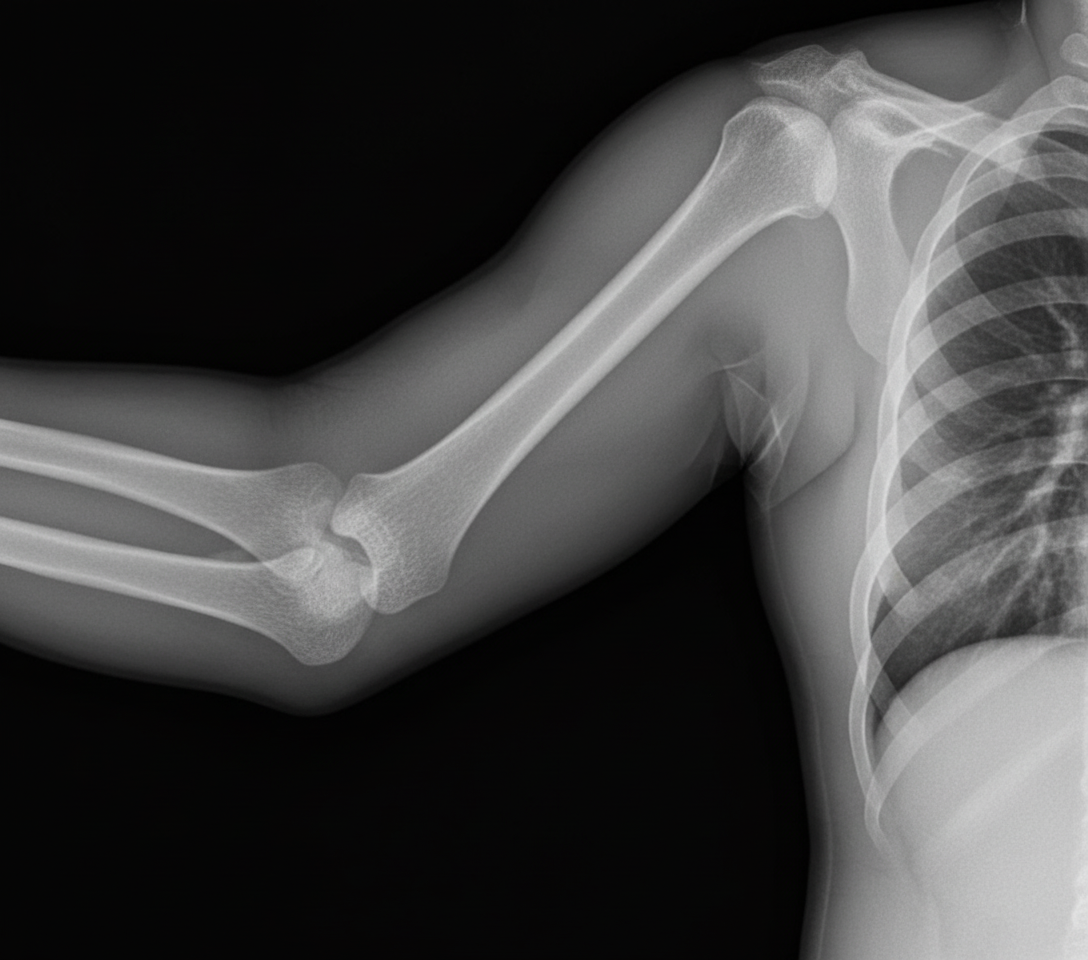
Which of the following elbow injuries involves the three-point relationship?
In radial nerve injuries, paralysis of the brachioradialis, extensor carpi radialis longus and brevis, extensor digitorum, and extensor pollicis longus, but sparing of the triceps, places the nerve lesion at which level?
Which type of nerve injury, involving contusion where the continuity of both the epineurial sheath and the axons is maintained, is known as:
What is the most common cause of amputation?
What are the complications of fracture of the radius?
According to Seddon's Classification, which of the following statements is FALSE?
Which of the following is NOT a lesion associated with recurrent dislocation of the shoulder?
Which of the following positions is classically seen in posterior dislocation of the hip?
A 35-year-old male presented with a fracture of the bilateral femur following a road traffic accident. After 3 days of hospitalization, he developed acute onset dyspnea, fever, and a petechial rash in the chest region. Which of the following is the most probable diagnosis?
What type of dislocation is associated with a Hill-Sachs lesion?
Explanation: ### Explanation The **three-point relationship** of the elbow refers to the clinical landmarking of the **olecranon process**, the **medial epicondyle**, and the **lateral epicondyle**. In a normal flexed elbow (90°), these three points form an isosceles triangle; in full extension, they lie in a straight horizontal line. #### Why Supracondylar Fracture is Correct In a **Supracondylar fracture of the humerus**, the fracture line is proximal to the epicondyles. Since the anatomy of the distal humerus and its relationship with the proximal ulna remains intact, the **three-point relationship is maintained**. This is the most critical clinical feature used to differentiate it from an elbow dislocation. #### Why Other Options are Incorrect * **Posterior Dislocation of the Elbow:** The olecranon is displaced posteriorly relative to the epicondyles. This **disturbs** the three-point relationship, making it the primary clinical differentiator from a supracondylar fracture. * **Fracture of the Medial/Lateral Epicondyle:** These are intra-articular or peri-articular fractures involving the landmarks themselves. Displacement of either epicondyle will **distort** the equilateral/isosceles triangle symmetry. #### NEET-PG High-Yield Pearls * **The "Rule of Three":** In Supracondylar fractures, the relationship is **Normal**. In Elbow Dislocation, the relationship is **Abnormal**. * **Most Common Complication:** The most common immediate complication of supracondylar fractures is **Neuropraxia** (Median nerve, specifically the Anterior Interosseous Nerve/AIN). * **Late Sequel:** The most characteristic late deformity is **Cubitus Varus** (Gunstock deformity). * **Emergency:** Always check the radial pulse to rule out **Volkmann’s Ischemic Contracture (VIC)** due to brachial artery involvement.
Explanation: ### Explanation The radial nerve originates from the posterior cord of the brachial plexus (C5-T1). To determine the level of a radial nerve lesion, one must evaluate the sequence of motor branches. **1. Why the Correct Answer is Right:** The **triceps brachii** is supplied by the radial nerve in the axilla and the upper part of the spiral groove. If the triceps is **spared**, the lesion must be distal to these branches. The branches to the **brachioradialis (BR)** and **extensor carpi radialis longus (ECRL)** arise just above the elbow (lateral supracondylar ridge). Since these muscles are paralyzed along with the finger and thumb extensors, the lesion must be located between the origin of the triceps branches and the elbow—specifically, at the **humeral shaft (mid-shaft)** within the spiral groove. **2. Why the Incorrect Options are Wrong:** * **Level of the elbow (A):** A lesion here (e.g., Posterior Interosseous Nerve palsy) would spare the BR and ECRL, as their innervation occurs proximal to the elbow. * **Avulsion at nerve root (C) / Brachial plexus (D):** Lesions at these proximal levels would involve the triceps, resulting in the loss of elbow extension, and would likely present with additional deficits in other nerves (e.g., axillary or ulnar). **3. Clinical Pearls for NEET-PG:** * **Saturday Night Palsy:** Compression in the axilla; triceps is involved. * **Holstein-Lewis Fracture:** Spiral fracture of the distal third of the humerus; most commonly associated with radial nerve palsy. * **Wrist Drop:** The hallmark of radial nerve injury above the level of the wrist. * **PIN Palsy (Low Radial Nerve Palsy):** Characterized by "Finger Drop" with **no** wrist drop (because ECRL is spared) and no sensory loss.
Explanation: ### Explanation The question describes **Neuropraxia**, the mildest form of nerve injury according to Seddon’s classification. **1. Why Neuropraxia is correct:** Neuropraxia is a physiological conduction block rather than a structural disruption. It is typically caused by compression or contusion. Key features include: * **Continuity:** Both the axon and the connective tissue sheaths (epineurium, perineurium, endoneurium) remain intact. * **Pathology:** Localized demyelination occurs at the site of injury, but there is **no Wallerian degeneration** distal to the injury. * **Recovery:** Full recovery occurs spontaneously within days to weeks as the myelin sheath repairs. **2. Why the other options are incorrect:** * **Axonotmesis:** This involves structural damage to the **axon**, leading to Wallerian degeneration. However, the supporting connective tissue frameworks (like the epineurium) remain intact. Recovery is slow (1mm/day) and depends on axonal regeneration. * **Neurotmesis:** This is the most severe grade where the nerve is **completely severed** (both axons and all connective tissue sheaths are divided). Spontaneous recovery is impossible; surgical repair is mandatory. * **Traumatic Neuroma:** This is a late complication of neurotmesis. When a nerve is cut and not apposed, the regenerating axonal sprouts form a disorganized, painful mass of fibrous tissue. **3. NEET-PG High-Yield Pearls:** * **Seddon vs. Sunderland:** Remember that Sunderland Grade I corresponds to Neuropraxia, Grade II to Axonotmesis, and Grades III-V represent varying degrees of Neurotmesis. * **Electrodiagnostic finding:** In Neuropraxia, Nerve Conduction Velocity (NCV) is normal distal to the lesion but shows a block across the lesion. * **Clinical Example:** "Saturday Night Palsy" (Radial nerve compression) is a classic example of Neuropraxia. * **Prognosis:** Neuropraxia = Excellent; Axonotmesis = Fair/Good; Neurotmesis = Poor without surgery.
Explanation: **Explanation:** The correct answer is **Peripheral Vascular Disease (PVD)**. **1. Why Peripheral Vascular Disease is correct:** Globally and in modern clinical practice, PVD (often associated with **Diabetes Mellitus**) is the leading cause of limb amputations, accounting for nearly 80-90% of all cases in the elderly population. The underlying pathophysiology involves chronic ischemia, non-healing arterial ulcers, and subsequent gangrene. In diabetic patients, the combination of "angiopathy, neuropathy, and immunopathy" significantly increases the risk of lower-limb loss. **2. Why other options are incorrect:** * **Trauma:** While trauma is the leading cause of amputation in **young adults and children** (specifically machinery accidents or vehicular trauma), it ranks second to vascular diseases in the general population. * **Frostbite and Burns:** These are classified under thermal injuries. While they can lead to necrosis necessitating amputation, they represent a very small percentage of total cases compared to chronic systemic diseases. **3. NEET-PG High-Yield Pearls:** * **Most common cause overall:** Peripheral Vascular Disease (PVD). * **Most common cause in young adults:** Trauma. * **Most common site of amputation:** Lower limb (specifically the toe or transtibial/below-knee). * **Ideal Stump Shape:** Cylindrical (facilitates better prosthetic fitting). * **Myodesis vs. Myoplasty:** *Myodesis* (suturing muscle to bone) is preferred over *myoplasty* (suturing muscle to muscle) in major amputations to provide better distal muscle stabilization. * **Krukenberg Procedure:** A specialized amputation of the forearm that creates a "pincer" grip using the radius and ulna, indicated for bilateral hand loss in blind patients.
Explanation: Fractures of the radius (including distal radius, shaft, or radial head) are common orthopedic injuries associated with several significant complications. The correct answer is **All of the above** because radial fractures can lead to vascular, soft tissue, and surgical complications. ### **Explanation of Options:** * **Volkmann Ischemic Contracture (VIC):** This is a devastating sequela of **Compartment Syndrome**. Fractures of the forearm (radius and ulna) are high-risk areas for increased intracompartmental pressure. If left untreated, ischemia leads to muscle infarction and eventual fibrosis/contracture of the forearm flexors. * **Myositis Ossificans:** This refers to heterotopic ossification within the soft tissues/muscles. It is particularly common in fractures around the elbow (radial head/neck) or when there is significant soft tissue trauma and hematoma formation. * **Infection:** This is a potential complication in any **open fracture** of the radius or following **Open Reduction and Internal Fixation (ORIF)** using plates and screws. ### **Clinical Pearls for NEET-PG:** * **Colles’ Fracture:** The most common complication is **Stiffness** (shoulder-hand syndrome), followed by **Malunion** (Dinner fork deformity). The most common late tendon complication is rupture of the **Extensor Pollicis Longus (EPL)**. * **Galeazzi Fracture:** (Distal radius fracture + DRUJ dislocation) often requires ORIF because it is inherently unstable. * **Monteggia Fracture:** (Proximal ulna fracture + Radial head dislocation) carries a risk of **Posterior Interosseous Nerve (PIN)** injury. * **VIC Sign:** The "Volkmann’s sign" is present when passive extension of the fingers is painful and limited unless the wrist is flexed.
Explanation: ### Explanation **Seddon’s Classification** of nerve injuries is a high-yield topic for NEET-PG, categorizing injuries into three types based on the severity of damage to the nerve components. **Why Option C is the Correct (False) Statement:** **Neurotmesis** is the most severe form of nerve injury involving complete anatomical disruption of both the axon and the connective tissue sheaths (endoneurium, perineurium, and epineurium). Because the guiding "tubes" for axonal regrowth are destroyed, **spontaneous recovery is impossible**. Surgical intervention (nerve repair or grafting) is mandatory, and even then, recovery is often incomplete. **Analysis of Other Options:** * **Option A:** True. Neurotmesis is defined by the complete transection of the nerve trunk. * **Option B:** True. In **Axonotmesis**, the axon is damaged but the endoneurial sheath remains intact. This allows for Wallerian degeneration followed by regeneration (approx. 1mm/day). A **positive Tinel’s sign** (tingling on percussion) that migrates distally is a hallmark of progressive axonal regeneration. * **Option D:** True. **Saturday night palsy** is a classic example of **Neuropraxia** (temporary physiological conduction block without anatomical damage) affecting the radial nerve due to prolonged compression. **High-Yield Clinical Pearls for NEET-PG:** 1. **Neuropraxia:** No Wallerian degeneration; recovery is rapid (days to weeks) and complete. 2. **Axonotmesis:** Wallerian degeneration occurs; recovery is slow but usually good because the basement membrane remains intact. 3. **Sunderland’s Classification:** An expansion of Seddon’s; it divides injuries into 5 degrees (1st degree = Neuropraxia; 5th degree = Neurotmesis). 4. **Order of recovery:** Autonomic function returns first, followed by deep pain, superficial pain, touch, and finally motor function.
Explanation: **Explanation:** Recurrent shoulder dislocation is primarily a result of structural damage to the **anterior-inferior glenohumeral complex**, which fails to maintain joint stability after an initial traumatic event. **Why Supraspinatus tear is the correct answer:** A Supraspinatus tear is a component of a **Rotator Cuff tear**. While rotator cuff tears are common in older patients following a shoulder dislocation, they are generally considered a *consequence* or a comorbid injury rather than a primary lesion responsible for the *recurrence* of instability. Recurrent dislocation is driven by "essential lesions" that compromise the labrum, bone, or capsule, not the dynamic stabilizers like the supraspinatus. **Analysis of Incorrect Options:** * **Bankart Lesion:** This is the most common "essential lesion." It involves an avulsion of the anterior-inferior glenoid labrum. Its presence significantly reduces joint stability, making it a hallmark of recurrence. * **Hill-Sachs Lesion:** This is a compression fracture of the posterolateral aspect of the humeral head, caused by the humeral head striking the sharp anterior glenoid rim during dislocation. A large Hill-Sachs lesion allows the humerus to "engage" the glenoid, facilitating repeat dislocations. * **Capsular Laxity:** Repeated dislocations stretch the joint capsule and the glenohumeral ligaments (especially the IGHL). This increased redundant volume in the capsule fails to provide the necessary tension to keep the humeral head centered. **High-Yield Clinical Pearls for NEET-PG:** * **ALPSA Lesion:** Anterior Labral Periosteal Sleeve Avulsion (labrum is displaced medially but remains attached to the periosteum). * **HAGL Lesion:** Humeral Avulsion of Glenohumeral Ligaments. * **Gold Standard Investigation:** MRI Arthrography is the investigation of choice for labral tears. * **Surgery:** Bankart Repair (reattaching the labrum) is the standard treatment for recurrent instability.
Explanation: In Orthopaedics, the clinical presentation of hip injuries is a high-yield topic for NEET-PG. The correct answer is **Posterior dislocation of the hip**, which is the most common type of hip dislocation (approx. 90%). ### **1. Why Posterior Dislocation is Correct** The classic clinical deformity in posterior dislocation is **Flexion, Adduction, and Internal Rotation (FADIR)**. This occurs because the femoral head is forced out of the acetabulum posteriorly, causing the limb to shorten and the femur to rotate medially. * **Mechanism:** Usually a "dashboard injury" where a force is applied to the flexed knee (e.g., RTA). ### **2. Why Other Options are Incorrect** * **Fracture of the Neck of Femur:** Presents with **Flexion, Abduction, and External Rotation**. The limb appears shortened, but unlike dislocation, it is rotated laterally. * **Anterior Dislocation of the Hip:** Presents with **Flexion, Abduction, and External Rotation (FABER)**. The femoral head is displaced anteriorly, often making it palpable in the inguinal region. * **Congenital Dislocation of the Hip (DDH):** Typically presents in neonates/infants with limited abduction, limb length discrepancy (Galeazzi sign), and positive Ortolani/Barlow maneuvers, rather than an acute traumatic deformity. ### **3. Clinical Pearls for NEET-PG** * **Mnemonic for Posterior Dislocation:** **"P-I"** (Posterior = Internal Rotation). * **Mnemonic for Anterior Dislocation/Neck Fracture:** **"A-E"** (Anterior/Neck = External Rotation). * **Nerve Injury:** The **Sciatic nerve** (specifically the peroneal component) is most commonly injured in posterior dislocations. * **Emergency:** Hip dislocation is a surgical emergency due to the high risk of **Avascular Necrosis (AVN)** of the femoral head. Reduction should ideally occur within 6 hours.
Explanation: ### Explanation **Correct Answer: A. Fat Embolism** The clinical presentation described is a classic triad of **Fat Embolism Syndrome (FES)**. FES typically occurs 24–72 hours after a traumatic injury to long bones (most commonly the **femur** or pelvis). * **Pathophysiology:** Mechanical trauma releases fat globules from the bone marrow into the systemic circulation. These globules cause mechanical obstruction and trigger a biochemical inflammatory response (free fatty acids damaging the endothelium). * **Clinical Triad:** 1. **Respiratory distress:** Dyspnea and hypoxemia (most common early sign). 2. **Neurological symptoms:** Confusion, agitation, or seizures. 3. **Petechial rash:** Typically found in the conjunctiva, axilla, and chest (pathognomonic but present in only 20-50% of cases). **Why other options are incorrect:** * **B. Air Embolism:** Usually occurs following central venous catheterization, neck trauma, or surgery in the sitting position. It presents suddenly (within seconds/minutes), not after 3 days. * **C. Deep Venous Thrombosis (DVT):** While common after trauma, DVT usually presents with unilateral limb swelling. If it leads to Pulmonary Embolism (PE), it causes dyspnea, but a **petechial rash and fever** are not characteristic of PE. * **D. Saddle Thrombus:** This is a large pulmonary embolism lodged at the bifurcation of the pulmonary artery. It causes sudden hemodynamic collapse and right heart failure, but not the specific petechial rash seen in FES. **High-Yield Clinical Pearls for NEET-PG:** * **Gurd’s Criteria:** Used for diagnosing FES (Major: Respiratory insufficiency, Petechial rash, Cerebral involvement). * **Snowstorm Appearance:** Classic finding on Chest X-ray (diffuse bilateral infiltrates). * **Treatment:** Primarily **supportive** (Oxygenation/Ventilation). Early stabilization/fixation of the fracture is the best preventive measure. * **Fat Globules** may be seen in urine or sputum (though not highly sensitive).
Explanation: **Explanation:** A **Hill-Sachs lesion** is a classic radiological finding associated with **Anterior Shoulder Dislocation**. It is a compression fracture (indentation) of the posterosuperolateral aspect of the humeral head. This occurs when the humeral head is forced out of the glenoid cavity and strikes against the sharp anterior-inferior edge of the glenoid rim. * **Mechanism:** During an anterior dislocation, the soft humeral head is "dented" by the harder cortical bone of the glenoid. This is often associated with a **Bankart lesion** (avulsion of the anterior-inferior labrum). **Analysis of Incorrect Options:** * **A. Hip joint dislocation:** Associated with injuries like the *Pipkin fracture* (femoral head fracture) or posterior wall acetabular fractures, but not Hill-Sachs. * **B. Elbow dislocation:** Commonly associated with the "Terrible Triad" (dislocation + radial head fracture + coronoid process fracture). * **C. Jaw dislocation:** Usually involves the temporomandibular joint (TMJ) and is associated with ligamentous laxity or trauma, not humeral head compression. **High-Yield Clinical Pearls for NEET-PG:** * **Reverse Hill-Sachs Lesion:** An indentation on the *anterior* aspect of the humeral head, seen in **Posterior Shoulder Dislocation**. * **Bankart Lesion:** The most common cause of recurrent shoulder dislocation; it involves the anteroinferior glenoid labrum. * **Imaging:** The Hill-Sachs lesion is best visualized on an **AP view with internal rotation** or a **Stryker Notch view**. * **Most Common Type:** Anterior dislocation is the most common type of shoulder dislocation (approx. 95%).
Principles of Fracture Management
Practice Questions
Upper Limb Fractures
Practice Questions
Lower Limb Fractures
Practice Questions
Spinal Trauma
Practice Questions
Pelvic and Acetabular Fractures
Practice Questions
Open Fractures
Practice Questions
Fractures in Children
Practice Questions
Fracture Complications
Practice Questions
Nonunion and Malunion
Practice Questions
Polytrauma Management
Practice Questions
Joint Dislocations
Practice Questions
Soft Tissue Injuries
Practice Questions
Get full access to all questions, explanations, and performance tracking.
Start For Free