
Thoracic Spine Disorders — MCQs

Percentage of surgical site infection in patients with a clean-contaminated wound after prophylactic antibiotic administration?
Answer: C. 0% to <10%
A 45-year-old man develops acute low-back pain radiating down the right leg, with progressive ankle-dorsiflexion weakness of MRC grade 2/5. MRI shows an L4–L5 disc prolapse compressing the right L5 root. Which management is indicated?
Answer: C. Urgent decompression
A skeletally immature 13-year-old has a flexible 30° right-thoracic lateral spinal curve with vertebral rotation, an apex at T6, and Risser grade 0. Neurological examination is normal, radiographs show no congenital vertebral anomaly, and no underlying cause is identified. A Milwaukee brace is prescribed. Which condition is being treated?
Answer: C. Idiopathic Scoliosis
How is the degree of deformity in scoliosis calculated?
Answer: C. Cobb's method
A 75-year-old female has chronic backache. Her DXA scan shows a T-score of -2.8. She has a wedge compression fracture at L1. What is the most likely diagnosis?
Answer: A. Osteoporosis
Which angle is the standard radiographic measure used to quantify scoliosis severity?
Answer: C. Cobb's Angle
A 50-year-old male with a history of chronic low back pain presents with new-onset bowel and bladder incontinence. Which investigation is indicated urgently?
Answer: A. Lumbar MRI
A 25-year-old man presents with neck pain after a road traffic accident; neurological examination is normal. What is the most likely diagnosis on this lateral cervical radiograph?
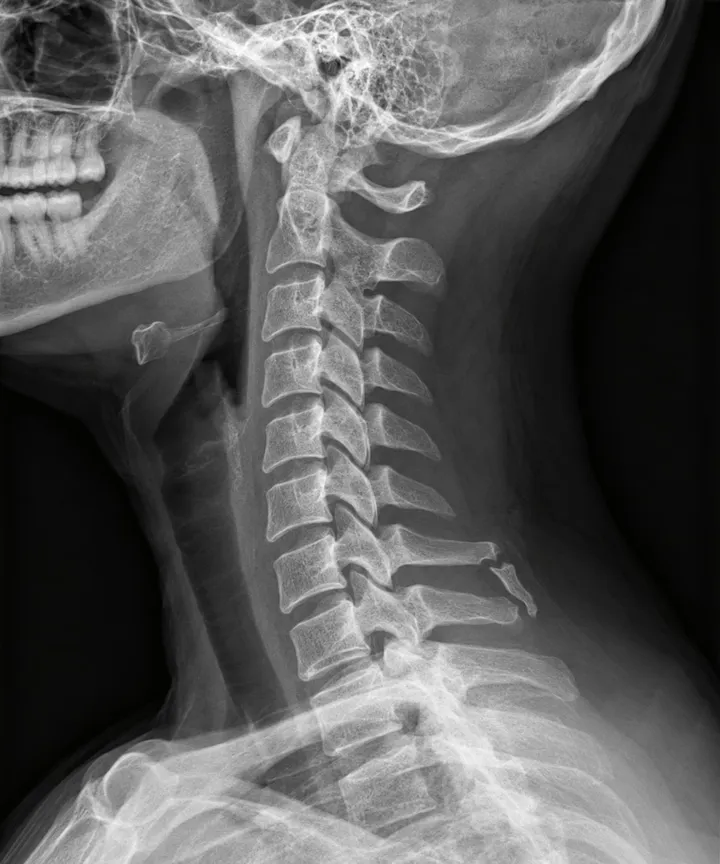
Answer: A. Spinous process fracture
Which of the following is least likely to be associated with progressive congenital scoliosis? Assume that the block vertebra is bilateral and symmetric.
Answer: C. Congenital block vertebra
The compression fracture is commonest in
Answer: D. Lower thoracic spine
Want unlimited practice?
Get full access to all questions, explanations, and performance tracking.
Scan to download app