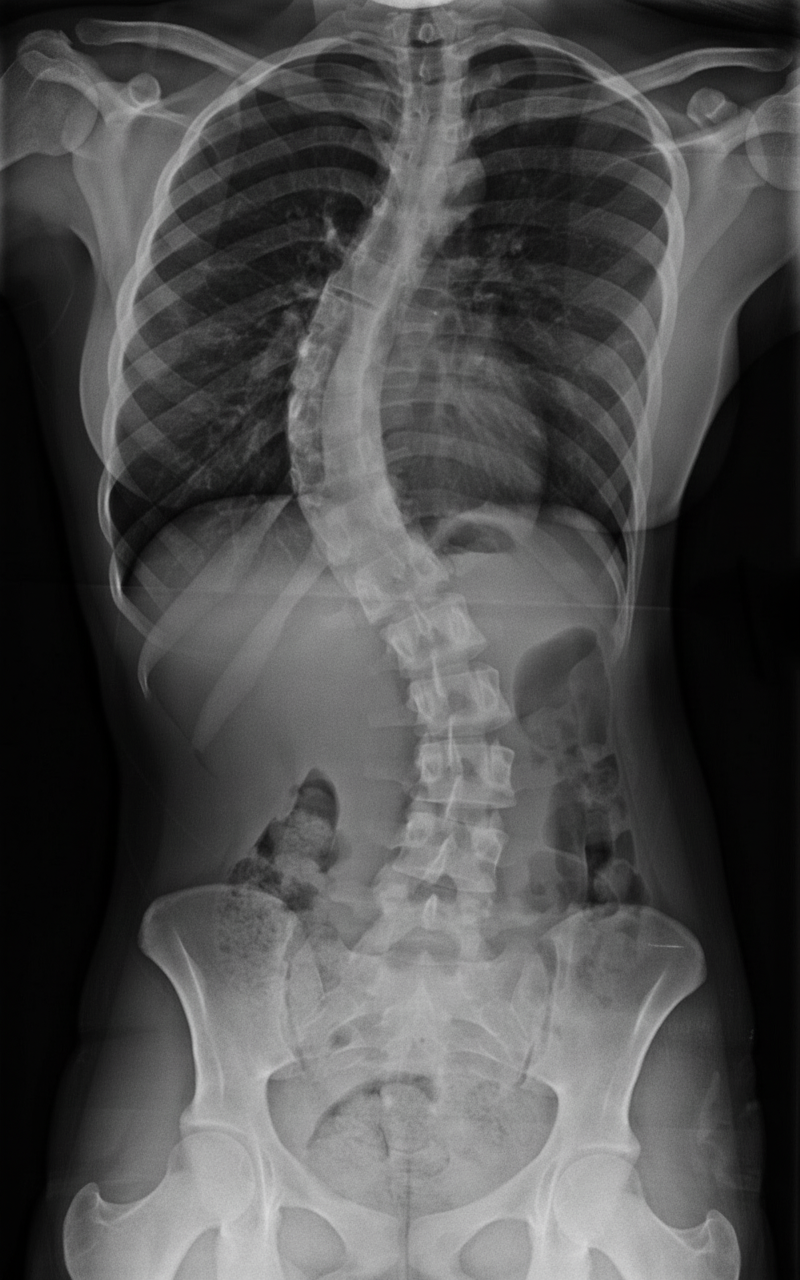
A 10-year-old boy presents with scoliosis, a tuft of hair over the skin of the lumbar spine, and weakness with features of lower motor neuron paralysis in both lower limbs. An X-ray of the spine reveals fusion of the two lumbar vertebrae at that level. What is the most likely diagnosis?
A middle-aged male presents with back pain. X-ray reveals syndesmophytes involving four continuous vertebrae. What is the most likely diagnosis?
Which of the following are indicators of poor prognosis in Pott's spine?
Arrange the following conditions according to the worsening stages in Tuli's clinical staging: paraplegia in extension, ankle clonus present with extensor plantar response and no sensory deficit, no sensory deficit with motor deficit and ambulatory with support, paraplegia in flexion?
Minerva jacket is used for which of the following conditions?
Which of the following is NOT an indication for surgery in Pott's spine?
A 27-year-old woman presents with pain and numbness in her right arm and hand, exacerbated by raising her arm overhead. A provisional diagnosis is made. Which of the following statements is true regarding this condition?
According to Boyd's classification, which grade is assigned when pain continues but the patient can still walk with effort?
What is the treatment of choice for a patient with D7-D8 Pott's disease presenting with paraplegia?
Milwaukee brace is used for the management of which condition?
Explanation: **Explanation:** The clinical presentation of a **tuft of hair (hypertrichosis)** over the lumbar spine, combined with **scoliosis** and **lower motor neuron (LMN) signs** in the lower limbs, is a classic triad for **Diastematomyelia**. **1. Why Diastematomyelia is correct:** Diastematomyelia is a form of spinal dysraphism where the spinal cord is longitudinally split into two halves by a fibrous, cartilaginous, or bony midline septum. This septum often "tethers" the cord. As the child grows, the vertebral column elongates faster than the spinal cord, causing traction injury. This leads to neurological deficits (LMN paralysis) and orthopedic deformities like scoliosis or clubfoot. Cutaneous markers (hair tufts, dimples, or lipomas) are present in over 50% of cases. **2. Why other options are incorrect:** * **Hemivertebra:** While a common cause of congenital scoliosis, it is a structural failure of vertebral formation and does not typically present with midline cutaneous hair tufts or primary LMN paralysis unless associated with other cord anomalies. * **Sacrococcygeal Teratoma:** This is a germ cell tumor presenting as a visible mass at the base of the coccyx, usually diagnosed in neonates. It does not cause a split cord or the specific neuro-orthopedic syndrome described. * **Spinal Muscular Atrophy (SMA):** This is a genetic degeneration of anterior horn cells. While it causes LMN weakness and scoliosis, it does not present with cutaneous markers (hair tufts) or vertebral fusion/septation. **Clinical Pearls for NEET-PG:** * **Imaging of Choice:** MRI is the gold standard to visualize the split cord. * **Associated Findings:** Often associated with **Tethered Cord Syndrome** and **Spina Bifida Occulta**. * **Key Sign:** The "tuft of hair" is the most common cutaneous sign of occult spinal dysraphism.
Explanation: **Explanation:** The correct answer is **Ankylosing Spondylitis (AS)**. The hallmark radiographic feature of AS is the formation of **syndesmophytes**, which are thin, vertical, bony outgrowths originating from the corners of the vertebral bodies. These result from inflammation and subsequent ossification of the outer fibers of the annulus fibrosus. When these syndesmophytes bridge multiple continuous vertebrae, they create the classic **"Bamboo Spine"** appearance. **Why other options are incorrect:** * **Diffuse Idiopathic Skeletal Hyperostosis (DISH):** While DISH also involves ossification of the spine, it typically presents as thick, flowing calcification of the **Anterior Longitudinal Ligament (ALL)**, often described as "melted candle wax." Crucially, DISH preserves the disc space and does not involve the sacroiliac (SI) joints, unlike AS. * **Rheumatoid Arthritis:** This primarily affects the cervical spine (atlantoaxial subluxation) and small joints of the hands. It is an erosive disease and does not typically form syndesmophytes. * **Osteoarthritis:** This presents with **osteophytes**, which are horizontal, claw-like bony spurs resulting from degenerative changes, rather than the vertical syndesmophytes seen in inflammatory spondyloarthropathies. **High-Yield Clinical Pearls for NEET-PG:** * **Earliest Sign:** The earliest radiographic sign of AS is **Sacroiliitis** (blurring of the lower 2/3rd of the SI joint). * **Genetic Association:** Strongly linked with **HLA-B27** (>90% of cases). * **Clinical Test:** **Schober’s Test** is used to assess restricted lumbar flexion. * **Extra-articular manifestation:** The most common is **Acute Anterior Uveitis**. * **Key Radiographic Terms:** "Bamboo spine," "Dagger sign" (ossification of supraspinous/interspinous ligaments), and "Anderson lesion" (discovertebral inflammation).
Explanation: In Pott’s spine (Tuberculous Spondylitis), prognosis is primarily determined by the severity of neurological deficit and the degree of spinal deformity. **Explanation of the Correct Answer (B):** The indicators of a **poor prognosis** in Pott’s paraplegia include: 1. **Healed vertebral lesion:** Paraplegia occurring in a healed lesion (Late-onset paraplegia) carries a worse prognosis than early-onset because it is often due to mechanical factors like internal gibbus or spinal stenosis rather than active inflammation/edema. 2. **Grade 4 Pott’s Paraplegia:** Based on the **Kumar Classification**, Grade 4 indicates complete motor and sensory loss with sphincter involvement. This severe neurological compromise has a lower recovery rate compared to Grades 1-3. 3. **Kyphotic angle > 60 degrees:** Severe deformity (especially in children) leads to permanent mechanical compression and "stretching" of the cord, which is less responsive to medical management. **Why other options are incorrect:** * **Short duration and Acute onset:** These are actually **good prognostic factors**. Rapid onset usually indicates inflammatory causes (abscess or edema) which respond well to Anti-Tubercular Treatment (ATT) and decompression. Chronic, slow-onset paraplegia suggests scarring and permanent cord changes. * Options A, C, and D incorrectly categorize these temporal factors or omit the critical threshold of the kyphotic angle. **High-Yield Clinical Pearls for NEET-PG:** * **Most common site:** Lower Thoracic/Thoracolumbar spine. * **First sign on X-ray:** Reduction in disc space (due to destruction of the subchondral endplate). * **Gold Standard Investigation:** MRI (shows marrow edema and cold abscess). * **Kumar's Grading:** Grade 1 (Negligible), Grade 2 (Mild), Grade 3 (Moderate/Spasticity), Grade 4 (Severe/Sphincter involvement).
Explanation: **Explanation:** **Tuli’s Clinical Staging** is a classification used to grade the severity of neurological deficit in Pott’s spine (Spinal Tuberculosis). It is a high-yield topic for NEET-PG as it tracks the progression from early upper motor neuron signs to complete paralysis. **1. Why the Correct Answer (A) is Right:** The staging follows a logical progression of neurological deterioration: * **Stage I:** Negligible deficit. Patient is unaware, but clinical examination reveals **ankle clonus and extensor plantar response** (Babinski sign). * **Stage II:** Mild deficit. The patient has a **motor deficit** (weakness) but is still **ambulatory with support**. * **Stage III:** Severe deficit. **Paraplegia in extension** occurs. The patient is non-ambulatory, and spasticity is high, keeping limbs extended. * **Stage IV:** Complete deficit. **Paraplegia in flexion** occurs. This represents the final stage where the extrapyramidal tracts are also involved, leading to flexor spasms and loss of sphincter control. **2. Why Other Options are Incorrect:** * **Option B & C:** These incorrectly place "motor deficit/ambulatory with support" before "ankle clonus." In Tuli’s staging, the presence of pathological reflexes (Stage I) precedes the functional loss of walking (Stage II). * **Option D:** This incorrectly places "Paraplegia in extension" before "motor deficit/ambulatory with support." A patient must lose the ability to walk (Stage II) before being classified as paraplegic (Stage III). **3. High-Yield Clinical Pearls for NEET-PG:** * **Stage I & II** are generally considered "Early/Mild" and often respond well to Conservative Management (AKT). * **Stage III & IV** are "Severe" and may require surgical decompression if there is no rapid improvement with drugs. * **Prognostic Tip:** Paraplegia in extension (Stage III) has a better prognosis than Paraplegia in flexion (Stage IV). * **Sensory Loss:** Usually appears between Stage II and Stage III. Stage IV often involves complete sensory loss and urinary/bowel incontinence.
Explanation: **Explanation:** The **Minerva jacket** (or Minerva cast) is a specialized orthopedic brace or plaster cast designed to immobilize the **cervical and upper thoracic spine**. It provides stabilization by encompassing the chin and occiput (to prevent head movement) and extending down to the rib cage or waist. **1. Why Cervical Tuberculosis is Correct:** In cases of spinal tuberculosis (Pott’s disease) involving the cervical vertebrae, rigid immobilization is crucial to prevent neurological deficits (quadriplegia) and promote healing. The Minerva jacket effectively restricts flexion, extension, and rotation of the neck, making it the traditional choice for **cervical and cervicothoracic junction** lesions. **2. Why the Other Options are Incorrect:** * **Dorsolumbar Tuberculosis:** This region (T12-L1) is typically immobilized using a **Taylor’s Brace** or a **Body Jacket (Milwaukee brace is for scoliosis)**. The Minerva jacket does not provide enough leverage to stabilize the lower spine. * **Lumbar Tuberculosis:** Lower spinal lesions require a **Goldthwait brace** or a lumbosacral orthosis (LSO) to restrict lumbar motion. * **Sacral Tuberculosis:** This is rare and usually managed with bed rest or pelvic stabilization; a jacket extending to the head is anatomically unnecessary. **Clinical Pearls for NEET-PG:** * **Four-Poster Brace:** Another orthosis used for cervical spine stabilization, but less rigid than the Minerva jacket. * **Halo-Vest:** Provides the maximum degree of cervical immobilization (superior to Minerva). * **Taylor’s Brace:** High-yield for **Dorsolumbar** spine (contains two vertical posterior bars). * **Milwaukee Brace:** Specifically used for **Scoliosis** (apex above T8). * **Somi Brace:** (Sternal Occipital Mandibular Immobilizer) is used for cervical spine, often in bedridden patients.
Explanation: In the management of **Pott’s spine (Tuberculous Spondylitis)**, the primary treatment is conservative, consisting of Anti-Tuberculosis Treatment (ATT) and bracing. Surgery is reserved for specific complications or failure of medical therapy. ### **Why "Stage 3 disease" is the correct answer:** The classification of Pott’s paraplegia is crucial for determining surgical intervention. * **Stage 3 disease** is characterized by **complete motor paralysis** (patient is bedridden) but with **intact sensations** and intact bowel/bladder control. * In Stage 1, 2, and 3, the standard protocol is to initiate a trial of conservative management (ATT) for **3–4 weeks**. Many patients in Stage 3 show significant neurological recovery with ATT alone; therefore, Stage 3 is **not** an immediate or absolute indication for surgery. ### **Explanation of Incorrect Options:** * **Option A (No improvement after 4 weeks of ATT):** This is a classic indication. If there is no neurological recovery or if the disease progresses despite adequate ATT, surgical decompression is mandatory to prevent permanent damage. * **Option C (Bowel and bladder involvement):** This corresponds to **Stage 5** disease. Loss of sphincter control signifies severe cord compression and is an absolute indication for urgent surgical intervention. * **Option D (Stage 4 disease):** Stage 4 involves complete motor paralysis with **sensory loss**. Because the neurological deficit is severe, these patients are often considered for earlier surgical intervention compared to Stage 3. ### **NEET-PG High-Yield Pearls:** * **Most common site:** Lower Thoracic and Upper Lumbar spine. * **Earliest sign on X-ray:** Reduction in disc space (due to destruction of the subchondral paradiscal bone). * **Tuli’s Classification:** Used for Pott's paraplegia (Stage 1: Negligible; Stage 2: Mild; Stage 3: Moderate; Stage 4: Severe; Stage 5: Sphincter involvement). * **Absolute Indications for Surgery:** Sudden onset paraplegia, bowel/bladder involvement, and progressive neurological deficit despite ATT.
Explanation: ### **Explanation: Thoracic Outlet Syndrome (TOS)** The clinical presentation of pain and numbness exacerbated by overhead activities in a young woman is classic for **Thoracic Outlet Syndrome (TOS)**. This condition results from the compression of the neurovascular bundle (brachial plexus and/or subclavian vessels) as it passes through the interscalene triangle, costoclavicular space, or sub-coracoid space. #### **Why Option C is Correct** The primary management for TOS is **conservative** (physical therapy, posture correction, and NSAIDs). However, if symptoms are refractory to conservative treatment or if there is progressive neurological deficit/vascular compromise, **surgical decompression** (e.g., first rib resection, scalenectomy, or cervical rib excision) is the definitive and most effective treatment to relieve pressure on the brachial plexus. #### **Why Other Options are Incorrect** * **Option A:** TOS is a peripheral nerve compression syndrome occurring at the thoracic outlet, not within the spinal canal. While cervical disc disease can mimic TOS (C8-T1 radiculopathy), they are distinct pathological entities. * **Option B:** Positional obliteration of the radial pulse (e.g., **Adson’s test**) is found in a significant percentage of the **asymptomatic normal population**. Therefore, it is considered non-specific and unreliable for a definitive diagnosis. * **Option D:** TOS most commonly affects the **lower trunk of the brachial plexus (C8 and T1)**, leading to symptoms in the ulnar nerve distribution (medial forearm and hand), rather than the median nerve. #### **High-Yield Clinical Pearls for NEET-PG** * **Most common cause:** Soft tissue abnormalities (e.g., anomalous scalene muscles) or bony abnormalities (e.g., **Cervical Rib**). * **Epidemiology:** More common in females (approx. 3:1 ratio). * **Clinical Tests:** **Roos Test** (Elevated Arm Stress Test - EAST) is considered the most reliable clinical screening tool. * **Gilliatt-Sumner Hand:** Severe cases may show wasting of the thenar and hypothenar eminence due to T1 nerve root compression.
Explanation: **Explanation:** The question refers to **Boyd’s Classification of Pain in Spinal Disorders**, which is a clinical grading system used to assess the functional impact of pain on a patient's mobility and daily activities. **Why Grade 2 is Correct:** According to Boyd’s classification, **Grade 2** is defined as a state where the patient experiences persistent or continuous pain, but they are still able to **walk with effort**. The pain is significant enough to be a constant presence, yet it has not yet reached the threshold of total functional incapacitation. **Analysis of Incorrect Options:** * **Grade 1 (Option A):** This represents mild or intermittent pain. The patient can walk normally without significant effort or functional limitation. * **Grade 3 (Option B):** This grade is assigned when the pain becomes severe enough that the patient is **unable to walk** or is confined to a bed/chair. The transition from Grade 2 to Grade 3 is marked by the loss of independent ambulation. * **Grade 4 (Option D):** This is the most severe stage, characterized by agonizing pain often accompanied by objective neurological deficits (like paralysis or bladder/bowel involvement) or complete physical collapse. **NEET-PG High-Yield Pearls:** * **Clinical Focus:** Boyd’s classification is specifically useful for documenting the progression of degenerative conditions like Lumbar Canal Stenosis or Prolapsed Intervertebral Disc (PIVD). * **Key Differentiator:** The "ability to walk with effort" is the hallmark of Grade 2. Once the patient stops walking, they move to Grade 3. * **Management Correlation:** Grades 1 and 2 are often managed conservatively, whereas Grades 3 and 4 frequently necessitate surgical intervention.
Explanation: In Pott’s disease (Spinal Tuberculosis), the primary treatment modality is medical management. **Why Anti-Koch’s Treatment (AKT) is the Correct Answer:** The standard of care for spinal TB, even in the presence of neurological deficits like paraplegia, is the initiation of **Anti-Koch’s Treatment (AKT)**. In most cases of "early-onset" paraplegia (caused by inflammatory edema, granulation tissue, or abscess), the neurological symptoms resolve significantly with chemotherapy alone. Surgery is generally reserved for patients who fail to respond to AKT or have specific mechanical indications. **Why Other Options are Incorrect:** * **Laminectomy:** This is generally **contraindicated** in Pott’s disease. Since TB primarily affects the vertebral bodies (anterior column), a laminectomy removes the only remaining stable posterior elements, leading to spinal instability and worsening kyphosis. * **Anterior/Posterior Decompression:** These are surgical interventions. While anterior decompression (e.g., Hong Kong operation) is effective for clearing necrotic bone and pus, it is **not the first-line** treatment of choice. Surgery is indicated only if there is no neurological improvement after 3–4 weeks of AKT, rapid worsening of paraplegia, or severe spinal instability. **Clinical Pearls for NEET-PG:** * **Most common site:** Lower Thoracic (Dorsal) spine. * **Earliest sign on X-ray:** Reduction in disc space (due to destruction of adjacent vertebral endplates). * **Cold Abscess:** In the dorsal spine, it presents as a **"Bird’s Nest" appearance** (paravertebral shadow) on X-ray. * **Tuli’s Classification:** Used to stage neurological deficit in spinal TB. * **Gold Standard Investigation:** MRI (shows marrow edema and soft tissue involvement earliest).
Explanation: **Explanation:** The **Milwaukee brace** (Cervico-Thoraco-Lumbo-Sacral Orthosis or CTLSO) is a classic active corrective orthosis primarily used for the non-operative management of **Scoliosis**. It is specifically indicated for curves with an apex above T8. The brace works on the principle of longitudinal traction and lateral pressure, utilizing a neck ring, pelvic mold, and upright bars to provide corrective forces that prevent curve progression during skeletal growth. **Analysis of Options:** * **Scoliosis (Correct):** It is the gold standard for high thoracic curves. It aims to maintain the curve until skeletal maturity (Risser sign 4 or 5). * **Kyphosis:** While the Milwaukee brace can be modified for Scheuermann’s kyphosis, its primary and most classic association in orthopedic examinations is Scoliosis. * **Spondylolisthesis:** This condition (forward slippage of vertebrae) is typically managed with a **Boston brace** (TLSO) or a lumbosacral corset to limit extension, not a Milwaukee brace. * **Developmental Dysplasia of the Hip (DDH):** DDH is managed using dynamic splints like the **Pavlik harness** (for infants <6 months) or a Von Rosen splint. **High-Yield Clinical Pearls for NEET-PG:** * **Boston Brace:** A Thoraco-Lumbo-Sacral Orthosis (TLSO) used for scoliosis with an apex below T8 (more cosmetically acceptable as it lacks the neck ring). * **Charleston Bending Brace:** A "night-time only" brace used for scoliosis. * **Indication for Bracing:** Generally indicated for curves between **20° and 40°** (Cobb’s angle) in a growing child. * **Indication for Surgery:** Usually required when the Cobb’s angle exceeds **40°–45°**.
Cervical Spine Disorders
Practice Questions
Thoracic Spine Disorders
Practice Questions
Lumbar Spine Disorders
Practice Questions
Intervertebral Disc Disease
Practice Questions
Spinal Stenosis
Practice Questions
Spondylolisthesis
Practice Questions
Spinal Deformities
Practice Questions
Spinal Infections
Practice Questions
Spinal Tumors
Practice Questions
Spinal Cord Injuries
Practice Questions
Minimally Invasive Spine Surgery
Practice Questions
Rehabilitation of Spine Conditions
Practice Questions
Get full access to all questions, explanations, and performance tracking.
Start For Free