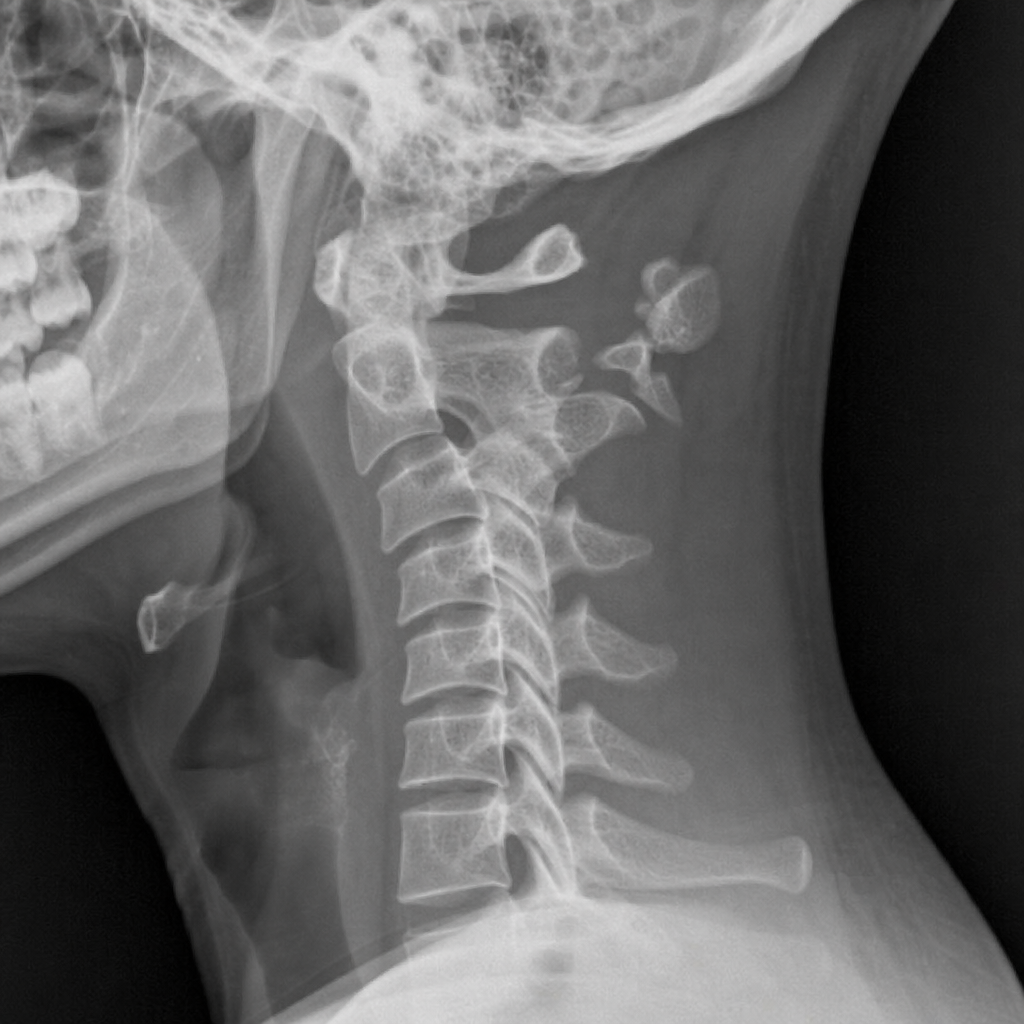
Which of the following is the MOST common skeletal manifestation in Type-1 Neurofibromatosis?
Scheuermann's disease occurs in which age group?
Which of the following is seen more commonly in rheumatoid arthritis than in ankylosing spondylitis?
What is the most common cause of secondary tumors affecting the spinal cord?
What is the next commonest site of intervertebral disc prolapse after L4-S1?
A 46-year-old male, a known alcoholic, presents with pain in the dorsal spine. Examination reveals tenderness at the dorso-lumbar junction. Radiographs show destruction of the 12th dorsal vertebra with loss of disc space between D12 and L1 vertebrae. What is the most probable diagnosis?
Which joint is NOT involved in Rheumatoid arthritis according to the 1987 ACR Classification Criteria?
A 40-year-old female presents with a history of fever, weight loss, polyarthralgia, morning stiffness, and bilateral hand pain. Based on the provided radiological findings, what is the most likely diagnosis?

Prolapsed intervertebral disc is most common at which spinal level?
Metal on metal articulation should be avoided in which of the following situations?
Explanation: ### Explanation **Neurofibromatosis Type 1 (NF-1)**, also known as von Recklinghausen disease, is an autosomal dominant multisystem disorder caused by a mutation in the *NF1* gene on chromosome 17. While it is primarily a neurocutaneous syndrome, skeletal manifestations occur in approximately 50% of patients. **Why Scoliosis is the Correct Answer:** Scoliosis is the **most common** skeletal abnormality in NF-1, affecting 10–30% of patients. It typically presents in two forms: 1. **Dystrophic (Short-segment):** Characterized by sharp angulation involving 4–6 vertebrae, often associated with vertebral body scalloping, rib penciling, and a high risk of rapid progression. 2. **Non-dystrophic:** Resembles adolescent idiopathic scoliosis and is more common but less severe. **Analysis of Incorrect Options:** * **A. Cortical thinning of long bones:** While cortical thinning and bowing (especially of the tibia) occur, they are less frequent than spinal deformities. * **B. Pseudoarthrosis:** Congenital pseudoarthrosis of the tibia is a classic "pathognomonic" sign of NF-1, but it is rare, occurring in only about 5% of cases. * **C. Sphenoid dysplasia:** This is a characteristic craniofacial feature of NF-1 (often leading to pulsating exophthalmos), but it is significantly less common than scoliosis. **High-Yield Clinical Pearls for NEET-PG:** * **Chromosome:** 17 (NF-1), 22 (NF-2). * **Pathognomonic Orthopaedic Sign:** Congenital pseudoarthrosis of the tibia (CPT). * **Radiological Sign:** "Dumbbell-shaped" tumors (neurofibromas) exiting the intervertebral foramina. * **Dystrophic Scoliosis Criteria:** Look for "penciling of ribs" and "vertebral scalloping" on X-rays. These cases often require early surgical intervention (posterior or combined fusion).
Explanation: **Explanation:** **Scheuermann’s Disease** (Juvenile Kyphosis) is a developmental disorder characterized by structural kyphosis of the thoracic or thoracolumbar spine. 1. **Why Adolescents is correct:** The disease typically manifests during the **pubertal growth spurt (ages 12–17)**. It occurs due to osteochondrosis of the secondary ossification centers of the vertebral bodies. The mechanical failure of the epiphyseal plates leads to wedge-shaped vertebrae, resulting in a fixed "hunchback" deformity. 2. **Why other options are incorrect:** * **Infants:** Spinal deformities in infants are usually congenital (e.g., hemivertebrae) rather than developmental osteochondrosis. * **Adults/Elderly:** While adults may present with the *sequelae* (chronic back pain or fixed deformity), the disease process itself initiates and progresses only during the skeletal growth phase of adolescence. Kyphosis in the elderly is more commonly due to osteoporotic compression fractures (Dowager’s hump). **High-Yield Clinical Pearls for NEET-PG:** * **Radiological Criteria (Sorensen’s Criteria):** Diagnosis requires anterior wedging of **≥5° in at least three adjacent vertebrae**. * **Schmorl’s Nodes:** These are herniations of the nucleus pulposus into the vertebral endplates, a classic radiological finding in this condition. * **Clinical Sign:** Unlike postural kyphosis, Scheuermann’s is a **fixed deformity**; it does not disappear on spinal extension or the Adam’s forward bend test. * **Treatment:** Conservative management with bracing (Milwaukee brace) is indicated for curves between 50°–75° in skeletally immature patients. Surgery is reserved for curves >75°.
Explanation: ### Explanation The correct answer is **D. Autoantibody against IgG**. **1. Why the Correct Answer is Right:** The "Autoantibody against IgG" refers to **Rheumatoid Factor (RF)**, which is an IgM antibody directed against the Fc portion of IgG. Rheumatoid Arthritis (RA) is characterized by the presence of RF and Anti-CCP antibodies. In contrast, Ankylosing Spondylitis (AS) belongs to the group of **Seronegative Spondyloarthropathies**, meaning these patients typically lack RF and other autoantibodies. **2. Why the Other Options are Wrong:** * **A. HLA-B27 haplotype:** This is strongly associated with **Ankylosing Spondylitis** (>90% of cases). While RA is associated with HLA-DR4, HLA-B27 is not a feature of RA. * **B. Sacroiliitis:** This is the hallmark radiographic finding of **Ankylosing Spondylitis** and is essential for its diagnosis. RA typically spares the sacroiliac joints, primarily affecting the small joints of the hands and the cervical spine. * **C. Increased incidence in men:** Ankylosing Spondylitis is significantly more common in **males** (approx. 3:1 ratio). Conversely, Rheumatoid Arthritis is more common in **females** (approx. 3:1 ratio). **3. Clinical Pearls for NEET-PG:** * **Spine Involvement:** In RA, the only part of the spine typically involved is the **Cervical Spine** (specifically Atlanto-axial subluxation). AS involves the entire spine, leading to the classic "Bamboo Spine" appearance. * **Joint Distribution:** RA is a symmetrical peripheral polyarthritis (sparing DIP joints). AS is characterized by axial skeleton involvement and enthesitis (inflammation at the site of tendon/ligament insertion). * **Seronegative Group:** Remember the mnemonic **PEAR** for Seronegative Spondyloarthropathies: **P**soriatic arthritis, **E**nteropathic arthritis, **A**nkylosing spondylitis, and **R**eactive arthritis. All are HLA-B27 associated and RF negative.
Explanation: **Explanation:** Spinal metastases are the most common tumors of the spine, and the vertebral column is the most frequent site for skeletal metastasis. **1. Why Lungs are the Correct Answer:** Statistically, **Lung cancer** is the most common primary source of spinal metastases in **men** and the most common cause overall when considering both genders in various global epidemiological studies. Lung cancer cells frequently spread via the arterial circulation, leading to rapid dissemination to the vertebral bodies. Because lung cancer has a high incidence and a high propensity for early systemic spread, it remains the leading cause of secondary spinal tumors. **2. Analysis of Incorrect Options:** * **Breast Cancer (Option B):** This is the most common cause of spinal secondaries in **women**. While extremely frequent, it ranks second to lung cancer when considering the total population. * **Prostate Cancer (Option C):** This is a very common cause in elderly men, typically presenting as **osteoblastic** (sclerotic) lesions. It spreads primarily via the Batson venous plexus. * **Gastrointestinal Tract (Option D):** GI malignancies (like colon or stomach cancer) can metastasize to the spine, but they do so much less frequently than lung, breast, or prostate cancers. **3. NEET-PG High-Yield Pearls:** * **Most common site of spinal metastasis:** Thoracic spine (70%), followed by the lumbar spine (20%). * **Most common location within the vertebra:** The **posterior aspect of the vertebral body** is the initial site, but the **pedicle** is the first part to show radiological changes (the "Winking Owl" sign on X-ray). * **Route of spread:** Most cancers spread via the **Batson venous plexus** (a valveless system connecting pelvic/thoracic veins to internal vertebral venous plexuses). * **Type of lesion:** Lung cancer usually causes **osteolytic** lesions, while Prostate cancer causes **osteoblastic** lesions.
Explanation: **Explanation:** Intervertebral disc prolapse (IVDP) occurs most frequently in regions of the spine that exhibit the greatest mobility and bear significant mechanical stress. **1. Why C6-C7 is the correct answer:** The most common site for IVDP overall is the lumbar spine, specifically the **L4-L5 and L5-S1** levels, which bear the maximum weight of the body. Following the lumbar region, the **cervical spine** is the second most common area involved. Within the cervical spine, the **C6-C7** level is the most frequent site of herniation (affecting the C7 nerve root), followed by C5-C6. This is due to the high degree of transition and mobility at the cervicothoracic junction. **2. Why the other options are incorrect:** * **T12-L1:** The thoracic spine is the least common site for disc prolapse because the rib cage provides significant stability and limits excessive movement, protecting the discs from mechanical wear. * **L1-L2 and L2-L3:** While these are lumbar discs, herniations at these "high lumbar" levels are statistically much rarer than L4-S1. Disc prolapse frequency in the lumbar spine follows a descending order from distal to proximal (L5-S1 > L4-L5 > L3-L4 > L2-L3 > L1-L2). **Clinical Pearls for NEET-PG:** * **Most common level overall:** L4-L5 (followed closely by L5-S1). * **Most common cervical level:** C6-C7 (affects C7 root; presents with weak triceps and loss of triceps reflex). * **Schmorl’s Nodes:** Prolapse of the nucleus pulposus into the vertebral body (vertical prolapse). * **Posterolateral Prolapse:** The most common direction of herniation because the posterior longitudinal ligament is weakest at the sides.
Explanation: ### Explanation The clinical presentation and radiological findings point towards **Pott’s spine (Tuberculous Spondylitis)**. **Why Pott’s Spine is Correct:** The hallmark of spinal tuberculosis is **paradiscal involvement**, where the infection starts in the subchondral bone and spreads across the **intervertebral disc space**, leading to its destruction. The involvement of the D12-L1 junction is the most common site for Pott's spine. In an alcoholic patient (who is likely immunocompromised), the risk of reactivation of TB is high. The classic triad seen here—vertebral destruction, loss of disc space, and localized tenderness—is pathognomonic for an infectious etiology, specifically TB in the Indian context. **Why Other Options are Incorrect:** * **Metastatic spine disease:** While it causes vertebral destruction, it characteristically **spares the disc space**. Malignancy affects the vertebral body and pedicles but does not cross the fibrocartilaginous disc. * **Multiple myeloma:** Similar to metastases, myeloma causes "punched-out" lytic lesions and vertebral collapse but **preserves the disc space**. It typically affects older age groups and presents with systemic features like anemia or renal failure. * **Missed trauma:** While trauma can cause vertebral collapse (wedge fracture), it would not typically cause progressive "destruction" of the bone or loss of disc space unless complicated by secondary infection. **High-Yield Clinical Pearls for NEET-PG:** * **Most common site:** Dorso-lumbar junction (D11–L2). * **Earliest sign on X-ray:** Rarefaction/blurring of the vertebral endplates. * **Paradiscal type:** Most common variety (80%); involves adjacent vertebrae and the intervening disc. * **Cold Abscess:** Formed by the collection of debris; in the lumbar region, it may track down the psoas sheath (Psoas abscess). * **MRI:** The investigation of choice for early diagnosis and assessing cord compression.
Explanation: **Explanation:** Rheumatoid Arthritis (RA) is a chronic inflammatory polyarthritis that characteristically involves **synovial joints**. The 1987 ACR (American College of Rheumatology) criteria emphasize the involvement of specific joint groups, typically sparing certain joints of the hands and feet. **Why Tarsometatarsal (TMT) is the correct answer:** The 1987 ACR criteria specifically exclude certain joints from the definition of "joint swelling/involvement" required for diagnosis. RA typically involves the small joints of the hands (MCP, PIP) and feet (MTP). The **Tarsometatarsal (TMT) joints**, along with the Distal Interphalangeal (DIP) joints and the 1st Carpometacarpal (CMC) joint, are characteristically **spared** in RA. These joints are more commonly involved in Osteoarthritis or Psoriatic Arthritis. **Analysis of Incorrect Options:** * **Knee (A) & Ankle (B):** These are large synovial joints frequently involved in the polyarticular distribution of RA. * **Metatarsophalangeal (D):** MTP joint involvement is a hallmark of RA and is often one of the earliest sites of clinical or radiographic changes (e.g., "daylight sign"). **High-Yield Clinical Pearls for NEET-PG:** * **Spine Involvement:** In the spine, RA **only** involves the **Cervical Spine** (specifically the Atlanto-axial joint). It spares the Thoracic and Lumbar spine because they lack synovial joints (they are symphyses). * **Joints Spared in RA:** DIP joints, 1st CMC joint, TMT joints, and the Thoracolumbar spine. * **Most Common Initial Site:** Small joints of hands and feet (PIP, MCP, MTP). * **2010 ACR/EULAR Criteria:** While the 1987 criteria focused on "rheumatoid nodules" and "radiographic erosions," the 2010 criteria focus on early diagnosis, emphasizing the number and size of joints involved and serology (RF/Anti-CCP).
Explanation: ***Rheumatoid arthritis*** - Combination of **systemic symptoms** (fever, weight loss), **morning stiffness**, and **bilateral hand pain** with **polyarthralgia** is classic for RA. - Radiological findings typically show **periarticular osteopenia**, **symmetric joint space narrowing** at **MCP/PIP joints**, and **marginal erosions**. *Osteoarthritis* - Primarily affects **weight-bearing joints** and **DIP joints** with **osteophyte formation** and **joint space narrowing**. - Lacks **systemic symptoms** like fever and weight loss, and morning stiffness is typically brief (<30 minutes). *Gout* - Presents with acute **monoarticular attacks**, commonly affecting the **first MTP joint** (podagra). - Radiological findings show **punched-out erosions** with **overhanging edges** and possible **tophi**, not bilateral hand involvement. *Psoriatic arthritis* - Characterized by **asymmetric joint involvement**, often affecting **DIP joints** with **pencil-in-cup deformity**. - Associated with **psoriatic skin lesions** and **nail changes**, which are not mentioned in this case.
Explanation: ### Explanation **Correct Answer: D. L5-S1** **Why it is correct:** The lumbar spine is the most common site for Prolapsed Intervertebral Disc (PIVD) because it bears the maximum weight of the body and undergoes significant mechanical stress. Within the lumbar region, the **L4-L5** and **L5-S1** levels are the most frequently affected (accounting for approximately 95% of cases). The **L5-S1** level is particularly vulnerable because it is the "lumbosacral junction"—the point where the mobile lumbar spine meets the fixed sacrum. This transition zone experiences the highest shearing forces and rotational strain during movement. Additionally, the posterior longitudinal ligament (PLL) is narrower at these lower levels, providing less structural support against disc herniation. **Why the other options are incorrect:** * **A & B (C1-C2 and C2-C3):** Disc prolapse is extremely rare at these levels. In fact, there is **no intervertebral disc between C1 (Atlas) and C2 (Axis)**. Cervical disc prolapse most commonly occurs at C5-C6 and C6-C7 due to the high mobility of the lower neck. * **C (L2-L4):** While these are lumbar levels, they are less prone to herniation than the lower segments (L4-S1) because they bear relatively less weight and are further from the high-stress lumbosacral transition zone. **High-Yield Clinical Pearls for NEET-PG:** * **Most common level overall:** L4-L5 or L5-S1 (L4-L5 is often cited as slightly more common in some texts, but L5-S1 is the classic answer for the "most common site of stress"). * **Nerve Root Involvement:** A posterolateral disc prolapse usually compresses the **traversing nerve root** (e.g., L4-L5 disc affects the L5 nerve root). * **Schmorl’s Nodes:** These are vertical herniations of the nucleus pulposus through the vertebral endplate into the body of the vertebra. * **Gold Standard Investigation:** MRI is the investigation of choice for PIVD.
Explanation: **Explanation:** The correct answer is **Young female**. The primary concern with **Metal-on-Metal (MoM)** articulations is the generation of metallic debris (cobalt and chromium ions) due to wear. These ions can cross the placental barrier, posing a potential **teratogenic risk** to the fetus. Therefore, MoM is strictly avoided in women of childbearing age who may wish to conceive. Additionally, females have a higher incidence of **Adverse Local Tissue Reaction (ALTR)** or "pseudotumors" compared to males. **Analysis of Incorrect Options:** * **Osteonecrosis (A):** MoM (specifically hip resurfacing) was historically indicated for young patients with osteonecrosis to preserve bone stock, provided the necrotic area was small. * **Inflammatory Arthritis (C):** While patients with inflammatory conditions (like Rheumatoid Arthritis) have a higher risk of metal hypersensitivity, it is not an absolute contraindication compared to the pregnancy risks in young females. * **Revision Surgery (D):** Revision surgery often requires specialized implants; while MoM is rarely the first choice for revision today, the specific contraindication regarding systemic ion toxicity is most critical in the context of pregnancy. **High-Yield Clinical Pearls for NEET-PG:** * **ALVAL:** Aseptic Lymphocytic Vasculitis-Associated Lesion is the histological hallmark of MoM wear. * **Pseudotumors:** Non-infectious, non-neoplastic cystic or solid masses associated with MoM. * **Safe levels:** Serum Cobalt/Chromium levels >7 parts per billion (ppb) indicate significant wear and potential failure. * **Current Status:** Due to high failure rates and local tissue reactions, MoM total hip arthroplasty has largely been replaced by Ceramic-on-Polyethylene or Ceramic-on-Ceramic.
Cervical Spine Disorders
Practice Questions
Thoracic Spine Disorders
Practice Questions
Lumbar Spine Disorders
Practice Questions
Intervertebral Disc Disease
Practice Questions
Spinal Stenosis
Practice Questions
Spondylolisthesis
Practice Questions
Spinal Deformities
Practice Questions
Spinal Infections
Practice Questions
Spinal Tumors
Practice Questions
Spinal Cord Injuries
Practice Questions
Minimally Invasive Spine Surgery
Practice Questions
Rehabilitation of Spine Conditions
Practice Questions
Get full access to all questions, explanations, and performance tracking.
Start For Free