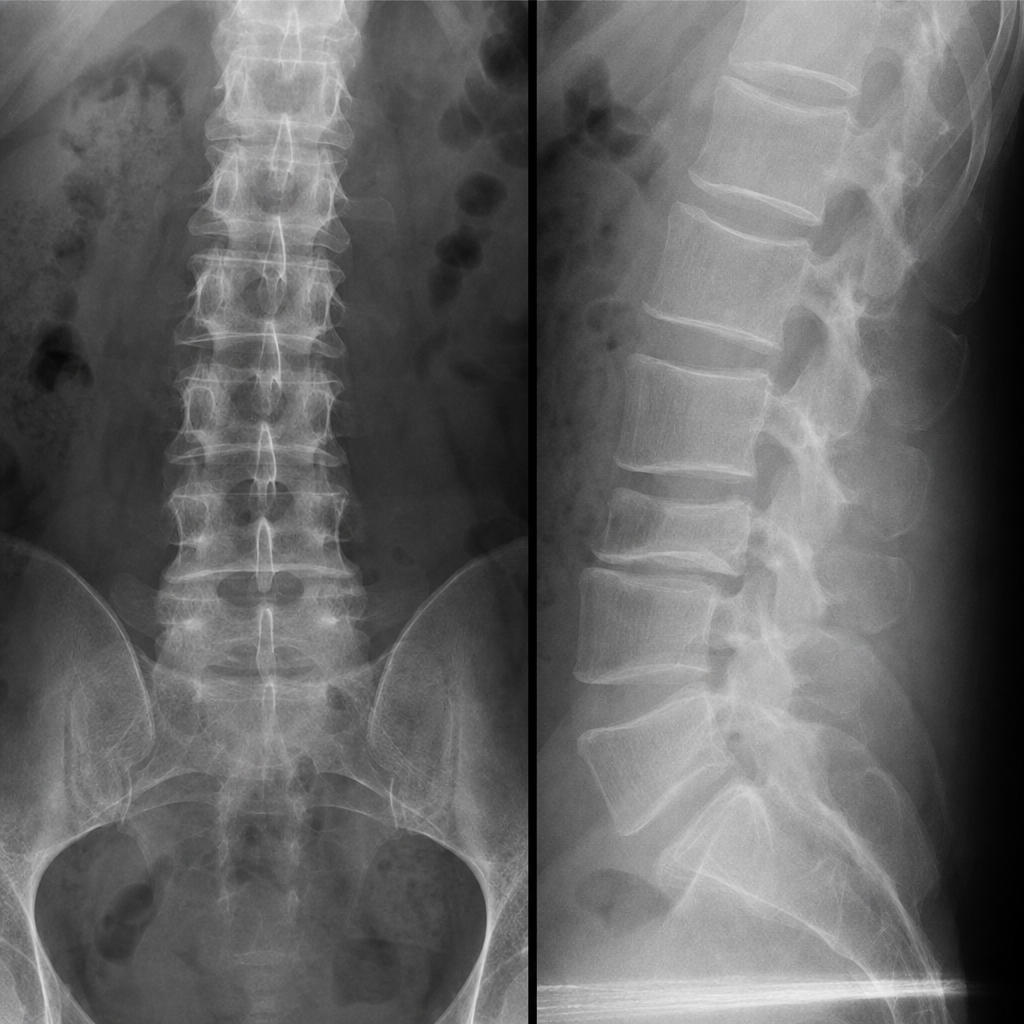
Vertebra Plana is associated with all of the following conditions except -
Adson's test is positive in -
In which condition is the Milwaukee Brace primarily used?
Halopelvic traction is primarily used for correcting which specific spinal deformity?
Block vertebrae are seen in which condition?
How is the degree of deformity in scoliosis calculated?
Anterolateral decompression is primarily indicated for
What is the most common movement force involved in fractures of the spine?
What is the most common site of spinal tuberculosis?
Which of the following sites is least common for intervertebral disc prolapse?
Explanation: ***Scheurmanns Disease*** - **Scheuermann's disease** is characterized by **vertebral wedging** and **kyphosis**, not a complete flattening of the vertebral body (vertebra plana). - It involves irregularities of the vertebral endplates and Schmorl's nodes, differing from the destructive process seen in vertebra plana. *Histiocytosis X* - **Histiocytosis X** (Langerhans cell histiocytosis) can cause destructive lesions in the vertebral body, leading to its collapse and the appearance of **vertebra plana**. - This condition is common among young children and is associated with eosinophilic granuloma. *Leukemia* - **Leukemic infiltration** of bone marrow can weaken vertebral bodies, causing **osteopenia** and eventual collapse, which may present as vertebra plana. - This is often seen in pediatric patients with acute lymphoblastic leukemia. *Excessive use of systemic steroids* - Long-term or excessive use of **systemic corticosteroids** can lead to **osteoporosis**, which weakens bones and makes vertebral bodies prone to compression fractures and collapse into vertebra plana. - This iatrogenic cause results from the negative impact of steroids on bone formation and increased bone resorption.
Explanation: ***Cervical rib*** - **Adson's test** assesses for **thoracic outlet syndrome (TOS)**, which can be caused by a cervical rib compressing the **subclavian artery** or **brachial plexus**. - A positive test occurs when the radial pulse diminishes or disappears upon specific head and arm maneuvers, indicating neurovascular compression. *Cervical spondylosis* - This condition involves **degenerative changes** in the cervical spine, such as bone spurs and disc herniation. - While it can cause neurological symptoms, it typically does not lead to a positive Adson's test, as the compression site is different from that assessed by the test. *Cervical fracture* - A cervical fracture is a **traumatic injury** to the bones of the neck. - Adson's test is not indicated for diagnosing fractures and performing it could exacerbate the injury. *Cervical dislocation* - Cervical dislocation is a severe injury where cervical vertebrae are **displaced from their normal alignment**. - Similar to fractures, Adson's test is not appropriate for diagnosing or evaluating dislocations and carries a risk of further injury.
Explanation: ***Adolescent Idiopathic Scoliosis*** - The **Milwaukee Brace** is a widely recognized and historically significant orthotic device used primarily for the non-surgical management of **scoliosis**, particularly **adolescent idiopathic scoliosis**. - It works by applying corrective forces to the spine to prevent further curvature progression and often allows for some correction during growth. *Congenital Kyphosis* - **Congenital kyphosis** is a spinal deformity present at birth, often caused by vertebral malformations, which is typically managed surgically, especially if progressive. - While bracing can be attempted for mild, flexible curves, the Milwaukee Brace is not the primary or most effective treatment for its structural nature. *Scheuermann's Disease* - **Scheuermann's disease** is a form of kyphosis where wedging of the vertebrae causes a rigid, exaggerated forward curvature of the thoracic spine. - While bracing can be used to treat Scheuermann's disease, the **Milwaukee brace** is not the brace of choice. A **kyphosis-specific brace** such as a kyphosis-bifocal brace or a molded thoracolumbar sacral orthosis (TLSO) is typically preferred. *Spondylolisthesis* - **Spondylolisthesis** involves the forward slippage of one vertebra over another, often in the lumbar spine. - Management typically involves activity restriction, physical therapy, and sometimes surgical fusion, with bracing aimed at stabilizing the spine rather than correcting a lateral curve, making the Milwaukee Brace unsuitable.
Explanation: **Kyphosis** * **Halopelvic traction** is a technique specifically designed to apply sustained corrective forces to the spine, making it particularly effective in treating severe **kyphosis**, especially in young patients prior to surgical correction. * It aids in gradually stretching soft tissues and straightening the spinal curvature over time, often used in cases of congenital or severe developmental kyphosis. *Scoliosis* * While traction can be used in some spinal deformities, **scoliosis** (lateral curvature) is more commonly treated with **bracing** or **surgical fusion**, as halopelvic traction is less effective in correcting the rotational component. * Correction of scoliotic curves typically involves forces applied in multiple planes, which halopelvic traction is not ideally suited for. *Spondylolisthesis* * **Spondylolisthesis** involves the **slippage of one vertebra over another**, which is primarily managed through **stabilization** to prevent further slippage. * Halopelvic traction is not indicated as it could potentially exacerbate instability in the presence of vertebral slippage. *Spinal stenosis* * **Spinal stenosis** refers to the **narrowing of the spinal canal**, which compresses nerves and is usually treated with **decompressive surgery** or **conservative management** for pain relief. * Traction methods are generally not used for spinal stenosis as they do not address the underlying anatomical narrowing and may worsen symptoms.
Explanation: ***Klippel-Feil syndrome*** - **Block vertebrae** are a characteristic radiographic finding in **Klippel-Feil syndrome**, resulting from the congenital fusion of two or more cervical vertebrae. - This fusion leads to a **short neck**, **low hairline**, and **restricted neck motion**. *Pagets disease* - **Paget's disease** is a chronic condition of abnormal bone remodeling, leading to enlarged and weakened bones. - While it can cause vertebral body changes, **block vertebrae** resulting from congenital fusion are not a typical feature. *Leukemia* - **Leukemia** involves uncontrolled proliferation of abnormal white blood cells, which can infiltrate bone marrow and cause lytic or blastic lesions in bones. - It does not cause **block vertebrae**, which are a developmental anomaly. *TB* - **Tuberculosis (TB) of the spine (Pott's disease)** is an infectious condition causing vertebral destruction, collapse, and kyphosis. - While TB can lead to vertebral collapse and eventual fusion during healing, the primary pathology is destructive and not the congenital fusion seen as **block vertebrae**.
Explanation: ***Cobb's method*** - This is the **standard radiographic measurement** used to assess the severity of spinal curvature in scoliosis. - It involves drawing lines along the **most tilted vertebrae** at the ends of the curve and measuring the angle formed by their intersection. *Hamburger method* - This is not a recognized method for calculating the degree of deformity in scoliosis. - There is **no established medical or orthopedic technique** bearing this name for scoliosis assessment. *Haldane method* - This method is primarily used in **biochemistry** to describe **enzyme kinetics** and is unrelated to scoliosis measurement. - It describes the relationship between reaction rates and reactant concentrations in biological systems. *Milwaukee method* - The **Milwaukee brace** is a historical type of orthotic device used to treat scoliosis, but it is not a method for calculating the degree of deformity. - While it is associated with scoliosis treatment, it does not involve the measurement of the curve itself.
Explanation: ***Spinal tuberculosis (Pott's disease)*** - **Anterolateral decompression** is crucial for **Pott's disease** to remove infected bone and pus, relieve pressure on the spinal cord, and facilitate fusion. - This approach allows direct access to the anterior spinal column, which is commonly affected by the destructive process of **tuberculosis**. *Spinal metastasis* - While spinal metastasis can cause compression, **anterolateral decompression** is less common as a primary approach; often, surgical treatment involves posterior decompression, stabilization, and adjuvant therapies like radiation. - The goal is often **pain management** and neurological preservation in the context of advanced disease. *Lumbar disc herniation* - **Lumbar disc herniation** is typically addressed by posterior approaches like **microdiscectomy** or laminectomy, which directly access the posterior aspect of the disc. - **Anterolateral decompression** is generally not indicated as the primary treatment for standard disc herniations. *Ankylosing spondylitis* - Surgical intervention in **ankylosing spondylitis** is usually reserved for severe kyphosis or spinal fractures, employing osteotomies and stabilization techniques, often through posterior approaches. - **Anterolateral decompression** is not a standard procedure for the typical manifestations or complications of **ankylosing spondylitis**.
Explanation: ***Compression*** - **Axial compression** due to falls from a height or direct impact is the most frequent mechanism leading to vertebral body fractures, such as **compression fractures**. - These forces typically crush the vertebral body, often without significant displacement of bone fragments. *Flexion* - While often present in spinal fractures, pure **flexion forces** alone are less common than compression as the primary force. - Flexion forces are most frequently involved in **wedge fractures** and **flexion-distraction injuries**, where they are often combined with compression or distraction. *Extension* - **Extension injuries** are relatively rare and usually occur in specific scenarios like being struck in the chin or in elderly patients with **ankylosing spondylitis**. - These forces can lead to fractures of the posterior elements or **hyperextension injuries** of the anterior spinal column. *Lateral Rotation* - **Rotational forces**, especially when combined with flexion or extension, can cause unstable fracture patterns like **fracture-dislocations**. - However, isolated **lateral rotation** as the primary injury mechanism is much less common than axial compression.
Explanation: ***T10-L1*** - The **thoracolumbar junction** (T10-L1) is the most common site for spinal tuberculosis (Pott's disease) due to its high vascularity and mechanical stress. - This region is particularly susceptible to hematogenous spread of *Mycobacterium tuberculosis*. *C7-T1* - While cervical spine involvement can occur, the **C7-T1 region** is less frequently affected by spinal tuberculosis than the thoracolumbar junction. - Tuberculosis in the cervical spine poses a higher risk for neurological deficits due to the smaller canal diameter. *T1-T5* - The mid-thoracic region (T1-T5) is less common for spinal tuberculosis compared to the thoracolumbar area. - Lesions in this area can still cause significant deformity (gibbus) and potential neurological compromise. *T10-L2* - This option is very close to the correct answer, but **T10-L1** specifically represents the peak incidence within the thoracolumbar region. - Including L2 slightly extends the range, but the highest concentration of cases is typically observed at the junction itself.
Explanation: ***T3 - T4*** - Intervertebral disc prolapse is **rare in the thoracic spine** (T2-T12) due to the limited mobility and strong rib cage support. - The T3-T4 level is particularly uncommon as it is located in the **mid-thoracic region**, which experiences less mechanical stress than the thoracolumbar junction. *L4 - L5* - This is one of the **most common sites** for lumbar disc prolapse, accounting for a significant percentage of cases. - The L4-L5 disc is subjected to **considerable mechanical stress** and movement during daily activities. *L5 - S1* - The L5-S1 disc is also a **very common site** for prolapse, frequently second only to L4-L5. - This level experiences high **compressive and rotational forces** due to its position at the base of the lumbar spine. *C6 - C7* - This is the **most common site for cervical disc prolapse**, especially in cases of cervical radiculopathy. - The C6-C7 segment experiences significant **flexion-extension and rotational movements**, predisposing it to disc degeneration and herniation.
Cervical Spine Disorders
Practice Questions
Thoracic Spine Disorders
Practice Questions
Lumbar Spine Disorders
Practice Questions
Intervertebral Disc Disease
Practice Questions
Spinal Stenosis
Practice Questions
Spondylolisthesis
Practice Questions
Spinal Deformities
Practice Questions
Spinal Infections
Practice Questions
Spinal Tumors
Practice Questions
Spinal Cord Injuries
Practice Questions
Minimally Invasive Spine Surgery
Practice Questions
Rehabilitation of Spine Conditions
Practice Questions
Get full access to all questions, explanations, and performance tracking.
Start For Free