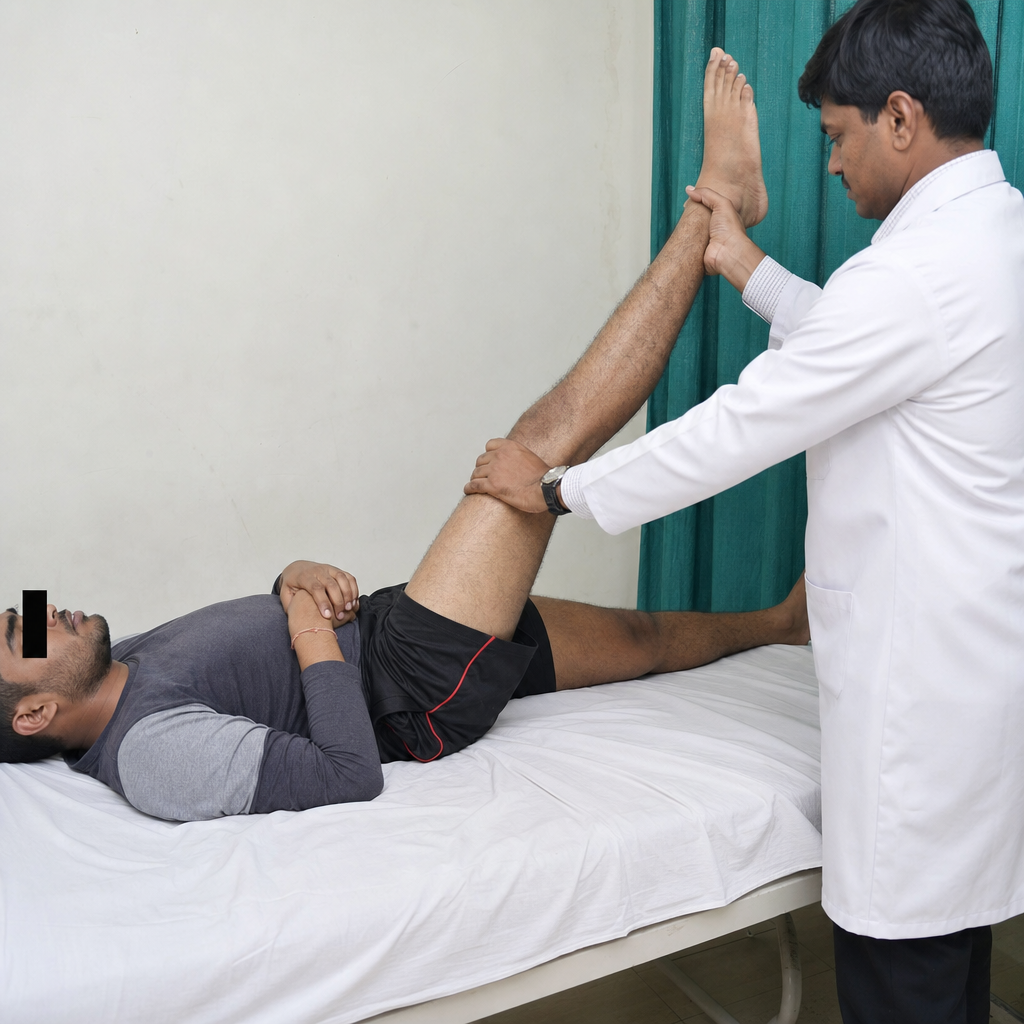
A patient while lifting a heavy weight presents with sudden onset pain in the lower back radiating along the postero-lateral thigh and lateral leg to the big toe with numbness. The most likely diagnosis is:
Q172
Tuberculosis of the spine commonly affects all of the following parts of the vertebra except:
Q173
False about fracture of vertebrae
Q174
A 33-year-old man is brought to the emergency department after being involved in a major motor vehicle accident. He is unable to move his legs and complains of severe pain in his mid to lower back. On physical examination, he is found to have exquisite tenderness over some of the bony prominence of his lower back, but no gross physical deformity can be appreciated. On neurologic examination, flaccid paralysis of both lower extremities and complete anesthesia to all sensory modalities below approximately the L3 dermatome are noted. Catheterization of his bladder yields approximately 700 mL of urine. Plain radiographs of the spine reveal compression fracture in the body of L3 with greater than 50% of loss in its height. A computed tomography (CT) scan through this area reveals a burst fracture of the body of L3. There are large fragments of bone driven dorsally with an 80% canal compromise. What is the cause of weakness?
Q175
A patient complains to a physician of chronic pain and tingling of the buttocks. The pain is exacerbated when the buttocks are compressed by sitting on a toilet seat or chair for long periods. No lumbar pain is noted. Pain is elicited when the physician performs Freiberg's maneuver. Most likely diagnosis?
Q176
Dennis stability concept is based on which of the following?
Q177
A 45-year-old patient presents with chronic lower back pain. X-ray shows anterior displacement of a vertebral body. What is the likely diagnosis?
Q178
Undertaker's fracture is seen at the level of cervical vertebra:
Q179
A 50-year-old male presents with chronic low back pain that has failed physical therapy and conservative measures. MRI shows disc herniation at L5-S1 with radiculopathy. What is the next step in management?
Q180
Which of the following is not a typical symptom of a lumbar disc herniation?
Spine Disorders Indian Medical PG Practice Questions and MCQs
Question 171: A patient while lifting a heavy weight presents with sudden onset pain in the lower back radiating along the postero-lateral thigh and lateral leg to the big toe with numbness. The most likely diagnosis is:
A. L4 - L5 Disc prolapsed (Correct Answer)
B. L3 - IA Disc prolapsed
C. L5 fracture
D. L5 - SI Disc prolapse
Explanation: ***L4 - L5 Disc prolapsed***
- A disc prolapse at the **L4-L5 level** typically compresses the **L5 nerve root**.
- This compression leads to pain radiating along the **postero-lateral thigh** and **lateral leg**, reaching the **big toe**, often accompanied by numbness in the same distribution due to **L5 dermatome** involvement.
*L3 - IA Disc prolapsed*
- A prolapse at the **L3-L4 level** would compress the **L4 nerve root**, causing pain in the **anterior thigh** and medial leg, with potential numbness over the **medial calf** and ankle.
- This presentation does not match the described symptoms of pain radiating to the big toe and lateral leg.
*L5 fracture*
- An **L5 fracture** would primarily manifest as localized lower back pain, often exacerbated by movement, and might not necessarily cause radiating pain or numbness in a dermatomal pattern to the big toe unless there's associated nerve root compression.
- The sudden onset with radiating pain in a specific distribution points more towards nerve impingement from a disc prolapse rather than a fracture.
*L5 - SI Disc prolapse*
- A disc prolapse at the **L5-S1 level** compresses the **S1 nerve root**.
- This typically results in pain radiating down the **posterior thigh**, **calf**, and to the **little toe** and lateral foot, along with numbness in the **S1 dermatome**, which is different from the big toe and lateral leg involvement described.
Question 172: Tuberculosis of the spine commonly affects all of the following parts of the vertebra except:
A. Lamina
B. Body
C. Spinous process (Correct Answer)
D. Pedicle
Explanation: ***Spinous process***
- **Tuberculosis of the spine (Pott's disease)** typically affects the anterior columns of the vertebrae, primarily the vertebral bodies, due to their rich vascular supply.
- The **spinous process** (posterior element) is rarely involved in tuberculosis because it has a relatively poor blood supply compared to the vertebral body.
*Lamina*
- The **lamina**, part of the vertebral arch (posterior element), is also less commonly affected by tuberculous spondylitis compared to the vertebral body.
- While possible in advanced or disseminated disease, initial involvement is usually anterior.
*Body*
- The **vertebral body** is the most commonly affected part of the vertebra in tuberculosis of the spine.
- This is due to its abundant blood supply, allowing for easy hematogenous spread of the *Mycobacterium tuberculosis* bacteria.
*Pedicle*
- The **pedicle** connects the vertebral body to the lamina and is considered an anterior element, albeit less frequently involved than the vertebral body itself.
- Involvement of the pedicle tends to occur via direct extension from an affected vertebral body or disk space.
Question 173: False about fracture of vertebrae
A. Fracture dislocation is common in flexion rotation injury
B. Chance fracture occurs due to flexion distraction injury
C. Wedge compression causes flexion injury
D. Anterior longitudinal ligament runs along the posterior surface of vertebral bodies (Correct Answer)
Explanation: ***Anterior longitudinal ligament runs along the posterior surface of vertebral bodies***
- The **anterior longitudinal ligament (ALL)** runs along the **anterior aspect** of the vertebral bodies, preventing hyperextension.
- The **posterior longitudinal ligament (PLL)** runs along the posterior surface of the vertebral bodies, within the vertebral canal.
*Fracture dislocation is common in flexion rotation injury*
- **Flexion-rotation injuries** are highly unstable and frequently lead to **fracture-dislocations** of the vertebral column.
- The combined forces cause significant disruption of both bony and ligamentous structures, increasing the likelihood of displacement.
*Chance fracture occurs due to flexion distraction injury*
- A **Chance fracture** (or seatbelt fracture) is caused by a **flexion-distraction injury**, typically seen in individuals wearing lap belts during deceleration.
- This mechanism results in a horizontal splitting of the vertebral body and posterior elements.
*Wedge compression causes flexion injury*
- A **wedge compression fracture** is the most common type of vertebral fracture and results from a **flexion injury** (hyperflexion).
- The anterior portion of the vertebral body collapses, creating a wedge shape, while the posterior column remains intact.
Question 174: A 33-year-old man is brought to the emergency department after being involved in a major motor vehicle accident. He is unable to move his legs and complains of severe pain in his mid to lower back. On physical examination, he is found to have exquisite tenderness over some of the bony prominence of his lower back, but no gross physical deformity can be appreciated. On neurologic examination, flaccid paralysis of both lower extremities and complete anesthesia to all sensory modalities below approximately the L3 dermatome are noted. Catheterization of his bladder yields approximately 700 mL of urine. Plain radiographs of the spine reveal compression fracture in the body of L3 with greater than 50% of loss in its height. A computed tomography (CT) scan through this area reveals a burst fracture of the body of L3. There are large fragments of bone driven dorsally with an 80% canal compromise. What is the cause of weakness?
A. Compression of the cauda equina (Correct Answer)
B. Compression of the conus medullaris
C. Rupture of the anterior spinal ligament
D. Compression of the spinal cord at the level of L3
Explanation: ***Compression of the cauda equina***
- The patient's presentation with flaccid paralysis of both lower extremities and complete anesthesia below L3, along with a **burst fracture of L3** and significant **canal compromise**, is consistent with **cauda equina syndrome**. The spinal cord typically ends at the L1-L2 vertebral level, so an injury at L3 would affect the cauda equina nerve roots.
- The **cauda equina** consists of lumbar and sacral nerve roots that innervate the lower extremities and bladder, explaining the incontinence (700 mL of urine retention) and neurological deficits observed.
*Compression of the conus medullaris*
- The **conus medullaris** is the tapered end of the spinal cord, located around the T12-L2 vertebral levels. While an injury at this level can cause similar neurological deficits, the L3 fracture is below this point.
- Compression of the conus medullaris often presents with a more **symmetrical and sudden onset** of symptoms, and the specific vertebral level of injury makes cauda equina more likely here.
*Rupture of the anterior spinal ligament*
- A rupture of the **anterior spinal ligament** alone would primarily lead to **spinal instability** and potentially pain, but it does not directly explain flaccid paralysis and anesthesia below L3.
- While ligamentous injury often accompanies fractures, the neurological deficits are due to **compression of neural structures**, not the ligament itself.
*Compression of the spinal cord at the level of L3*
- The **spinal cord typically terminates** at the L1-L2 vertebral level in adults, forming the conus medullaris, and then continues as the cauda equina.
- Therefore, compression at the L3 level would not directly involve the spinal cord itself but rather the **nerve roots of the cauda equina**.
Question 175: A patient complains to a physician of chronic pain and tingling of the buttocks. The pain is exacerbated when the buttocks are compressed by sitting on a toilet seat or chair for long periods. No lumbar pain is noted. Pain is elicited when the physician performs Freiberg's maneuver. Most likely diagnosis?
A. Disk compression of the sciatic nerve
B. Fibromyalgia
C. Popliteus tendinitis
D. Piriformis syndrome (Correct Answer)
Explanation: ***Piriformis syndrome***
- The symptoms of **chronic pain and tingling in the buttocks**, exacerbated by sitting, and the positive finding on **Freiberg's maneuver** (passive internal rotation of the hip) are hallmark signs.
- This condition involves **entrapment or irritation of the sciatic nerve by the piriformis muscle**, which is located deep in the buttock.
*Disk compression of the sciatic nerve*
- While it can cause similar symptoms, the absence of **lumbar pain** makes a primary disc issue less likely.
- **Freiberg's maneuver** is specific to piriformis irritation, not typically for disk compression.
*Fibromyalgia*
- Fibromyalgia presents with **widespread musculoskeletal pain** and tenderness, not typically localized to the buttocks with specific positional exacerbation.
- It does not involve nerve entrapment or specific orthopedic maneuvers like Freiberg's maneuver.
*Popliteus tendinitis*
- Popliteus tendinitis causes pain in the **posterolateral aspect of the knee**, not the buttocks.
- It is typically associated with activities involving downhill running or pivoting of the knee.
Question 176: Dennis stability concept is based on which of the following?
A. 4 columns
B. 3 columns (Correct Answer)
C. 5 columns
D. 2 columns
Explanation: ***3 columns***
- The **Denis classification** system for spinal stability divides the vertebra into three conceptual columns: **anterior**, **middle**, and **posterior**.
- This three-column model helps in assessing the **stability of spinal fractures** and guiding treatment decisions.
*4 columns*
- The four-column concept is **not standard** for Denis classification; it would overcomplicate the established three-column model.
- Adding a fourth column lacks the **clinical utility** and widespread acceptance of the Denis system.
*5 columns*
- A five-column system is **not recognized** in the standard Denis classification of spinal stability.
- Such a detailed breakdown would be **excessive** and not provide additional practical information for assessing stability.
*2 columns*
- The two-column concept, often seen in older classifications like **Holdsworth classification**, predates Denis's work and was found to be **less comprehensive** for assessing spinal stability.
- It does not account for the critical stabilizing role of the **middle column** in spinal fractures.
Question 177: A 45-year-old patient presents with chronic lower back pain. X-ray shows anterior displacement of a vertebral body. What is the likely diagnosis?
A. Spondylosis
B. Compression fracture
C. Osteoporosis
D. Spondylolisthesis (Correct Answer)
Explanation: ***Spondylolisthesis***
- This condition involves the **anterior displacement** (slipping forward) of one vertebral body over the one below it, which perfectly matches the X-ray finding.
- It often causes **chronic lower back pain**, especially in active individuals or those with degenerative changes.
*Spondylosis*
- Refers to **degenerative changes** in the spine, including **osteophytes** and **disc space narrowing**, but typically does not involve anterior vertebral displacement.
- While it can cause chronic back pain, the specific X-ray finding points away from isolated spondylosis.
*Compression fracture*
- Involves a **collapse of the vertebral body**, usually due to trauma or osteoporosis, leading to a **decreased vertebral height**.
- It does not present as an anterior displacement of an entire vertebral body.
*Osteoporosis*
- This is a condition of **decreased bone density**, making bones fragile and prone to fractures (e.g., compression fractures), but it does not directly cause anterior vertebral displacement.
- While osteoporosis can be an underlying factor for some spinal conditions, it is not the direct diagnosis for the described X-ray finding.
Question 178: Undertaker's fracture is seen at the level of cervical vertebra:
A. C5-C6
B. C6-C7 (Correct Answer)
C. C3-C4
D. C1-C2
Explanation: **C6-C7**
- An **undertaker's fracture** is a post-mortem injury typically seen in cases of hanging, resulting from the neck's hyperextension.
- It commonly affects the lower cervical spine, most frequently at the **C6-C7 level**, due to the biomechanics of the forces involved.
*C5-C6*
- While cervical fractures can occur at various levels, **C5-C6** is less common for an undertaker's fracture specifically.
- This level is more frequently associated with **cervical spondylosis** or traumatic injuries from falls.
*C3-C4*
- Fractures at the **C3-C4 level** can be life-threatening as they are close to the phrenic nerve origin, but they are not characteristic of "undertaker's fracture."
- Injuries at this level are less common in the specific context of post-mortem hyperextension.
*C1-C2*
- Fractures of **C1 (atlas) and C2 (axis)**, such as a Jefferson fracture or hangman's fracture, are distinct and result from different mechanisms.
- They are not typically referred to as "undertaker's fracture," which implies a specific post-mortem injury pattern.
Question 179: A 50-year-old male presents with chronic low back pain that has failed physical therapy and conservative measures. MRI shows disc herniation at L5-S1 with radiculopathy. What is the next step in management?
A. Epidural steroid injection (Correct Answer)
B. Surgical decompression
C. Acupuncture
D. NSAIDs
Explanation: ***Epidural steroid injection***
- This is often the appropriate **next step** for radiculopathy from disc herniation that has failed conservative management, as it can reduce **inflammation** and pain at the nerve root.
- It helps manage pain and allows patients to engage more effectively in **physical therapy**.
*Surgical decompression*
- This is typically considered after **less invasive methods** like epidural steroid injections have failed, especially if there are progressive neurological deficits or intractable pain.
- While it can relieve nerve compression, it carries higher risks than injections and is not the immediate next step after failure of basic conservative measures.
*Acupuncture*
- While acupuncture can be used as an **adjunctive therapy** for chronic pain, it is not primary management for symptomatic disc herniation with radiculopathy that has failed physical therapy.
- There is limited evidence to support its effectiveness in resolving nerve compression or significant radicular symptoms.
*NSAIDs*
- **NSAIDs** are part of the initial conservative management for low back pain and disc herniation.
- Since the question states that **conservative measures have failed**, continuing or restarting NSAIDs alone would likely be ineffective and is not the next step.
Question 180: Which of the following is not a typical symptom of a lumbar disc herniation?
A. Positive straight leg raise test
B. Saddle anesthesia (Correct Answer)
C. Radicular leg pain
D. Weakness in foot dorsiflexion
Explanation: ***Saddle anesthesia***
- While a severe complication, **saddle anesthesia** is indicative of **cauda equina syndrome**, a medical emergency, and not a typical, isolated symptom of a simple lumbar disc herniation.
- It suggests **compression of multiple nerve roots** in the lumbosacral region, beyond what is usually seen with a single disc herniation.
*Positive straight leg raise test*
- This is a common and reliable physical exam finding in patients with **lumbar disc herniation**, indicating nerve root irritation.
- It elicits radiating pain down the leg when the affected leg is raised between 30 and 70 degrees.
*Radicular leg pain*
- **Radicular pain**, often described as sharp, shooting pain down the leg, is the hallmark symptom of a lumbar disc herniation as it signifies **nerve root compression**.
- The pain typically follows a **dermatomal pattern**, corresponding to the specific nerve root involved.
*Weakness in foot dorsiflexion*
- Weakness in **foot dorsiflexion** (commonly affecting the **L4 or L5 nerve roots**) is a frequently observed neurological deficit in lumber disc herniation.
- This can be assessed through manual muscle testing and is a sign of **motor nerve root compression**.