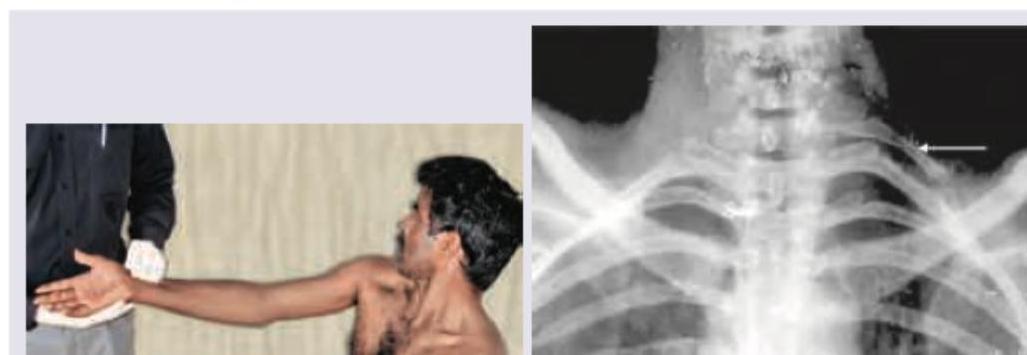
Which of the following is NOT an X-ray finding of Rheumatoid Arthritis?
Which of the following is a poor prognostic indicator of Pott's paraplegia?
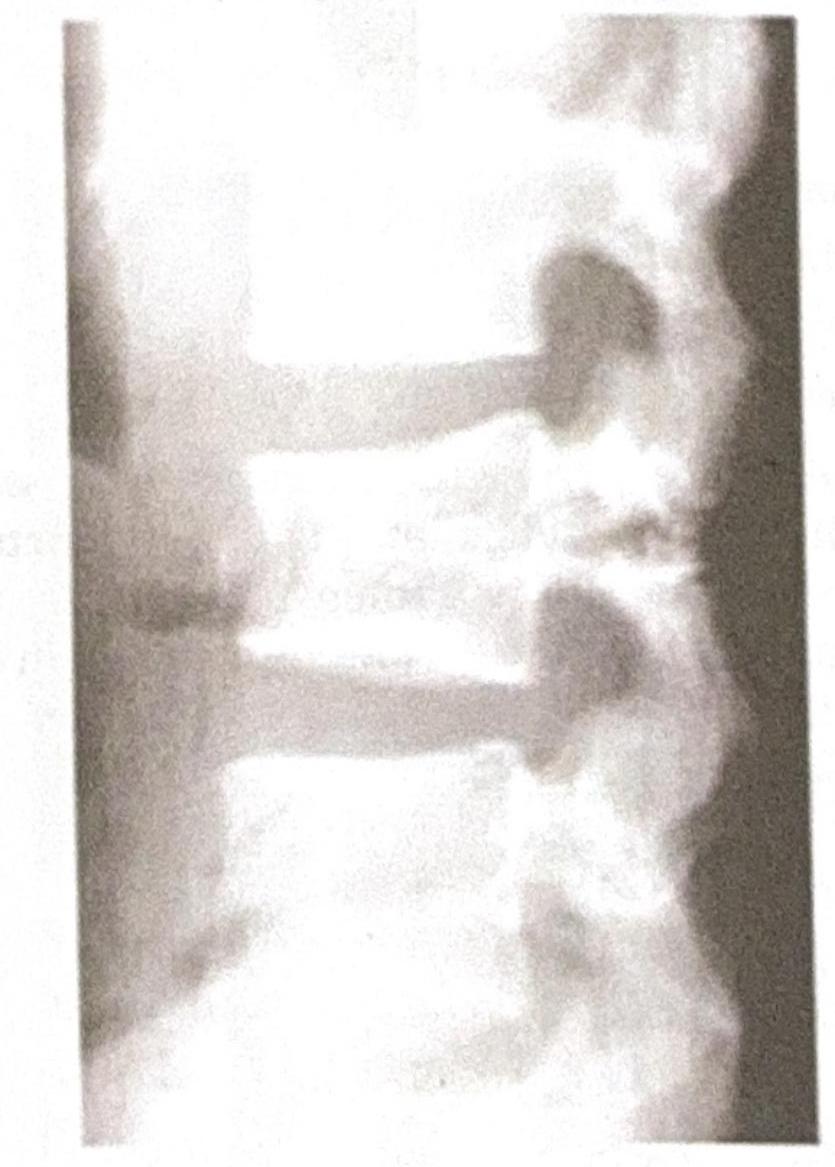
Which of the following is NOT true about spinal tuberculosis?
When do you operate for a prolapsed disc?
A 42-year-old male presents with frequent attacks of joint pain. An X-ray reveals soft tissue swelling. What is the most likely diagnosis?
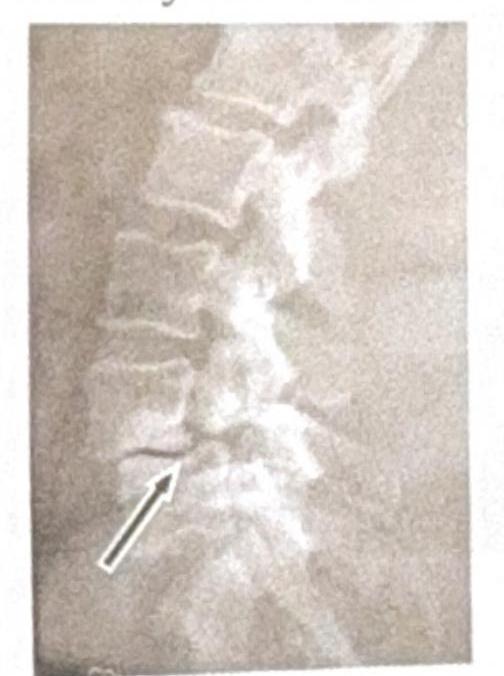
A 22-year-old man presents with low back pain and stiffness, which have progressively worsened over several months. He also reports nocturnal stiffness and hip pain. Physical examination reveals paravertebral muscle tenderness and limited lumbar spine flexion. Radiographic findings of the lumbar spine are shown. What is the most likely diagnosis?

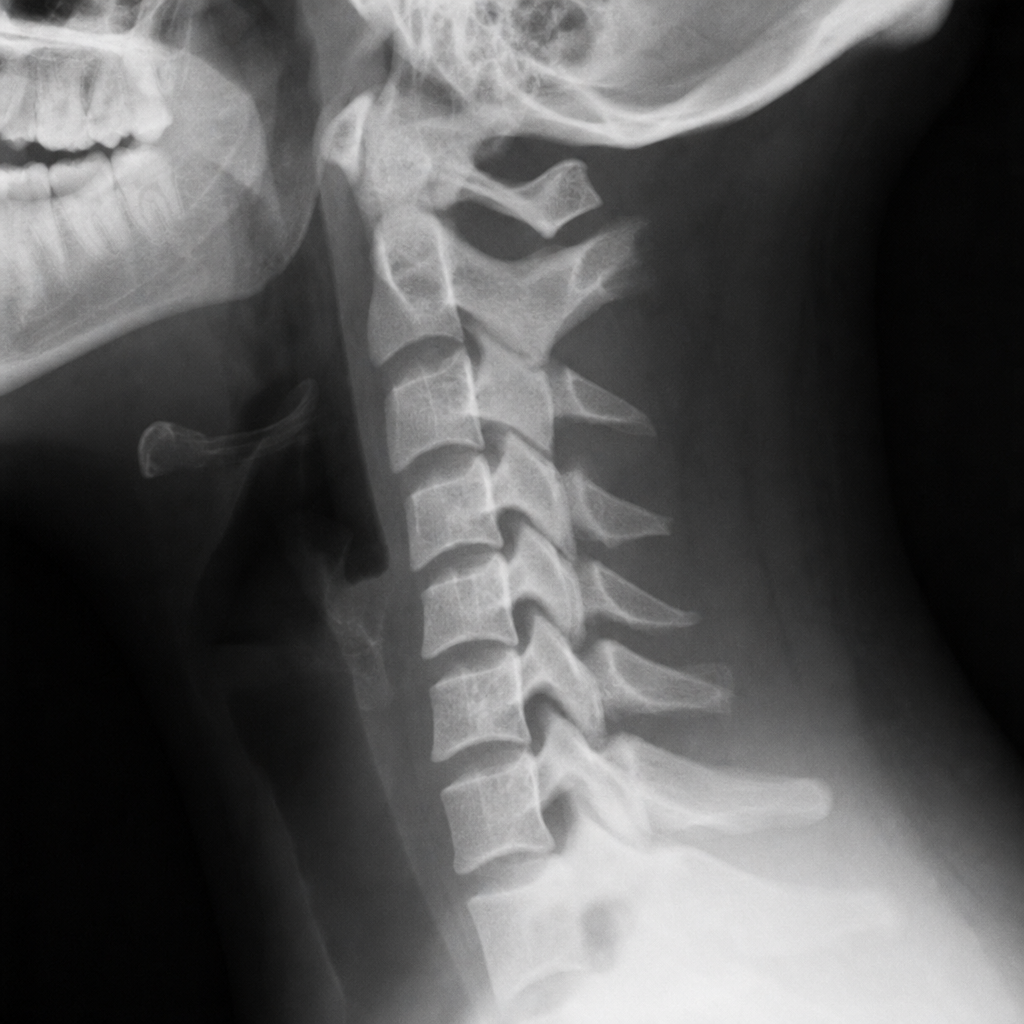
In a patient with cervical disc prolapse, what is the recommended management?
Which of the following is not a feature of Tuberculosis of the spine?
Which of the following is FALSE regarding Charcot's joint in diabetes mellitus?
What is the investigation of choice for a lumbar prolapsed disc?
Explanation: **Explanation:** Rheumatoid Arthritis (RA) is primarily an **inflammatory, erosive** polyarthritis. The hallmark of the disease is synovial hypertrophy (pannus formation) which leads to the destruction of articular cartilage and bone. **Why "Periarticular new bone formation" is the correct answer:** In RA, the inflammatory process is destructive rather than osteoblastic. **Periarticular osteopenia** (decreased bone density) is a classic finding due to increased local blood flow and cytokine activity. In contrast, **new bone formation** (such as osteophytes, subchondral sclerosis, or involucrum) is characteristic of degenerative conditions like Osteoarthritis or infective conditions like Osteomyelitis, but is notably absent in RA. **Analysis of Incorrect Options:** * **Soft tissue swelling:** This is the earliest radiographic sign of RA, representing active synovitis and effusion. * **Reduced joint space:** As the pannus destroys the articular cartilage, the space between the bone ends narrows symmetrically. * **Subchondral cysts (Geodes):** These occur when synovial fluid is forced into the bone through surface erosions, creating radiolucent pockets. **NEET-PG High-Yield Pearls:** 1. **Earliest Sign:** Soft tissue swelling. 2. **Earliest Bone Sign:** Periarticular osteopenia (juxta-articular rarefaction). 3. **Pathognomonic Finding:** Marginal erosions (Rat-bite erosions) at the "bare areas" of the bone. 4. **Spine Involvement:** RA characteristically involves the **Cervical Spine** (specifically Atlanto-axial subluxation); it notably spares the Thoracic and Lumbar spine. 5. **Key Distinction:** Osteoarthritis shows subchondral sclerosis and osteophytes; RA shows osteopenia and no new bone formation.
Explanation: **Explanation:** Pott’s paraplegia (spinal tuberculosis with neurological deficit) is classified into two types based on the timing of onset relative to disease activity. The prognosis depends significantly on the underlying pathology causing cord compression. **Why "Healed Disease" is the correct answer:** Late-onset paraplegia occurring in **healed disease** carries a poor prognosis. In these cases, the compression is usually caused by **permanent structural changes** such as a sharp "internal kyphosis" (bony ridge), spinal stenosis, or dense pachymeningitis (fibrosis of the dura). Since the compression is mechanical and chronic rather than inflammatory, it does not respond to Anti-Tubercular Therapy (ATT) and often requires complex surgical decompression with limited neurological recovery. **Analysis of Incorrect Options:** * **Early onset & Active disease:** These occur during the peak of the infection. The compression is typically due to "soft" factors like inflammatory edema, abscess (cold abscess), or granulation tissue. These respond excellently to ATT and rest, leading to a **good prognosis**. * **Wet lesion:** This refers to an active lesion with significant pus/abscess formation. While it sounds severe, "wet" lesions are easier to evacuate surgically or treat with medication compared to "dry" (fibrous/bony) lesions, thus carrying a **better prognosis** than healed disease. **High-Yield Clinical Pearls for NEET-PG:** * **Most common site:** Thoracic spine (narrowest canal, highest risk of paraplegia). * **First clinical sign:** Spasticity and increased deep tendon reflexes (UMN lesion). * **Girdlestone’s Classification:** Differentiates early-onset (active) from late-onset (healed) paraplegia. * **Surgery Indication:** If there is no neurological improvement after 3–4 weeks of conservative treatment (ATT), surgery (Anterolateral decompression) is indicated.
Explanation: **Explanation:** Spinal tuberculosis (Pott’s disease) typically involves the destruction of the anterior portion of the vertebral bodies and the intervening disc space. **1. Why Option C is the correct answer (False statement):** In spinal TB, the destruction and collapse of the anterior vertebral bodies lead to a **Kyphotic deformity** (Gibbus or hunchback), not an exaggerated lumbar lordosis. As the anterior column collapses, the spine bends forward. Lumbar lordosis is actually **lost or flattened** as a compensatory mechanism or due to muscle spasms in the early stages. **2. Analysis of Incorrect Options (True statements):** * **Option A:** **Back pain** is indeed the earliest and most common presenting symptom, often accompanied by localized tenderness and stiffness (night cries in children). * **Option B:** The **dorsolumbar (thoracolumbar) junction** (T12-L1) is the most common site of involvement, followed by the lumbar spine. * **Option C:** Spinal TB is almost always **secondary** to a primary focus elsewhere in the body, most commonly the **lungs** (via hematogenous spread through Batson’s venous plexus) or lymph nodes. **Clinical Pearls for NEET-PG:** * **Paradiscal type:** The most common pattern where the infection starts in the subchondral bone and crosses the disc space. * **Cold Abscess:** A hallmark of Pott's disease; it lacks the traditional signs of inflammation (heat, redness). In the lumbar region, it may track down the psoas muscle sheath (**Psoas abscess**). * **Neurological Deficit:** Pott’s paraplegia is the most serious complication, often caused by pressure from an abscess, granulation tissue, or bony sequestra. * **Radiology:** The earliest sign is narrowing of the disc space and blurring of the vertebral endplates.
Explanation: ### Explanation The management of a Prolapsed Intervertebral Disc (PIVD) is primarily conservative, as approximately 90% of cases resolve with rest, analgesics, and physiotherapy. **Why Option C is Correct:** The standard indication for elective surgery (Discectomy) is **failed conservative management**. If severe, radiating pain persists for **6–12 weeks** despite adequate rest and medical treatment, and it significantly interferes with the patient's quality of life, surgical intervention is indicated to prevent chronic nerve root irritation and psychological distress. **Analysis of Incorrect Options:** * **Option A:** Social or professional status is never a primary clinical indication for surgery. Surgery carries inherent risks (e.g., failed back syndrome) that do not justify "convenience." * **Option B:** While motor weakness is an indication, surgery is not exclusive to painless cases. In fact, radicular pain is the most common symptom leading to surgery. * **Option D:** This is a **trick option**. While Cauda Equina Syndrome (CES) is an absolute indication for surgery, it is an **emergency** (requiring decompression within 24–48 hours). The question asks "when do you operate" in a general context; Option C represents the most common clinical scenario for elective PIVD surgery. **Clinical Pearls for NEET-PG:** * **Absolute Indications for Surgery:** Cauda Equina Syndrome (bladder/bowel involvement, saddle anesthesia) and progressive motor weakness. * **Gold Standard Investigation:** MRI Spine. * **Most Common Level:** L4-L5 followed by L5-S1. * **Surgical Procedure of Choice:** Microdiscectomy is currently preferred over open discectomy. * **Straight Leg Raising Test (SLRT):** The most sensitive physical exam finding for lumbar PIVD.
Explanation: ### Explanation **Correct Answer: A. Gout** **Why it is correct:** Gout is a crystal-induced arthropathy characterized by recurrent, episodic attacks of acute joint pain (typically the first metatarsophalangeal joint). In the early stages of gout, X-rays are often normal or show only **nonspecific soft tissue swelling** around the affected joint due to acute inflammation. As the disease progresses to chronic tophaceous gout, characteristic "punched-out" erosions with overhanging edges (Martel’s sign) appear, but soft tissue swelling remains the earliest radiographic hallmark. **Why the other options are incorrect:** * **B. Parathyroid Adenoma:** This leads to hyperparathyroidism. Radiographic features typically include subperiosteal bone resorption (especially in phalanges), "salt and pepper" skull, and Brown tumors, rather than simple episodic joint pain with soft tissue swelling. * **C. Psoriasis:** Psoriatic arthritis typically presents with "pencil-in-cup" deformities, joint space narrowing, and dactylitis ("sausage digit"). While it causes swelling, the clinical history of "frequent attacks" and the classic radiographic presentation differ from gout. * **D. Rheumatoid Arthritis:** This is characterized by symmetrical small joint involvement, periarticular osteopenia, and marginal erosions. While soft tissue swelling occurs, the chronicity and symmetry distinguish it from the episodic nature of gout. **High-Yield NEET-PG Pearls:** * **Earliest X-ray sign of Gout:** Soft tissue swelling. * **Pathognomonic X-ray sign:** Punched-out erosions with overhanging margins (**Martel’s sign** or Gouty hooks). * **Gold Standard Diagnosis:** Demonstration of **negatively birefringent, needle-shaped** monosodium urate crystals under polarized microscopy. * **Joint of choice:** The first MTP joint is the most common site (**Podagra**).
Explanation: ***Ankylosing spondylitis*** - Progressive **low back pain** and **stiffness** with **nocturnal symptoms** in a young male, along with **limited lumbar spine flexion**, are classic features of ankylosing spondylitis. - Radiographic findings typically show **sacroiliac joint involvement** and may progress to the characteristic **"bamboo spine"** appearance due to syndesmophyte formation. *Reiter syndrome* - Also known as **reactive arthritis**, typically follows **genitourinary** or **gastrointestinal infections** and presents with the classic triad of **arthritis**, **conjunctivitis**, and **urethritis**. - Usually affects **peripheral joints** asymmetrically rather than causing progressive spinal involvement with characteristic radiographic changes. *Marfan syndrome* - A **connective tissue disorder** characterized by **tall stature**, **arachnodactyly**, **lens dislocation**, and **cardiovascular abnormalities** like aortic root dilatation. - Does not typically cause **inflammatory back pain** or the specific radiographic spinal changes seen in spondyloarthropathies. *Rheumatoid arthritis* - Primarily affects **small joints** of the hands and feet in a **symmetric pattern**, with morning stiffness that improves throughout the day. - Associated with **positive rheumatoid factor** and **anti-CCP antibodies**, and does not typically cause the characteristic spinal fusion seen in ankylosing spondylitis.
Explanation: In cervical disc prolapse, the primary concern is the potential for **spinal cord compression (myelopathy)** or severe nerve root compromise. ### **Explanation of the Correct Answer** **Option C (Immediate surgery)** is the correct choice because cervical disc herniation can lead to acute myelopathy or progressive neurological deficits. Unlike the lumbar spine, where the canal is wider and contains the cauda equina, the cervical canal contains the spinal cord. Any significant central prolapse can cause irreversible cord damage. Surgery (such as Anterior Cervical Discectomy and Fusion - ACDF) is indicated to decompress the neural structures and prevent permanent paralysis or sensory loss. ### **Analysis of Incorrect Options** * **Option A:** Restrictive or aggressive exercises in the acute phase can exacerbate the disc protrusion and worsen cord compression. * **Option B:** While skin traction is sometimes used for symptomatic relief in minor radiculopathy, **skeletal traction and manipulation** are contraindicated in acute disc prolapse as they risk sudden, catastrophic cord injury. * **Option C vs D:** While mild cases (radiculopathy without deficit) may start with medical management, the standard teaching for a diagnosed "prolapse" in an exam context—especially when "preventing neurological complications" is mentioned—prioritizes surgical decompression to safeguard the cord. ### **High-Yield Clinical Pearls for NEET-PG** * **Most common level:** C5-C6 (affects C6 root) followed by C6-C7 (affects C7 root). * **Rule of Nerves:** In the cervical spine, the nerve root exits *above* the corresponding vertebrae (e.g., C6 root exits between C5 and C6). * **Clinical Sign:** **Spurling’s Test** (foraminal compression test) is highly specific for cervical radiculopathy. * **Gold Standard Investigation:** MRI Spine. * **Red Flags:** Look for Hoffman’s sign, hyperreflexia, or gait ataxia, which indicate myelopathy and necessitate urgent surgical intervention.
Explanation: **Explanation:** Spinal Tuberculosis (Pott’s Disease) typically involves the destruction of the anterior portion of the vertebral bodies. This leads to a **loss of lumbar lordosis** rather than an exaggeration of it. **Why "Exaggerated lumbar lordosis" is the correct answer (The False Statement):** In TB spine, the destruction and collapse of the anterior vertebral body cause the spine to bend forward, leading to **Kyphosis** (Gibbus deformity). In the lumbar region, the normal inward curve (lordosis) is first flattened and then reversed. Exaggerated lordosis is typically seen in conditions like spondylolisthesis or pregnancy, not in spinal infections. **Analysis of Incorrect Options (True Features of TB Spine):** * **Back pain:** This is the **earliest and most common** presenting symptom. It is usually dull, aching, and localized to the site of involvement. * **Stiffness of the back:** This occurs due to protective paravertebral muscle spasms. Patients often exhibit the "Coin Test" positive (bending at the knees instead of the waist to pick up an object). * **Cold abscess:** A hallmark of TB, these are collections of liquefactive necrosis and debris that lack the typical signs of acute inflammation (heat, redness). They can track along tissue planes (e.g., Psoas abscess). **NEET-PG High-Yield Pearls:** * **Most common site:** Lower Thoracic and Upper Lumbar vertebrae. * **First radiological sign:** Paradoxical expansion of the disc space (rare) followed by **narrowing of the disc space** and erosion of the subchondral bone. * **Paradiscal type:** The most common pattern of involvement (affects adjacent vertebrae and the intervening disc). * **Gold Standard Investigation:** MRI is the investigation of choice for early diagnosis and assessing neurological involvement.
Explanation: **Explanation:** Charcot’s Neuroarthropathy is a progressive degenerative condition characterized by joint destruction, pathological fractures, and dislocations due to loss of protective sensation (most commonly caused by Diabetes Mellitus). **Why Total Ankle Replacement (TAR) is the Correct Answer (FALSE statement):** Total Ankle Replacement is generally **contraindicated** in Charcot’s joint. The underlying pathology involves severe bone resorption, poor bone quality, and ligamentous instability. Because the patient lacks proprioception and pain sensation, they tend to overload the prosthetic components, leading to early loosening, periprosthetic fractures, and high rates of infection or catastrophic failure. **Analysis of Other Options:** * **A. Limitation of movements with bracing:** This is a mainstay of conservative management. Offloading the joint using a Total Contact Cast (TCC) or a Charcot Restraint Orthotic Walker (CROW) is essential to prevent further deformity during the active (Eichenholtz Stage I) phase. * **B. Arthrodesis:** Surgical fusion (Arthrodesis) is the preferred surgical intervention for a stable, plantigrade foot if conservative measures fail. It provides a rigid, durable weight-bearing surface, though it carries a higher risk of non-union in diabetic patients. * **D. Arthrocentesis:** While not a primary treatment, it may be used diagnostically to rule out septic arthritis, which is the most important differential diagnosis for an acute, red, swollen Charcot joint. **Clinical Pearls for NEET-PG:** * **Eichenholtz Classification:** Stage 0 (At-risk), Stage I (Development/Fragmentation), Stage II (Coalescence), Stage III (Remodeling). * **Clinical Sign:** A "rocker-bottom foot" deformity is a classic late-stage finding due to midfoot collapse. * **Differential Diagnosis:** To distinguish Charcot from Osteomyelitis, use the **Elevation Test**: redness in Charcot joint usually disappears when the limb is elevated for 5–10 minutes, whereas cellulitis/infection redness persists.
Explanation: **Explanation:** **MRI (Magnetic Resonance Imaging)** is the investigation of choice (Gold Standard) for a lumbar prolapsed intervertebral disc (PIVD). The primary reason is its superior **soft-tissue contrast resolution**, which allows for clear visualization of the nucleus pulposus, the annulus fibrosus, and the relationship between the herniated disc material and neural structures (thecal sac and nerve roots). It is non-invasive and does not involve ionizing radiation. **Analysis of Incorrect Options:** * **X-ray:** This is the initial screening tool. While it can show indirect signs like disc space narrowing or rule out bony pathologies (fractures, tumors), it cannot visualize the disc itself or neural compression. * **CT Scan:** Excellent for assessing bony anatomy and lateral recess stenosis. However, it has poor soft-tissue resolution compared to MRI and involves significant radiation. It is usually reserved for patients with contraindications to MRI (e.g., pacemakers). * **Myelogram:** An invasive procedure involving the injection of contrast into the subarachnoid space. It was the gold standard in the pre-MRI era but is now rarely used except in specific cases of "CT Myelography" when MRI is unavailable or inconclusive. **Clinical Pearls for NEET-PG:** * **Most common level of Lumbar PIVD:** L4-L5, followed by L5-S1. * **Most common direction of protrusion:** Posterolateral (due to the thinning of the Posterior Longitudinal Ligament). * **Rule of Nerve Root Involvement:** In a posterolateral protrusion, the **traversing (lower) nerve root** is typically compressed (e.g., L4-L5 disc affects the L5 root). * **Emergency Indication:** Immediate MRI and surgery are required if **Cauda Equina Syndrome** (saddle anesthesia, bladder/bowel dysfunction) is suspected.
Cervical Spine Disorders
Practice Questions
Thoracic Spine Disorders
Practice Questions
Lumbar Spine Disorders
Practice Questions
Intervertebral Disc Disease
Practice Questions
Spinal Stenosis
Practice Questions
Spondylolisthesis
Practice Questions
Spinal Deformities
Practice Questions
Spinal Infections
Practice Questions
Spinal Tumors
Practice Questions
Spinal Cord Injuries
Practice Questions
Minimally Invasive Spine Surgery
Practice Questions
Rehabilitation of Spine Conditions
Practice Questions
Get full access to all questions, explanations, and performance tracking.
Start For Free