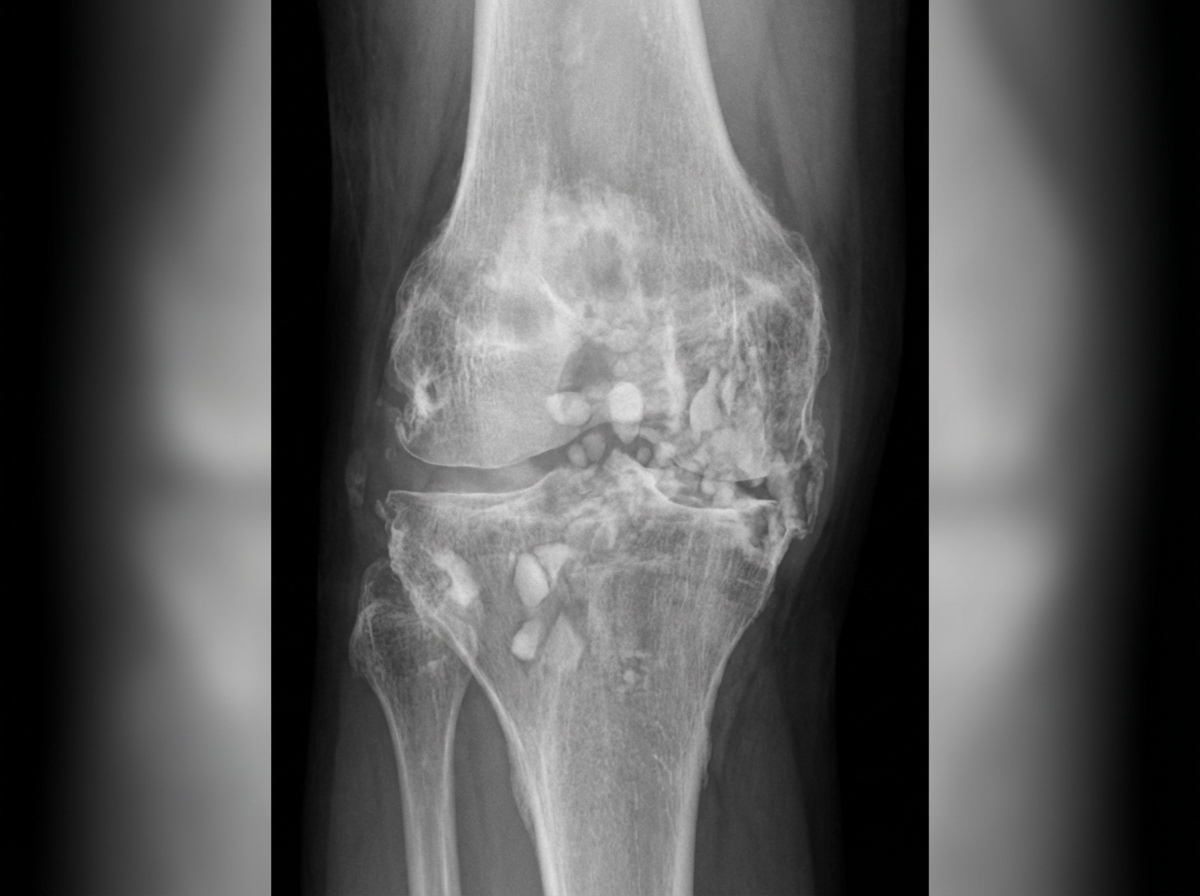
What is the characteristic position of the leg in the synovitis stage of tubercular arthritis?
Caries sicca is seen in which anatomical location?
Which of the following is/are not a feature of rheumatoid arthritis?
What is reactive tuberculous arthritis known as?
Garre's chronic non-suppurative sclerosing osteomyelitis is characterized clinically by?
What is Medial epicondylitis also known as?
Which of the following statements is false about Garre's osteomyelitis?
Caries sicca refers to which of the following?
Which of the following is true regarding acute pyogenic osteomyelitis?
Which of the following is FALSE about fibrous ankylosis?
Explanation: In Tuberculosis of the hip, the deformity progresses through three distinct clinical stages based on the pathological changes in the joint. **1. Why Option C is Correct:** In the **Stage of Synovitis** (Stage I), there is an accumulation of inflammatory exudate (joint effusion) within the joint capsule. To accommodate this increased fluid and minimize intra-articular pressure, the patient instinctively holds the hip in the position of **maximum joint capacity**. This position is **Flexion, Abduction, and External Rotation**. Clinically, this results in "apparent lengthening" of the limb because the pelvis tilts downwards on the affected side to bring the abducted leg parallel to the other. **2. Why the other options are incorrect:** * **Option A (Flexion, Adduction, Internal Rotation):** This is the characteristic deformity of the **Stage of Arthritis (Stage II)**. As the disease progresses, the articular cartilage is destroyed, and the protective spasm of the stronger adductor and flexor muscles leads to this position, resulting in "apparent shortening." * **Option B & D:** These combinations do not correspond to the physiological state of the hip joint during the progression of TB. Extension is rarely seen in inflammatory hip conditions as it increases intra-articular pressure. **NEET-PG High-Yield Pearls:** * **Stage I (Synovitis):** Flexion, Abduction, External Rotation (**FABER**). *Apparent lengthening.* * **Stage II (Arthritis):** Flexion, Adduction, Internal Rotation (**FADIR**). *Apparent shortening.* * **Stage III (Erosion/Destruction):** Further FADIR with **True Shortening** due to "wandering acetabulum" or pathological dislocation. * **Earliest sign of Hip TB:** Limitation of **internal rotation and extension**. * **Phemister’s Triad (Radiology):** Juxta-articular osteopenia, peripheral osseous erosions, and gradual joint space narrowing.
Explanation: **Explanation:** **Caries sicca** is a specific clinical presentation of **Tuberculosis (TB) of the shoulder joint**. The term "sicca" means dry; it refers to the dry form of the disease characterized by significant wasting of the deltoid muscle and destruction of the humeral head without the formation of a "cold abscess" or sinus tract. * **Why Shoulder is Correct:** In the shoulder, TB often follows an indolent course where bone destruction occurs via granulation tissue, but the typical caseous pus (cold abscess) is absent. This leads to a stiff, "dry" joint with severe muscle atrophy, making the shoulder the classic site for this condition. * **Why other options are incorrect:** * **Hip and Knee:** TB in these weight-bearing joints usually presents as the "moist" or "exudative" form, characterized by significant joint effusion, synovial thickening, and frequent cold abscess formation. * **Metatarsal:** TB of the short tubular bones (metatarsals/metacarpals) is known as **Spina Ventosa**, characterized by expansile bone destruction and a "wind-filled" appearance on X-ray. **High-Yield Clinical Pearls for NEET-PG:** * **Triad of TB Shoulder:** Pain, stiffness (frozen shoulder-like), and marked deltoid wasting. * **Radiological sign:** Look for **Phemister’s triad** (juxta-articular osteopenia, peripheral erosions, and gradual joint space narrowing). * **Spina Ventosa:** Most common in children; involves phalanges and metatarsals. * **Pott’s Paraplegia:** The most common complication of spinal TB (the most common site of skeletal TB overall).
Explanation: **Explanation:** Rheumatoid Arthritis (RA) is a chronic, systemic inflammatory disease primarily characterized by **inflammatory destruction** of the joints. The hallmark of RA is a proliferative granulation tissue called **Pannus**, which originates from the synovium and invades the joint space. **Why Osteophyte is the correct answer:** **Osteophytes** (bony outgrowths) are the hallmark of **Osteoarthritis (OA)**, a degenerative joint disease. In OA, the body attempts to repair damaged cartilage by increasing bone surface area, leading to subchondral sclerosis and osteophyte formation. In contrast, RA is an erosive disease; it causes bone loss rather than bone formation. **Analysis of other options:** * **A. Pannus formation:** This is the pathognomonic feature of RA. It consists of inflammatory cells (lymphocytes, plasma cells), neovascularization, and fibroblasts that release collagenases. * **B. Osteosclerosis and osteoclastic activity:** While "osteosclerosis" is more typical of OA, RA involves intense **osteoclastic activity** mediated by RANKL, leading to periarticular osteopenia and marginal erosions. (Note: In the context of this question, the absence of osteophytes is the most definitive differentiator). * **C. Erosion of cartilage:** The enzymes (proteases and collagenases) released by the pannus directly digest the articular cartilage, leading to joint space narrowing and eventual ankylosis. **NEET-PG High-Yield Pearls:** * **Earliest Radiological Sign of RA:** Periarticular soft tissue swelling and **periarticular osteopenia** (juxta-articular rarefaction). * **Characteristic Deformities:** Swan-neck deformity, Boutonniere deformity, and Z-deformity of the thumb. * **Serology:** Anti-CCP (Cyclic Citrullinated Peptide) is more specific than Rheumatoid Factor (RF). * **Joint Involvement:** RA typically involves small joints of hands (MCP, PIP) but **spares the Distal Interphalangeal (DIP) joints**, whereas OA commonly affects the DIP joints (Heberden’s nodes).
Explanation: **Explanation:** **Poncet’s disease** is a rare aseptic **reactive arthritis** observed in patients with active tuberculosis (usually extrapulmonary). Unlike tuberculous arthritis, where the bacilli are present within the joint, Poncet’s disease is an immune-mediated hypersensitivity reaction to the *Mycobacterium tuberculosis* antigen. It typically presents as a symmetrical polyarthritis involving large joints (like the knees and ankles) and resolves completely without residual joint damage once anti-tubercular treatment (ATT) is initiated. **Analysis of Incorrect Options:** * **A. Spina Ventosa:** This refers to tuberculous dactylitis, which involves the short tubular bones of the hands and feet (metacarpals, metatarsals, and phalanges). It is characterized by subperiosteal bone formation and expansion of the bone marrow cavity, giving it a "wind-filled" appearance on X-ray. * **B. Pott’s Disease:** This is the most common form of skeletal tuberculosis, specifically referring to **tuberculous spondylitis** (infection of the spine). It typically involves the lower thoracic and upper lumbar vertebrae and can lead to kyphotic deformity (gibbus) and neurological deficits. **High-Yield Clinical Pearls for NEET-PG:** * **Poncet’s vs. TB Arthritis:** In Poncet’s, the synovial fluid is **sterile** (no AFB on smear or culture), whereas TB arthritis is a direct monoarticular infection with positive cultures. * **Most common site of Skeletal TB:** Spine (Pott's disease), followed by the Hip and Knee. * **Cold Abscess:** A hallmark of TB, it is a collection of pus without the classic signs of inflammation (heat, redness). * **Triad of Pott’s Paraplegia:** Spasticity, sensory loss, and bladder/bowel involvement.
Explanation: **Explanation:** **Garre’s Sclerosing Osteomyelitis** is a specific type of chronic osteomyelitis characterized by a low-grade, non-suppurative inflammatory response. It typically affects children and young adults, most commonly involving the **mandible** or the **tibia**. **1. Why Periosteal Bone Formation is Correct:** The hallmark of Garre’s osteomyelitis is a **reactive periosteal thickening**. The low-grade irritation stimulates the periosteum to lay down new bone in concentric layers. On imaging, this presents as the classic **"Onion-skin" appearance** (laminated periosteal reaction). This leads to a clinical thickening of the bone without the formation of pus, sequestrum, or involucrum. **2. Why the Other Options are Incorrect:** * **A. Endosteal bone formation:** While there may be some secondary narrowing of the medullary canal due to sclerosis, the primary clinical and radiological feature defining Garre’s is the subperiosteal deposition of new bone, not endosteal growth. * **C & D. Resorption of bone:** Garre’s is a **sclerotic (formative)** lesion, not a lytic (destructive) one. Resorption of medullary or cortical bone is characteristic of acute pyogenic osteomyelitis or aggressive tumors, whereas Garre’s is defined by its "non-suppurative" and bone-forming nature. **NEET-PG High-Yield Pearls:** * **Most common site:** Mandible (often associated with dental caries/periapical infection). * **Key X-ray finding:** "Onion-skin" appearance (must be differentiated from Ewing’s Sarcoma). * **Clinical feature:** Bony hard swelling with minimal pain and **no discharging sinuses** (since it is non-suppurative). * **Treatment:** Primarily conservative (antibiotics and removal of the source of infection, e.g., tooth extraction); surgery is rarely required.
Explanation: **Explanation:** **Medial epicondylitis**, commonly known as **Golfer’s elbow**, is an overuse injury characterized by inflammation and microtearing at the common flexor origin on the medial epicondyle of the humerus. It primarily involves the **Pronator teres** and **Flexor carpi radialis** muscles. The condition results from repetitive wrist flexion and forearm pronation, movements typical in golf, racquet sports, or manual labor. **Analysis of Options:** * **Tennis Elbow (Lateral Epicondylitis):** This is the most common overuse syndrome of the elbow. It involves the common extensor origin, specifically the **Extensor Carpi Radialis Brevis (ECRB)**. It presents with pain over the lateral epicondyle exacerbated by resisted wrist extension. * **Student’s Elbow (Olecranon Bursitis):** This refers to inflammation of the bursa located over the olecranon process. It is caused by chronic pressure or friction (e.g., leaning on elbows while studying) and presents as a fluctuant swelling at the posterior elbow. * **Miner’s Elbow:** This is another clinical synonym for **Olecranon Bursitis**, historically associated with miners working in cramped spaces leaning on their elbows. **High-Yield Clinical Pearls for NEET-PG:** 1. **Cozen’s Test:** Used to diagnose Lateral Epicondylitis (pain on resisted wrist extension). 2. **Medial Epicondylitis Test:** Pain is elicited by passive wrist extension while the elbow is extended. 3. **Nerve Involvement:** The **Ulnar nerve** runs in the retrocondylar groove behind the medial epicondyle; chronic medial epicondylitis can occasionally lead to ulnar neuropathy (Cubital Tunnel Syndrome). 4. **Treatment:** Primarily conservative (Rest, Ice, NSAIDs, and eccentric strengthening). Corticosteroid injections are reserved for refractory cases.
Explanation: **Explanation:** **Garre’s Osteomyelitis**, also known as **Chronic Non-Suppurative Sclerosing Osteomyelitis** or **Proliferative Periostitis**, is a unique form of chronic osteomyelitis characterized by peripheral subperiosteal bone deposition. It is essentially a reactive process where the periosteum forms new bone in response to a low-grade, chronic infection or irritation. **Why "None of the above" is correct:** All the statements provided (A, B, and C) are clinically accurate descriptions of the disease. Since no statement is false, "None of the above" is the correct choice. * **Option A (Correct Statement):** It predominantly affects **children and young adults** (usually under 25 years) because their periosteum possesses high osteogenic potential and is loosely attached, allowing for easier expansion and new bone formation. * **Option B (Correct Statement):** The **mandible** is the most common site involved in the head and neck region. In the long bones, the tibia is frequently affected. * **Option C (Correct Statement):** The most common etiology is a periapical infection resulting from a **carious mandibular first molar** with pulp exposure. The low-grade infection spreads to the periosteum, triggering the characteristic "onion-skin" thickening. **Clinical Pearls for NEET-PG:** * **Radiological Hallmark:** Classic **"Onion-skin" appearance** due to concentric layers of subperiosteal new bone formation. * **Clinical Presentation:** Presents as a bony, hard, non-tender swelling along the lower border of the jaw. * **Treatment:** The primary goal is to remove the source of infection (e.g., endodontic treatment or extraction of the infected tooth). Once the focus is removed, the bone typically undergoes physiological remodeling over several months.
Explanation: **Explanation:** **Caries sicca** is a specific clinical form of **Tuberculosis of the shoulder joint**. The term is derived from Latin, where *Caries* refers to bone destruction and *Sicca* means "dry." 1. **Why Option A is correct:** Unlike TB in other joints which often presents with significant swelling, "cold abscess" formation, and pus (exudative type), Caries sicca is the **dry, proliferative type** of TB. It is characterized by: * Marked wasting of the deltoid muscle. * Severe restriction of all shoulder movements. * Absence of swelling or abscess formation. * Radiologically, it shows "punched-out" erosions in the head of the humerus. 2. **Why other options are incorrect:** * **TB Wrist (Option B):** Typically presents with swelling, palmar bursitis (Compound Palmar Ganglion), and progressive stiffness, but is not referred to as Caries sicca. * **TB Ankle (Option C):** Usually presents with pain, limping, and swelling around the malleoli. * **TB Calcaneum (Option D):** This is the most common site for TB of the small bones of the foot, often presenting with a chronic discharging sinus, but it does not follow the "dry" pathology of the shoulder. **High-Yield Clinical Pearls for NEET-PG:** * **Most common site of Skeletal TB:** Spine (Pott’s disease), followed by the Hip. * **Shoulder TB:** Is relatively rare (<5% of osteoarticular TB) and usually affects adults. * **Phemister’s Triad (Radiology of TB joints):** 1. Juxta-articular osteoporosis, 2. Peripherally located osseous erosions, 3. Gradual narrowing of the joint space. * **Treatment:** Standard ATT (Antitubercular therapy) for 12–18 months and mobilization once the pain subsides to prevent ankylosis.
Explanation: **Explanation:** Acute pyogenic osteomyelitis is a bacterial infection of the bone, most commonly caused by *Staphylococcus aureus*. **Why Option D is Correct:** In the pathology of chronic osteomyelitis (which follows the acute phase), **Cloacae** are openings or gaps in the involucrum. These gaps allow for the exit of pus and necrotic debris (sequestrum) from the infected medullary cavity to the skin surface via **discharging sinuses**. **Analysis of Incorrect Options:** * **Option A:** The most common site is the **metaphysis**, not the diaphysis. This is due to the presence of "hairpin" loops of capillary vessels where blood flow slows down, allowing bacteria to settle (sludging). * **Option B:** The definitions are reversed. **Sequestrum** is a piece of dead bone that has become detached from healthy bone, while **Involucrum** is the layer of new, reactive bone that forms around the sequestrum. * **Option C:** The most common mode of infection, especially in children, is **hematogenous spread** (blood-borne), not direct inoculation. Direct inoculation is more common in adults following open fractures or surgery. **High-Yield Clinical Pearls for NEET-PG:** * **Most common organism:** *Staphylococcus aureus* (overall). * **Sickle cell patients:** *Salmonella* is a high-yield association. * **Earliest X-ray sign:** Soft tissue swelling (seen at 3–5 days). Bony changes (rarefaction) take 10–14 days to appear. * **Investigation of choice:** **MRI** is the most sensitive and specific early investigation. * **Brodie’s Abscess:** A form of subacute osteomyelitis characterized by a radiolucent lesion with a sclerotic rim.
Explanation: ### Explanation In orthopaedics, ankylosis refers to the stiffness or fixation of a joint. It is broadly classified into **Bony Ankylosis** (true) and **Fibrous Ankylosis** (false). **Why Option A is the Correct (False) Statement:** Septic arthritis is characterized by the release of proteolytic enzymes by bacteria and polymorphonuclear leukocytes. These enzymes rapidly destroy the articular cartilage, leading to bone-on-bone contact. As the infection heals, new bone forms across the joint space, typically resulting in **Bony Ankylosis**. Therefore, stating that fibrous ankylosis is a complication of septic arthritis is incorrect; it is the classic cause of bony ankylosis. **Analysis of Other Options:** * **Option B (Is painful):** Fibrous ankylosis involves the presence of fibrous tissue between joint surfaces. Because this tissue can stretch and pull on sensitive structures during movement, it is characteristically **painful**. (In contrast, bony ankylosis is painless). * **Option C (Movement is possible):** In fibrous ankylosis, there is "shaking" or a few degrees of restricted, painful movement. In bony ankylosis, movement is zero. * **Option D (Most common cause is TB hip):** Tuberculosis of the joints (like the hip) is a "cold" infection that lacks proteolytic enzymes. It destroys the joint slowly, leading to healing by fibrous scarring rather than bone formation. Thus, **TB is the most common cause of fibrous ankylosis**. **High-Yield Clinical Pearls for NEET-PG:** * **Bony Ankylosis:** Seen in Septic Arthritis and Ankylosing Spondylitis. It is painless with zero movement. * **Fibrous Ankylosis:** Seen in Tuberculosis and Rheumatoid Arthritis. It is painful with slight movement. * **X-ray Distinction:** Bony ankylosis shows trabecular bone crossing the joint space; fibrous ankylosis shows a blurred joint space without bony bridges.
Septic Arthritis
Practice Questions
Osteomyelitis
Practice Questions
Tuberculosis of Bones and Joints
Practice Questions
Fungal and Parasitic Infections
Practice Questions
Diabetic Foot Infections
Practice Questions
Prosthetic Joint Infections
Practice Questions
Reactive Arthritis
Practice Questions
Management of Joint Infections
Practice Questions
Prevention of Orthopaedic Infections
Practice Questions
Biofilms in Orthopaedic Infections
Practice Questions
Antibiotic Prophylaxis
Practice Questions
Implant-Related Infections
Practice Questions
Get full access to all questions, explanations, and performance tracking.
Start For Free